Mary Queen of Scots

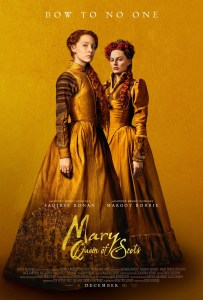
Written by Beau Willimon who is best known for creating the critically acclaimed Netflix TV series House of Cards, Mary Queen of Scots is an enticing historical drama about a unique time in British history in which two strong female leaders vied for control over the British monarchy, and the film itself is anchored by two terrifically powerful actresses. As to be expected from the creator of the political thriller House of Cards, much of the movie is a series of sometimes convoluted acts of palace intrigue and outright violent conflict in order to decide who would be the rightful ruler of the United Kingdom. The story is set around the year 1569 after Mary Stuart, played by Oscar nominee Saoirse Ronan, has returned to her native Scotland from France following the death of her first husband. With the support of the Scots and British Catholics, she claims legitimacy to take over the throne from the reigning monarch and her cousin Queen Elizabeth I, played by Oscar nominee Margot Robbie. In London, Elizabeth is surrounded in court by competing factions made up of her advisers, including William Cecil who is played by Guy Pearce and her lover Robert Dudley, played by Joe Alwyn. On the other side in Scotland, Mary who is proclaimed Mary Queen of Scots also has to deal with her own palace intrigue, including her second husband Lord Darnley who is played by Jack Lowden, at the same time dealing with the firebrand Protestant minister John Knox who is played by David Tennant. Tensions between the two intensify after Mary has a child who could make a legitimate claim to being an heir, while Elizabeth remains childless without a strong desire to marry a husband. Although at times the script can seem uneven and be complicated to the casual viewer, the true strength of the film is the brilliant acting performances from the lead actresses who give off an air of royalty and their costumes and makeup look very realistic for the time. Overall, I found it to be an enjoyable historical drama that albeit slightly flawed is a movie worthy to watch if you are a fan of the historical film genre and looking for tour-de-force acting performances.
Ben is Back

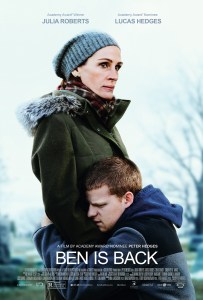
Written and directed by Oscar-nominated screenwriter Peter Hedges best-known for 2007’s Dan in Real Life and adapting the screenplay for 2002’s About a Boy, Ben is Back is an emotionally powerful indie drama that provides a glimpse into the current opioid crisis through one family’s struggles, anchored by a terrific cast. The plot takes place over 24 hours after the unexpected return of the nineteen-year-old Ben Burns, played by the excellent Oscar-nominated young actor Lucas Hedges who also happens to be the filmmaker’s son. We eventually learn that he has been at a drug rehab facility, and, over the course of the film, we are given greater details into how he got addicted and how it has adversely affected his family. His mother Holly Burns, played by Oscar winner Julia Roberts who deserves an Oscar nomination for this role, is extremely happy that her troubled son has come home for Christmas, but she still remains cautious and ensures that he is sober and stays out of trouble. Ben’s African-American stepfather Neal, played by Emmy winner Courtney B. Vance best known for his role as Johnnie Cochran in the 2016 FX series about O.J. Simpson, along with his sister Ivy, played by Kathryn Newton, are less than thrilled about his return and remind Holly that Ben has caused so much harm in the past that he may do it again on this visit. The remainder of the story follows Ben along with Holly, at Ben’s reluctance, as they venture into the underbelly of their small town’s illicit drug industry to retrieve the family dog. Meeting with his former drug dealers and drug-addicted friends, Ben must face his own demons and struggles to stop himself from relapsing, which he knows would almost definitely have tragic consequences. At the same time, Holly grapples with the difficult circumstances of her own son’s life; while still being a loving and devoted mother, she must remain extremely strict with Ben in order to help him overcome his addiction. Although it is very much a personal journey, the movie vividly reveals the extent to which the opioid crisis in today’s society is destroying the lives of previously normal healthy teenagers and the families who must deal with their loved ones’ criminal behaviors without really knowing how to help them stay clean. It shows that the epidemic affects all communities no matter the class status; for instance, Ben comes from a upper-middle-class suburban family living in a relatively peaceful small town. Despite his good upbringing, he spirals out of control and becomes heavily addicted to such powerful drugs as heroin and cocaine after his physician prescribes him narcotic painkillers. Overall, although it is very difficult to watch at times, I thought the film, with its compelling script and top-notch acting performances, is an extremely important work that provides the audience with a much-needed exploration of the opioid epidemic ravaging the United States.

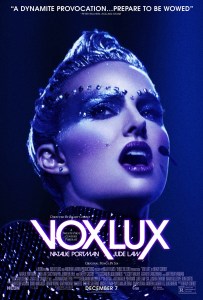
Vox Lux

Directed by American actor and filmmaker Brady Corbet whose 2015 feature film debut The Childhood of a Leader received acclaim at the Venice Film Festival, Vox Lux is a rather unusual movie that I would best describe as an experimental film festival indie movie and is remarkable primarily as a result of the terrific acting performance given by Oscar winner Natalie Portman. Somewhat like a theatrical play, the film is divided into several acts tied together through the narration given by Willem Dafoe, and it follows the rapid rise in fame of the fictitious pop superstar Celeste. We first meet the young Celeste, played by Raffey Cassidy, in the year 1999 as a fourteen-year-old survivor of a school mass shooting who decides to perform a song with her older sister Eleanor, played by Stacy Martin, at a memorial service for the victims. Her beautiful song captures the nation’s heart and almost immediately the two sisters work with an aggressive talent manager played by Oscar-nominated actor Jude Law. The film flashes forward to a point where Celeste begins to become a musical sensation and travels to Stockholm with her sister to work with a famous pop songwriter. After witnessing the erosion of her innocence by attending wild parties with much older men, the major act of the movie takes place in the year 2017 when the now thirtysomething adult Celeste, played by Natalie Portman in a very dedicated role, is trying to stage a comeback tour after a publicity nightmare that took place several years prior and almost destroyed her career. Clearly her success has had a personal toll on her relationship with her previously inseparable sister and has caused her to become a foul-mouthed alcoholic. She even has a teenage daughter named Albertine, also played by Raffey Cassidy, who Celeste is in no state to take care of her and thereby her sister Eleanor has become her guardian. Taking place over the course of an afternoon and evening, the film finally reaches its climax when Celeste performs on stage at a large venue in her native Staten Island. With original songs written by pop musician Sia, Natalie Portman bursts off the screen as a very believable popstar complete with extravagant makeup and costumes while performing a highly choreographed stereotypical pop music performance. Even when she is not on stage using her actual singing voice, Portman is truly mesmerizing by giving a powerful performance as a brash and immature celebrity who never really grew up as a result of the enveloping music world with its highly demanding managers, publicists, and studio executives. Overall, I thought it was perhaps too eccentric of a movie to appeal to most audiences, but it serves as a showcase for the masterful acting of the extremely talented Natalie Portman.

Schindler’s List (25th Anniversary Theatrical Release)

Directed by critically-acclaimed filmmaker Steven Spielberg who won several Oscars for this particular film that is considered one of the greatest of the 20th century, Schindler’s List was recently remastered and released on the big screen for its 25th anniversary, and I found it to be extremely relevant in today’s divisive times in which hate crimes have risen. Although I saw it many years ago, simply watching it at a movie theater had an even greater emotional impact on an already extremely powerful film exploring the evils of the Holocaust perpetrated by the Nazis. Based on a true story, the plot follows Oskar Schindler, played by Liam Neeson who was nominated for his extraordinary role, who was an industrialist working alongside the Nazi party in Krakow, Poland and went on to save up to 1,200 Jewish people from extermination by the end of World War II. The almost three and a half hour long film with its potent black-and-white cinematography and intense attention to detail still stands the test of time as probably the most important artistic representation of the Holocaust. In addition to the nuanced performance given by the great Liam Neeson, the movie is full of beautiful and very memorable acting performances, especially Ben Kingsley who gives a remarkably tender performance as Schindler’s Jewish accountant Itzhak Stern and a young Ralph Fiennes who gives a horrifyingly realistic performance as the truly evil Nazi officer Amon Göth. In retrospect, Liam Neeson wholeheartedly deserved the Oscar for Best Actor as well as the other lead actors deserving awards in their respective Oscar categories. As was the case at the time of its release, the most indelible image from the entire movie is the appearance of a little girl wearing a red coat, the only color amongst the symbolically stark black-and-white imagery. The film was correctly recognized for the astounding directorial vision of Steven Spielberg who quite effectively captures the horrors of the labor and death camps of the Holocaust without showing a gratuitous amount of blood and gore. Overall, I found it to remain one of the most profound cinematic experiences of my life as a result of the stupendous directing, writing, acting, musical composition, and cinematography; the movie is truly worthy of its seven Academy Awards, including Best Picture, Best Director, Best Adapted Screenplay, and Best Original Score. If you ever get the chance to see this extraordinary cinematic piece of history on the big screen, it is definitely worth your time and money and will leave you even more in awe than viewing it on the small screen and before the beautiful restoration done for the 25th anniversary.

They Shall Not Grow Old

Directed and produced by Peter Jackson who is best known for the worldwide phenomenon Lord of the Rings and Hobbit film series, They Shall Not Grow Old is a truly remarkable and game-changing documentary that explores the daily lives of British and Imperial soldiers fighting in the trenches during World War I. The film is compiled from over 100 hours of original film footage taken from the Imperial War Museums and the BBC based in the United Kingdom, as well as over 600 hours of interviews given by 200 veterans in various oral history projects. Although it is comprised of the now dated archival footage taken during the war, the amazing documentary vibrantly brings the soldiers back to life by colorizing the black-and-white footage and altering it to better match modern cinematic formats. Going even a step further, a team of lip readers were assembled to try and understand what the soldiers were saying in the silent footage and, in turn, their work is used by voice actors who speak the very words that the soldiers may have been using. This pioneering use of modern technology throughout the film has a profound impact on the viewer who for the very first time is able to witness the most realistic account of a war that ended 100 years ago, stories that have been lost through time and place. Unlike a traditional documentary in which there is a single narrator that pieces together a narrative about the subject and many interviews are presented as is in a linear fashion, the filmmaker makes the unusual yet extremely effective decision to rely on audio given by 120 veterans interviewed over the years as the only narration. Each soldiers’ oral testimony gives the already vivid documentary a much more personal tone in which the soldiers themselves recount first-hand their harrowing experiences during such a tragic and brutal war that resulted in the deaths of millions and widespread destruction across Europe. Overall, I found it to be one of the more mesmerizing historical documentaries that I have ever seen, and I have no doubt that the film’s unique realism will stand the test of time as one of the most important pieces of history about World War I.

Mortal Engines

Co-written and produced by legendary filmmaker Peter Jackson who is best known for directing the massively popular and acclaimed Lord of the Rings and Hobbit film series, Mortal Engines is a visually arresting and creative blockbuster movie that follows in the long line of post-apocalyptic films based on young adult fiction, but, ultimately, the weak script filled with plot holes and devoid of truly compelling characters is a recipe for a massive flop. Based on the Mortal Engines novel quartet written by Philip Reeve beginning in 2001, the plot revolves around the young revolutionary Hester Shaw, played by Icelandic actress Hera Hilmar, who lives in a post-apocalyptic world in which most of humanity lives on massive mobile cities that rove the so-called Great Hunting Ground and must take over smaller settlements on wheels in order for the larger communities such as London to survive. The visuals very much reminded me of the Mad Max movies in which elaborate machines built from a hodgepodge of antiquated technology move across desolate and immense landscapes. The protagonist Hester is on a revenge mission to kill one of London’s leaders named Thaddeus Valentine, played by the only recognizable actor Hugo Weaving, who was responsible for her mother’s death years ago. At the same time, she sympathizes with the opposition Anti-Traction League whose people live on static settlements behind the Shield Wall in what used to be Asia. Rather stereotypically in movies in this genre, the young heroine must fight off evil forces who pose an existential threat to the good guys. The secretly malevolent Valentine whose own daughter Katherine does not really know his intentions is in search of Old-Tech weapons that can wipe out the Anti-Tractionists living beyond the previously impenetrable Shield Wall. Eventually, Hester along with an apprentice historian from London named Tom, played by Irish actor Robert Sheehan, team up with a revolutionary leader named Anna Fang, played by South Korean musician and actress Jihae, who pilots a fantastical aircraft. There are several other subplots involving formulaic romances and unusual guardians that, rather than adding to the story, bogs down the already messy storyline. Overall, it is a rather large disappointment for a Peter Jackson-produced fantasy movie that relies too heavily on elaborate CGI, which are rather spectacular and unique even for the genre, and whose creative imagery and premise is not done any justice by the overall poor quality of the story and acting.

Roma

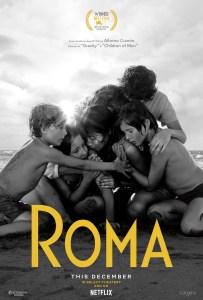
Written and directed by critically acclaimed Mexican filmmaker Alfonso Cuarón who won the Oscar for Best Director for the 2013 movie Gravity, Roma is a beautifully intimate movie that takes the power of an epic film with its magnificent panoramic cinematography and heartfelt storytelling that is both personal and explores Mexican society on a larger scale. Loosely based upon the filmmaker’s own life growing up in Mexico City in the 1970s in the upper-middle-class Roma neighborhood, the story is a rather simple yet deeply personal one revolving around a maid named Cleo, played by first-time actress Yalitza Aparicio in a remarkably tender performance, who works for a relatively wealthy family headed by Sophia and her increasingly distant husband Antonio. As an indigenous young woman from an extremely poor village in southern Mexico, Cleo who lives along with another housekeeper named Adela at the family’s house comes to be seen as part of their family and is beloved by the four young children who treat her as a second mother. Much of the film focuses on the daily tasks of Cleo who truly runs the household, including doing the laundry, cleaning, cooking, waking up the kids, and putting the kids to sleep. To give the movie a nostalgic and almost home video feel, the filmmaker makes the superb decision to film the entire movie in black-and-white and full of long takes that slowly and beautifully sweeps and pans across the scenes. Furthermore, the story is made that much more powerful by having the narrative structure primarily focus on Cleo yet, at the same time, exploring the historical societal and political events happening across Mexico in 1970 and 1971. For instance, Cleo witnesses a large student protest in the streets of Mexico City that turned violent with paramilitary forces murdering students in cold blood, but the filmmaker is able to bring it down to a personal level by having the event trigger the pregnant Cleo having her water break and facing her own traumatic tragedy. Although the plot may not sound that interesting to most viewers, the top-notch craftsmanship of Cuarón makes for an amazingly compelling story complete with so much heartwarming and heartbreaking moments that it is hard for the audience to look away from such a mesmerizing cinematic experience. Overall, I found it to be perhaps the best movie of the year that is worthy of many Academy Awards, and the already award-winning director who made the film as a passion project is able to reach the pinnacle of his art and thereby move even the most dismissive viewer. The only issue is that a majority of audiences will not be able to see it on the big screen, the only place that it should be seen with its epic cinematography, as a result of the movie being released on the streaming platform Netflix; however, it is not surprising that such a breakthrough film would be made available in such a industry-changing fashion and may very well make history by earning Netflix an Oscar for Best Picture.

At Eternity’s Gate

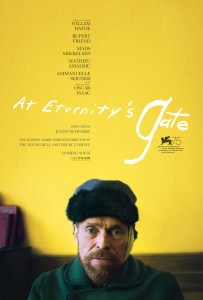
Directed by Golden Globe winner Julian Schnabel whose 2007 film The Diving Bell and the Butterfly won the Golden Globe for Best Foreign Language Film and was nominated for four Academy Awards, At Eternity’s Gate is a beautifully-shot and uniquely creative biopic about the final days of famed Dutch painter Vincent van Gogh living and working in the South of France towards the end of the 19th century. Played by the mesmerizing Willem Dafoe who is nominated for a Golden Globe for his performance, the penniless and unappreciated Vincent van Gogh is encouraged to move to the small town of Arles in the South of France and is occasionally accompanied by his friend and fellow artist Paul Gauguin, played by Golden Globe winner Oscar Isaac. Besides Paul Gauguin, the only emotional and financial support that he received was from his brother and struggling Parisian art dealer Theo, played by Emmy nominee Rupert Friend. Rather than following the typical formula of a straightforward biopic, the movie reflects the impressionistic artworks of Vincent van Gogh by relying on shaky avant-garde camera work and an unstructured storyline that also explores the mental instability of such a genius as Vincent van Gogh. A majority of the film follows him as he travels the French countryside with his paints and easel trying to discover the perfect places to paint his now masterpieces. His work and mind was so out-of-the-box at the time that he was disparaged by the villagers as a violent lunatic and would be committed several times to a mental institution for his eccentric behavior. The vibrant sequences in which Vincent van Gogh is recreating his environment are brilliantly captured by the filmmaker who visually compares the final results with the actual surroundings inspiring the artwork. The movie is also broken up by several philosophical monologues given by Vincent van Gogh and those caring for him in the institutions, including a priest who is played by Mads Mikkelsen and a doctor who is played by Mathieu Amalric. Evident by his ideas of grandeur and his blasé decision to famously cut off his own ear, Vincent van Gogh is portrayed as the archetypal tortured genius who was before his time and thereby led a very troubled life that eventually ended in tragedy. Overall, I found it to be a hypnotic and extremely well-crafted film that effectively tries to explore the inner psyche and artistry of such an enigmatic and only relatively recently internationally well-regarded artistic icon as Vincent van Gogh who is magnificently brought to life by the one and only Willem Dafoe.

The Favourite

Directed by critically acclaimed Greek filmmaker Yorgos Lanthimos whose 2015 movie The Lobster was nominated for the Academy Award for Best Original Screenplay, The Favourite is a rather bizarre historical drama containing elements of dark humor that is elevated to be one of the best movies of the year because of the Oscar-worthy acting performances of the three lead actresses. The story is based on real life events that took place during the time of the British monarch Queen Anne in the early 18th century, at a time when England was at war with France. Played by Olivia Colman who is nominated for a Golden Globe for her performance, Queen Anne is portrayed as a rather weak and frail figure as a result of her struggles with illness, including gout, and is at the center of palace intrigue including two ladies of the Court. The Duchess of Marlborough Sarah Churchill, played by Oscar winner Rachel Weisz, is initially the favorite of Queen Anne and is given great responsibility over matters of the state during the convalescence of the Queen. The audience quickly learns that Sarah is also the secret lover of Queen Anne who relies heavily on Sarah’s personal advice and looks to her for support. Things are complicated with the arrival of Sarah’s young cousin Abigail Hill, played by Oscar winner Emma Stone, who has lost her position and is now seeking a job working at the Royal Palace. After she gets into the good graces of Queen Anne, Abigail begins a very tense rivalry with the Queen’s current favorite Sarah over who can become the coveted personal favorite of the rather buffoonish Queen. At the same time, the Queen’s power is being tested by the Member of Parliament Robert Harley, played by Nicholas Hoult, who opposes the monarchy’s plan to raise land taxes to support the unpopular war with France. The cunning ploys between the fiercely competitive Sarah and Abigail eventually come to a head and leads to Sarah temporarily being away from the Royal Court. With her absence, Abigail continues in haste her successful endeavor to curry favor with Queen Anne whose disconcerting and petty antics continue to bewilder the Court. Evident of her rise in stature, Abigail even begins a relationship with a baron named Samuel Masham, played by Joe Alwyn. A key aspect of the filmmaker’s unique style, the movie is filled with some rather outlandish and quite simply weird moments, however, it is to a much lesser degree than his earlier works. The strangeness is quite effective in satirizing the excesses and eccentricities of a Royal Court, particularly Queen Anne’s in the early 1700s at the corroding height of the British Monarchy. Overall, I found it to be a highly entertaining and fascinating film that delves deep into the closed-door politics of the Royal Palace, and it is very special as a result of the brilliant casting of three actresses at the top of their game.

Ralph Breaks the Internet

The follow-up to the hugely successful Disney computer animated film Wreck-It Ralph released in 2012, Ralph Breaks the Internet is an endearing and extremely creative computer animated feature that effectively incorporates popular culture into a family-friendly story about changing friendships. Like the original, the plot follows a video arcade character named Ralph, voiced by Oscar nominee John C. Reilly, and his adventures with his best friend, another character from a racing video arcade game named Vanellope who is voiced by comedian Sarah Silverman. They both live in a magical world in which they can travel between games at a video arcade that is full of eccentric and lovable characters. The major twist in this particular film is that both best friends end up venturing into the previously unknown world of the internet after the owner of the arcade installs a Wi-Fi router giving them access to the colorful expensive universe of the internet. Ralph must look for eBay in order to purchase a part for Vanellope‘s racing game before it is permanently shut down. The filmmakers create a playful environment recreating what the internet could look like to children characters in which well-known websites like eBay and Facebook are represented as vibrant buildings within a large city. Not realizing that they must pay eBay actual money, Ralph and Vanellope embark on an entertaining adventure to make money through a spambot website represented by a street hawker and eventually a YouTube-like video website. Through the help of a search bar named KnowsMore, voiced by Alan Tudyk, the two are first led to an online racing game called Slaughter Race where they meet a tough racer named Shank, voiced by Gal Gadot best known for her role as Wonder Woman. Ralph finally discovers that he can make the necessary money by posting viral videos to the video sharing website BuzzzTube run by an algorithm represented by the fashionable character Yesss, voiced by Oscar nominee Taraji P. Henson. Chaos ensues after Ralph helps unleash a virus that could possibly prevent Vanellope from wanting to stay in the online game with her new friend Shank. His jealousy and sadness over the possible separation from his dear friend is a message to the viewer about the hardships of a changing role in relationships with friends and family. Ralph eventually comes to terms with his best friend’s desires, and they are able to remain friends despite not always being together at the arcade. Overall, I found it to be a fun and unique movie appealing to both adults and kids who can appreciate the clever representations of the internet and the heartfelt message underscoring the entire premise. The only fault with the film is the occasional oversaturation of pop culture that can sometimes feel like an advertisement for the real products and intellectual property represented, especially during a scene in which all of the Disney princesses appear.