The Sense of an Ending

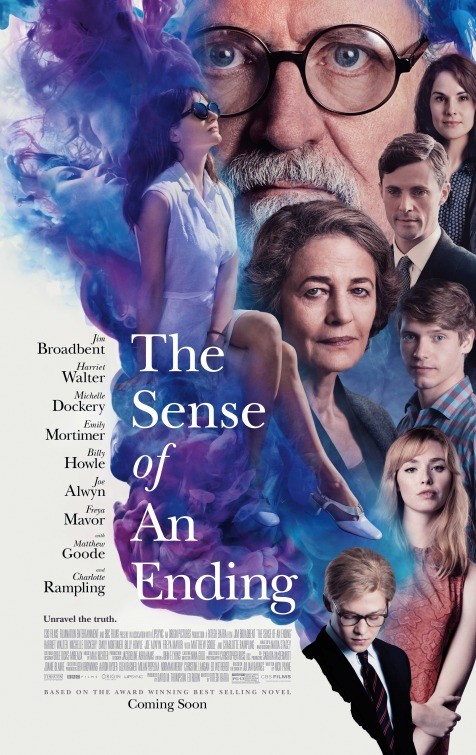
Based on the best-selling novel of the same name written by Julian Barnes in 2011, The Sense of an Ending revolves around an elderly man plagued by his past and is a beautiful dramatic film that feels very British whose talented filmmaker expertly navigates the mysteries of the story. Tony Webster, played by the superb Jim Broadbent, must face his college years after learning of the death of an ex-girlfriend’s mother who has bequeathed him a diary written by an old friend from college. The movie switches back and forth between flashbacks to that time and Tony’s current life where he still has a friendly relationship with his ex-wife and helps his single pregnant daughter, played by Michelle Dockery of Downton Abbey fame. It is not fully clear what Tony is so distraught about and what happened those many years ago, and, therefore, the audience is led on a mystery in which we, along with Tony, must figure out ways to tie up the loose ends. We learn that his ex-girlfriend Veronica who we meet in flashbacks and is played by Charlotte Rampling refuses to turn over the diary that her mother, played by Emily Mortimer, has given Tony. It is surmised that it has something to do with Veronica’s relationship with his dear friend who wrote the diary and the untimely death of said friend. Like Tony who does not fully understand his impact on the lives of others, the
ending of the movie is rather ambiguous but makes the viewer think about how our emotions and relationships can cause great pain or happiness on those around us. Overall, I found it to be emotionally powerful drama that is imbued with a sense of mystery to
keep the audience on its toes, and it was greatly enhanced by the tour de force acting of the ensemble cast, especially the quintessential British actor Jim Broadbent.

The Last Word

The Last Word is a fairly generic comedy drama about an unexpected friendship
that has moments of wit and charm and is anchored by the strong acting performances from the always terrific Shirley MacLaine and relative newcomer Amanda Seyfried. Shirley MacLaine plays Harriet Lauler, a retired highly successful businesswoman and a curmudgeon not really liked by anyone in her community and family, who feels like she is at the end of her life and decides to commission her own obituary even before her death. Eventually, she enlists the obituary writer at the local newspaper and an aspiring writer,
played by Seyfried, to research her life and interview many people from throughout her life in order to write an appealing obituary. However, the young writer realizes that almost nobody is willing to talk to her about Harriet since so many have hated her for her grumpy and strict attitudes. After being faced with this reality, Harriet makes it her mission to craft the perfect obituary by creating new memories and trying to create positive relationships with others. Therefore, the final half of the film becomes a redemption story for Harriet who discovers her passion for music by becoming a DJ at a local independent radio station, becomes a mentor for a poor African-American girl, and eventually develops a close kinship with Seyfried’s character. My favorite part
of the movie is Shirley MacLaine who gives her typically perfect performance as a curmudgeon committing unintentionally funny antics but gradually comes to understand the meaning of life and tries to reform her ways before her inevitable death. Overall, I found it to be a cute film that had its moments of morbidity as should be the case with a movie about a elderly woman and her obituary, but the film would probably not work were it not for Shirley MacLaine’s spot on acting.

Kong: Skull Island

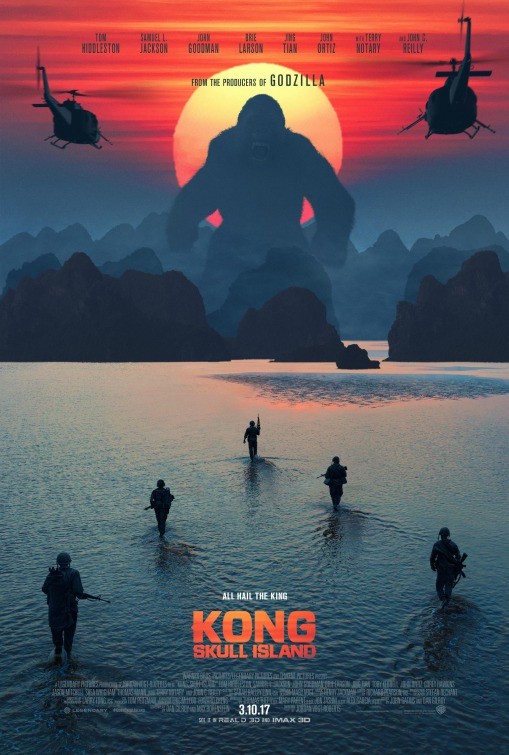
Part of a long line of films revolving around the classic monster King Kong who first appeared in 1933, Kong: Skull Island is a fun and stylish action-adventure flick that is unlike any other King Kong movie by being heavily influenced by the 1979 Vietnam-set film Apocalypse Now. John Goodman plays the director of a secretive government
organization investigating the supernatural who leads a group of researchers and Army personnel in 1973 to an unexplored island called Skull Island that may reveal unusual creatures. After their first encounter with King Kong, the expeditionary group gets
split up and must cross the mysteriously dangerous island to reach their helicopter rendezvous pickup point. The soldiers led by a gung-ho lieutenant colonel, played by Samuel L. Jackson, lean on their militaristic instincts and feel that Kong is a threat and must be eliminated with military force. On the other hand, the other group comprising of a mercenary and former officer in the British Special Air Service, played by Tom Hiddleston, and a young female photographer and pacifist, played by Oscar-winner Brie Larson, sympathize with Kong after realizing that he is the protector of the island and the human inhabitants that they encounter. The latter group are amazed to discover an American soldier, played by John C. Reilly, who has been stranded on the island since 1944 after crash landing his airplane towards the end of World War II. Similar to Marlon Brando’s elusive character who lives deep in the jungles of Vietnam with natives in Apocalypse Now, John C. Reilly’s character named Marlow has become the de facto leader
of the indigenous people and warns the newcomers of the dangers of Skull Island, particularly the sinister creatures known as the Skullcrawlers. Eventually, the militaristic group pull out all the stops, including napalm and other explosives, to try and kill Kong while the group that met up with Marlow try all their best to save Kong knowing his role as the island’s godlike protector. Overall, I found it to be an enjoyable moviegoing experience that provided all the cheap thrills and excitement from a typical
action movie involving monsters but went one step further by capturing the mood of the 1970’s and the Vietnam War in its striking resemblance to the classic Apocalypse Now.

Logan

The tenth installment of the blockbuster Marvel Comics’ X-Men film series since its debut in 2000, Logan is a superhero movie unlike any other by transcending formulaic conventions of the comic book genre to become a deeply emotional and serious drama about love and dying. Reprising his role for the ninth and likely final time, Hugh Jackman portrays Logan, often referred to as Wolverine, who is experiencing a great low point in his life and whose superpowers have increasingly diminished with age. Set in 2029, unexplained events have led to the practical extinction of mutants, people with genetic superpowers, and Logan is living a quiet, alcohol-fueled life as a chauffeur in El Paso. As a result of discrimination and attempted eradication from fearful non-mutants, the de facto leader of the X-Men Professor Charles Xavier, played by Patrick Stewart, lives hidden away just across the border in Mexico with an albino mutant, played by Stephen Merchant. Logan visits often to make sure Xavier, the only person he has really loved like family, gets his medication since he is suffering from a debilitating and dangerous illness onset by age. Eventually, they, along with a young mutant named Laura who possesses the same powers as Wolverine and is depicted terrifically by the newcomer actress Dafne Keen, are hunted down by a sinister organization led by its vicious chief of security, portrayed by Boyd Holbrook of Narcos fame. Unlike most comic book adaptations, the movie shows the characters in a more empathetic and vulnerable light as they are chased across the country in hopes of reaching a place called Eden across the border in Canada. The theme of crossing a border out of hope while eluding dangerous and prejudicial forces is especially potent nowadays with the divisive rhetoric over immigration and discrimination. The superheroes themselves show their humanity: Logan, previously shown as indestructible, clearly suffers physically and mentally after several violent fights, and he is greatly affected by the increasingly frail condition of his beloved father figure Xavier. Largely unseen in other superhero films, there is an emotional connection between the super powerful characters Logan, Xavier, and Laura; it is as if they are on a road trip as grandfather, son, and granddaughter in which they have bonding time. With its chase storyline set across sweeping landscapes and a clear struggle between good and evil in intimate battles, the film also feels heavily influenced by the Western genre. Clearly alluded to this fact is when Xavier and Laura watch the classic movie Shane and later a quote from the movie is used at a particularly poignant moment at the end. Overall, I found it to be a refreshing take on the rather stale and predictable comic book superhero film genre: the filmmaker is able to craft a beautiful story about extraordinary characters dealing with ordinary and raw human emotions. The movie takes a slow-paced and nuanced look at characters and plot lines that have been generically rehashed over the years and ultimately results in probably the best film ever adapted from a comic book.

Get Out

Written and directed by Jordan Peele who is best known as the co-creator of the hit sketch comedy series Key & Peele, Get Out is a surprisingly phenomenal film that expertly crafts the comedy and horror genres to create an incisive social satire about contemporary racism. The plot follows black photographer Chris Washington, played by Daniel Kaluuya, as he goes to the suburbs to visit the parents of his white girlfriend Rose Armitage, played by Allison Williams. Rose not telling her parents that her boyfriend is black makes Chris worried about their reaction when he first meets them. However, he is pleasantly surprised by the warm welcome of her father and neurosurgeon Dean, played by Bradley Whitford, and her mother and psychiatrist Missy, played by Catherine Keener. After spending more time with the family and meeting their black maid Georgina and black groundskeeper Walter who both act zombie-like, Chris senses there is something peculiar about the Armitages and their white neighbors. The film rapidly evolves into a horror thriller after Missy hypnotizes Chris, and he learns more about what is actually going on in the neighborhood. He relays his concerns to his black friend Rod who works for the TSA and serves as comic relief, with his exaggerated reactions and outlandish theories about what Chris is experiencing. Things get even weirder when Chris tells Rose about his suspicions and that they both must get out immediately. The film’s ending intensifies as plot twists abound and the audience finally figures out the sinister secrets of the neighborhood. What makes the movie so good is Peele’s ability to perfectly time scary and funny moments in order to keep the viewer engaged. By using the horror genre in which everything is not as it seems, Peele also cleverly devises a way to comment on society as a whole. He uses film to highlight the fact that racism still exists today even if people claim that we are in a post-racial society the result of Obama’s election. For instance, the Armitages, seemingly the epitome of white liberalism who say they would vote a third time for Obama, and their white suburban neighbors have a dark side that may counter their belief that they are far from being racists. Thereby, as evidenced by current race relations, actions and beliefs do not have to be overt in order to make somebody racist, but unrecognized subtle acts of prejudice can have a little-by-little detrimental affect on another race. Overall, I found it to be a highly entertaining experience, despite my general dislike of scary movies, that unexpectedly provides a profoundly important message about racism. 

A United Kingdom

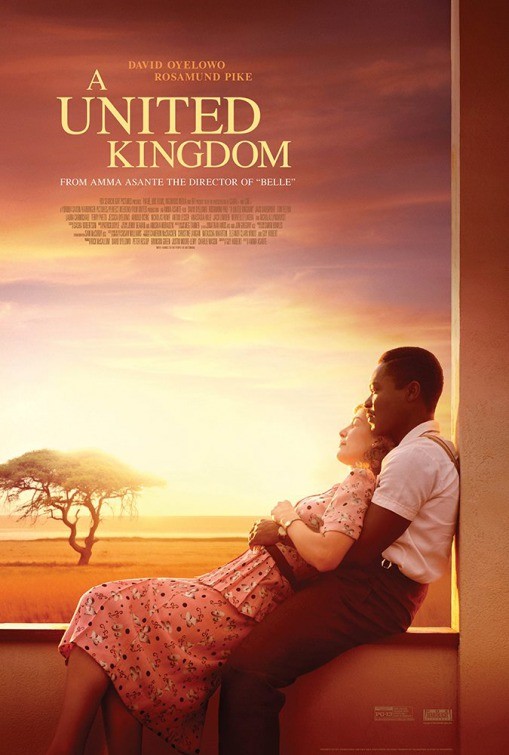
Based on an incredible true story, A United Kingdom is a beautifully crafted film with strong acting performances that tells a remarkable story of forbidden love. Set in the late 1940s, the story follows Seretse Khama, the black King of Bechuanaland (modern-day Botswana) and portrayed by David Oyelowo, and his controversial romantic relationship with a white British woman named Ruth Williams, played by Rosamund Pike, whom he met during his studies in London. To the chagrin of British authorities and his family and tribe back home, they eventually marry and move back to his hometown in Africa to officially become the king of his people. The British government fear that the interracial couple will interfere with politics, particularly the government’s relationship with South Africa, which just imposed apartheid criminalizing interracial marriage. It is believed that South Africa could use the marriage as a pretext to invade colonial Botswana, or the British could lose out on the potential for oil and other minerals in the region. Despite opposition, internationally, and from Khama’s own powerful uncle who served as regent, they steadfastly refuse to divorce, and they start their own family in Bechuanaland even though they are threatened with exile and a lengthy separation from one another. At one point during a meeting with British authorities, he is not allowed to leave England and cannot visit his wife who is still in Africa. Their case to be allowed to live in his beloved homeland as ruler makes its way all the way through the British Parliament and is even discussed by Winston Churchill. The movie is especially poignant because it tells a truly extraordinary story I have never heard of about injustice and race relations that feels particularly relevant in today’s divisive political climate. It is made even more powerful as a result of the terrific performances of the two main lead actors whose chemistry makes the characters’ profound love feel realistic. Overall, I found it to be a must-see film about how forbidden love due to unjust laws can be overcome, with brilliant filmmaking and acting to boot.

The Lego Batman Movie

A spinoff of the hugely successful The Lego Movie released in 2014, The Lego Batman Movie lives up to its predecessor as a hugely entertaining film that delights kids and adults alike as a result of its clever use of animation and a script full of irreverent humor. Taking place several years after The Lego Movie in which Batman played a role, Batman, voiced perfectly by the deep-voiced comedian Will Arnett, feels lonely without family and is always eager to be the lone hero of Gotham City. The film humorously shows him moping throughout Wayne Manor and the Batcave accompanied by Alfred, voiced by Ralph Fiennes, who, among other things, prepares Batman’s favorite meal of microwaved Lobster Thermidor. Batman is overjoyed to be put back in action when the Joker, voiced by Zach Galifianakis, returns with a crew of famous villains to wreak havoc on Gotham City in order to become Batman’s most hated villain. The rest of the movie follows Batman in his madcap adventure to stop the Joker and is begrudgingly assisted by Robin, voiced by Michael Cera, and the daughter of recently retired Commissioner Gordon who herself was just promoted to police commissioner, voiced by Rosario Dawson. I particularly enjoyed the self-referential and very much irreverent humor: the character Batman makes fun of himself and refers to the many portrayals of Batman in TV and film. For instance, he refers to the speech bubbles with random words during a fight, an obvious ode to the famously cheesy original Batman TV show. Furthermore, I thought it was especially creative to depict villains from other Hollywood films, including King Kong, the Wicked Witch from the West from The Wizard of Oz, Lord Voldemort from Harry Potter, and Sauron from The Lord of the Rings. Overall, I found it to be a terrifically fun-filled movie that perfectly blends spectacular animation with extreme wit and humor to make for a wonderful cinematic experience even for adults hesitant to see an animated film involving Legos.

The Salesman

Directed by critically acclaimed Iranian filmmaker Asghar Farhadi whose 2011 A Separation won the Oscar for best foreign language film, The Salesman is an emotionally powerful film that masterfully uses simmering tensions between a couple during a particularly trying time to craft a superb slow burn dramatic thriller. The movie follows the married couple Emad and Rana, both professional actors performing in Arthur Miller’s play The Death of a Salesman, who are forced to evict their condemned apartment in Tehran and move to another apartment previously inhabited by a mysterious woman. While she is alone at their new home, Rana is attacked by a stranger who may have been an acquaintance of the previous tenant. Emad becomes increasingly obsessed with finding the culprit and protecting his wife, but in a way that goes too far and consequently strains their relationship. As all this domestic drama unfolds, the couple must continue to act in the famously dramatic Arthur Miller play as if nothing happened back at home. Although there is very little action in the film, the nuanced performances of the main actors, regulars in Farhadi’s other works, create a palpably tense environment in which the characters’ human emotions are riveting in and of itself. Like the filmmaker’s other cinematic masterpieces, the movie is a perfect example of a master storyteller weaving human complexities and difficult societal and cultural issues into a thought-provoking yet enthralling narrative. As it progresses, the film delves into the complicated aspects of justice, revenge, and forgiveness, and how they affect interactions with loved ones at times of crisis. Overall, I found it to be one of the more rewarding cinematic experiences this year because of its powerful storytelling and brilliantly subtle acting performances, and it is more than deserving to win the Oscar for best foreign language film.

John Wick: Chapter 2

Following the surprise success of the original John Wick released in 2014, John Wick: Chapter 2 is a terrifically fun and slick action thriller that puts most sequels to shame because it is equally good if not better than the original. In a continuation of his rebirth as an action star since his breakout role of Neo in The Matrix films, Keanu Reeves plays John Wick, a particularly skilled assassin rightfully nicknamed The Boogeyman, who is forced out of retirement still dealing with his wife’s death several years prior. He is part of an international underground society of assassins known as The Continental and is bound to one more assignment by a blood oath to a high-ranking Italian gangster. The assassination that he is tasked with takes him to Rome where his impressive fighting skills are used to dispatch an army of bodyguards, including a particularly brutal assassin played by Common. Eventually, the tables are turned on Wick, and he spends the rest of the movie evading a trove of Continental members across Rome and back in New York City. Almost perfectly typecasting the famously subdued Reeves, Wick has very little dialogue and fights and kills with Zen-like precision even as he suffers bloody injuries. Already reminiscent of The Matrix with its highly choreographed martial arts fighting sequences, the film reunites Keanu Reeves with Laurence Fishburne who, like Morpheus in The Matrix series, plays a philosophizing leader of the criminal underground. I particularly enjoyed the absurdly out-of-place old-fashioned formalities of The Continental headquartered at classically luxurious hotels in which the prim and proper concierge arranges services for well-dressed assassins. Furthermore, the leader of the New York branch who acts more as a hotel manager, named Winston and portrayed by Ian McShane, runs a tight ship and ensures that no business is conducted on the premises at the risk of a member’s execution or excommunication. Overall, I found the movie to be a stylish and inventive take on the increasingly stale action genre and takes the audience on a thoroughly entertaining joyride.

Split

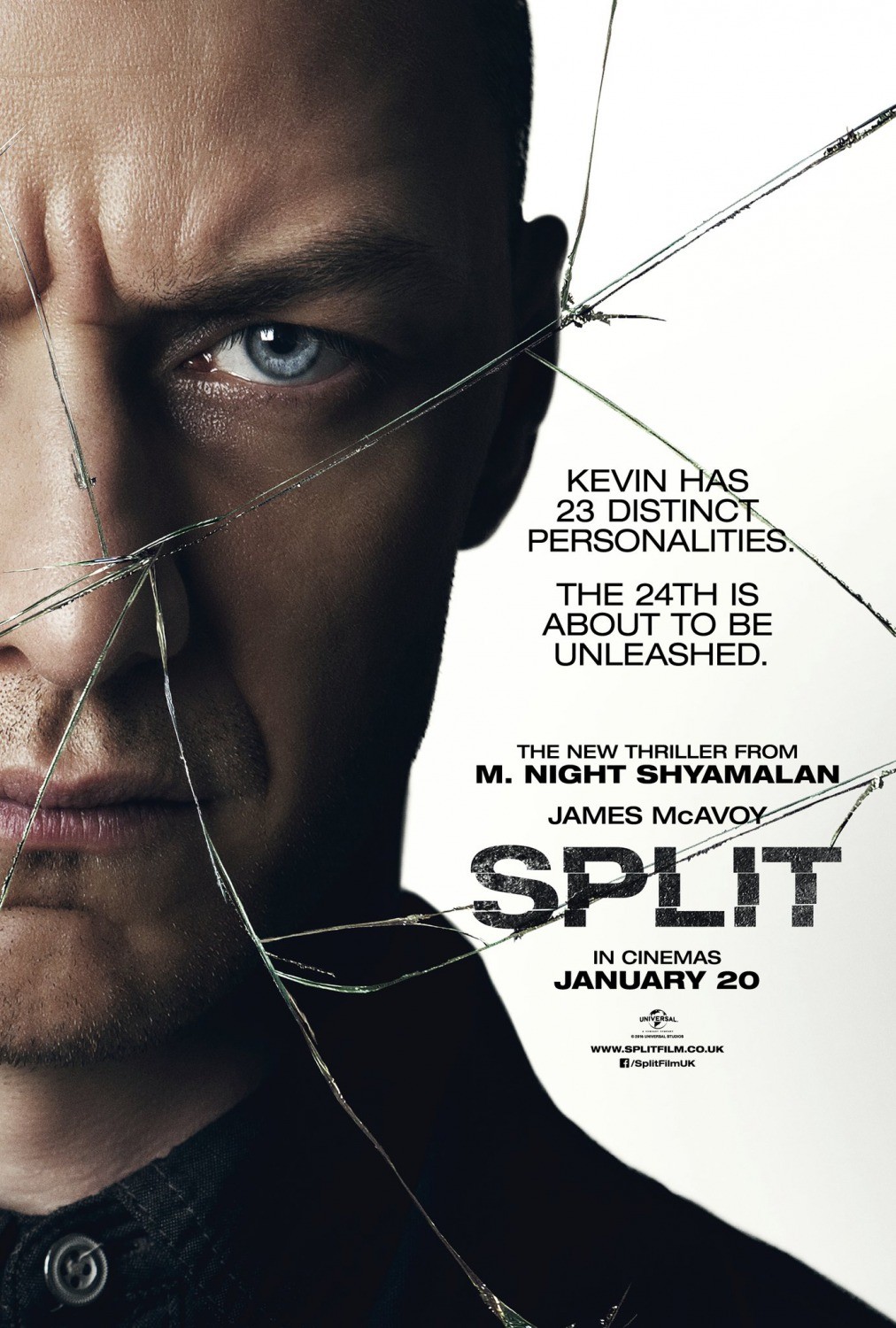
Directed by M. Night Shyamalan who is best known for 1999’s The Sixth Sense, Split is a surprisingly good movie for Shyamalan who unfortunately has had a string of below-average films since his sterling debut. What makes the film really shine is the brilliant acting performance from James McAvoy who convincingly depicts the myriad personalities of the character Kevin who suffers from dissociative identity disorder. It starts out with the kidnapping of three high school girls who are locked away in a cellar-like room by Kevin who has a total of 23 different personalities. Some personalities are compassionate and innocent like Barry who tries to control the other personalities and Hedwig who is a 9 year old boy. However, some of his other personalities are malevolent and downright creepy like Dennis who came up with the idea of kidnapping the girls and Patricia who is a mysteriously conniving woman. Throughout the film, Kevin through the personality of Barry tries to get help from his longtime psychiatrist Dr. Fletcher who attempts to calm his dangerous and neurotic sides. Her theory that those with dissociative identity disorder can literally transform their bodies physically is horrifyingly proven true towards the end as Kevin takes on a 24th personality, the supernaturally strong Beast. The filmmaker effectively uses mystery and terror to create a suspenseful yet entertaining experience with disturbing and violent results. Since most of the action is rather slow paced and simply makes the audience question which personality will show up, the movie is not your typical slasher horror film filled with over-the-top blood and gore. What also surprised me was that, unlike a majority of Shyamalan’s works, the ending was rather predictable for a filmmaker known for his trademark surprise twists. Overall, I found it to be an enjoyably thrilling film that finally provides a glimmer of M. Night Shyamalan’s past original glory and would have flopped without James McAvoy’s impressive ability to play so many roles in one character.