Silence

Directed by Academy Award-winning director Martin Scorsese as a passion project 25 years in the making, Silence is an often difficult to watch film that as the title suggests is full of silent moments reflecting the characters’ religious introspection and how God could exist in such a cruel world. Set in 17th century Japan when the country was closed to Westerners and Christians were violently oppressed, the film follows the Portuguese Jesuit priests Father Rodrigues, played by Andrew Garfield, and Father Garupe, played by Adam Driver. Both eagerly religious men are snuck into forbidden Japan on a mission to find the missing Father Ferreira, portrayed by Liam Neeson, who may have apostatized, or renounced Christianity. When the men first arrive in the Nagasaki region, they are greeted enthusiastically by downtrodden farmers who have had to hide their Catholic faith. The priests live out of sight during the day to avoid the draconian Japanese inquisitors but return to the villagers at night to give Mass, Communion, confession, and baptism, strictly forbidden rituals not given by clergy in several years. Through the eyes of Garfield’s and Driver’s characters, we witness the horrifying torture and gruesome killings of those suspected to be Christians by the Japanese authorities. For instance, men are tied to crucifixes on the shore where rising tides eventually drown them, and innocent bystanders are executed if one person does not apostatize. The major tactic used by the Japanese to discover who is a Christian is to force individuals to trample, or step, on a stone inscribed with the image of Jesus or other Christian iconography. Eventually, Father Rodrigues is detained by brutal Japanese officials who insist that he immediately apostatize while being told that Father Ferreira has renounced his faith and now lives as a Buddhist with a Japanese wife. Scorsese does a brilliant job of underscoring the priests and Japanese Christians torturously grappling with their inner personal faith as they suffer unimaginably simply for being Christians. Mirroring often tedious spiritual exploration that takes time and quiet reflection, the movie is almost three hours long with very little action and has extended stretches of no dialogue. Furthermore, the film heavily relies on nature for storytelling by filling the soundtrack with insect and other wild noises instead of a more conventional musical score. The sweepingly beautiful yet rough landscape of rural Japan is also perfectly captured by the powerfully nuanced cinematography. Overall, I found it to be a spiritually moving cinematic experience about what it means to follow a religion and how even the most dire circumstances can be overcome with deep personal convictions. Although it definitely is not for everyone or the faint of heart, the movie presents yet another terrific case why Martin Scorsese is one of the most talented filmmakers today.
Gold

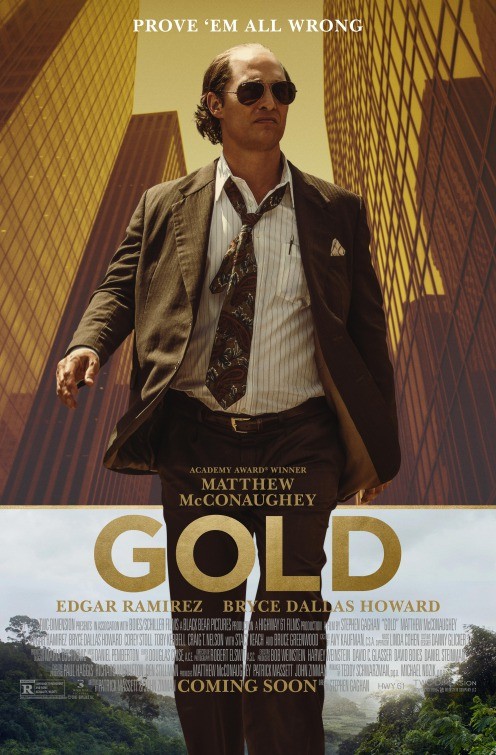
Loosely based on actual events, Gold tells a fascinating story about a down-on-his-luck gold prospector portrayed by the believably gruff Matthew McConaughey, but, unfortunately, the movie fails to meet expectations with its haphazard script. McConaughey plays the balding pot-bellied Kenny Wells who inherits struggling Washoe Mining based in Reno, Nevada after the death of his successful father and is looking for his big break. After working out of a bar where his girlfriend, played by Bryce Dallas Howard, is a waitress, he has a dream of having a successful mine in the jungles of Indonesia. He decides to travel to Indonesia where he devises a plan with a desperate geologist named Michael Acosta, portrayed by Édgar Ramírez. They set the groundwork for a mine deep in the remote jungle on a shoestring budget raised by friends and small investors back in Reno. After months of finding nothing, Acosta finally discovers traces of gold and exuberantly informs Wells who has been suffering from malaria. Thinking that they hit it big time, the rest of the film follows McConaughey’s character as he raises additional funds and is courted by Wall Street. However, his overnight success strains his relationship with his longtime girlfriend. Eventually, his company is listed on the New York Stock Exchange, and many analysts predict that he has discovered the largest gold deposit of the decade, worth almost 30 billion dollars. His life has finally on an upward trajectory, but the viewer is aware that something is amiss because the film flashes forward to the late nineties as he is being investigated by the FBI. Due to outside circumstances, including the actions of the authoritarian Indonesian government, and tensions with his partner Acosta, everything seems to go wrong for the briefly successful Wells. The movie’s major flaw is that the plot is all over the place, and there is an obvious lack of suspense or excitement for such an intriguing story about gold prospectors. Overall, I found it to be a surprisingly dull film that wasted a very strong performance from Oscar winner Matthew McConaughey who physically delved deep into the character.

Patriots Day

From Peter Berg who directed 2013’s Lone Survivor and 2016’s Deepwater Horizon, Patriots Day is a well done procedural drama that follows the events of the Boston Marathon bombings in April 2013 and provides insight into the many men and women who were victims as well as those investigating and capturing the culprits. The events leading up to, during, and after the terrorist attack are shown from the perspective of the fictional Boston Police Department Sergeant Tommy Saunders, portrayed by Boston native Mark Wahlberg. The movie captures the Boston Strong attitude when all of Boston came together during an especially trying time, and one way the filmmaker does this is by casting real Bostonians as extras. Much of the movie revolves around finding out what happened and how to pursue the bombers. The local officials, including the Boston Police Commissioner Ed Davis portrayed by John Goodman, Boston Mayor Thomas Menino, and Massachusetts Governor Deval Patrick, have initial investigative differences, typical of most Hollywood depictions, with the federal government represented by FBI Special Agent Richard DesLauriers, played by Kevin Bacon. Underscoring patriotism and the desire to seek justice, the filmmaker shows many of these characters working together to arrest and capture the Tsarnaev brothers whose free reign terrorizes the entire city of Boston. Free of excessively gruesome imagery of the actual attacks, the film attempts to focus on the emotional aftermath and vividly retrace what happens over the course of the days that follow until those responsible are no longer a threat. The power of the movie is visualizing the events for the viewer even though most Americans already know many of the details. Overall, I found it to an effectively somber and emotional film that shines a light on terrorism and how authorities are able to tackle such a timely issue in a humane and thorough manner.

The Founder

Directed by John Lee Hancock who is best known for 2009’s The Blind Side, The Founder is an entertaining film that tells the fascinating true story of the great American icon known as McDonald’s. Oscar-nominated actor Michael Keaton gives a strong performance as Ray Kroc, a desperate businessman from Illinois who helped transform McDonald’s into a billion-dollar global corporation. We first meet Kroc in 1954 working as a traveling salesman for a milkshake maker manufacturer and hoping to break through in the business world while supporting his wife played by Laura Dern. Eventually, he ends up in San Bernardino, California where he discovers a small pioneering fast food restaurant owned and operated by the McDonald brothers, the older Mac played by John Carroll Lynch and the inventive Dick played by Nick Offerman. Ray Kroc will do anything to get a piece of the McDonald’s pie and will ultimately use questionable tactics to take advantage of the two hard-working brothers already satisfied with running a single successful restaurant. Providing a remarkably fast and efficient method never used before to serve hamburgers, the McDonald’s innovative fast food model inspires Kroc to convince the brothers to franchise the restaurant across the nation. Kroc becomes increasingly hostile to the largely naive founding brothers who are hesitant to give more control to their new partner. To get around the original contract and make more money, he devises a plan to purchase the real estate of each franchise and form a company exerting more control over McDonald’s. The movie effectively illustrates the corrupting influence of money by depicting Ray Kroc towards the end as a conniving character unsympathetic to the true founders of McDonald’s and even to his own wife who stood by his side. Through the alluring performance of Michael Keaton, the viewer is given a glimpse into the largely unseen side of such an iconic brand and a man who has become known as the founder of McDonald’s. Overall, I found it to be a highly compelling film about a complicated figure in the seemingly mundane fast food world and leaves the audience with a disillusioned view of the Golden Arches.

Hidden Figures

Based on a true story, Hidden Figures is a well-crafted inspirational film about a group of women who contributed significantly to the early American space program despite facing intense discrimination. Set in 1961 as the nascent NASA attempts to send the first American into space, it follows three African-American female mathematicians working at the Langley Research Center in Hampton, Virginia tasked with computing the flight trajectories of manned spacecraft. Due to the discriminatory norms and laws of the time, they were forced to work in a segregated division where it was practically impossible to move up the career ladder. Eventually, the main protagonist Katherine Goble Johnson, a brilliant mathematician played by Taraji P. Henson, breaks the color barrier by being permitted to work at the Space Task Group led by the tough director Al Harrison portrayed by Kevin Costner. She was allowed access out of necessity in order to catch up with the rapidly advancing Soviets who were the first to send a satellite and human into space. At the same time, the movie shows the struggles of Mary Jackson, portrayed by Janelle Monáe, who fights for her education to become an engineer, and Dorothy Vaughan, played by Oscar winner Octavia Spencer, who wants to be treated as an equal as a supervisor at NASA. Helping to round out the characters, the film also presents the women’s personal lives and how they cope with the immense pressures they experience at their stressful yet important jobs. Their vital contributions that ensure the safety of such astronauts as Alan Shepard and John Glenn seem to be readily dismissed simply because of their skin color and gender. Overall, I found it to be a must-see movie that provides an uplifting and historically relevant glimpse into the largely unknown role of African American women in such a quintessentially American success story as putting a man in space.

Fences

Based on the Pulitzer Prize-winning play written by August Wilson in 1983, Fences is an acting tour de force that powerfully evokes the ups and downs of being a working-class African American family living in 1950s Pittsburgh. Directed by Denzel Washington, the main protagonist named Troy is a middle-aged African American working as a trash collector and is brilliantly played by Oscar winner Denzel Washington. Oscar-nominated actress Viola Davis plays Troy’s stay-at-home wife who dutifully adores her husband despite his personal indiscretions. Similar to its original source material as a Broadway play, the movie has one primary setting, and the majority of the scenes are emotional conversations between the characters, with very little action. The film does a brilliant job of portraying the intrinsic struggles of being black and poor at a time when Jim Crow laws were still on the books. Washington’s character must deal with the responsibility of raising children from different women and must face his personal demons in his relationship with his strong-willed wife. Consequently, the movie delves into what it means to be a father and husband living in a society full of institutional discrimination. Troy uses tough love on his teenage son in order to teach him a lesson and ensure that his son leads a better and more productive life than he was able to accomplish. Overall, I found it to be a terrifically executed dramatic film that exposes the viewer to largely alien life experiences, reinforced through nuanced yet profound acting performances.

Passengers

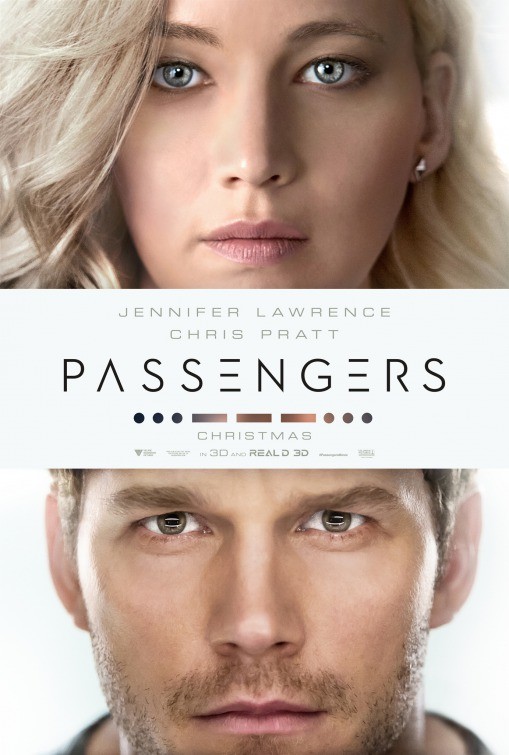
Directed by Oscar-nominated director Morten Tyldum who is best known for 2015’s The Imitation Game, Passengers is a fairly good and visually appealing sci-fi film that ultimately falls short of its lofty potential with its casting of Jennifer Lawrence and Chris Pratt. Set in the future when intergalactic travel is possible, Chris Pratt plays Jim Preston, a mechanical engineer from Earth who mysteriously wakes up too early from hibernation on his way to the distant colonial planet of Homestead II. Over time, he falls in love with the only other passenger to accidentally wake up, a beautiful young woman named Aurora who is played by Jennifer Lawrence. After their relationship begins on a rather controversial foot, they discover that something is very wrong with the spaceship they are traveling on with 5,000 other hibernating passengers. If they do not come up with a solution, the two are faced with spending the rest of their lives in space since they are supposed to reach their destination in 90 years. Although they are surrounded by luxurious amenities and a friendly robotic bartender named Arthur, played by Michael Sheen, they are desperate to find a way to go back into hibernation. The highlight of the movie is the terrific chemistry between Lawrence and Pratt, two of the hottest actors today whose charisma and attractiveness make their on-screen love interest more appealing. Also, the modern sets and props, accentuated by CGI, give the film a realistic and polished vision of future space travel. Overall, despite the visually arresting aesthetic, the movie never fully takes off and is beset by a slow pace with very little action, unusual for a Hollywood sci-fi blockbuster with such a high budget and talented actors.

A Monster Calls

Based on the best-selling 2011 book written by Patrick Ness after the death of writer Siobhan Dowd who came up with the original idea, A Monster Calls is an emotionally powerful movie that mixes a tragic story about human suffering and fantastical elements of allegory. The film follows Conor, a 12-year-old boy living in England who must cope with his single mother suffering from a terminal illness. Feeling extremely isolated at home and school where he is bullied, he is visited by a monster in the form of a tree who provides him an outlet for his difficult life. The monster, voiced by Liam Neeson, feels very much part of his vivid imagination and is inspired by his love for drawing creatures. The appearance of the friendly monster late at night serves as a coping mechanism for Conor as he is subjected to the unfathomable experience of watching his mother, portrayed by Oscar-nominated actress Felicity Jones, slowly die and without the constant presence of his father. Eventually, the monster forces him to rebell against his school bullies and his less-than-endearing grandmother, played by Sigourney Weaver. The filmmaker crafts an evocative, almost magical story by interspersing fantastical animated sequences that feel as if they jump off the pages of an artistic child’s notebook. It provides a visually spectacular experience that helps to underscore the deeply moving emotions of the suffering characters. Overall, I found it to be a wholly unique movie whose message is ultimately uplifting despite the fact that it can be best described as a tearjerker. The imagery is symbolic of the raw emotions of a child too young to have to go through such profound grief.

Jackie

Directed by the critically acclaimed Chilean filmmaker Pablo Larraín, Jackie is a powerful film about the JFK assassination as told from the personal perspective of Jacqueline Kennedy, with a remarkable performance from Academy Award-winning actress Natalie Portman. The JFK assassination has been explored many times in cinema and television, yet this movie gives a uniquely important contribution by depicting the personal toll the horrific event had on those intimately involved. The movie follows Jackie as she experiences the visceral shock of watching her husband being viciously murdered and the aftermath as she tries to cope with his death as well as helping the American people cope with the tragedy. It is primarily told through a series of flashbacks as she recounts those fateful days in November 1963 to a journalist, played by Billy Crudup, at the Kennedy Compound in Hyannis Port, Massachusetts. Although much of the dialogue is fictionalized dramatization, the filmmaker crafts a vivid picture of the emotional trauma experienced by Jackie, not just as another public figure, but as a wife who just lost her beloved, albeit complicated husband. We witness her heart-wrenching grief of suddenly becoming a widow and having to tell her two young children that their father is gone. Portman gives a nuanced and dignified performance, very much like the real young and stylish first lady, who must deal with her own emotions while at the same time planning the logistics of burying an American president, moving out of the White House, and ensuring a seamless transition to the new president. The film’s power lies in its subdued and vignette-heavy structure that focuses on intimate details rather than the sensational criminal act of the assassination itself. It feels very much like an independent movie because of its artistic use of cinematography, slow pace, and in-depth character studies that rely on terrific acting performances. The filmmaker also cleverly uses songs from the musical Camelot to underscore the idealistic JFK presidency, often referred to as Camelot, that came to a crashing halt with an act of violence. Overall, I found it to be a film of immense poignancy that effectively captures the human emotion of grief, primarily as a result of Natalie Portman giving one of the more memorable acting performances of the year.

La La Land

From Damien Chazelle who received a Academy Award nomination for best director for 2014’s Whiplash, La La Land is a vibrantly energetic film that revives the musical genre to its former glory. At its heart, it is an ode to old Hollywood and the thriving contemporary metropolis of Los Angeles. The movie follows a young woman named Mia, terrifically portrayed by the fresh-faced Emma Stone, who has moved to Los Angeles to pursue a career in acting. Like many other young actors and actresses, she has dreams of hitting it big time, but she has the typical experience of being rejected and stuck in a dead-end job to make ends meet. Through a series of chance encounters, she meets an equally aspiring young artist named Sebastian, played by the brilliant and handsome Ryan Gosling, and they began a whirlwind romance told through exuberant musical numbers. Sebastian himself is an old school jazz pianist who has difficulty breaking through the highly commercialized music industry, and he has dreams of opening an old fashioned jazz club. Like the film’s style and genre, both characters feel like they are from a bygone era and remain idealistic despite the challenges they face in their respective rapidly changing and business-oriented entertainment industries. This new paradigm is reflected by John Legend who plays a musician catering to contemporary taste simply to make a buck and forces Sebastian to face the harsh realities of the music business. What makes the movie so special is its interspersal of wildly energetic and magically shot sequences in which the characters sing and dance in highly choreographed fashion, reminiscent of Fred Astaire musicals. The film employed the rather clever technique of dimming the lights around the characters as they began a musical sequence. Not particularly a fan of musicals, I was pleasantly surprised that the filmmaker only used musical numbers when it was necessary and not too over-the-top to be distracting from the storyline. Overall, I found it to be one of the more joyful and exciting experiences I have had at the movies: the musical elements were effusively entertaining and the plot was well-crafted nostalgia. I would recommend it to those looking for a light-hearted time that harks back to the heyday of old Hollywood romance and musicals.