The BFG

Adapted from Roald Dahl’s children book of the same name written in 1982, The BFG is a cute family-friendly film about an orphan girl and a gentle giant. The film reunites director Steven Spielberg and Academy Award winning actor Mark Rylance who were both involved in 2015’s Bridge of Spies. Rylance plays the CGI-enhanced titular character BFG, which stands for big friendly giant. The movie begins at a London orphanage where Sophie is lonely and often wanders the hallways in the middle of the night. This one particular night she hears something stirring outside the window and is amazed to discover a literal giant roaming the streets. She is taken by him back to the magical Giant Land and his cave where he lives. Eventually, they develop a close friendship and Sophie helps him, who she affectionately calls BFG, to fight off nine bullying giants. With such whimsical names as Fleshlumpeater and Gizzardgulper, BFG also must protect Sophie from these giants who want her for food since they are human “bean” eaters. One of my favorite parts of the film is the humorous language spoken by BFG, a quaint combination of broken English and gibberish with such made-up words as crockadowndillies and scrumdiddlyumptious. Visually, the movie is marvelously well done: CGI was effective in creating a realistic illusion of giants while still retaining the actors’ recognizable facial features. By using live action with elements of CGI, the film’s ability to tell a uniquely fantastical story was greatly enhanced. The juxtaposition of an actual child actor playing Sophie with the realistically outsized BFG underscores the story’s lesson about friendship. People of all shapes and sizes and from all backgrounds who may normally be enemies can in fact develop close relationships. Quite simply, not all giants should be judged as scary human-eating creatures; BFG is the complete opposite of the sinister perception of a monster. Furthermore, it is about the power of dreams. BFG is a dreamcatcher who sneaks into the human-inhabited cities to capture children’s dreams and also has the power to give children either good or bad dreams. Beyond fostering simple dreams while sleeping, he is able to fulfill Sophie’s dream of leaving the orphanage and having a semblance of a family with BFG. Overall, I found the movie to be an adorable film that can be enjoyed by all in a family. Its fantasy style and hopeful storytelling reminded me of Martin Scorsese’s 2011 Hugo and the many iterations of Peter Pan.
The Shallows

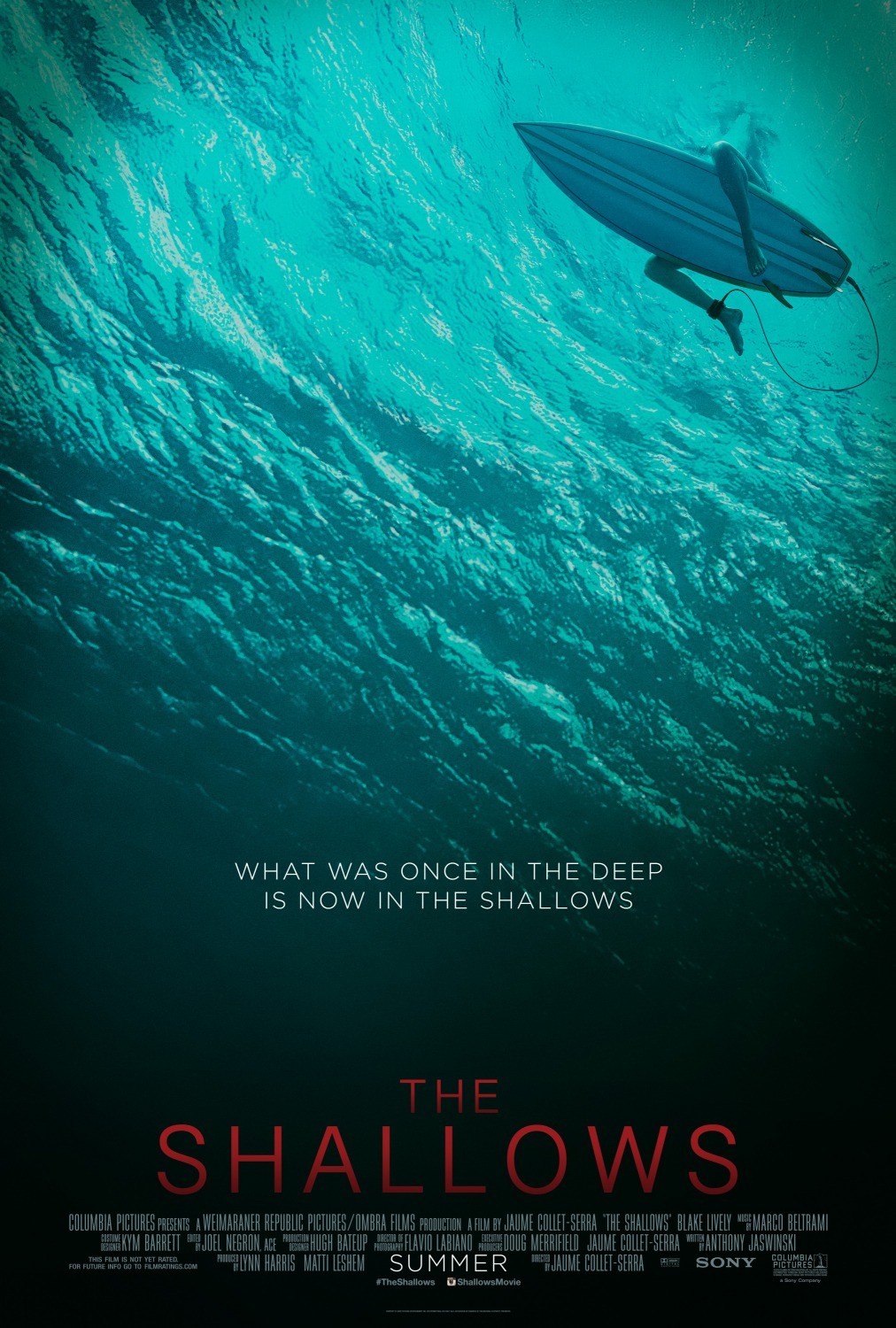
A surprisingly thrilling movie, The Shallows stars Blake Lively as an aimless surfer who must fend for her life from a great white shark. The film’s first 20 minutes or so is like any other surfing movie, complete with stunning action shots in a beautiful tropical setting. It starts with her being driven through a dense jungle to a secluded beach in Mexico. Along the journey, she converses with her local driver during the only major speaking part of the film. Through her conversation and a series of photos shown on screen as if on her cell phone, we learn that Lively’s character has always dreamed of visiting this particular beach because of her mother’s personal connection with it. When she finally gets in the water to catch some waves, palpable tension is created because we never know when the shark will inevitably attack. Nearing dusk and all alone, the telltale shark fin is spotted lurking near her and your mind unconsciously hears the theme music from Jaws. Much of the rest of the film, Lively’s character is trapped on a small outcropping of rocks only 200 yards away from the shore. She is forced to muster up the courage to devise a way of escaping her deadly predicament with the limited resources at her disposal. Its focus on a single individual figuring out how to survive reminded me of the movies Castaway and 127 Hours. The film is also obviously reminiscent of the all-time classic shark movie Jaws; in fact, it may very well be the best shark-themed movie released since Spielberg’s 1975 thriller. Like Jaws, a lot of the suspense is created without even showing the shark and even includes underwater shots seemingly from the shark’s perspective. However, there are a few brief shots of the shark actually attacking its victims with some gore. Going into the movie, I was expecting a cheesy B-movie that would not be able to overcome its inherently gimmicky premise of one woman on a rock versus one very hungry great white shark. However, I came away impressed with the film’s successful ability to create a very suspenseful and exhilarating cinematic experience, ultimately transcending its basic shtick.

The Legend of Tarzan

Following a long line of film adaptations of Edgar Rice Burrough’s Tarzan books, The Legend of Tarzan takes a different take on the eponymous character of Tarzan played by Alexander Skarsgård. Almost a decade removed from the African jungles, John Clayton III, also known as Tarzan, is living a life of an aristocrat in England with his beautiful wife Jane played by Margot Robbie. However, at the request of the British government, he is sent back to the Congo as a diplomatic envoy. Accompanied by Jane and the gun-toting American diplomat George Washington Williams played by Samuel L. Jackson, Tarzan discovers that the Congo and his tribal friends are being brutally oppressed by the Belgian colonial powers of King Leopold II. Eventually, Tarzan runs into trouble with the reprehensible Belgian leader Captain portrayed by the always marvelously devious Christoph Waltz. Waltz’s performance is by far the best of the film: his character, based on a real person, nonchalantly orders the wholesale butchering of locals in the greedy pursuit of diamonds. He does all this while dressed in immaculate white suits and clutching a rosary that he uses as a weapon. With the help of his animal friends, including some of the apes that raised him, Tarzan returns to his wild self to rescue Jane and the enslaved tribesmen. Although the story has been told countless times, the film contains flashbacks to Tarzan as a child taken care of by animals and his first meetings of Jane. As a lover of history, I was mostly fascinated by the depiction of Belgian colonialism in Africa in the late 19th century. The movie was set in the Congo Free State at a time when the Belgian military and mercenaries known as the Force Publique exploited the territory for its rich natural resources. Their ruthless stranglehold resulted in what some believe to be an estimated ten million Congolese deaths and the enslavement of millions. The atrocities were a stark reminder to Jackson’s character who witnessed American slavery and the abusive treatment of Native Americans. Interestingly, his character George Washington Williams was a real historical figure who helped expose the brutalities in the Congo. Overall, I found the film to be an entertaining adventure story that brings a unique twist to the Tarzan saga. It is particularly noteworthy for providing a historical context enlightening to many viewers who may never have known about the genocidal Belgian colonialism in the Congo.

Finding Dory

The sequel to Finding Nemo released in 2003, Finding Dory is the latest in a long line of great Pixar animated movies that delights children and adults alike. It very effectively uses non-vulgar comedy and adventure to convey important messages about life. The film follows everyone’s favorite blue fish with short-term memory loss, Dory voiced by Ellen DeGeneres, as she looks for her long lost parents voiced by Eugene Levy and Diane Keaton. With the help of Nemo and his father Marlin voiced by Albert Brooks, Dory goes on a fun-filled journey across the ocean and eventually ends up at the Marine Life Institute. A subtle indictment of SeaWorld, the Marine Life Institute is an aquatic-themed amusement park that houses sea life for so-called rehabilitation before they are supposed to be released back into the ocean. There, Dory inadvertently parts ways with Nemo and Marlin but encounters new friends, including the grumpy octopus Hank voiced by Ed O’Neill and clumsy beluga whale voiced by Ty Burrell. Through a series of cleverly funny episodes, Dory must figure out how to deal with her memory issues in order to navigate her way back to her parents. Although her forgetfulness is entertaining to watch, the audience feels sympathetic for Dory who suffers from the disability of having short-term memory loss. Therefore, the film, showing Dory’s struggles and its effects on others around her, addresses an important issue: finding ways to cope with and accept disabilities. Like most Pixar movies, it uses incisive humor with a heavy dose of puns and wit to create a very amusing moviegoing experience. It is able to do all this while teaching a lesson that the audience is not even aware of at the time. Overall, I would highly recommend the movie to all ages and say that it is even a worthy competitor to the original Finding Nemo.

Free State of Jones

image

Starring Academy Award winner Matthew McConaughey, Free State of Jones tells a truly fascinating overlooked true story of the American Civil War and Reconstruction in the South. McConaughey portrays Newton Knight, a larger-than-life figure who is still controversial to this day, who started a small uprising against the Confederacy in the rural Mississippi county of Jones. After enduring the bloody brutality of such battles as the Siege of Corinth in 1862, Knight deserted the Confederate Army and returned home to a dire situation. Many of the local poor white farmers were burdened with high taxes that deprived them of badly needed food supplies. Feeling targeted by the Confederacy and to escape prosecution, Knight hid in the swamp with escaped slaves and other deserters and eventually formed what would be known as the Knight Company. As the group grew with more disenfranchised farmers, they became surprisingly effective in repelling the Confederate authorities. However, General Sherman and the Union Army refused to help the group since they were perceived as simply a small group of bandits with no real power. The movie is unique in that it conveys an alternate message about the Confederate South: a thoroughly white Southerner like Knight has no qualms working with blacks and even fights for their rights during Reconstruction. Through the use of on-screen text giving historical context, the film gives an important historical lesson about the Civil War, its aftermath, and the suppression of black civil rights. The film’s only major drawback is that it tries to fit too much information into a relatively short amount of time. For instance, it almost randomly flashes forward 85 years to a trial when Knight’s descendant is questioned for committing the crime of interracial marriage. Such scenes help to tell the totality of racial discrimination in Mississippi. The movie would feel more coherent if it just focused on the Knight Company around the time of the Civil War. Matthew McConaughey gives an authentic performance as a gritty yet preacher-like rebel leader with a controversial personal life. Overall, I found the film intriguing for telling a noteworthy and powerful piece of history but whose storytelling could be more tightly woven.

Independence Day: Resurgence

image

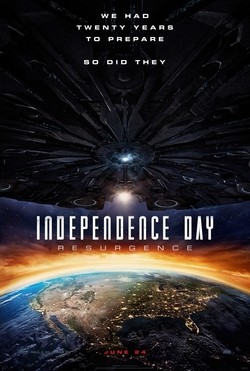
A follow-up to the Hollywood blockbuster Independence Day released in 1996, Independence Day: Resurgence is a fairly lackluster sequel that is visually appealing but filled with cliche, cheesy dialogue. It is basically the same film as the original: the same aliens return to invade Earth yet again and humans unify to fight the aliens. This time, an international defense force is created using alien technology but the attack is on a much larger scale. Relying heavily on CGI, the aliens obliterate many cities and landmarks in epic fashion. I did feel a sense of nostalgia as I watched the film since I remember the original from when I was 11 years-old. The original was one of the first major sci-fi popcorn flicks I saw that was visually stunning, at least for 90’s standards prior to today’s advanced CGI. Although Will Smith did not reprise his role, the movie brings back several of the major members of the original cast, including Jeff Goldblum and Bill Pullman. Like the original, it even included an inspiring speech from Pullman who now portrays the reclusive former president. The movie includes the requisite elements of a love story, eccentric scientists, military camaraderie, and rousing patriotism. Overall, I found the film to be a fairly typical sci-fi blockbuster, with a rather silly premise, whose primary purpose is to serve as a vehicle for special effects.

Central Intelligence

image

Starring Kevin Hart and Dwayne “The Rock” Johnson, Central Intelligence is a fairly formulaic action comedy that surprisingly has moments of laughter. The film begins when the characters are in a high school: Hart plays Calvin, a popular jock nicknamed The Golden Jet, and Johnson plays Bob, a bullied nerd nicknamed Fat Robbie. After a particularly embarrassing episode in which Calvin helps Bob, Bob finds a lifelong bond with Calvin even if Calvin does not realize it. The movie then flashes forward twenty years later. Calvin is an accountant who feels that his life has not lived up to his expectations and is rather boring until the appearance of Bob. Dramatically changed since high school, Bob is extremely physically fit and has become an undercover CIA agent. Calvin is begrudgingly enlisted to help uncover an international terrorist plot involving spy satellites. Like most of his movie roles, Kevin Hart relies on his hyperactive, fast-talking comedy that embraces his diminutive stature. Although less funny, Dwayne Johnson’s status as an action star who is quite literally huge complements well with the clownish personality of Hart’s character. The actors’ chemistry and the sheer juxtaposition of their physical size is what makes the movie an above-average comedy. For extra measure, there are also some funny cameos from Aaron Paul, Jason Bateman, and Melissa McCarthy. Overall, the movie exceeded my expectations and serves well as a silly action comedy to help pass time during the summer blockbuster season.

Special Report: Back to the Future

Recently, I attended a special screening of Back to the Future at a fundraising benefit in Chatham, Massachusetts for the Michael J. Fox Foundation for Parkinson’s Research. I had the distinct privilege of meeting and talking with actor Christopher Lloyd who played Dr. Emmett “Doc” Brown and co-writer and producer Bob Gale.

image

Still easily recognizable as the white-haired eccentric scientist in his most well-known role, Lloyd was very approachable and graciously answered my questions about Back to the Future. He, along with Gale, told me that the cast and crew members are like a family, and they still gather several times a year. Lloyd and a few other Back to the Future alums, including Gale and the director Robert Zemeckis, live in Santa Barbara, California, so it is not unusual for them to get together. Lloyd told me that he remains close to Michael J. Fox, who courageously fights Parkinson’s and tries to attend Back to the Future events despite tiring easily. In fact, Lloyd told me that he was just with Fox in Philadelphia for one of the many Comic-Cons that he attends a year. When I asked him about the possibility of another Back to the Future film, he said he does not know and that it is up to Gale.

image

I also talked at length with Bob Gale who was the one that came up with the premise for the films. Much more outspoken than Christopher Lloyd and clearly passionate about filmmaking, Gale told me how he was inspired to write Back to the Future. A number of years ago, he was going through his father’s belongings and discovered a yearbook describing his father as the senior class president, a fact that he never knew. Gale remembered that his class president was quite disagreeable and wondered whether he would have been friends with his father in high school. Curious about his father’s past, he thought it would be interesting to make a movie that travels back in time to when a character’s parents were younger.

I asked Gale a more timely question: whether Donald Trump was really an inspiration for the older Biff character. He told me that Trump was not the only direct inspiration, but rather he got his ideas from other people at the time like Trump, people with large egos who wanted their name plastered all over cities like Las Vegas. More generally, I asked if there were any other inspirations for Back to the Future. He didn’t mention any filmmaker that really inspired him besides the Westerns of John Ford for the third Back to the Future film.

Finally, Gale gave me insight into the casting of Michael J. Fox as Marty McFly. The first half of the film was originally filmed with Eric Stoltz as Marty, but he said they were eventually fortunate enough to arrange for Fox, their first choice, to join the cast. They were not able to get him initially because Fox was on the popular show Family Ties and was not given leave for the filming of Back to the Future.

Then, I asked whether there will ever be another Back to the Future. Unlike Christopher Lloyd’s response, Gale said there will never be another film in the series without Michael J. Fox, who is unlikely to reprise his role as a result of his health condition. Finally, Bob Gale mentioned that he has two other projects in the pipeline but said he could not divulge the details due to being superstitious.

After these fascinating conversations with Lloyd and Gale, I got to see the original Back to the Future on the big screen for my first time. Even though it was made in 1985, the movie itself still stands up as a cult classic with the right blend of sci-fi and comedy. It was a truly memorable evening to be able to talk with Christopher Lloyd and Bob Gale and see the film in its proper setting, all for a worthy cause in combating Parkinson’s disease. I even got to stand in front of a replica of the famed DeLorean, complete with a flux capacitor!

image

Weiner

image

Following the 2013 New York City mayoral candidacy of former congressman Anthony Weiner, Weiner is a superb political documentary that is at the same time funny and tragic. The film is a behind-the-scenes look at Weiner’s shot at political redemption, two years after resigning from Congress in 2011 for his infamous sexting scandal. It begins with archival footage of his promising career, especially his impassioned support for the 9/11 first responders health bill. Mostly relying on the filmmakers simply rolling the camera in a cinéma vérité style, we watch a political campaign starting from the ground up and eventually building momentum. However, an even more disastrous scandal, involving Weiner sending much more explicit images after the first revelation, proves to derail the campaign. The film unwittingly becomes a case study in crisis management. Almost comically, nothing seems to stop the nuclear meltdown that has become Anthony Weiner’s campaign. One of the more fascinating aspects of the documentary is the cringe-worthy reactions of his wife Huma Abedin, a close aide to Hillary Clinton. She becomes a sympathetic character whose marital problems are relentlessly made public. As a result, the film is at times painful to watch as Abedin is paraded in front of the cameras and Weiner continues to make things worse. The story really is stranger than fiction, and it is hard not to laugh at the absurdities of the situation, particularly with his last name. The filmmaker rightly asks Weiner why on Earth would he agree to being filmed. The movie is also about the modern media who, fairly or not, completely focused on salacious details at the detriment of the central characters. Through its fly-on-the-wall style, the documentary reminded me of the groundbreaking 1993 political documentary The War Room about Bill Clinton’s first presidential campaign. Overall, I would highly recommend the film for its ability to incisively show the inner workings of a political campaign, one mired in scandal and damage control. It is able to delve into the usually mundane world of politics in a entertaining and riveting fashion.

Genius

image
Based on a true story, Genius follows the complicated relationship between the famed literary editor Maxwell Perkins played by Colin Firth and acclaimed novelist Thomas Wolfe played by Jude Law. Already a well-regarded editor at Scribner’s of such authors as F. Scott Fitzgerald and Ernest Hemingway, Perkins faces his biggest challenge of working with the often irksome Wolfe. First meeting in 1929, he agrees to edit Wolfe’s extremely long first manuscript of the novel Look Homeward, Angel, which had been rejected by all other publishing houses. The film provides a unique glimpse into the often unseen process of book editing and how it can be painstakingly difficult for both editor and author. Workaholics by nature, both men’s personal lives are adversely affected by their work. Perkins struggles to juggle his career with his family life, especially his wife played by Laura Linney, an aspiring playwright who feels underappreciated. Wolfe’s prodigious writing habits also alienates his love life with a married costume designer played by Nicole Kidman: his wild temperament provokes jealousy and neglect. After the first novel is published, Perkins faces an even greater challenge when Wolfe, who has become his friend in a albeit tumultuous relationship, presents him with literally crates full of his latest manuscript. Numbering about 6,000 pages and constantly added to by Wolfe, it takes more than two years to publish what would become the 1935 novel Of Time and the River. Filmed in grayer tones and with outbursts of ragtime-sounding jazz, the film accentuates the early 20th century setting and the characters’ emotional rollercoaster rides. Colin Firth’s performance evokes a rather straitlaced yet very talented office dweller who only takes off his bowler-style hat during particularly intense scenes. Jude Law is the polar opposite: he gives a manic performance of a uncouth, often drunk writer who happens to be one of the greatest novelists. Overall, the movie is fairly well done and tells a quite interesting story of the inner workings of the literary world and how genius often comes at a price. Complete with actual readings from Thomas Wolfe’s writings and cameos of Fitzgerald and Hemingway as characters in the storyline, the film should surely delight fans of great American literature.