A Bigger Splash

image

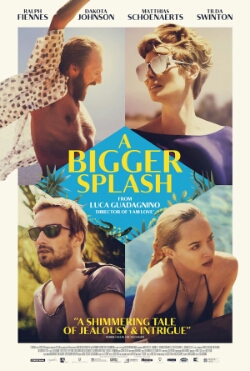
Based on the 1969 French film La Piscine, A Bigger Splash is a very sensual drama that evolves into a slow-burn thriller full of seduction and deception. Tilda Swinton plays a famous David Bowie-esque rock star named Marianne recuperating from a throat surgery with her younger boyfriend Paul played by Matthias Schoenaerts on the Italian island of Pantelleria. Their tranquility is unexpectedly interrupted by the arrival of Marianne’s former lover Harry portrayed by Ralph Fiennes and beautiful young daughter Penelope portrayed by Dakota Johnson. What follows is a clash of personalities and love interests that starts amicably on the surface but eventually descends into darkness. A quintessential player with intoxicating energy and mischief, Harry stirs up the past, visualized through the film’s flashbacks to his troubled romance with Marianne. His intentions and reason for being there is left murky for much of the film. Further complicating things is Penelope, a Lolita-type character, who flirts with and tries to seduce the young and handsome Paul who has his own past demons. The movie creates a perfect atmosphere for the palpable tension percolating until literally splashing over at the plot’s climax. Pantelleria is a small volcanic island that, although stunningly beautiful, gives a rustic, almost ominous vibe with its dry and barren landscape. The rocky terrain reflects the increasingly rocky relationships between the four characters. As tensions escalate, the island is also beset by strong Sirocco winds and rainstorms. All at the same time, the score dramatically shifts into much more menacing music and finally with a operatic crescendo at the most intense scene. The film’s exploration of human desire and jealousy is accentuated by the terrific acting from the four principal actors. It is anchored by Tilda Swinton who exudes an otherworldly aura despite her character rarely speaking. Following his real life playboy reputation, Ralph Fiennes gives a raw performance as a hedonistic rabble-rouser living on the edge. The younger actors equally impressed, including Dakota Johnson who is ironically more sultry than her role in Fifty Shades of Grey. Overall, the film was a high-quality erotic thriller exhibiting the hallmarks of a foreign flick with a permissive attitude and emphasis on first-rate acting.
The Nice Guys

image

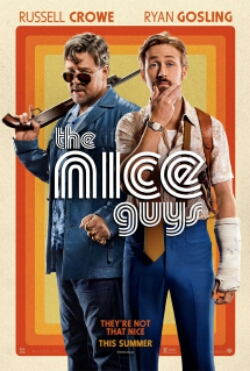
Written and directed by Shane Black who wrote the original Lethal Weapon, The Nice Guys is a very entertaining action comedy set in the 1970s. Russell Crowe and Ryan Gosling are two private detectives who go on a wild goose chase after the mysterious death of an adult film actress in Los Angeles. The film is very aware of cinematic history in that it blends elements of a classic crime caper with screwball comedy filled with Three Stooges-esque physical comedy. The soundtrack is particularly effective: songs from Earth, Wind & Fire, Kiss, and America along with the classic Pina Colada Song effortlessly tells us the setting. Also mixed in is a score that sometimes feel like it comes from a 1940s film noir to remind us that the film is essentially a crime mystery. The pairing of the tough guy persona of Russell Crowe along with the sometimes naive buffoonery of Ryan Gosling is terrifically cast, similar to Mel Gibson and Danny Glover in the quintessential buddy action comedy Lethal Weapon. Known for his good looks and charisma, Ryan Gosling paradoxically plays a character who quite literally stumbles and sheepishly squeals his way through unraveling the plot’s mysteries. The film takes on such an entertaining joy ride that the almost satirically preposterous conspiracy discovered at the end is irrelevant. I would highly recommend the movie based on its well-timed elements of action and comedy and perfect casting of Russell Crowe and Ryan Gosling whose on-screen chemistry will hopefully be replicated soon.

Green Room

image

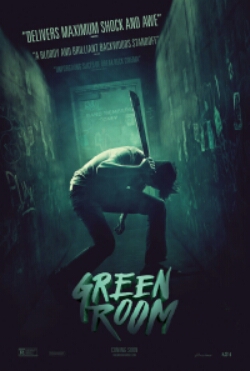
Green Room is a well-directed independent film that is definitely not for the faint-hearted. At the beginning, the film follows a punk rock band that is literally living gas tank to gas tank on a cross-country tour and eventually end up somewhere they really should not be. Desperate for any paying gig, the band of young misfits arrive at a run-down compound located deep in the Oregon woods where they perform in front of a large gathering of white supremacists. The group  find themselves trapped inside the back green room after a young female is discovered murdered. The movie becomes a slow burn thriller in which we really do not know what happened and what exactly the gang of white supremacists are doing at the compound. Then, it rapidly descents into hell for the band members after the arrival of the gang’s leader played by Patrick Stewart who tries to clean up the mess and elude the police. As probably the greatest asset to the film, the acting from Stewart is top-notch; his brilliantly creepy performance as an unrepentant psychopath is so markedly different from what we are used to in Star Trek. Evolving into a classic midnight special, the standoff elevates into an extreme level of violence and gore. Although the scenes of violence can be gratuitous, the movie maintains clever dialogue and outstanding acting. The band’s default leader played by Anton Yelchin develops from being subdued and indecisive to becoming a no-holds-barred fighter adamant on escaping alive along with a young woman portrayed by the sublime Imogen Poots. I would recommend Green Room only to those willing to go on a wild roller coaster of thrills and are not squeamish.

Money Monster

image

Directed by Jodie Foster, Money Monster follows in the footsteps of The Big Short by providing an entertaining movie about the pitfalls of Wall Street. It is a gripping real-time thriller that blurs the line between villain and hero and that everything may not be as it seems. George Clooney, portraying a Jim Cramer-type host of a popular financial television show, is taken hostage by a desperate man, effectively played by Jack O’Connell, looking for revenge and answers after losing most of his money from a bad investment overhyped by Clooney’s character. As the man with the gun, O’Connell’s character at first blush seems to be the villain but over the course of the hostage crisis we are left feeling sympathetic for his plight. The movie resonates well with the current political and economic environment in which politicians like Bernie Sanders rail against income inequality and the perceived corruption of Wall Street. While having moments of comic relief, the film directly and indirectly addresses such serious subject matters as the implications of cable news, reality television, and the business of Wall Street. It is about a so-called journalist walking a fine line between entertainment and journalism and a violent situation that is broadcast live around the world like reality television and caused by the powerless feeling injustice at the hands of the rich and powerful. Overall, I found it to be an entertaining blockbuster that provides the right amount of thrills and smarts to make it worth watching in theaters.