The Last Word

The Last Word is a fairly generic comedy drama about an unexpected friendship
that has moments of wit and charm and is anchored by the strong acting performances from the always terrific Shirley MacLaine and relative newcomer Amanda Seyfried. Shirley MacLaine plays Harriet Lauler, a retired highly successful businesswoman and a curmudgeon not really liked by anyone in her community and family, who feels like she is at the end of her life and decides to commission her own obituary even before her death. Eventually, she enlists the obituary writer at the local newspaper and an aspiring writer,
played by Seyfried, to research her life and interview many people from throughout her life in order to write an appealing obituary. However, the young writer realizes that almost nobody is willing to talk to her about Harriet since so many have hated her for her grumpy and strict attitudes. After being faced with this reality, Harriet makes it her mission to craft the perfect obituary by creating new memories and trying to create positive relationships with others. Therefore, the final half of the film becomes a redemption story for Harriet who discovers her passion for music by becoming a DJ at a local independent radio station, becomes a mentor for a poor African-American girl, and eventually develops a close kinship with Seyfried’s character. My favorite part
of the movie is Shirley MacLaine who gives her typically perfect performance as a curmudgeon committing unintentionally funny antics but gradually comes to understand the meaning of life and tries to reform her ways before her inevitable death. Overall, I found it to be a cute film that had its moments of morbidity as should be the case with a movie about a elderly woman and her obituary, but the film would probably not work were it not for Shirley MacLaine’s spot on acting.

Logan

The tenth installment of the blockbuster Marvel Comics’ X-Men film series since its debut in 2000, Logan is a superhero movie unlike any other by transcending formulaic conventions of the comic book genre to become a deeply emotional and serious drama about love and dying. Reprising his role for the ninth and likely final time, Hugh Jackman portrays Logan, often referred to as Wolverine, who is experiencing a great low point in his life and whose superpowers have increasingly diminished with age. Set in 2029, unexplained events have led to the practical extinction of mutants, people with genetic superpowers, and Logan is living a quiet, alcohol-fueled life as a chauffeur in El Paso. As a result of discrimination and attempted eradication from fearful non-mutants, the de facto leader of the X-Men Professor Charles Xavier, played by Patrick Stewart, lives hidden away just across the border in Mexico with an albino mutant, played by Stephen Merchant. Logan visits often to make sure Xavier, the only person he has really loved like family, gets his medication since he is suffering from a debilitating and dangerous illness onset by age. Eventually, they, along with a young mutant named Laura who possesses the same powers as Wolverine and is depicted terrifically by the newcomer actress Dafne Keen, are hunted down by a sinister organization led by its vicious chief of security, portrayed by Boyd Holbrook of Narcos fame. Unlike most comic book adaptations, the movie shows the characters in a more empathetic and vulnerable light as they are chased across the country in hopes of reaching a place called Eden across the border in Canada. The theme of crossing a border out of hope while eluding dangerous and prejudicial forces is especially potent nowadays with the divisive rhetoric over immigration and discrimination. The superheroes themselves show their humanity: Logan, previously shown as indestructible, clearly suffers physically and mentally after several violent fights, and he is greatly affected by the increasingly frail condition of his beloved father figure Xavier. Largely unseen in other superhero films, there is an emotional connection between the super powerful characters Logan, Xavier, and Laura; it is as if they are on a road trip as grandfather, son, and granddaughter in which they have bonding time. With its chase storyline set across sweeping landscapes and a clear struggle between good and evil in intimate battles, the film also feels heavily influenced by the Western genre. Clearly alluded to this fact is when Xavier and Laura watch the classic movie Shane and later a quote from the movie is used at a particularly poignant moment at the end. Overall, I found it to be a refreshing take on the rather stale and predictable comic book superhero film genre: the filmmaker is able to craft a beautiful story about extraordinary characters dealing with ordinary and raw human emotions. The movie takes a slow-paced and nuanced look at characters and plot lines that have been generically rehashed over the years and ultimately results in probably the best film ever adapted from a comic book.

A United Kingdom

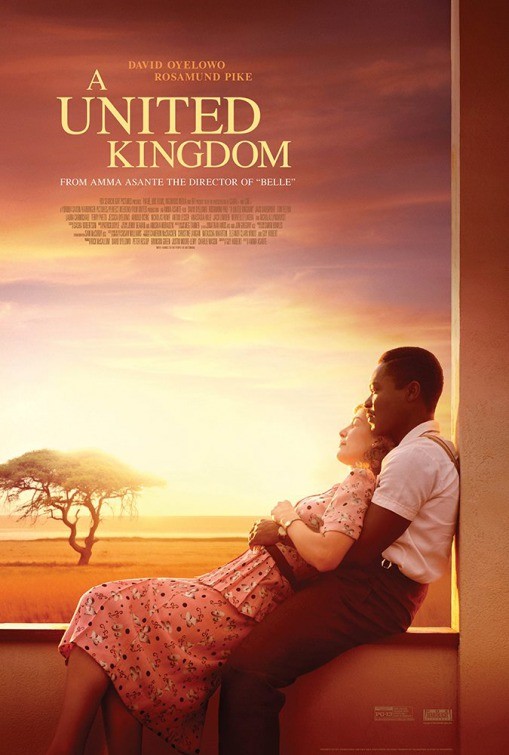
Based on an incredible true story, A United Kingdom is a beautifully crafted film with strong acting performances that tells a remarkable story of forbidden love. Set in the late 1940s, the story follows Seretse Khama, the black King of Bechuanaland (modern-day Botswana) and portrayed by David Oyelowo, and his controversial romantic relationship with a white British woman named Ruth Williams, played by Rosamund Pike, whom he met during his studies in London. To the chagrin of British authorities and his family and tribe back home, they eventually marry and move back to his hometown in Africa to officially become the king of his people. The British government fear that the interracial couple will interfere with politics, particularly the government’s relationship with South Africa, which just imposed apartheid criminalizing interracial marriage. It is believed that South Africa could use the marriage as a pretext to invade colonial Botswana, or the British could lose out on the potential for oil and other minerals in the region. Despite opposition, internationally, and from Khama’s own powerful uncle who served as regent, they steadfastly refuse to divorce, and they start their own family in Bechuanaland even though they are threatened with exile and a lengthy separation from one another. At one point during a meeting with British authorities, he is not allowed to leave England and cannot visit his wife who is still in Africa. Their case to be allowed to live in his beloved homeland as ruler makes its way all the way through the British Parliament and is even discussed by Winston Churchill. The movie is especially poignant because it tells a truly extraordinary story I have never heard of about injustice and race relations that feels particularly relevant in today’s divisive political climate. It is made even more powerful as a result of the terrific performances of the two main lead actors whose chemistry makes the characters’ profound love feel realistic. Overall, I found it to be a must-see film about how forbidden love due to unjust laws can be overcome, with brilliant filmmaking and acting to boot.

The Salesman

Directed by critically acclaimed Iranian filmmaker Asghar Farhadi whose 2011 A Separation won the Oscar for best foreign language film, The Salesman is an emotionally powerful film that masterfully uses simmering tensions between a couple during a particularly trying time to craft a superb slow burn dramatic thriller. The movie follows the married couple Emad and Rana, both professional actors performing in Arthur Miller’s play The Death of a Salesman, who are forced to evict their condemned apartment in Tehran and move to another apartment previously inhabited by a mysterious woman. While she is alone at their new home, Rana is attacked by a stranger who may have been an acquaintance of the previous tenant. Emad becomes increasingly obsessed with finding the culprit and protecting his wife, but in a way that goes too far and consequently strains their relationship. As all this domestic drama unfolds, the couple must continue to act in the famously dramatic Arthur Miller play as if nothing happened back at home. Although there is very little action in the film, the nuanced performances of the main actors, regulars in Farhadi’s other works, create a palpably tense environment in which the characters’ human emotions are riveting in and of itself. Like the filmmaker’s other cinematic masterpieces, the movie is a perfect example of a master storyteller weaving human complexities and difficult societal and cultural issues into a thought-provoking yet enthralling narrative. As it progresses, the film delves into the complicated aspects of justice, revenge, and forgiveness, and how they affect interactions with loved ones at times of crisis. Overall, I found it to be one of the more rewarding cinematic experiences this year because of its powerful storytelling and brilliantly subtle acting performances, and it is more than deserving to win the Oscar for best foreign language film.

Silence

Directed by Academy Award-winning director Martin Scorsese as a passion project 25 years in the making, Silence is an often difficult to watch film that as the title suggests is full of silent moments reflecting the characters’ religious introspection and how God could exist in such a cruel world. Set in 17th century Japan when the country was closed to Westerners and Christians were violently oppressed, the film follows the Portuguese Jesuit priests Father Rodrigues, played by Andrew Garfield, and Father Garupe, played by Adam Driver. Both eagerly religious men are snuck into forbidden Japan on a mission to find the missing Father Ferreira, portrayed by Liam Neeson, who may have apostatized, or renounced Christianity. When the men first arrive in the Nagasaki region, they are greeted enthusiastically by downtrodden farmers who have had to hide their Catholic faith. The priests live out of sight during the day to avoid the draconian Japanese inquisitors but return to the villagers at night to give Mass, Communion, confession, and baptism, strictly forbidden rituals not given by clergy in several years. Through the eyes of Garfield’s and Driver’s characters, we witness the horrifying torture and gruesome killings of those suspected to be Christians by the Japanese authorities. For instance, men are tied to crucifixes on the shore where rising tides eventually drown them, and innocent bystanders are executed if one person does not apostatize. The major tactic used by the Japanese to discover who is a Christian is to force individuals to trample, or step, on a stone inscribed with the image of Jesus or other Christian iconography. Eventually, Father Rodrigues is detained by brutal Japanese officials who insist that he immediately apostatize while being told that Father Ferreira has renounced his faith and now lives as a Buddhist with a Japanese wife. Scorsese does a brilliant job of underscoring the priests and Japanese Christians torturously grappling with their inner personal faith as they suffer unimaginably simply for being Christians. Mirroring often tedious spiritual exploration that takes time and quiet reflection, the movie is almost three hours long with very little action and has extended stretches of no dialogue. Furthermore, the film heavily relies on nature for storytelling by filling the soundtrack with insect and other wild noises instead of a more conventional musical score. The sweepingly beautiful yet rough landscape of rural Japan is also perfectly captured by the powerfully nuanced cinematography. Overall, I found it to be a spiritually moving cinematic experience about what it means to follow a religion and how even the most dire circumstances can be overcome with deep personal convictions. Although it definitely is not for everyone or the faint of heart, the movie presents yet another terrific case why Martin Scorsese is one of the most talented filmmakers today.

Gold

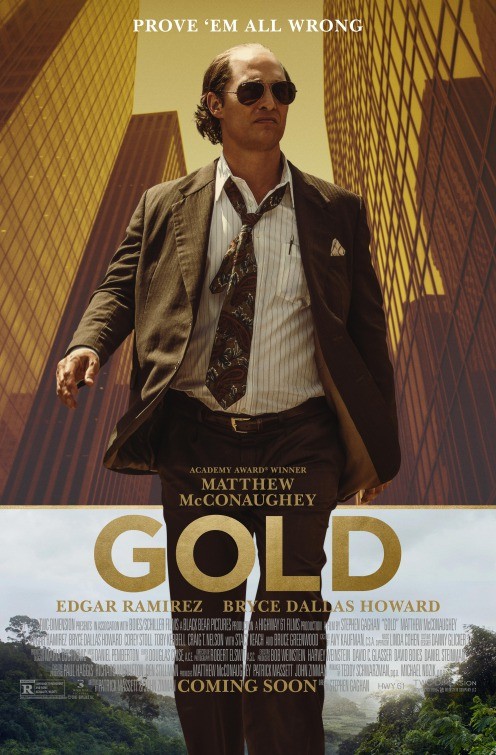
Loosely based on actual events, Gold tells a fascinating story about a down-on-his-luck gold prospector portrayed by the believably gruff Matthew McConaughey, but, unfortunately, the movie fails to meet expectations with its haphazard script. McConaughey plays the balding pot-bellied Kenny Wells who inherits struggling Washoe Mining based in Reno, Nevada after the death of his successful father and is looking for his big break. After working out of a bar where his girlfriend, played by Bryce Dallas Howard, is a waitress, he has a dream of having a successful mine in the jungles of Indonesia. He decides to travel to Indonesia where he devises a plan with a desperate geologist named Michael Acosta, portrayed by Édgar Ramírez. They set the groundwork for a mine deep in the remote jungle on a shoestring budget raised by friends and small investors back in Reno. After months of finding nothing, Acosta finally discovers traces of gold and exuberantly informs Wells who has been suffering from malaria. Thinking that they hit it big time, the rest of the film follows McConaughey’s character as he raises additional funds and is courted by Wall Street. However, his overnight success strains his relationship with his longtime girlfriend. Eventually, his company is listed on the New York Stock Exchange, and many analysts predict that he has discovered the largest gold deposit of the decade, worth almost 30 billion dollars. His life has finally on an upward trajectory, but the viewer is aware that something is amiss because the film flashes forward to the late nineties as he is being investigated by the FBI. Due to outside circumstances, including the actions of the authoritarian Indonesian government, and tensions with his partner Acosta, everything seems to go wrong for the briefly successful Wells. The movie’s major flaw is that the plot is all over the place, and there is an obvious lack of suspense or excitement for such an intriguing story about gold prospectors. Overall, I found it to be a surprisingly dull film that wasted a very strong performance from Oscar winner Matthew McConaughey who physically delved deep into the character.

Patriots Day

From Peter Berg who directed 2013’s Lone Survivor and 2016’s Deepwater Horizon, Patriots Day is a well done procedural drama that follows the events of the Boston Marathon bombings in April 2013 and provides insight into the many men and women who were victims as well as those investigating and capturing the culprits. The events leading up to, during, and after the terrorist attack are shown from the perspective of the fictional Boston Police Department Sergeant Tommy Saunders, portrayed by Boston native Mark Wahlberg. The movie captures the Boston Strong attitude when all of Boston came together during an especially trying time, and one way the filmmaker does this is by casting real Bostonians as extras. Much of the movie revolves around finding out what happened and how to pursue the bombers. The local officials, including the Boston Police Commissioner Ed Davis portrayed by John Goodman, Boston Mayor Thomas Menino, and Massachusetts Governor Deval Patrick, have initial investigative differences, typical of most Hollywood depictions, with the federal government represented by FBI Special Agent Richard DesLauriers, played by Kevin Bacon. Underscoring patriotism and the desire to seek justice, the filmmaker shows many of these characters working together to arrest and capture the Tsarnaev brothers whose free reign terrorizes the entire city of Boston. Free of excessively gruesome imagery of the actual attacks, the film attempts to focus on the emotional aftermath and vividly retrace what happens over the course of the days that follow until those responsible are no longer a threat. The power of the movie is visualizing the events for the viewer even though most Americans already know many of the details. Overall, I found it to an effectively somber and emotional film that shines a light on terrorism and how authorities are able to tackle such a timely issue in a humane and thorough manner.

The Founder

Directed by John Lee Hancock who is best known for 2009’s The Blind Side, The Founder is an entertaining film that tells the fascinating true story of the great American icon known as McDonald’s. Oscar-nominated actor Michael Keaton gives a strong performance as Ray Kroc, a desperate businessman from Illinois who helped transform McDonald’s into a billion-dollar global corporation. We first meet Kroc in 1954 working as a traveling salesman for a milkshake maker manufacturer and hoping to break through in the business world while supporting his wife played by Laura Dern. Eventually, he ends up in San Bernardino, California where he discovers a small pioneering fast food restaurant owned and operated by the McDonald brothers, the older Mac played by John Carroll Lynch and the inventive Dick played by Nick Offerman. Ray Kroc will do anything to get a piece of the McDonald’s pie and will ultimately use questionable tactics to take advantage of the two hard-working brothers already satisfied with running a single successful restaurant. Providing a remarkably fast and efficient method never used before to serve hamburgers, the McDonald’s innovative fast food model inspires Kroc to convince the brothers to franchise the restaurant across the nation. Kroc becomes increasingly hostile to the largely naive founding brothers who are hesitant to give more control to their new partner. To get around the original contract and make more money, he devises a plan to purchase the real estate of each franchise and form a company exerting more control over McDonald’s. The movie effectively illustrates the corrupting influence of money by depicting Ray Kroc towards the end as a conniving character unsympathetic to the true founders of McDonald’s and even to his own wife who stood by his side. Through the alluring performance of Michael Keaton, the viewer is given a glimpse into the largely unseen side of such an iconic brand and a man who has become known as the founder of McDonald’s. Overall, I found it to be a highly compelling film about a complicated figure in the seemingly mundane fast food world and leaves the audience with a disillusioned view of the Golden Arches.

Hidden Figures

Based on a true story, Hidden Figures is a well-crafted inspirational film about a group of women who contributed significantly to the early American space program despite facing intense discrimination. Set in 1961 as the nascent NASA attempts to send the first American into space, it follows three African-American female mathematicians working at the Langley Research Center in Hampton, Virginia tasked with computing the flight trajectories of manned spacecraft. Due to the discriminatory norms and laws of the time, they were forced to work in a segregated division where it was practically impossible to move up the career ladder. Eventually, the main protagonist Katherine Goble Johnson, a brilliant mathematician played by Taraji P. Henson, breaks the color barrier by being permitted to work at the Space Task Group led by the tough director Al Harrison portrayed by Kevin Costner. She was allowed access out of necessity in order to catch up with the rapidly advancing Soviets who were the first to send a satellite and human into space. At the same time, the movie shows the struggles of Mary Jackson, portrayed by Janelle Monáe, who fights for her education to become an engineer, and Dorothy Vaughan, played by Oscar winner Octavia Spencer, who wants to be treated as an equal as a supervisor at NASA. Helping to round out the characters, the film also presents the women’s personal lives and how they cope with the immense pressures they experience at their stressful yet important jobs. Their vital contributions that ensure the safety of such astronauts as Alan Shepard and John Glenn seem to be readily dismissed simply because of their skin color and gender. Overall, I found it to be a must-see movie that provides an uplifting and historically relevant glimpse into the largely unknown role of African American women in such a quintessentially American success story as putting a man in space.

Fences

Based on the Pulitzer Prize-winning play written by August Wilson in 1983, Fences is an acting tour de force that powerfully evokes the ups and downs of being a working-class African American family living in 1950s Pittsburgh. Directed by Denzel Washington, the main protagonist named Troy is a middle-aged African American working as a trash collector and is brilliantly played by Oscar winner Denzel Washington. Oscar-nominated actress Viola Davis plays Troy’s stay-at-home wife who dutifully adores her husband despite his personal indiscretions. Similar to its original source material as a Broadway play, the movie has one primary setting, and the majority of the scenes are emotional conversations between the characters, with very little action. The film does a brilliant job of portraying the intrinsic struggles of being black and poor at a time when Jim Crow laws were still on the books. Washington’s character must deal with the responsibility of raising children from different women and must face his personal demons in his relationship with his strong-willed wife. Consequently, the movie delves into what it means to be a father and husband living in a society full of institutional discrimination. Troy uses tough love on his teenage son in order to teach him a lesson and ensure that his son leads a better and more productive life than he was able to accomplish. Overall, I found it to be a terrifically executed dramatic film that exposes the viewer to largely alien life experiences, reinforced through nuanced yet profound acting performances.