Directed by Robert Zemeckis who is best known for the 1994 Academy Award-winning film Forrest Gump, Allied takes an unusual twist on the World War II-set Hollywood blockbuster by making it a predominantly romantic movie. The film starts in Nazi-controlled French Morocco in 1942 where we meet a Canadian intelligence officer, played by Brad Pitt, who is on a secret mission to assassinate a high-ranking German official. As part of his cover, he works closely with a beautiful French Resistance fighter, played by the Oscar-winning French actress Marion Cotillard. Eventually, they fall in love and get married after moving to London several months after their operation. Besides the constant bombardment of London from German bombers, the couple leads a rather normal life and even become parents to a daughter amidst an air raid. However, things begin to go awry after Pitt’s character is informed by his British military intelligence boss that his beloved wife may in fact be a Nazi spy. Extremely wary of what he is told about the woman he loves, he breaks protocol and decides to take matters into his own hands by personally uncovering the truth. Over the course of the movie, there are several thrilling scenes resembling a traditional war film, especially during their mission and the bombing of London, but, at its heart, it is a love story. Although with much higher stakes, it is essentially about times when one’s relationships are tested and who can one really trust when several allegiances overlap. Undoubtedly two good-looking people who are international superstars, Brad Pitt and Marion Cotillard lend the film a certain quality of sexiness, which makes their on-screen chemistry even more appealing. Overall, I found it to be an enjoyable cinematic experience that was surprisingly more of a romance than I expected from a movie about German spies at the height of World War II.
Drama
The Edge of Seventeen
Starring Oscar-nominated actress Hailee Steinfeld, The Edge of Seventeen is a surprisingly good coming-of-age movie about a teenage girl facing the typical pitfalls of an American highschooler. Steinfeld plays an insecure seventeen-year-old named Nadine who feels overshadowed by her handsome and popular older brother and has only one true friend. Like most teenage comedies, the film follows the often awkward and, in retrospect, laughable experiences that a typical teenager goes through in average American society. Feeling like she has no place especially after experiencing a personal tragedy several years prior, she tries to fit in with her high school peers by trying to become popular while grappling with her social awkwardness, sexuality, and emotional instability. Throughout the film, she turns to her rather dour yet ultimately motivational history teacher, portrayed by Woody Harrelson, who almost begrudgingly gives her advice on life, with a realistic perspective. She is unable to truly connect with her mother, played by Kyra Sedgwick, who seems to favor her older brother and has her own personal problems to deal with following the family tragedy. Nadine is particularly upset after she learns that her best friend is dating her brother and her crush appears to be completely oblivious to her existence. She appears to take actions that are completely out of her character as a means of coming to terms with her complicated life. Towards the end of the movie, she comes to a better realization of who she is and develops an unexpected bond with a fellow classmate. Overall, I found the film to be much more than your typical high school comedy as a result of its stellar performances and terrifically original screenplay. As other critics have remarked, it is strikingly similar to the classic 1980’s John Hughes films, including Sixteen Candles and The Breakfast Club, and breathes new life to the teen angst comedy drama genre.
Loving

From well-known independent movie director Jeff Nichols who directed 2012’s Mud and 2016’s Midnight Special, Loving is a subtle yet beautiful film based on the amazing true story of one of the most important civil rights victories of the 20th century. It follows an interracial couple, Richard and Mildred Loving, from the small town of Central Point, Virginia who were married in 1958 but faced legal trouble for being married in a state that forbid interracial marriage. As emphasized by the understated performances of Joel Edgerton who plays Richard and Ruth Negga who plays Mildred, the poor and largely uneducated couple were simple country folks who just wanted to spend time together as a married couple. Due to the law in Virginia, they were almost immediately arrested and thrown in jail after they married in Washington, D.C. where interracial marriage was legal. The extremely unsympathetic local sheriff and judge ordered them to leave the state or face long imprisonment. As a result, they settled in an impoverished neighborhood of Washington, D.C. where they raised their three children. Eventually, after several years, Mildred feared for the safety of her children, and the family surreptitiously moved back to Virginia to be nearby their extended relatives. Hiding away from authorities, the ACLU got involved and hired a team of lawyers to overturn the anti-interracial marriage laws. Through their efforts, the Supreme Court decided in their favor in 1967 and resulted in the legalization of interracial marriage throughout the entire nation. The film was remarkably effective in showing the quietly affectionate and humble couple by following a slow and subdued plot line. Both characters really did not speak much and were hesitant to take legal recourse because it would complicate their lives. The nuanced acting performances gave the audience the impression that this was a couple in great pain and cared for nothing more than sharing their love with one another. Although it revolved around a landmark civil rights case, the filmmaker made the movie less of a legal drama and more of a character study about unquestioned yet, at the time, rather unusual love. Overall, I found the film to be an emotionally powerful cinematic experience that tells a truly historic story about overcoming racial injustice. It especially resonates with contemporary audiences since it follows the equally significant Supreme Court decision to legalize same-sex marriage as well as the continued racial friction in the United States.
Backdrop

Richard Perry Loving was born in 1933 to impoverished white parents in Central Point, Virginia, and Mildred Delores Jeter Loving was born in 1939 in the same small town to parents who were of mixed African American and Native American heritage. After Mildred became pregnant at the age of 18, they married in Washington, D.C. in June 1958 but were arrested a few weeks later in July after returning to Virginia where interracial marriage and cohabitation was outlawed under the Racial Integrity Act of 1924. They received a sentence of one year in jail in early January 1959, the sentence was suspended for 25 years if they moved out of the state. They lived the next several years in Washington, D.C. with their three children Donald, Peggy, and Sidney. Tired of being far away from their family and the difficulties of living in the city, Mildred wrote a letter in 1964 to Attorney General Robert F. Kennedy who referred them to a team of American Civil Liberties Union lawyers led by Bernard S. Cohen. After years of unfavorable judgments and appeals in Virginia and federal court, the United States Supreme Court led by Chief Justice Earl Warren on June 12, 1967 overturned the 1883 decision Pace v. Alabama and ruled that so-called anti-miscegenation were unconstitutional. At the time of the ruling, Virginia along with fifteen other Southern states had laws forbidding interracial marriage. The landmark case Loving v. Virginia became the legal precedent for the more recent same-sex marriage court cases, including Obergefell v. Hodges decision in 2015 that legalized it nationwide. Neither of them would live to see their legacy because Richard died at the age of 41 in 1975 following a traffic accident with a drunk driver, and Mildred died at the age of 68 in 2008 from pneumonia.
Arrival
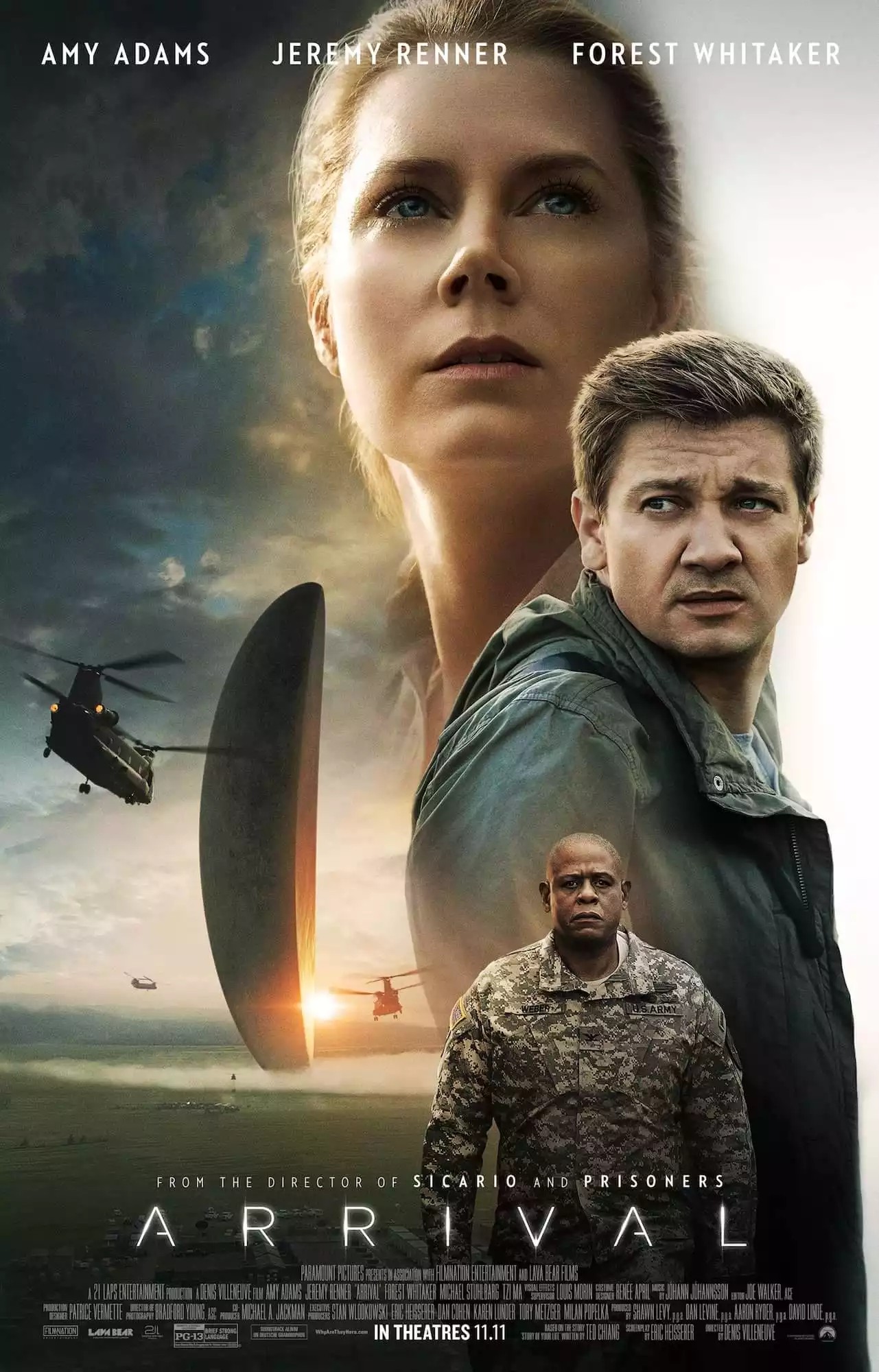
From Denis Villeneuve who directed 2013’s Prisoners and 2015’s Sicario, Arrival is a brilliantly crafted intelligent sci-fi film that heavily relies on terrific performances rather than over-the-top fantastical CGI. Played by the two-time Golden Globe winner Amy Adams, Louise Banks is a linguistics professor tasked with the unusual role of communicating with aliens who have mysteriously landed twelve spacecraft across the world. Not knowing whether they are peaceful or hostile visitors, a global panic ensues, and the United States government and other nations must figure out how to proceed without provoking war. Dr. Banks along with a team of experts, including a theoretical physicist portrayed by Jeremy Renner, are recruited by Forest Whitaker’s character, a U.S. Army Colonel, to unearth the extraterrestrials’ intentions. Working through her own personal issues, Dr. Banks must face the alien creatures and interpret their language with the aid of complex mathematical and scientific computations. The film underscores the mysterious circumstances by setting the floating crescent-shaped spacecraft that arrived on American soil in the eerily quiet Montana countryside where a temporary military outpost is established. It is smart sci-fi that delves into somewhat plausible scientific details and the often overlooked important implications of the linguistics academic field. Dr. Banks uses her esoteric knowledge to come to understand the aliens and try to prevent the world’s fearful militaries from embarking on a cataclysmic war possibly resulting in the extinction of the human race. Without spoiling the mind-blowing plot, the further along she gets in her extraterrestrial interactions the stranger things get for her. The movie’s thought-provoking material reminded me of such sci-fi films as 1997’s Contact and 2014’s Interstellar. Like those sci-fi flicks, the audience leaves the theater thinking about what really happened and tries to warp their mind around the deeply philosophical issues that it provokes. Overall, I found it to be one of the more noteworthy sci-fi films in recent memory because it went beyond simply providing mindless action like most Hollywood blockbusters. It was full of superb acting and masterful elements of mystery and intricate science fiction based on real science and fields of study.
Moonlight
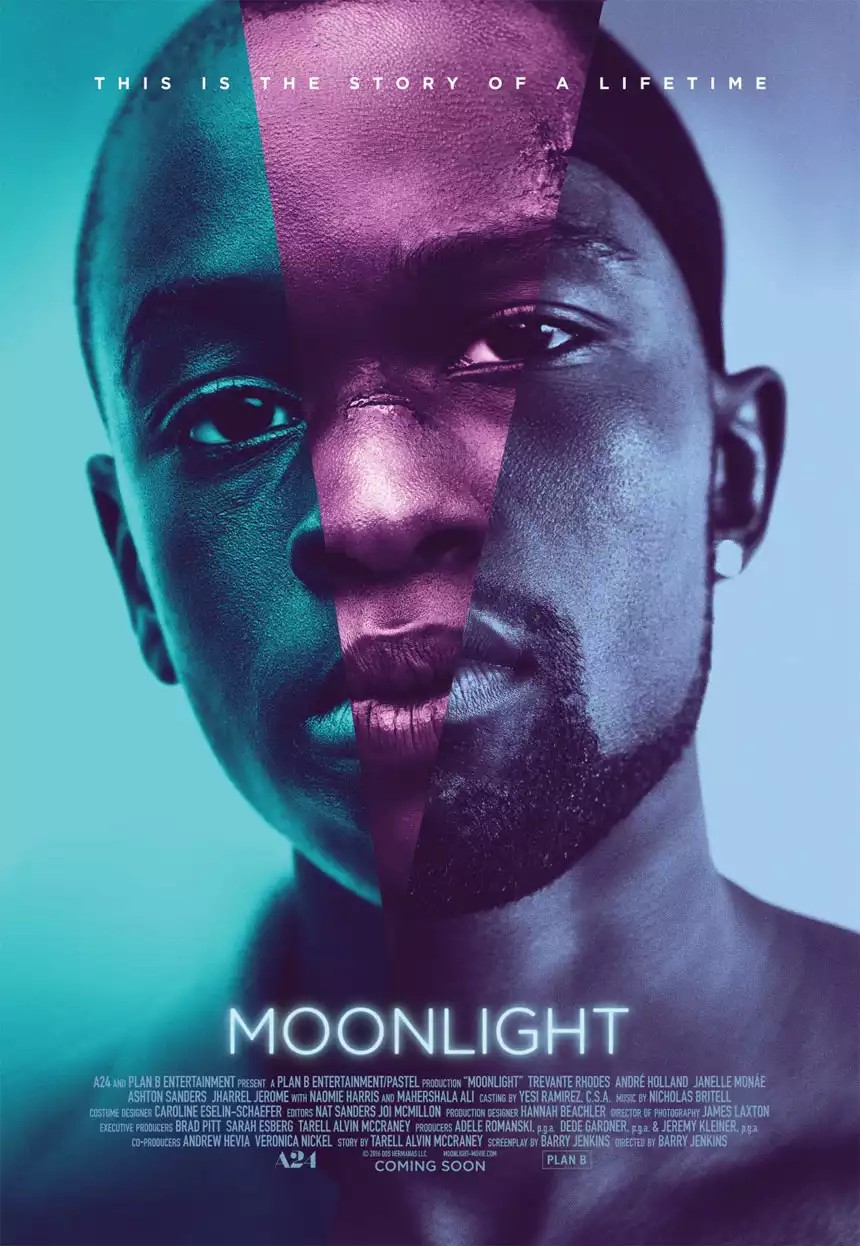
A truly unique cinematic achievement, Moonlight is a remarkably powerful film anchored by mesmerizing performances that heartbreakingly convey the extreme hardships of a struggling young man in the slums of Miami. Divided into three distinct parts, the movie is comprised of a series of vignettes following the main character Chiron as he grows up as a black child living in extreme poverty with a drug-addicted mother, played by the dynamic Naomie Harris. We first meet him as a shy child trying to find his place on the tough streets of Miami and eventually finds a father figure in a local drug dealer. Played by Mahershala Ali of House of Cards fame, Juan is a black Cuban who, although a drug dealer that supplies drugs to Chiron’s mother, treats Chiron with great care and respect. Juan takes him under his wing and teaches him how to survive on the streets in addition to more fatherly things like how to swim. Throughout the course of his life, Chiron must cope with living rather independently without a present father and with a self-destructive mother. The next part follows Chiron as a teenager who must deal with violent bullies at school and questions himself as a homosexual surrounded by a hyper-masculine culture. He begins to fall in love with a classmate he has grown up with who is also secretly gay. The final chapter flashes forward almost a decade at a time that Chiron tries to make a life for himself and largely patterned after Juan. However, after encountering someone from his past, portrayed by André Holland, he begins to come to terms with who he really is and is faced with changing his life for the better. What makes the film so special is the filmmaker’s evocative storytelling that makes the audience empathize with a young black gay man growing up in an impoverished crime-ridden American neighborhood. It is a vastly under-represented story in the media and entertainment industry that needs to be told. From a cinematic perspective, the movie is beautiful shot and full of richly dramatic scenes that linger in raw emotion heightened by terrific acting. It feels very much like an independent film that does not rely on big action and creates a reflective atmosphere partly through its use of a subtle yet operatic-like musical score. Overall, I found it to be a transcendent movie with the capability of changing people’s views on the especially timely social issues facing black America and those struggling largely in the dark against unimaginable odds. The film is by far one of the best of the year and is worthy of Oscar buzz for its sheer filmmaking brilliance.
Desierto
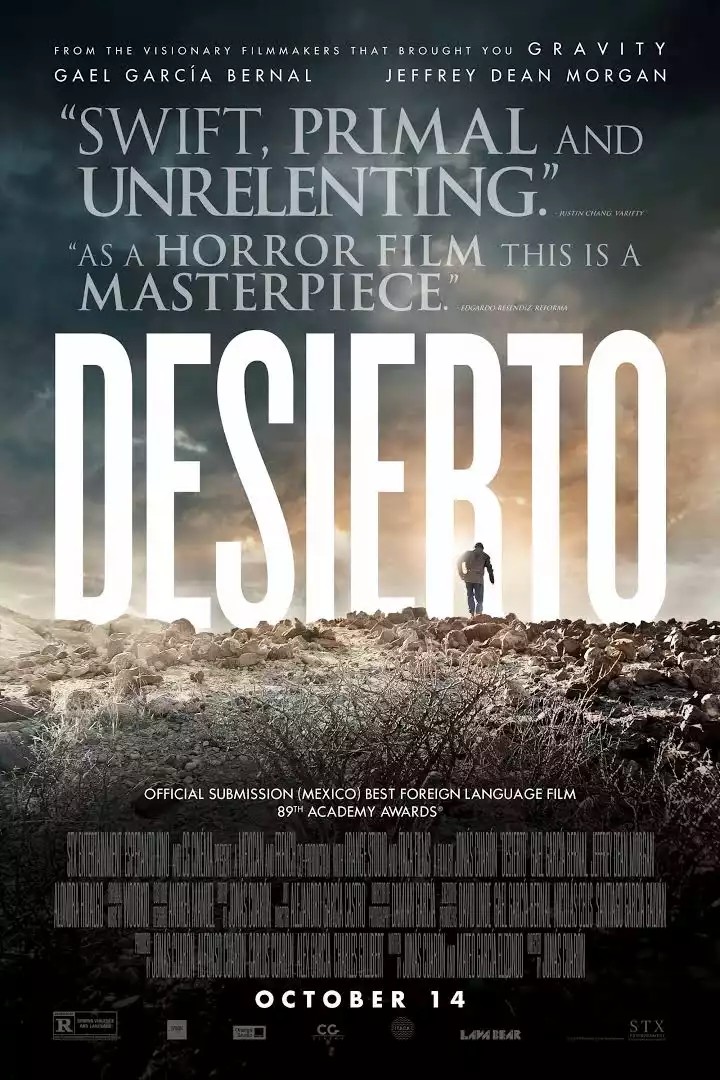
Written and directed by Jonás Cuarón and produced by his father Alfonso Cuarón best known for directing 2013’s Gravity, Desierto is a thriller movie with a rather unusual twist of having an indirect yet unsubtle undercurrent of immigration politics. It revolves around a group of undocumented immigrants who attempt to cross the border into the United States but encounter an unexpected sinister obstacle. After their smugglers’ truck breaks down in the Mexican desert, the fourteen migrants are forced to take the treacherous trek through the desert while avoiding the Border Patrol. Once they have just crossed into America, all of a sudden, shots ring out and several immigrants in the group are gunned down. The shooter turns out to be a psychotic racist, played by Jeffrey Dean Morgan, who takes matters into his own hands by systematically hunting down undocumented immigrants as if they are animals. Eventually, the survivors are led by a man, portrayed by Gael García Bernal, desperately trying to return to his family in California. The film is basically one long chase scene between Morgan’s character with his vicious hunting dog named Tracker and the random unarmed men and women he feels justified murdering in cold blood. Although extremely exaggerated, Morgan’s character represents the staunchly xenophobic anti-immigrant fringe element in American society. He does not see the migrants as humans simply striving for a better life but rather as stray animals who must be put down. However, poetic justice is served at the end when the tables are finally turned on Morgan’s character. The film is especially timely given the fact that anti-immigrant rhetoric is at a all time high during this particularly divisive election season. Overall, I found the best part of the movie was its atypical and thought-provoking premise regarding such sensitive issues as immigration and racism. It did provide an adequate amount of simple thrills to create a sense of terror for unsuspecting people on an already perilous journey.
Hacksaw Ridge
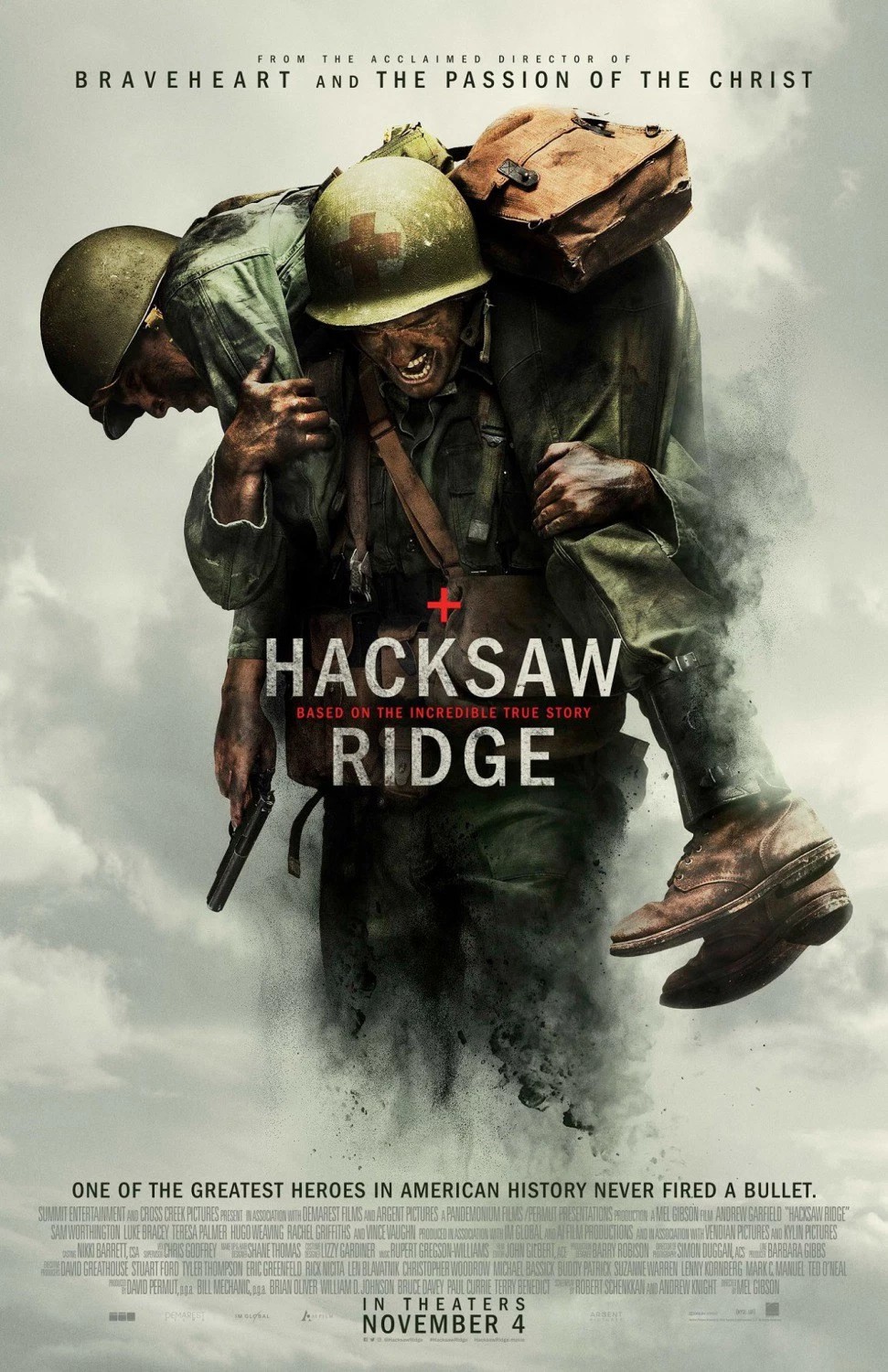
Directed by Mel Gibson in his first movie since 2006’s Apocalypto, Hacksaw Ridge is a tremendous World War II movie that is remarkable both for its brutally realistic depiction of war and powerful story of heroism. It is based on the true life story of Desmond Doss who served in the Pacific Theater as a combat medic and was distinct for refusing to carry a weapon of any sort. Growing up in a working-class family in Lynchburg, Virginia, Doss, portrayed by the baby-faced Andrew Garfield, had a difficult childhood but always maintained deeply-held religious convictions as a Seventh Day Adventist. The first part of the film is primarily focused on his life back at home before he enlisted in the army and includes his falling in love with a local nurse named Dorothy. It also revealed his often tense relationship with his drunk and abusive father, played by Hugo Weaving, who clearly suffers from post-traumatic stress as a World War I veteran. Although his faith taught him to be nonviolent, Doss enlisted in the military to serve the United States like his fellow countrymen and eventually was deployed with the 77th Infantry Division in 1944. However, while at boot camp where he meets his initially unsympathetic sergeant, played by Vince Vaughn, he is scorned by his fellow soldiers and commanding officers for his pacifist stance. Ultimately, he is granted conscientious objector status and allowed to serve as a medic without ever touching a rifle. The second part of the movie is much more gritty and does not hold back on showing the truly hellish parts of warfare. It follows Doss and his regiment in May 1945 as they attempt to take control of an area of the Japanese-controlled island of Okinawa, simply referred to as Hacksaw Ridge. At times, the very extended sequence of extremely graphic combat violence is difficult to watch but is very much necessary to underscore the horrific costs of war. Throughout such intense scenes, Desmond Doss is portrayed as the epitome of courage: he voluntarily goes in harm’s way to save as many lives as possible without a means of defending himself. He must literally rely on his fellow soldiers for his life and, in the process, develops an unbreakable bond of brotherhood. His heroism was richly rewarded when he became the first conscientious objector to receive the Congressional Medal of Honor from President Harry Truman. Overall, I found the film to be one of the best war movies made and the horrifically gruesome battle scenes reminded me of Saving Private Ryan. Besides simply presenting a skillful portrayal of warfare, it has a heartfelt message about courage and the struggle between a person’s conscience and patriotic duty. For all his personal flaws, Mel Gibson is finally back to form and gives us a film worthy of Braveheart.
Backdrop

Born in 1919 in Lynchburg, Virginia, Desmond Doss was drafted in April 1942 and worked in a naval shipyard in Newport News before serving as a combat medic in an infantry unit. Although he could have received a deferment as a conscientious objector, he was deployed with a rifle company in the 1st Battalion, 307th Infantry, 77th Infantry Division and sent to the Pacific Theater, first to Guam and the Philippines before eventually arriving on Okinawa in May 1945. He participated in taking the 350-foot high Maeda Escarpment, ominously referred to as Hacksaw Ridge, a heavily fortified part of the vitally important island of Okinawa. The three-month campaign collectively known as the Battle of Okinawa resulted in over 12,000 American deaths and more than 75,000 Japanese deaths on top of the upwards of 150,000 civilian casualties. Okinawa was only 340 miles off the Japanese Mainland and therefore could serve as a crucial air base for an Allied invasion.

During the course of the battle over the Ridge, Desmond Doss is estimated to have saved the lives of 75 soldiers, all without touching a single weapon or killing any Japanese. Throughout the war, he was injured at least three times and lost five ribs and a lung as a direct result of contracting tuberculosis on the island. He was also largely deaf for more than twelve years as a result of doctors accidentally giving him an overdose of antibiotics. Following the war, he spent five and a half years recuperating at various times in VA hospitals and was eventually discharged in 1951. He spent the remainder of his life primarily in Georgia and Alabama where he grew his own vegetables on a farm with his wife Dorothy who he was married to from 1942 until her death in 1991. In 1993, he married his second wife Frances and together until his death in 2006. He died in Piedmont, Alabama at the age of 87 due to respiratory complications associated with his tuberculosis. For his service, he was awarded the Congressional Medal of Honor on October 12th, 1945 by President Harry Truman, which made him the first conscientious objector to receive the honor and remains to this day only one of three to have ever received it.

American Pastoral

Based on the Pulitzer Prize-winning novel published in 1997 by acclaimed author Philip Roth, American Pastoral tells a fascinating story that, unfortunately, does not live up to its evocative subject matter by being mired in too many complexities. The film is the directorial debut of Ewan McGregor who also plays the main protagonist Seymour “Swede” Levov, a former high school star athlete turned successful businessman whose life is turned upside down after the radicalization of his daughter. Set in 1960s New Jersey, he lives a relatively normal life in small-town America with his beautiful former beauty pageant wife, portrayed by Jennifer Connelly, and runs his father’s glove-making business in Newark. Nothing seems wrong with his daughter except for a persistent stutter, but things radically change as she becomes a teenager. She quickly develops an extremely liberal political consciousness and rails against the Vietnam War and racial injustice. Depicted by former child actress Dakota Fanning, the daughter Merry is much more than a typically rebellious teenager after she mysteriously disappears and is implicated in the bombing of a local post office. Interspersed with archival footage of race riots and violence perpetrated by radical groups such as the Weather Underground, the movie rather haphazardly attempts to touch upon every civil rights issue of such a turbulent time as the 1960s. It also wants to show the profoundly devastating effects that having a possibly criminal child has on a family. The whole situation is particularly upsetting for Seymour, a good-natured and responsible father who believed he raised his child the right way. McGregor does give a fairly good performance as a grief-stricken father searching for answers and the whereabouts of his beloved yet troubled daughter. Overall, the film misses the mark by squeezing way too many details and storylines to make it a cohesive and even coherent cinematic exploration of important matters on life and societal ills. It had the potential of being a movie powerfully evoking the zeitgeist of the 1960s but largely fell short possibly due to the rookie directorial mistakes of the otherwise talented actor Ewan McGregor.
Certain Women

From the critically acclaimed independent director Kelly Reichardt, Certain Women is a very subdued independent drama that follows the lives of three women living in Montana. The film is definitely not for everyone because it is very much an artsy performance-driven movie whose plot is very slow pace and melodramatic. It is separated into three acts in which the characters really do not intersect besides their stories taking place in and around the frontier town of Livingston, Montana. The first story follows a lawyer played by Laura Dern who is representing a local man going through a particularly difficult time after suffering a work-related injury. Her character is eventually enlisted to get her increasingly desperate client out of a hostage-taking situation. Rather abruptly, the film shifts to the next story, which revolves around a husband and wife played by Michelle Williams trying to build their own house. There is some apparent tension between her character and their daughter who is increasingly resentful of living in a tent as they gather construction supplies. Williams’ character drives a hard bargain with an elderly man who is in possession of a stockpile of sandstone they want for the house. Finally, we meet a young Native American ranch hand, portrayed by Lily Gladstone, living by herself in the middle of nowhere as she tends horses. Like all the other female protagonists, she feels very isolated and depressingly lonely and tries to find a way to connect with others. She begins to develop a fondness for a young lawyer played by Kristen Stewart who teaches a local class about education law. In what could be best described as the movie’s epilogue, the filmmaker briefly revisits each of the stories to reach some semblance of a resolution, albeit rather open-ended. Overall, I appreciated the ability of the filmmaker to weave three slightly connected stories of strong-willed everyday working women against a rather bleak yet beautiful background of rustic Montana. Definitely requiring an acquired taste, the film feels more like a poem reflecting on ordinary life and isolation and is not like your typical narrative film.
A Man Called Ove

Based on a 2012 best-selling Swedish novel, A Man Called Ove is a well-crafted darkly funny movie with a powerfully bittersweet message about the loss and unexpected discovery of love and friendship. Brilliantly portrayed by the Swedish actor Rolf Lassgård, Ove is a grumpy old man who lives alone in a suburban development where he tries to strictly control the homeowners association. He rarely associate with his neighbors but, when he does, he is usually reprimanding them for various relatively small infractions. With the arrival of an Iranian immigrant and her Swedish family in the close-knit community, things begin to change for the extremely guarded and unfriendly Ove. The film shows how he became such a curmudgeon by flashing back to his challenging past when he had some semblance of happiness with his wife. In morbidly humorous fashion, he reflects on his earlier life during his absurdly unsuccessful suicide attempts, which are largely interrupted by his new well-intentioned neighbors. Through the course of the movie, the viewer comes to sympathize with Ove who is largely the way he is because of profound grief he experiences ever since his beloved wife’s death. His Iranian neighbor develops an initially unwanted close relationship with him and helps him come to grips with the loss of his true love. Eventually, they become friends, and he learns from her to be a better neighbor and overall person. The film is so effectively able to be endearing due to its remarkable balance between moments of sentimentality and comedy, all without being an overly melodramatic depiction of grief. Overall, I found it to be a very refreshing movie attesting to the goodness of human nature while keeping the audience entertained through its rather dry sense of humor. It is another superb example of why foreign language films with subtitles should not be so readily disregarded by popular audiences; you will sorely miss a great movie full of powerfully uplifting emotions.