War Dogs

From the director of The Hangover series, War Dogs tells the fascinating true story of a pair of twenty-somethings who become arms dealers for the United States military. Returning to his hometown of Miami, Efraim Diveroli, portrayed by Jonah Hill, recruits old childhood friend David Packouz, portrayed by Miles Teller, in a new rather ill-repute yet legal business venture. With the movie being primarily from his perspective, Packouz is in a dead-end job and desperate for money at first hesitates to partner with his estranged friend. However, eventually he takes part in Diveroli’s ingenious scheme to bid on small military contracts for weapons, ammunition, and other equipment such as bulletproof vests, deals that the major defense contractors overlook. Essentially serving as middlemen, their company AEY makes them millionaires during the heyday of the Iraq War in 2006. After meeting a very shady character played by Bradley Cooper who seems to come straight out of American Hustle, they decide to hit it big time and eventually win a $300 million contract to provide weapons to Afghanistan. Diveroli playing fast and loose with the rules and laws catches up to them during the deal when they encounter unscrupulous individuals in Albania. They also face major repercussions with the United States military and government. Interestingly, the director whose claim to fame is comedies tries to make the movie entertaining with some comedic bits and an energetic soundtrack with even songs from Creedence Clearwater Revival. The tone shifts especially when the partners struggle with one another, and the film becomes more of a serious drama. Jonah Hill gives a terrific performance and at times channels his morally reprehensible and wild character from The Wolf of Wall Street. The movie itself reminded me of Nicolas Cage’s Lord of War in its depiction of arms dealers and The Wolf of Wall Street in its depiction of of a hedonistic and corrupt workplace. Overall, I found it to be an entertaining film with a serious undertone that delves into a deeply fascinating story that is truly stranger than fiction.
Backdrop

David Packouz (left) and Efraim Diveroli (right) at a Miami gun range

At the time they both got involved with AEY, the founder Diveroli was only 18 years old and Packouz was 23 years old. By the end of 2006, it is estimated they made $10.5 million off 149 Department of Defense contracts. Both men are now in their early to mid-thirties and were convicted and served time for conspiracy, fraud, and other felonies related to the Afghan arms deal. Diveroli spent 4 years in a federal prison following his 2011 conviction while Packouz spent seven months under house arrest. According to some people, they are no longer friends and are not on speaking terms. In fact, Packouz is suing his former partner over the money he never received from AEY; he claims Diveroli still has some wealth while he is on Social Security. Diveroli is currently suing the movie’s studio Warner Brothers for using his story without his permission and without being paid.
Florence Foster Jenkins

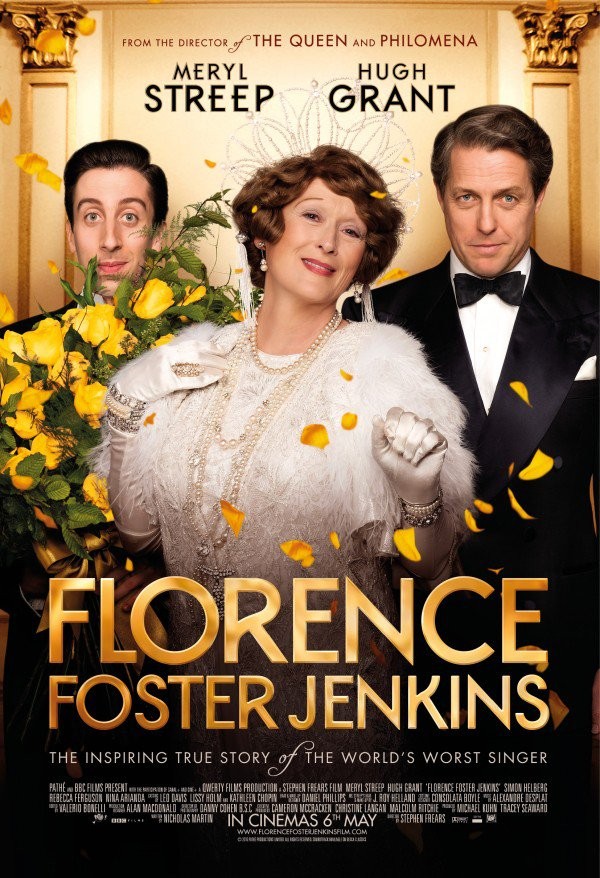
Directed by Stephen Frears who also directed The Queen and Philomena, Florence Foster Jenkins is a delightful film about a New York socialite who happened to be a terrible singer. Surrounded by enablers who simply wanted to profit from her wealth, Jenkins played by the always marvelous Meryl Streep tries to fulfill her dream of becoming a classical singer. Hugh Grant portrays her husband and British Shakespearean actor St. Clair Bayfield who encourages her passions while shielding her from critics knowing that she is not a great singer. His intentions are somewhat ambiguous: it is not readily apparent whether he is with her for her money or true love. The movie has charmingly funny interactions with bemused yet complicit professional vocal coaches and musicians, including her well-compensated pianist Cosmé McMoon played by Simon Helberg of The Big Bang Theory fame. Bayfield’s and others’ ruse runs amok when she books a public performance at Carnegie Hall with the naïve belief that she has the talent to sing at such a prestigious venue. Despite predominantly being a comedy, the film has a heartfelt undertone that supports one’s pursuit of a lifelong dream against all odds. The movie is particularly effective in conveying its high society 1940s New York setting with sumptuous costumes and elaborate sets. It feels especially nostalgic with its traditional film technique of a vertical line wipe transitioning from one scene to the next. Overall, I found the film to be an amusing and entertaining glimpse into a largely unheard of and rather unusual story of a woman with larger-than-life ambitions.

Backdrop

As part of a new addition to the blog, “Backdrop” will provide pertinent historical context and tidbits about the film reviewed.

Born in 1868 to a wealthy Pennsylvania family, Florence Foster Jenkins was a talented pianist who at a young age performed for President Rutherford B. Hayes at the White House. After her father refused to pay for her musical education, she left home and married Dr. Frank Jenkins in 1885. However, the relationship did not last long when she learned she had contracted syphilis from her husband. Syphilis may have been a contributing factor to her hand injury that prevented her from continuing to play the piano. In New York in 1909, she met St. Clair Bayfield, with whom she began a lifelong romance even though they never actually married. That same year, she received a large inheritance after her father passed away. She then pursued her singing ambitions in New York social clubs and eventually Carnegie Hall as portrayed in the film. The renowned composer and songwriter Cole Porter was a devoted follower of Jenkins and reportedly had to jab his cane into his foot so as not to laugh out loud during her performances. Several recordings of her singing were widely released by RCA Victor beginning in the 1950s, and several CD reprints have been produced since then. Only weeks after her famous Carnegie Hall debut in 1944, Jenkins died at the age of 76. She was survived by her beloved Bayfield who died in 1967.
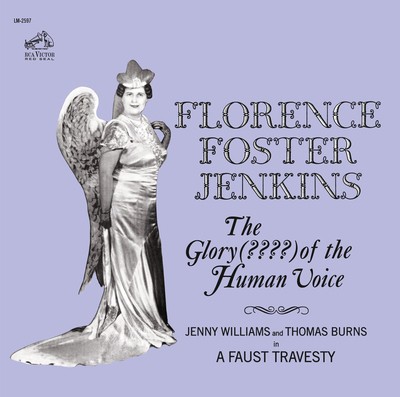
For an actual audio recording of her singing, check out the following link: https://youtu.be/qtf2Q4yyuJ0

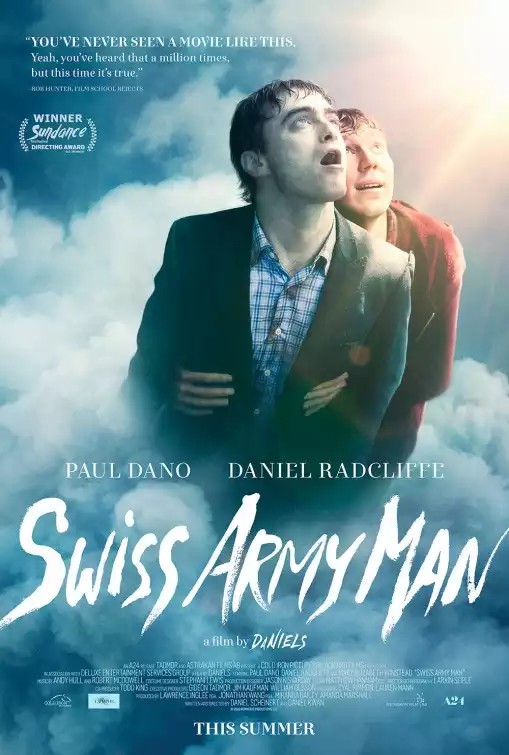
Swiss Army Man

Winner of the directing award at the 2016 Sundance Film Festival, Swiss Army Man is surely one of the strangest yet most creative movies that you will see this year and maybe even in your lifetime. The film has been known for audiences walking out in the middle who find the subject matter too absurd and disgusting. Despite this fact, it has still been applauded as one of the more unique and surprisingly captivating cinematic experiences. Paul Dano plays the despondent Hank who we first meet stranded on a desert island all by himself and about to hang himself. However, out of nowhere, he sees a corpse washing ashore that makes him decide against committing suicide. To his amazement, the body shows signs of life: it has persistent and explosive flatulence. Hank discovers that he can use the corpse’s gas to propel himself off the island and to an unknown densely forested land. He soon learns the body, which is portrayed by Daniel Radcliffe, possesses magical powers that allow for partial reanimation. Almost like a baby, the corpse named Manny begins to talk nonsense and must learn from Hank what it means to live. Having lost all hope and love in life, Hank teaching Manny the basics of living, including sexuality, becomes a cathartic experience. To better explain human interaction to Manny, Hank constructs elaborate sets resembling the real world from repurposed trash found in the forest. For instance, he replicates a bus where Manny supposedly first meets his true love Sarah, a fact that he cannot remember from before his death. Already peculiar enough that a corpse is talking, the movie gets even more bizarre in the ways that Manny becomes an “multi-purpose tool” for Hank’s survival. Rather repulsively, such things include a certain body part acting as a compass, his mouth pouring out freshwater, and his posterior shooting objects like a gun. Paradoxically, the film’s ludicrous premise does not prevent it from becoming an endearing story of friendship and what it truly means to be a human. The message is that one must continue to have hope even when it feels like all is lost. As such, Hank was able to discover the first real person that he could emotionally connect with and love, only after the lowest point in his life when he was contemplating suicide. Overall, I was surprised that a movie with such extremely ridiculous and downright perplexing  moments could be so full of meaning. I would recommend it to those looking for a truly distinct movie and can look past its gross-out surrealism.

Hunt for the Wilderpeople

A truly original comedy from New Zealand, Hunt for the Wilderpeople is an oddball adventure story about a juvenile orphan from the city named Ricky Baker, played brilliantly by the young New Zealand actor Julian Dennison. Bouncing from one foster home to another after committing various misdemeanors, Ricky finds himself adopted by an older couple living in the wilderness. He eventually develops an affectionate relationship with the effusive and doting Aunt Bella but finds difficulty get close to the grumpy and gritty Uncle Hec played by the always terrific Sam Neill. Clearly out of his element as a self-described gangster, Ricky gets lost in the “bush” with Hec, and they must find a way back home. All the while, a nationwide manhunt, led by the overly officious child welfare officer Paula and her dimwitted police companion, is underway for Ricky who is mistakenly believed to have been kidnapped by his adoptive uncle. The film evolves into a hilarious wild goose chase in which Ricky and Hec encounter truly “out-there” characters living in the wilds of New Zealand. The comic effect is reinforced by the absurdly over-the-top militaristic police force, especially the gung-ho antics of Paula. Besides being an uproariously good time of a movie, the film paints a rather endearing picture of a troubled orphan who is acting out as a form of crying out for help. After experiencing the adventure of getting lost, Ricky finally finds a semblance of family with Hec who teaches him how to survive in nature. Of indigenous New Zealand Maori heritage from the city, Ricky discovers familial love in the most unexpected place with Hec, a white backwoods curmudgeon. Overall, I would highly recommend the film and rank it as one of my favorite movies of the year. It would be almost impossible for a viewer to come away from the movie without a feeling of sheer delight: it has the perfect blend of humor and charm to create a genuinely memorable moviegoing experience.

The Shallows

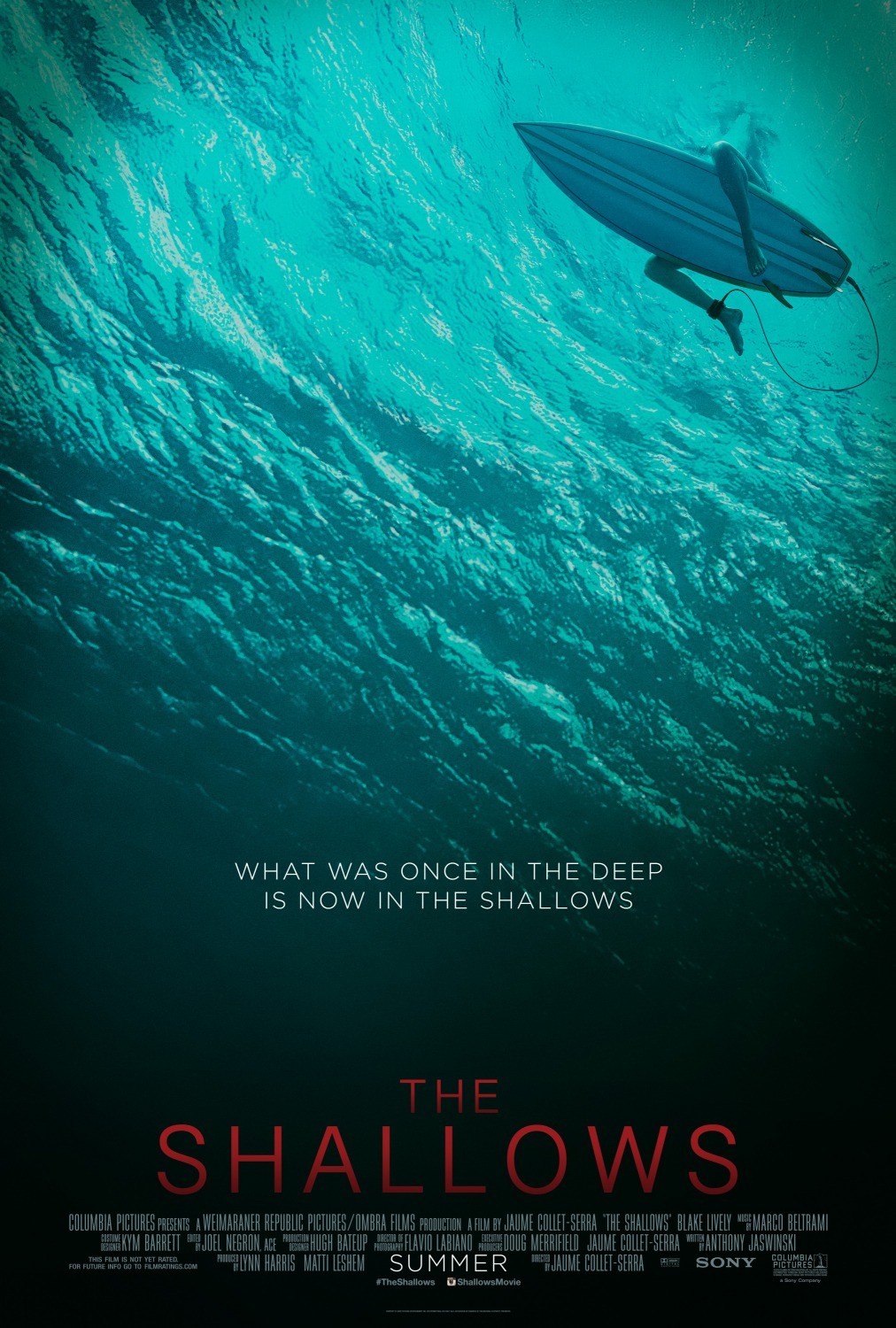
A surprisingly thrilling movie, The Shallows stars Blake Lively as an aimless surfer who must fend for her life from a great white shark. The film’s first 20 minutes or so is like any other surfing movie, complete with stunning action shots in a beautiful tropical setting. It starts with her being driven through a dense jungle to a secluded beach in Mexico. Along the journey, she converses with her local driver during the only major speaking part of the film. Through her conversation and a series of photos shown on screen as if on her cell phone, we learn that Lively’s character has always dreamed of visiting this particular beach because of her mother’s personal connection with it. When she finally gets in the water to catch some waves, palpable tension is created because we never know when the shark will inevitably attack. Nearing dusk and all alone, the telltale shark fin is spotted lurking near her and your mind unconsciously hears the theme music from Jaws. Much of the rest of the film, Lively’s character is trapped on a small outcropping of rocks only 200 yards away from the shore. She is forced to muster up the courage to devise a way of escaping her deadly predicament with the limited resources at her disposal. Its focus on a single individual figuring out how to survive reminded me of the movies Castaway and 127 Hours. The film is also obviously reminiscent of the all-time classic shark movie Jaws; in fact, it may very well be the best shark-themed movie released since Spielberg’s 1975 thriller. Like Jaws, a lot of the suspense is created without even showing the shark and even includes underwater shots seemingly from the shark’s perspective. However, there are a few brief shots of the shark actually attacking its victims with some gore. Going into the movie, I was expecting a cheesy B-movie that would not be able to overcome its inherently gimmicky premise of one woman on a rock versus one very hungry great white shark. However, I came away impressed with the film’s successful ability to create a very suspenseful and exhilarating cinematic experience, ultimately transcending its basic shtick.

Free State of Jones

image

Starring Academy Award winner Matthew McConaughey, Free State of Jones tells a truly fascinating overlooked true story of the American Civil War and Reconstruction in the South. McConaughey portrays Newton Knight, a larger-than-life figure who is still controversial to this day, who started a small uprising against the Confederacy in the rural Mississippi county of Jones. After enduring the bloody brutality of such battles as the Siege of Corinth in 1862, Knight deserted the Confederate Army and returned home to a dire situation. Many of the local poor white farmers were burdened with high taxes that deprived them of badly needed food supplies. Feeling targeted by the Confederacy and to escape prosecution, Knight hid in the swamp with escaped slaves and other deserters and eventually formed what would be known as the Knight Company. As the group grew with more disenfranchised farmers, they became surprisingly effective in repelling the Confederate authorities. However, General Sherman and the Union Army refused to help the group since they were perceived as simply a small group of bandits with no real power. The movie is unique in that it conveys an alternate message about the Confederate South: a thoroughly white Southerner like Knight has no qualms working with blacks and even fights for their rights during Reconstruction. Through the use of on-screen text giving historical context, the film gives an important historical lesson about the Civil War, its aftermath, and the suppression of black civil rights. The film’s only major drawback is that it tries to fit too much information into a relatively short amount of time. For instance, it almost randomly flashes forward 85 years to a trial when Knight’s descendant is questioned for committing the crime of interracial marriage. Such scenes help to tell the totality of racial discrimination in Mississippi. The movie would feel more coherent if it just focused on the Knight Company around the time of the Civil War. Matthew McConaughey gives an authentic performance as a gritty yet preacher-like rebel leader with a controversial personal life. Overall, I found the film intriguing for telling a noteworthy and powerful piece of history but whose storytelling could be more tightly woven.

Genius

image
Based on a true story, Genius follows the complicated relationship between the famed literary editor Maxwell Perkins played by Colin Firth and acclaimed novelist Thomas Wolfe played by Jude Law. Already a well-regarded editor at Scribner’s of such authors as F. Scott Fitzgerald and Ernest Hemingway, Perkins faces his biggest challenge of working with the often irksome Wolfe. First meeting in 1929, he agrees to edit Wolfe’s extremely long first manuscript of the novel Look Homeward, Angel, which had been rejected by all other publishing houses. The film provides a unique glimpse into the often unseen process of book editing and how it can be painstakingly difficult for both editor and author. Workaholics by nature, both men’s personal lives are adversely affected by their work. Perkins struggles to juggle his career with his family life, especially his wife played by Laura Linney, an aspiring playwright who feels underappreciated. Wolfe’s prodigious writing habits also alienates his love life with a married costume designer played by Nicole Kidman: his wild temperament provokes jealousy and neglect. After the first novel is published, Perkins faces an even greater challenge when Wolfe, who has become his friend in a albeit tumultuous relationship, presents him with literally crates full of his latest manuscript. Numbering about 6,000 pages and constantly added to by Wolfe, it takes more than two years to publish what would become the 1935 novel Of Time and the River. Filmed in grayer tones and with outbursts of ragtime-sounding jazz, the film accentuates the early 20th century setting and the characters’ emotional rollercoaster rides. Colin Firth’s performance evokes a rather straitlaced yet very talented office dweller who only takes off his bowler-style hat during particularly intense scenes. Jude Law is the polar opposite: he gives a manic performance of a uncouth, often drunk writer who happens to be one of the greatest novelists. Overall, the movie is fairly well done and tells a quite interesting story of the inner workings of the literary world and how genius often comes at a price. Complete with actual readings from Thomas Wolfe’s writings and cameos of Fitzgerald and Hemingway as characters in the storyline, the film should surely delight fans of great American literature.

Maggie’s Plan

image

Directed by Rebecca Miller, the daughter of famed playwright Arthur Miller and wife of Daniel Day-Lewis, Maggie’s Plan is the quintessential indie rom-com, reminiscent of a Woody Allen comedy. It stars Greta Gerwig as Maggie, an insecure control freak living in New York who decides to have a baby on her own in order to make up for her failed love life. As described by the film’s title, she wants her life to follow according to her exact plans. However, her set course in life is unexpectedly altered when she meets an anthropologist named John played by Ethan Hawke. Unhappily married to Julianne Moore’s character, a world-renowned Danish anthropologist at Columbia, John gets advice from Maggie about his new novel that he is struggling to write. Eventually, John, feeling underappreciated by his wife, and Maggie, grasping to a new love interest, begin a world wind romantic affair that ultimately leads to his divorce. Forced to take care of John and his children, Maggie does not feel in control of her life and so she develops a new plan. She confides in her close friends humorously played by Bill Hader and Maya Rudolph that she wants to reunite John with his ex-wife. Throughout the movie, the viewer is taken on an unusual journey marked by many elements of screwball comedy, including Maggie’s encounters with a “pickle entrepreneur.” A staple of independent comedies, Gerwig gives a nuanced and often very funny performance as a neurotic who absurdly tries to destroy her love life simply to completely control her life. Furthermore, Hawke and Moore help to round out the film with their witty depiction of academic intellectuals replete with occasional drama and charm. Evoking the movie’s screwball nature, many of the scenes are scored by the hallmarks of a Woody Allen comedy: the music sounds like old-time jazz that has a playful and energetic spirit. Overall, I would recommend the film to all fans of romantic comedies and those looking for a lively and smart independent comedy, making for an enjoyable time at the movies.

The Idol

image

Based on a true story, The Idol is a Palestinian film that tells the inspiring tale of Mohammed Assaf played by the Arab-Israeli actor Tawfeek Barhom. He overcomes the struggles of being a Palestinian living in the squalor of Gaza to become an international popstar after winning the second season of Arab Idol in 2013. The first half of the movie follows Assaf as a child when he forms a small music group with his sister and two close friends. Although pop music is frowned upon in their largely conservative society more concerned with survival, Assaf’s childhood band scrapes together whatever they can to follow their passion of playing music. Assaf perseveres to pursue a better life even in the midst of personal tragedy, poverty, and the threat of war. The movie’s second half fast-forwards to Assaf’s late teens and early twenties when he realizes that the new music competition television show Arab Idol, a recent offshoot of American Idol, may lead to his musical breakthrough. However, he discovers that as a Palestinian it will not be easy to even simply audition like other contestants. The harsh realities of Gaza are powerfully represented by the film juxtaposing bombed-out buildings and other images of decades-long warfare against the modern and glitzy television show. The rise of Assaf who eventually captures the hearts of all Palestinians against all odds is a potent message of inspiration. By following one Palestinian’s journey, the movie humanizes the tragic and complicated circumstances of the Middle East in a politically subtle yet evocative manner. It tells a remarkably uplifting story of how hope and perseverance can prevail over adversity and help fulfill one’s dreams. Overall, the film feels like a Palestinian version of Slumdog Millionaire, with its similar plot of an impoverished young man navigating the obstacles of a largely hostile environment to achieve fame through a television contest.

A Bigger Splash

image

Based on the 1969 French film La Piscine, A Bigger Splash is a very sensual drama that evolves into a slow-burn thriller full of seduction and deception. Tilda Swinton plays a famous David Bowie-esque rock star named Marianne recuperating from a throat surgery with her younger boyfriend Paul played by Matthias Schoenaerts on the Italian island of Pantelleria. Their tranquility is unexpectedly interrupted by the arrival of Marianne’s former lover Harry portrayed by Ralph Fiennes and beautiful young daughter Penelope portrayed by Dakota Johnson. What follows is a clash of personalities and love interests that starts amicably on the surface but eventually descends into darkness. A quintessential player with intoxicating energy and mischief, Harry stirs up the past, visualized through the film’s flashbacks to his troubled romance with Marianne. His intentions and reason for being there is left murky for much of the film. Further complicating things is Penelope, a Lolita-type character, who flirts with and tries to seduce the young and handsome Paul who has his own past demons. The movie creates a perfect atmosphere for the palpable tension percolating until literally splashing over at the plot’s climax. Pantelleria is a small volcanic island that, although stunningly beautiful, gives a rustic, almost ominous vibe with its dry and barren landscape. The rocky terrain reflects the increasingly rocky relationships between the four characters. As tensions escalate, the island is also beset by strong Sirocco winds and rainstorms. All at the same time, the score dramatically shifts into much more menacing music and finally with a operatic crescendo at the most intense scene. The film’s exploration of human desire and jealousy is accentuated by the terrific acting from the four principal actors. It is anchored by Tilda Swinton who exudes an otherworldly aura despite her character rarely speaking. Following his real life playboy reputation, Ralph Fiennes gives a raw performance as a hedonistic rabble-rouser living on the edge. The younger actors equally impressed, including Dakota Johnson who is ironically more sultry than her role in Fifty Shades of Grey. Overall, the film was a high-quality erotic thriller exhibiting the hallmarks of a foreign flick with a permissive attitude and emphasis on first-rate acting.