Life

Directed by Swedish filmmaker Daniel Espinosa, Life is a fairly typical ‘trapped in space’ sci-fi thriller that provides enough thrills and a creative twist on extraterrestrial horror to make for an entertaining film. Unlike most science fiction, the setting of the International Space Station instead of a futuristic spacecraft makes the storyline somewhat more plausible, as if it could take place today. The movie starts out with the six-member multinational crew making a significant scientific discovery of a small living organism recovered from Mars. However, the British biologist on board realizes the specimen is more than it seems and the Quarantine Officer, played by Rebecca Ferguson, must ensure that their discovery is kept contained in the quarantined laboratory as a result of the potential dangers. Ryan Reynolds’ character who is an American pilot for the space station risks his life in order to save the British biologist who is confronted with the very real dangers of the organism’s ability to cause harm. The specimen rapidly grows and becomes stronger in the presence of the oxygen-rich environment of the International Space Station. In several horrifying scenes, the entire crew, including the Russian commander and the American medical officer, played by Jake Gyllenhaal, must battle for their own survival as the space creature nicknamed Calvin causes irreparable damage to the space station in which all communications with Earth have been cut off and there is no easy escape. The filmmaker does an excellent job of re-creating what it must be like to live in space and seemingly presents the International Space Station in a realistic fashion, complete with the correct scientific implements. Overall, I found it to be a good but not great movie in a long line of films about the terrifying nature of space, and it is a excitingly fun sci-fi flick to pass the time.

Logan

The tenth installment of the blockbuster Marvel Comics’ X-Men film series since its debut in 2000, Logan is a superhero movie unlike any other by transcending formulaic conventions of the comic book genre to become a deeply emotional and serious drama about love and dying. Reprising his role for the ninth and likely final time, Hugh Jackman portrays Logan, often referred to as Wolverine, who is experiencing a great low point in his life and whose superpowers have increasingly diminished with age. Set in 2029, unexplained events have led to the practical extinction of mutants, people with genetic superpowers, and Logan is living a quiet, alcohol-fueled life as a chauffeur in El Paso. As a result of discrimination and attempted eradication from fearful non-mutants, the de facto leader of the X-Men Professor Charles Xavier, played by Patrick Stewart, lives hidden away just across the border in Mexico with an albino mutant, played by Stephen Merchant. Logan visits often to make sure Xavier, the only person he has really loved like family, gets his medication since he is suffering from a debilitating and dangerous illness onset by age. Eventually, they, along with a young mutant named Laura who possesses the same powers as Wolverine and is depicted terrifically by the newcomer actress Dafne Keen, are hunted down by a sinister organization led by its vicious chief of security, portrayed by Boyd Holbrook of Narcos fame. Unlike most comic book adaptations, the movie shows the characters in a more empathetic and vulnerable light as they are chased across the country in hopes of reaching a place called Eden across the border in Canada. The theme of crossing a border out of hope while eluding dangerous and prejudicial forces is especially potent nowadays with the divisive rhetoric over immigration and discrimination. The superheroes themselves show their humanity: Logan, previously shown as indestructible, clearly suffers physically and mentally after several violent fights, and he is greatly affected by the increasingly frail condition of his beloved father figure Xavier. Largely unseen in other superhero films, there is an emotional connection between the super powerful characters Logan, Xavier, and Laura; it is as if they are on a road trip as grandfather, son, and granddaughter in which they have bonding time. With its chase storyline set across sweeping landscapes and a clear struggle between good and evil in intimate battles, the film also feels heavily influenced by the Western genre. Clearly alluded to this fact is when Xavier and Laura watch the classic movie Shane and later a quote from the movie is used at a particularly poignant moment at the end. Overall, I found it to be a refreshing take on the rather stale and predictable comic book superhero film genre: the filmmaker is able to craft a beautiful story about extraordinary characters dealing with ordinary and raw human emotions. The movie takes a slow-paced and nuanced look at characters and plot lines that have been generically rehashed over the years and ultimately results in probably the best film ever adapted from a comic book.

Passengers

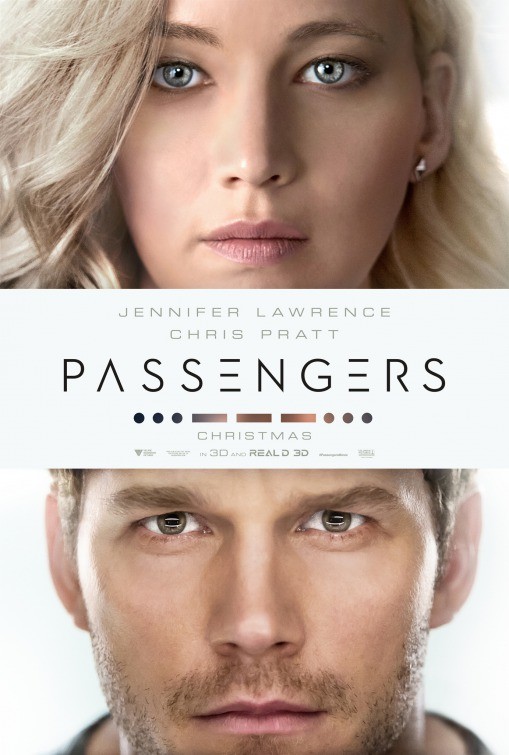
Directed by Oscar-nominated director Morten Tyldum who is best known for 2015’s The Imitation Game, Passengers is a fairly good and visually appealing sci-fi film that ultimately falls short of its lofty potential with its casting of Jennifer Lawrence and Chris Pratt. Set in the future when intergalactic travel is possible, Chris Pratt plays Jim Preston, a mechanical engineer from Earth who mysteriously wakes up too early from hibernation on his way to the distant colonial planet of Homestead II. Over time, he falls in love with the only other passenger to accidentally wake up, a beautiful young woman named Aurora who is played by Jennifer Lawrence. After their relationship begins on a rather controversial foot, they discover that something is very wrong with the spaceship they are traveling on with 5,000 other hibernating passengers. If they do not come up with a solution, the two are faced with spending the rest of their lives in space since they are supposed to reach their destination in 90 years. Although they are surrounded by luxurious amenities and a friendly robotic bartender named Arthur, played by Michael Sheen, they are desperate to find a way to go back into hibernation. The highlight of the movie is the terrific chemistry between Lawrence and Pratt, two of the hottest actors today whose charisma and attractiveness make their on-screen love interest more appealing. Also, the modern sets and props, accentuated by CGI, give the film a realistic and polished vision of future space travel. Overall, despite the visually arresting aesthetic, the movie never fully takes off and is beset by a slow pace with very little action, unusual for a Hollywood sci-fi blockbuster with such a high budget and talented actors.

Rogue One: A Star Wars Story

Directed by Gareth Edwards who directed the 2014 Godzilla remake, Rogue One: A Star Wars Story is a well-crafted Hollywood blockbuster that blends the right amount of science fiction, explosive action, and hallmarks of the Star Wars universe to create a highly entertaining cinematic experience. Its style and narrative hark back to the original three films under George Lucas and is thankfully much better than the more recent prequels. Like its other Disney predecessor Star Wars: The Force Awakens from 2015, the movie is effectively able to recapture the original spirit and creativity that has made Star Wars such a wildly successful sci-fi franchise. Although within the same narrative universe of the other films, it is very much a standalone side project with a whole slew of new characters and planets and can be loosely called a prequel to the originals and a sequel to the prequels. In the movie, Oscar-nominated actress Felicity Jones plays a young woman named Jyn Erso whose absent father, portrayed by the fabulous Danish actor Mads Mikkelsen, is a brilliant engineer forced to design a deadly weapon for the powerful dictatorship of the Galactic Empire. After being held captive by a Rebel fighter depicted by Forest Whitaker, she is allowed to join forces with the Rebel Alliance in the hopes of preventing her father’s weapon from being deployed by the Empire and Director Orson Krennic portrayed by the terrifically evil Ben Mendelssohn. She teams up with Captain Cassian Andor, portrayed by Mexican actor Diego Luna, and the wisecracking reprogrammed Imperial robot K-2SO to steal the plans for what we come to learn is the Death Star and find a way to disable it. As with any other Star Wars movie, there are plenty of dogfights between Imperial and Rebel starfighters in outer space, in addition to land battles involving phaser blasters and Stormtroopers. These skirmishes are beautifully CGI-enhanced but not too over-the-top in order to keep with the appropriate continuation of the earlier films from several decades ago. The filmmakers made the right stylistic choice to mimic the now antiquated CGI set designs and relatively low budget custom designs from the original 1970s versions. The now well-known Star Wars iconography and storylines are kept intact despite the addition of so many new characters. To the delight of both avid fans and casual viewers, there are cameos of many beloved characters, including a certain villainous heavy breather and some friendly robots. Overall, I found this latest installment in the Star Wars saga to be a highly enjoyable joyride that does not skimp on good storytelling and nuanced acting performances from up-and-coming actors. If this movie is any indication, I very much look forward to the future Star Wars films that have already been planned for years to come.

Arrival

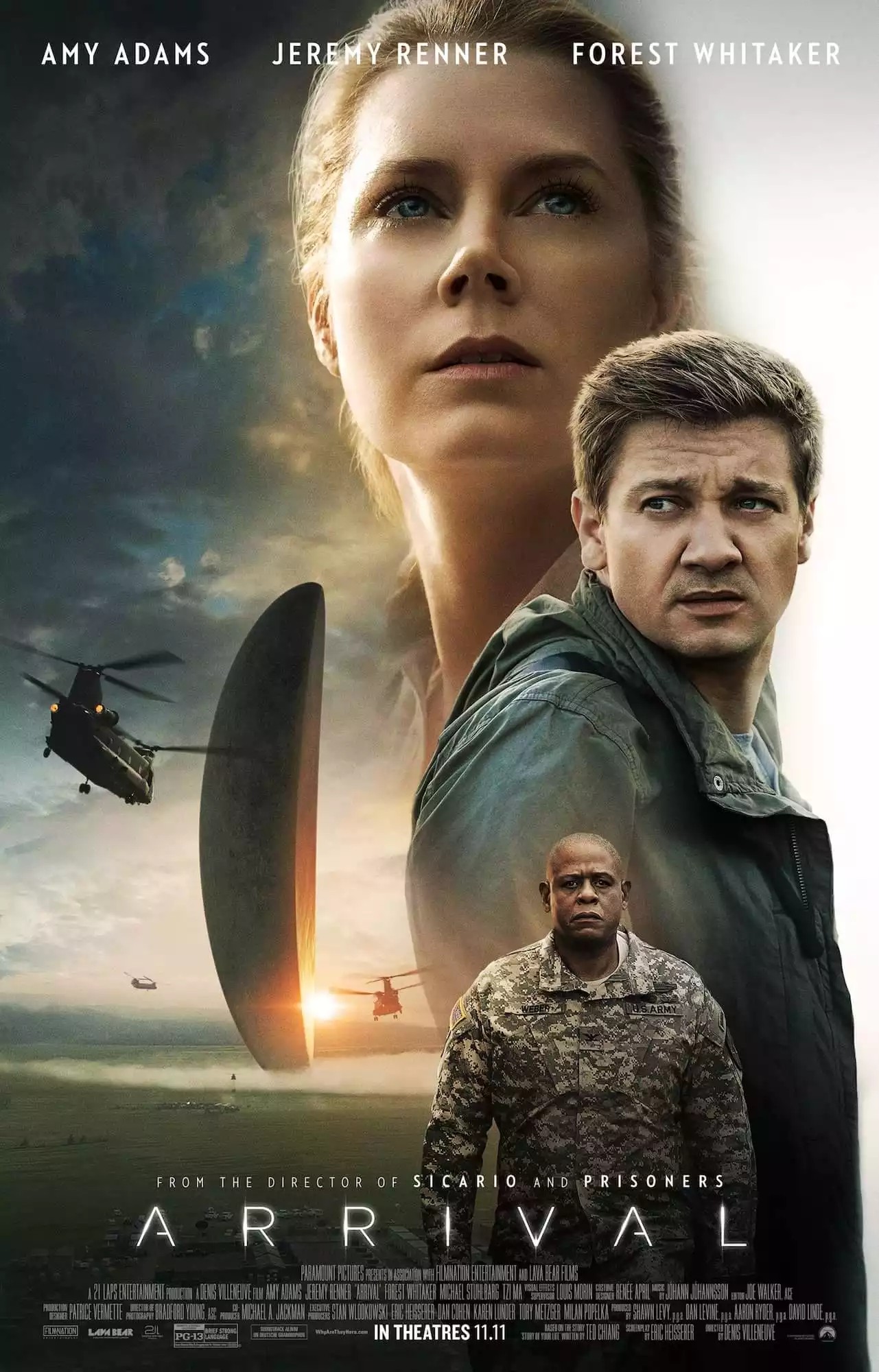
From Denis Villeneuve who directed 2013’s Prisoners and 2015’s Sicario, Arrival is a brilliantly crafted intelligent sci-fi film that heavily relies on terrific performances rather than over-the-top fantastical CGI. Played by the two-time Golden Globe winner Amy Adams, Louise Banks is a linguistics professor tasked with the unusual role of communicating with aliens who have mysteriously landed twelve spacecraft across the world. Not knowing whether they are peaceful or hostile visitors, a global panic ensues, and the United States government and other nations must figure out how to proceed without provoking war. Dr. Banks along with a team of experts, including a theoretical physicist portrayed by Jeremy Renner, are recruited by Forest Whitaker’s character, a U.S. Army Colonel, to unearth the extraterrestrials’ intentions. Working through her own personal issues, Dr. Banks must face the alien creatures and interpret their language with the aid of complex mathematical and scientific computations. The film underscores the mysterious circumstances by setting the floating crescent-shaped spacecraft that arrived on American soil in the eerily quiet Montana countryside where a temporary military outpost is established. It is smart sci-fi that delves into somewhat plausible scientific details and the often overlooked important implications of the linguistics academic field. Dr. Banks uses her esoteric knowledge to come to understand the aliens and try to prevent the world’s fearful militaries from embarking on a cataclysmic war possibly resulting in the extinction of the human race. Without spoiling the mind-blowing plot, the further along she gets in her extraterrestrial interactions the stranger things get for her. The movie’s thought-provoking material reminded me of such sci-fi films as 1997’s Contact and 2014’s Interstellar. Like those sci-fi flicks, the audience leaves the theater thinking about what really happened and tries to warp their mind around the deeply philosophical issues that it provokes. Overall, I found it to be one of the more noteworthy sci-fi films in recent memory because it went beyond simply providing mindless action like most Hollywood blockbusters. It was full of superb acting and masterful elements of mystery and intricate science fiction based on real science and fields of study. 

Independence Day: Resurgence

image

A follow-up to the Hollywood blockbuster Independence Day released in 1996, Independence Day: Resurgence is a fairly lackluster sequel that is visually appealing but filled with cliche, cheesy dialogue. It is basically the same film as the original: the same aliens return to invade Earth yet again and humans unify to fight the aliens. This time, an international defense force is created using alien technology but the attack is on a much larger scale. Relying heavily on CGI, the aliens obliterate many cities and landmarks in epic fashion. I did feel a sense of nostalgia as I watched the film since I remember the original from when I was 11 years-old. The original was one of the first major sci-fi popcorn flicks I saw that was visually stunning, at least for 90’s standards prior to today’s advanced CGI. Although Will Smith did not reprise his role, the movie brings back several of the major members of the original cast, including Jeff Goldblum and Bill Pullman. Like the original, it even included an inspiring speech from Pullman who now portrays the reclusive former president. The movie includes the requisite elements of a love story, eccentric scientists, military camaraderie, and rousing patriotism. Overall, I found the film to be a fairly typical sci-fi blockbuster, with a rather silly premise, whose primary purpose is to serve as a vehicle for special effects.

Special Report: Back to the Future

Recently, I attended a special screening of Back to the Future at a fundraising benefit in Chatham, Massachusetts for the Michael J. Fox Foundation for Parkinson’s Research. I had the distinct privilege of meeting and talking with actor Christopher Lloyd who played Dr. Emmett “Doc” Brown and co-writer and producer Bob Gale.

image

Still easily recognizable as the white-haired eccentric scientist in his most well-known role, Lloyd was very approachable and graciously answered my questions about Back to the Future. He, along with Gale, told me that the cast and crew members are like a family, and they still gather several times a year. Lloyd and a few other Back to the Future alums, including Gale and the director Robert Zemeckis, live in Santa Barbara, California, so it is not unusual for them to get together. Lloyd told me that he remains close to Michael J. Fox, who courageously fights Parkinson’s and tries to attend Back to the Future events despite tiring easily. In fact, Lloyd told me that he was just with Fox in Philadelphia for one of the many Comic-Cons that he attends a year. When I asked him about the possibility of another Back to the Future film, he said he does not know and that it is up to Gale.

image

I also talked at length with Bob Gale who was the one that came up with the premise for the films. Much more outspoken than Christopher Lloyd and clearly passionate about filmmaking, Gale told me how he was inspired to write Back to the Future. A number of years ago, he was going through his father’s belongings and discovered a yearbook describing his father as the senior class president, a fact that he never knew. Gale remembered that his class president was quite disagreeable and wondered whether he would have been friends with his father in high school. Curious about his father’s past, he thought it would be interesting to make a movie that travels back in time to when a character’s parents were younger.

I asked Gale a more timely question: whether Donald Trump was really an inspiration for the older Biff character. He told me that Trump was not the only direct inspiration, but rather he got his ideas from other people at the time like Trump, people with large egos who wanted their name plastered all over cities like Las Vegas. More generally, I asked if there were any other inspirations for Back to the Future. He didn’t mention any filmmaker that really inspired him besides the Westerns of John Ford for the third Back to the Future film.

Finally, Gale gave me insight into the casting of Michael J. Fox as Marty McFly. The first half of the film was originally filmed with Eric Stoltz as Marty, but he said they were eventually fortunate enough to arrange for Fox, their first choice, to join the cast. They were not able to get him initially because Fox was on the popular show Family Ties and was not given leave for the filming of Back to the Future.

Then, I asked whether there will ever be another Back to the Future. Unlike Christopher Lloyd’s response, Gale said there will never be another film in the series without Michael J. Fox, who is unlikely to reprise his role as a result of his health condition. Finally, Bob Gale mentioned that he has two other projects in the pipeline but said he could not divulge the details due to being superstitious.

After these fascinating conversations with Lloyd and Gale, I got to see the original Back to the Future on the big screen for my first time. Even though it was made in 1985, the movie itself still stands up as a cult classic with the right blend of sci-fi and comedy. It was a truly memorable evening to be able to talk with Christopher Lloyd and Bob Gale and see the film in its proper setting, all for a worthy cause in combating Parkinson’s disease. I even got to stand in front of a replica of the famed DeLorean, complete with a flux capacitor!

image

X-Men: Apocalypse

image

X-Men: Apocalypse is a fairly standard comic book movie that pits superheroes with CGI-enhanced powers against a supervillain threatening humanity. It is the ninth installment in the lucrative X-Men franchise and part of a trilogy following the X-Men characters in their youth beginning in the 1960s. The film is set in 1983 coinciding with the rise of the main antagonist, an ancient mutant known as En Sabah Nur played by Oscar Isaac under a heavy layer of makeup and special effects. A ragtag group of young mutants under the tutelage of a young Professor Xavier played by James McAvoy join forces to save the human and mutant races from this god-like malevolent force. There is also a subplot rivalry between Professor Xavier and the multi-dimensional Magneto played by Michael Fassbender, archrivals as they get older in the earlier films. The movie feels more like an extension of an origin story and would not work as well as a standalone film. We are introduced to many mutants before they become the familiar characters from the previous films. Their younger selves are presented in unique and sometimes entertaining ways that provide important background information on their more recognizable adult selves. However, I enjoyed the first movies more because of the acting gravitas of Patrick Stewart and Ian McKellen and the appearance of Hugh Jackman’s Wolverine beyond a simple cameo. Overall, I thought the film did not break the comic book movie mold but stuck to the rather generic formula proven to practically guarantee box office success for the major studios. It provides enough CGI action and entertainment to appease the hordes of die-hard comic book fans and those looking for a summer popcorn flick.