DIFF 2017: Day 4

Menashe is an intimate family drama about a troubled widower and his adolescent son, with the distinction of taking place within the ultra-Orthodox Hasidic Jewish community in New York. With the entire dialogue spoken in Yiddish, the viewer gets a glimpse into a largely unseen and misunderstood deeply religious group, and how their traditions dictate practically every aspect of life, things that would be considered antiquated by most people. It follows the main character as he tries to bond with his son who is forcibly adopted by his uncle, and he struggles throughout the movie to have his son live with him despite his difficult life as a working-class single father. Despite their unusual circumstances and living very strictly, the ultra-Orthodox community is in some ways just like the rest of us, complete with family trauma and other human troubles.

What Lies Upstream is an investigative documentary that shines a spotlight on the terrifying reality of the widespread contamination of drinking water throughout the United States. The filmmaker dives deep into the issues surrounding the 2014 West Virginia chemical spill that made the drinking water toxic for hundreds of thousands of people, particularly the metropolitan area of Charleston. In his pursuit of what really happened and how it could have happened, the filmmaker interviews officials from state government, state and federal regulatory agencies, health experts, and environmental activists. The movie reveals that economically-distressed West Virginia is not the only community impacted by the polluting manufacturers and chemical companies: the filmmaker even updates the documentary to include the highly publicized Flint, Michigan water crisis in which drinking water was contaminated by lead. The problem is so systemic that even the the EPA and CDC who are tasked with protecting Americans are not doing all they can to ensure that America drinking water is safe largely as a result of them being beholden to politicians and lobbyists.

Berlin Syndrome is a riveting thriller about a beautiful young Australian tourist who travels to Berlin and begins an intimate relationship with a handsome and charismatic German schoolteacher. Eventually, the main character, portrayed terrifically by Teresa Palmer, discovers that he is not as he seems and has a very sinister side to himself. She realizes that she is being held hostage in his apartment and may never be let go alive; he subjects her to psychological torture and sexual violence while pretending that they can have a normal relationship. Echoing the Stockholm Syndrome in which hostages develop affection towards the hostage-takers, she is seduced by him and engages in a very sexual relationship before she becomes the obvious victim of a kidnapping. They continue to engage in intimate acts during her captivity; however, it is not entirely clear whether she is just playing along or has some bizarre affection towards him. I thought the film did a excellent job of presenting a slow burn thriller about a horrifying situation that could happen to any susceptible tourist or person traveling alone.

DIFF 2017: Day 3

As I have done in years past, I will be posting short reviews of the movies that I will be watching over the course of the Dallas International Film Festival. Check back at the end of every day until April 9th to keep up with the latest in independent and documentary filmmaking at the largest film festival in Dallas.

Score: A Film Music Documentary is a fascinating documentary about an integral aspect of cinema that is often overlooked by movie audiences despite be present in every single movie you watch. Through a series of interviews with composers of movie scores whether little known or such titans as Hans Zimmer, Danny Elfman, and Quincy Jones, we are given a previously unseen glimpse into the process of creating the art form known as film music. The filmmaker also underscores the significance of music by showing clips of some of the most famous scores along with some background information from film historians and filmmakers, including James Cameron and Steven Spielberg. It is a much more complex technical and artistic procedure than most people realize; it involves many hours writing compositions, collaborating with the filmmakers, and conducting a live studio orchestra.

Heartstone is a beautifully shot and emotionally powerful coming-of-age Icelandic movie about a young teenager named Thor as he experiences the difficult transition from boyhood to manhood, particularly his relationships with his best friend and girls while coping with his sexuality. Although he lives in a very rural community on the coast of Iceland, a place foreign from our own, the film shows him doing what typical adolescents do: breaking things, horsing around, dealing with bullies and family, experiencing a first crush, and exploring sex. However, the story delves deeper and deeper into more complicated and depressing subjects. For instance, his best friend is dealing with the possibility that he may be a homosexual, and he must confront his abusive father and distant mother. After things turn for the worse, Thor’s bond with his friend and family grows stronger, which leads him on a path to true manhood. All this drama is set against the breathtaking landscape of the remote Icelandic mountains and coast, underscoring the beauty and dangers of adolescence and the emotional isolation of the characters.

Special Report: Back to the Future

Recently, I attended a special screening of Back to the Future at a fundraising benefit in Chatham, Massachusetts for the Michael J. Fox Foundation for Parkinson’s Research. I had the distinct privilege of meeting and talking with actor Christopher Lloyd who played Dr. Emmett “Doc” Brown and co-writer and producer Bob Gale.

image

Still easily recognizable as the white-haired eccentric scientist in his most well-known role, Lloyd was very approachable and graciously answered my questions about Back to the Future. He, along with Gale, told me that the cast and crew members are like a family, and they still gather several times a year. Lloyd and a few other Back to the Future alums, including Gale and the director Robert Zemeckis, live in Santa Barbara, California, so it is not unusual for them to get together. Lloyd told me that he remains close to Michael J. Fox, who courageously fights Parkinson’s and tries to attend Back to the Future events despite tiring easily. In fact, Lloyd told me that he was just with Fox in Philadelphia for one of the many Comic-Cons that he attends a year. When I asked him about the possibility of another Back to the Future film, he said he does not know and that it is up to Gale.

image

I also talked at length with Bob Gale who was the one that came up with the premise for the films. Much more outspoken than Christopher Lloyd and clearly passionate about filmmaking, Gale told me how he was inspired to write Back to the Future. A number of years ago, he was going through his father’s belongings and discovered a yearbook describing his father as the senior class president, a fact that he never knew. Gale remembered that his class president was quite disagreeable and wondered whether he would have been friends with his father in high school. Curious about his father’s past, he thought it would be interesting to make a movie that travels back in time to when a character’s parents were younger.

I asked Gale a more timely question: whether Donald Trump was really an inspiration for the older Biff character. He told me that Trump was not the only direct inspiration, but rather he got his ideas from other people at the time like Trump, people with large egos who wanted their name plastered all over cities like Las Vegas. More generally, I asked if there were any other inspirations for Back to the Future. He didn’t mention any filmmaker that really inspired him besides the Westerns of John Ford for the third Back to the Future film.

Finally, Gale gave me insight into the casting of Michael J. Fox as Marty McFly. The first half of the film was originally filmed with Eric Stoltz as Marty, but he said they were eventually fortunate enough to arrange for Fox, their first choice, to join the cast. They were not able to get him initially because Fox was on the popular show Family Ties and was not given leave for the filming of Back to the Future.

Then, I asked whether there will ever be another Back to the Future. Unlike Christopher Lloyd’s response, Gale said there will never be another film in the series without Michael J. Fox, who is unlikely to reprise his role as a result of his health condition. Finally, Bob Gale mentioned that he has two other projects in the pipeline but said he could not divulge the details due to being superstitious.

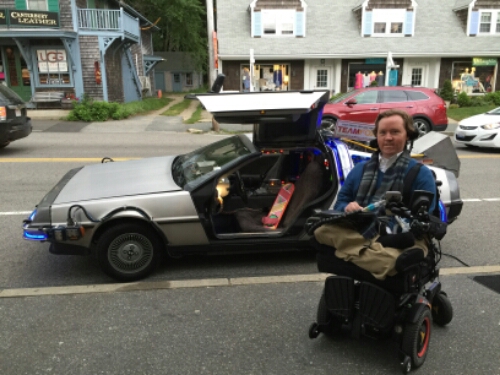
After these fascinating conversations with Lloyd and Gale, I got to see the original Back to the Future on the big screen for my first time. Even though it was made in 1985, the movie itself still stands up as a cult classic with the right blend of sci-fi and comedy. It was a truly memorable evening to be able to talk with Christopher Lloyd and Bob Gale and see the film in its proper setting, all for a worthy cause in combating Parkinson’s disease. I even got to stand in front of a replica of the famed DeLorean, complete with a flux capacitor!

image