Life

Directed by Swedish filmmaker Daniel Espinosa, Life is a fairly typical ‘trapped in space’ sci-fi thriller that provides enough thrills and a creative twist on extraterrestrial horror to make for an entertaining film. Unlike most science fiction, the setting of the International Space Station instead of a futuristic spacecraft makes the storyline somewhat more plausible, as if it could take place today. The movie starts out with the six-member multinational crew making a significant scientific discovery of a small living organism recovered from Mars. However, the British biologist on board realizes the specimen is more than it seems and the Quarantine Officer, played by Rebecca Ferguson, must ensure that their discovery is kept contained in the quarantined laboratory as a result of the potential dangers. Ryan Reynolds’ character who is an American pilot for the space station risks his life in order to save the British biologist who is confronted with the very real dangers of the organism’s ability to cause harm. The specimen rapidly grows and becomes stronger in the presence of the oxygen-rich environment of the International Space Station. In several horrifying scenes, the entire crew, including the Russian commander and the American medical officer, played by Jake Gyllenhaal, must battle for their own survival as the space creature nicknamed Calvin causes irreparable damage to the space station in which all communications with Earth have been cut off and there is no easy escape. The filmmaker does an excellent job of re-creating what it must be like to live in space and seemingly presents the International Space Station in a realistic fashion, complete with the correct scientific implements. Overall, I found it to be a good but not great movie in a long line of films about the terrifying nature of space, and it is a excitingly fun sci-fi flick to pass the time.

The Salesman

Directed by critically acclaimed Iranian filmmaker Asghar Farhadi whose 2011 A Separation won the Oscar for best foreign language film, The Salesman is an emotionally powerful film that masterfully uses simmering tensions between a couple during a particularly trying time to craft a superb slow burn dramatic thriller. The movie follows the married couple Emad and Rana, both professional actors performing in Arthur Miller’s play The Death of a Salesman, who are forced to evict their condemned apartment in Tehran and move to another apartment previously inhabited by a mysterious woman. While she is alone at their new home, Rana is attacked by a stranger who may have been an acquaintance of the previous tenant. Emad becomes increasingly obsessed with finding the culprit and protecting his wife, but in a way that goes too far and consequently strains their relationship. As all this domestic drama unfolds, the couple must continue to act in the famously dramatic Arthur Miller play as if nothing happened back at home. Although there is very little action in the film, the nuanced performances of the main actors, regulars in Farhadi’s other works, create a palpably tense environment in which the characters’ human emotions are riveting in and of itself. Like the filmmaker’s other cinematic masterpieces, the movie is a perfect example of a master storyteller weaving human complexities and difficult societal and cultural issues into a thought-provoking yet enthralling narrative. As it progresses, the film delves into the complicated aspects of justice, revenge, and forgiveness, and how they affect interactions with loved ones at times of crisis. Overall, I found it to be one of the more rewarding cinematic experiences this year because of its powerful storytelling and brilliantly subtle acting performances, and it is more than deserving to win the Oscar for best foreign language film.

John Wick: Chapter 2

Following the surprise success of the original John Wick released in 2014, John Wick: Chapter 2 is a terrifically fun and slick action thriller that puts most sequels to shame because it is equally good if not better than the original. In a continuation of his rebirth as an action star since his breakout role of Neo in The Matrix films, Keanu Reeves plays John Wick, a particularly skilled assassin rightfully nicknamed The Boogeyman, who is forced out of retirement still dealing with his wife’s death several years prior. He is part of an international underground society of assassins known as The Continental and is bound to one more assignment by a blood oath to a high-ranking Italian gangster. The assassination that he is tasked with takes him to Rome where his impressive fighting skills are used to dispatch an army of bodyguards, including a particularly brutal assassin played by Common. Eventually, the tables are turned on Wick, and he spends the rest of the movie evading a trove of Continental members across Rome and back in New York City. Almost perfectly typecasting the famously subdued Reeves, Wick has very little dialogue and fights and kills with Zen-like precision even as he suffers bloody injuries. Already reminiscent of The Matrix with its highly choreographed martial arts fighting sequences, the film reunites Keanu Reeves with Laurence Fishburne who, like Morpheus in The Matrix series, plays a philosophizing leader of the criminal underground. I particularly enjoyed the absurdly out-of-place old-fashioned formalities of The Continental headquartered at classically luxurious hotels in which the prim and proper concierge arranges services for well-dressed assassins. Furthermore, the leader of the New York branch who acts more as a hotel manager, named Winston and portrayed by Ian McShane, runs a tight ship and ensures that no business is conducted on the premises at the risk of a member’s execution or excommunication. Overall, I found the movie to be a stylish and inventive take on the increasingly stale action genre and takes the audience on a thoroughly entertaining joyride.

Split

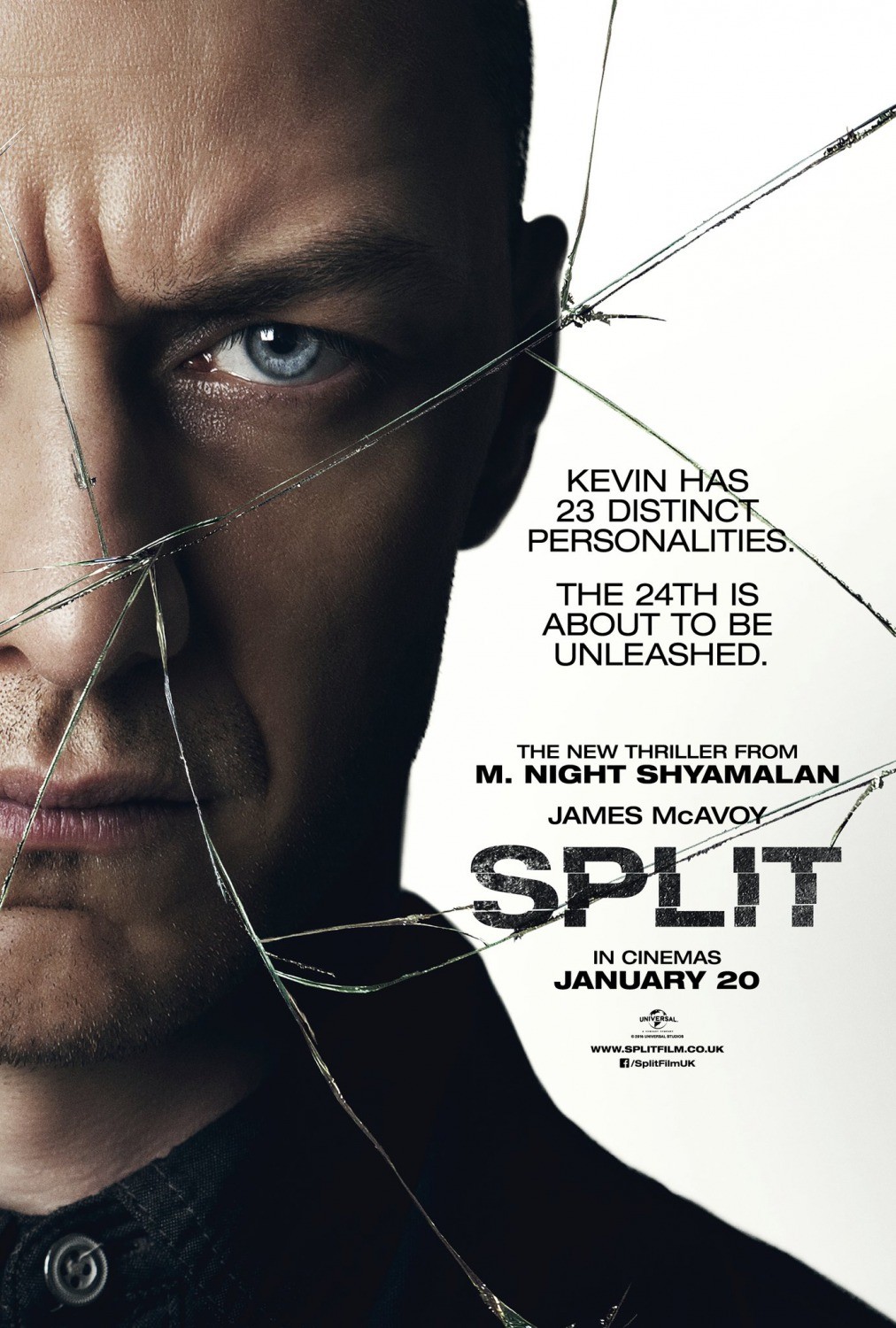
Directed by M. Night Shyamalan who is best known for 1999’s The Sixth Sense, Split is a surprisingly good movie for Shyamalan who unfortunately has had a string of below-average films since his sterling debut. What makes the film really shine is the brilliant acting performance from James McAvoy who convincingly depicts the myriad personalities of the character Kevin who suffers from dissociative identity disorder. It starts out with the kidnapping of three high school girls who are locked away in a cellar-like room by Kevin who has a total of 23 different personalities. Some personalities are compassionate and innocent like Barry who tries to control the other personalities and Hedwig who is a 9 year old boy. However, some of his other personalities are malevolent and downright creepy like Dennis who came up with the idea of kidnapping the girls and Patricia who is a mysteriously conniving woman. Throughout the film, Kevin through the personality of Barry tries to get help from his longtime psychiatrist Dr. Fletcher who attempts to calm his dangerous and neurotic sides. Her theory that those with dissociative identity disorder can literally transform their bodies physically is horrifyingly proven true towards the end as Kevin takes on a 24th personality, the supernaturally strong Beast. The filmmaker effectively uses mystery and terror to create a suspenseful yet entertaining experience with disturbing and violent results. Since most of the action is rather slow paced and simply makes the audience question which personality will show up, the movie is not your typical slasher horror film filled with over-the-top blood and gore. What also surprised me was that, unlike a majority of Shyamalan’s works, the ending was rather predictable for a filmmaker known for his trademark surprise twists. Overall, I found it to be an enjoyably thrilling film that finally provides a glimmer of M. Night Shyamalan’s past original glory and would have flopped without James McAvoy’s impressive ability to play so many roles in one character. 

Gold

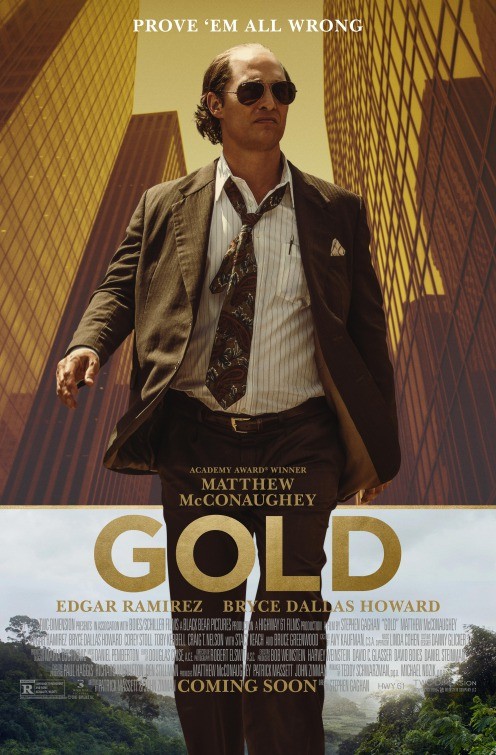
Loosely based on actual events, Gold tells a fascinating story about a down-on-his-luck gold prospector portrayed by the believably gruff Matthew McConaughey, but, unfortunately, the movie fails to meet expectations with its haphazard script. McConaughey plays the balding pot-bellied Kenny Wells who inherits struggling Washoe Mining based in Reno, Nevada after the death of his successful father and is looking for his big break. After working out of a bar where his girlfriend, played by Bryce Dallas Howard, is a waitress, he has a dream of having a successful mine in the jungles of Indonesia. He decides to travel to Indonesia where he devises a plan with a desperate geologist named Michael Acosta, portrayed by Édgar Ramírez. They set the groundwork for a mine deep in the remote jungle on a shoestring budget raised by friends and small investors back in Reno. After months of finding nothing, Acosta finally discovers traces of gold and exuberantly informs Wells who has been suffering from malaria. Thinking that they hit it big time, the rest of the film follows McConaughey’s character as he raises additional funds and is courted by Wall Street. However, his overnight success strains his relationship with his longtime girlfriend. Eventually, his company is listed on the New York Stock Exchange, and many analysts predict that he has discovered the largest gold deposit of the decade, worth almost 30 billion dollars. His life has finally on an upward trajectory, but the viewer is aware that something is amiss because the film flashes forward to the late nineties as he is being investigated by the FBI. Due to outside circumstances, including the actions of the authoritarian Indonesian government, and tensions with his partner Acosta, everything seems to go wrong for the briefly successful Wells. The movie’s major flaw is that the plot is all over the place, and there is an obvious lack of suspense or excitement for such an intriguing story about gold prospectors. Overall, I found it to be a surprisingly dull film that wasted a very strong performance from Oscar winner Matthew McConaughey who physically delved deep into the character.

Patriots Day

From Peter Berg who directed 2013’s Lone Survivor and 2016’s Deepwater Horizon, Patriots Day is a well done procedural drama that follows the events of the Boston Marathon bombings in April 2013 and provides insight into the many men and women who were victims as well as those investigating and capturing the culprits. The events leading up to, during, and after the terrorist attack are shown from the perspective of the fictional Boston Police Department Sergeant Tommy Saunders, portrayed by Boston native Mark Wahlberg. The movie captures the Boston Strong attitude when all of Boston came together during an especially trying time, and one way the filmmaker does this is by casting real Bostonians as extras. Much of the movie revolves around finding out what happened and how to pursue the bombers. The local officials, including the Boston Police Commissioner Ed Davis portrayed by John Goodman, Boston Mayor Thomas Menino, and Massachusetts Governor Deval Patrick, have initial investigative differences, typical of most Hollywood depictions, with the federal government represented by FBI Special Agent Richard DesLauriers, played by Kevin Bacon. Underscoring patriotism and the desire to seek justice, the filmmaker shows many of these characters working together to arrest and capture the Tsarnaev brothers whose free reign terrorizes the entire city of Boston. Free of excessively gruesome imagery of the actual attacks, the film attempts to focus on the emotional aftermath and vividly retrace what happens over the course of the days that follow until those responsible are no longer a threat. The power of the movie is visualizing the events for the viewer even though most Americans already know many of the details. Overall, I found it to an effectively somber and emotional film that shines a light on terrorism and how authorities are able to tackle such a timely issue in a humane and thorough manner.

Miss Sloane

Directed by John Madden who is best known for 1998’s Shakespeare in Love, Miss Sloane is a riveting political thriller about a high-powered Washington lobbyist who uses her sometimes dirty tactics to help pass a gun control bill. The terrific acting performance from Oscar-nominated actress Jessica Chastain is really what makes the movie shine. Chastain portrays the lead character Elizabeth Sloane whose ruthless reputation makes her a particularly well sought-after lobbyist at one of the nation’s leading lobbying firms, run by Sam Waterston’s character. Complicating the audience’s characterization of her as a spineless and greedy lobbyist, she rejects an offer from the extremely powerful gun lobby to help defeat a bill mandating universal background checks for gun purchases. Instead, she shocks everyone by joining a small lobbying group, led by Mark Strong’s activist character, whose intent is to pass that very law. The filmmaker makes the interesting decision to have the story be played out mostly through flashbacks as Sloane is being investigated at a Senate hearing whose chair is a hostile Senator played by John Lithgow. Reinforcing the notion that politics is a nasty business full of conniving characters, the film follows Chastain’s character as she commits morally questionable and borderline illegal activities for the sole purpose of winning. However, the viewer feels torn because her actions can be justified as being in the pursuit of a just cause. The final plot twist in the end really drives home the film’s central question of whether the end justifies the means. Overall, I found it to be an enjoyable political thriller that feels especially relevant in today’s toxic political environment and transcends the genre by having one of the year’s best performances from Jessica Chastain. 

Nocturnal Animals

Written and directed by famed fashion designer Tom Ford, Nocturnal Animals is a stylishly peculiar film noteworthy for its nuanced acting performances and cinematically stunning details. The movie stars Amy Adams as a wealthy contemporary art gallery owner living in Los Angeles who one day receives a draft for a novel written by her estranged ex-husband. As she reads the mysterious and violent manuscript late at night at her immaculate modern mansion, the viewer is transported to the novel’s actual story set in desolate West Texas. The main protagonist, played by Jake Gyllenhaal, is driving with his wife and daughter in the middle of nowhere on their way to Marfa, Texas when they are unexpectedly confronted by a group of men led by Aaron Taylor-Johnson’s vicious character. As the story progresses, the movie switches back and forth between Adams’ character who has flashbacks to her ex-husband, also played by Jake Gyllenhaal, and the written narrative as the protagonist searches for his missing family. The always terrific and creepy Michael Shannon appears as the local detective investigating the disappearance and has no qualms with seeking justice outside the law. Amy Adams’ character becomes increasingly horrified with the feeling that her ex-husband’s writings may allude to their soured relationship and the possibly violent repercussions. Therefore, the film in both of its parallel story lines is at its heart a story of love and betrayal and is full of macabre themes emphasized by the strange qualities of the film. Clearly not for everyone, especially those disturbed easily, it is very much an artsy movie concerned with the look and feel and whose plot leaves you hanging at the end. The director Tom Ford’s career in high fashion is readily apparent in the way that he creates a beautifully shot film complete with sumptuous scenery and costumes. Overall, I found it to be a highly well-crafted movie with top-notch acting and cinematography but sometimes to be too weird and dark for most moviegoers.

Desierto

Written and directed by Jonás Cuarón and produced by his father Alfonso Cuarón best known for directing 2013’s Gravity, Desierto is a thriller movie with a rather unusual twist of having an indirect yet unsubtle undercurrent of immigration politics. It revolves around a group of undocumented immigrants who attempt to cross the border into the United States but encounter an unexpected sinister obstacle. After their smugglers’ truck breaks down in the Mexican desert, the fourteen migrants are forced to take the treacherous trek through the desert while avoiding the Border Patrol. Once they have just crossed into America, all of a sudden, shots ring out and several immigrants in the group are gunned down. The shooter turns out to be a psychotic racist, played by Jeffrey Dean Morgan, who takes matters into his own hands by systematically hunting down undocumented immigrants as if they are animals. Eventually, the survivors are led by a man, portrayed by Gael García Bernal, desperately trying to return to his family in California. The film is basically one long chase scene between Morgan’s character with his vicious hunting dog named Tracker and the random unarmed men and women he feels justified murdering in cold blood. Although extremely exaggerated, Morgan’s character represents the staunchly xenophobic anti-immigrant fringe element in American society. He does not see the migrants as humans simply striving for a better life but rather as stray animals who must be put down. However, poetic justice is served at the end when the tables are finally turned on Morgan’s character. The film is especially timely given the fact that anti-immigrant rhetoric is at a all time high during this particularly divisive election season. Overall, I found the best part of the movie was its atypical and thought-provoking premise regarding such sensitive issues as immigration and racism. It did provide an adequate amount of simple thrills to create a sense of terror for unsuspecting people on an already perilous journey. 

The Girl on the Train


Based on the runaway best-selling book published in 2015, The Girl on the Train is an entertaining psychological thriller whose greatest assets are the acting from Emily Blunt and the plot twists. Blunt does a superb job of playing Rachel Watson, a recently divorced woman who is mentally unhinged suffering from severe alcoholism and delusions. She becomes obsessive over a couple she sees from the train that she takes her on daily commute to and from New York City. Rachel soon learns that the woman, whose name is Megan, is actually the nanny to her ex-husband’s infant daughter from his new marriage. Her estranged ex-husband Tom, portrayed by Justin Theroux, and his new wife Anna also live a few doors down from Megan and her husband Scott. Not knowing whether Rachel is correct or simply crazy, the viewer becomes increasingly suspicious of her belief that the characters are involved in extramarital affairs or even more nefarious actions. Things get particularly intense after the mysterious disappearance of Megan, and the audience is left wondering if Rachel is somehow involved. Already accused of stalking Tom and Anna, the police led by a detective, played by Allison Janney, pin Rachel as the primary suspect. The film is particularly intriguing because what we came to believe was true in the beginning is completely thrown out the window towards the end. The viewer begins to second-guess all of the characters’ stories, particularly all the nasty things Tom has said about his ex-wife Rachel. Although I thoroughly enjoy movies with surprise endings, many parts of the plot are somewhat far-fetched and rely heavily on coincidences. For instance, what are the chances that Rachel from a fast-moving train could really see important moments at exactly the right time? Overall, I thought the film did a fairly good job of presenting the elements of a melodramatic psychological thriller, complete with unexpected events and not knowing who to trust, but fell short of transcending the genre like 2014’s Gone Girl.