Deepwater Horizon

Based on the incredible true story of what is commonly referred to as the BP oil spill, Deepwater Horizon follows the largely untold story of the workers on the Deepwater Horizon drilling rig who fought for their lives after a devastating blowout on April 20, 2010. It is directed by Peter Berg who is known for the 2013 true story war film Lone Survivor, which also starred Mark Wahlberg as the main hero. The first part of the film follows what happened before the disaster, predominantly from the perspective of Wahlberg’s real character Mike Williams who was the Chief Electronics Technician on Deepwater Horizon. The viewer gets a glimpse of his personal life, particularly his relationship with his daughter and wife played by Kate Hudson. What fascinated me the most was the actual details of what it’s like to live and work on a massive rig 5,000 feet above the sea floor and 52 miles off the Louisiana coast. It also provided important context: I never before realized that Deepwater Horizon was not actually an oil rig but was rather used to explore and drill the holes for more permanent oil rigs. Unlike other rigs, it was essentially a boat that had thrusters allowing it to float in a stationary position on the surface of the Gulf of Mexico. The film delves into the technical aspects of offshore drilling and the safety apparatuses used to prevent the buildup of pressure that ultimately caused the accident. As depicted in the film, BP who leased the rid and was represented by two of its visiting executives and a supervisor, played by John Malkovich, attempted to cut corners on safety to speed up on beginning the extraction of an estimated 200 million gallons of oil a year. To no avail, several workers for Transocean, the operator of Deepwater Horizon, and Offshore Installation Manager Jimmy Harrell, portrayed by Kurt Russell, warned that the concrete supporting the newly drilled hole could be insufficient. The rest of the story becomes more of an action thriller after the safety mechanisms fail and explosions engulf the entire rig in an inferno. The filmmaker vividly recreates the disaster in such great detail that the viewer is left on the edge of their seats despite knowing the outcome. It shows the heroics of the workers, particularly Mark Wahlberg’s character, as they try to save as many fellow workers as possible and prevent an ecological calamity. As poignantly described by the actual survivors in the film’s epilogue, the Deepwater Horizon catastrophe ended up being the worst oil disaster in American history, with 11 deaths and 200 million gallons spilled over the course of 87 days. Overall, I found the film to be well worth seeing due to its technical insight and exhilarating action sequences captivating the heroics of everyday workers at a time of peril.
Our Kind of Traitor

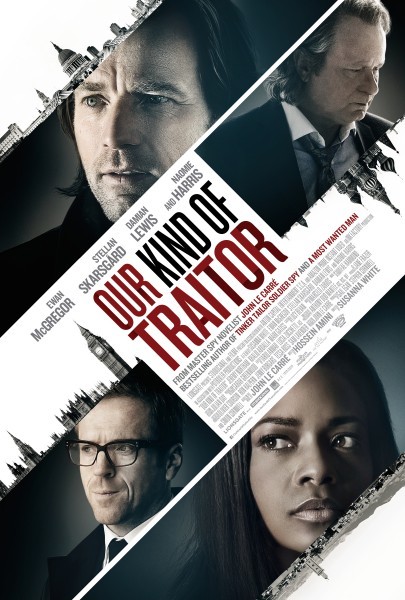
Adapted from John le Carré’s 2010 novel of the same name, Our Kind of Traitor is an above-average spy thriller complete with an all-star cast. The film is the tenth film adaptation of le Carré, the famed contemporary British novelist known for espionage fiction following his early career in British intelligence. Like some of his other works, the film involves a normal law-abiding citizen, in this case an English professor named Perry played by Ewan McGregor, who finds himself entangled in an intricate web of international intrigue. While on vacation with his wife played by Naomie Harris in Marrakech, Morocco, Perry randomly meets a Russian oligarch named Dima who helps launder money for the Russian Mafia. Portrayed by Stellan Skarsgård, Dima takes Perry on a whirlwind of stereotypically extravagant Russian parties, all for what we soon learn to be ulterior motives. Fearing for the safety of his family, the slick Dima covertly passes to the in-over-his-head Perry a thumb drive connecting names with secret bank accounts. He wants the information to reach MI6 so that he can negotiate asylum for him and his family. Eventually, Damian Lewis’s character is brought in as the MI6 handler who is eager for more proof of the elaborate Russian money-laundering scheme that may also implicate high-ranking British officers. Perry and his wife become stuck between their allegiance to the British government and Dima’s family’s safety. Overall, I found the film to be an interesting take on a spy thriller but ultimately left me wanting more. Although the acting performances were a strong suit, the film is not up to the level of the other terrific le Carré’s adaptations, particularly The Constant Gardener, Tinker Tailor Soldier Spy, and the recent BBC miniseries The Night Manager.

The Shallows

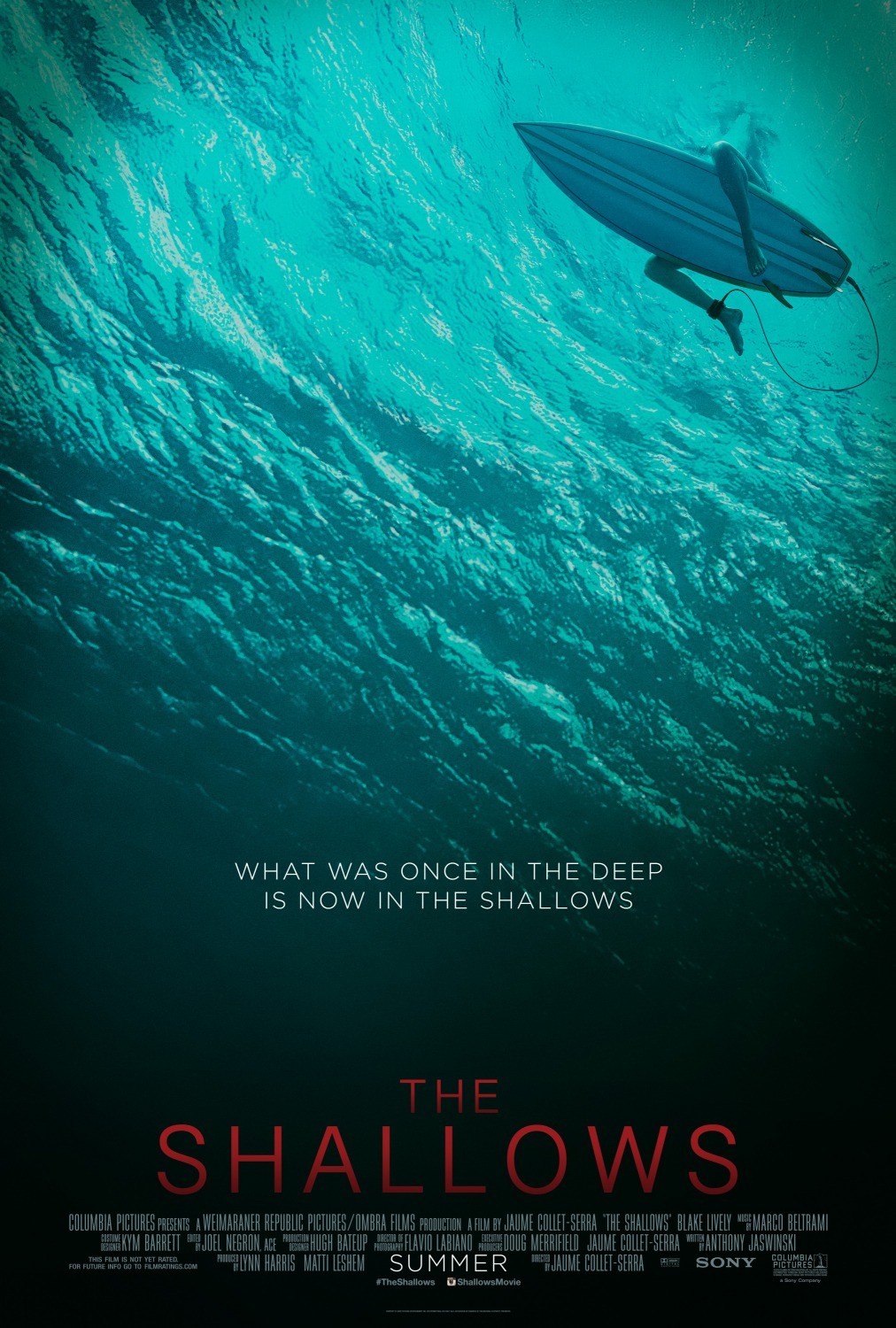
A surprisingly thrilling movie, The Shallows stars Blake Lively as an aimless surfer who must fend for her life from a great white shark. The film’s first 20 minutes or so is like any other surfing movie, complete with stunning action shots in a beautiful tropical setting. It starts with her being driven through a dense jungle to a secluded beach in Mexico. Along the journey, she converses with her local driver during the only major speaking part of the film. Through her conversation and a series of photos shown on screen as if on her cell phone, we learn that Lively’s character has always dreamed of visiting this particular beach because of her mother’s personal connection with it. When she finally gets in the water to catch some waves, palpable tension is created because we never know when the shark will inevitably attack. Nearing dusk and all alone, the telltale shark fin is spotted lurking near her and your mind unconsciously hears the theme music from Jaws. Much of the rest of the film, Lively’s character is trapped on a small outcropping of rocks only 200 yards away from the shore. She is forced to muster up the courage to devise a way of escaping her deadly predicament with the limited resources at her disposal. Its focus on a single individual figuring out how to survive reminded me of the movies Castaway and 127 Hours. The film is also obviously reminiscent of the all-time classic shark movie Jaws; in fact, it may very well be the best shark-themed movie released since Spielberg’s 1975 thriller. Like Jaws, a lot of the suspense is created without even showing the shark and even includes underwater shots seemingly from the shark’s perspective. However, there are a few brief shots of the shark actually attacking its victims with some gore. Going into the movie, I was expecting a cheesy B-movie that would not be able to overcome its inherently gimmicky premise of one woman on a rock versus one very hungry great white shark. However, I came away impressed with the film’s successful ability to create a very suspenseful and exhilarating cinematic experience, ultimately transcending its basic shtick.

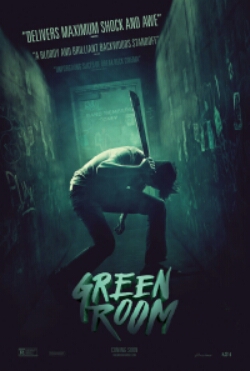
Green Room

image

Green Room is a well-directed independent film that is definitely not for the faint-hearted. At the beginning, the film follows a punk rock band that is literally living gas tank to gas tank on a cross-country tour and eventually end up somewhere they really should not be. Desperate for any paying gig, the band of young misfits arrive at a run-down compound located deep in the Oregon woods where they perform in front of a large gathering of white supremacists. The group  find themselves trapped inside the back green room after a young female is discovered murdered. The movie becomes a slow burn thriller in which we really do not know what happened and what exactly the gang of white supremacists are doing at the compound. Then, it rapidly descents into hell for the band members after the arrival of the gang’s leader played by Patrick Stewart who tries to clean up the mess and elude the police. As probably the greatest asset to the film, the acting from Stewart is top-notch; his brilliantly creepy performance as an unrepentant psychopath is so markedly different from what we are used to in Star Trek. Evolving into a classic midnight special, the standoff elevates into an extreme level of violence and gore. Although the scenes of violence can be gratuitous, the movie maintains clever dialogue and outstanding acting. The band’s default leader played by Anton Yelchin develops from being subdued and indecisive to becoming a no-holds-barred fighter adamant on escaping alive along with a young woman portrayed by the sublime Imogen Poots. I would recommend Green Room only to those willing to go on a wild roller coaster of thrills and are not squeamish.

Money Monster

image

Directed by Jodie Foster, Money Monster follows in the footsteps of The Big Short by providing an entertaining movie about the pitfalls of Wall Street. It is a gripping real-time thriller that blurs the line between villain and hero and that everything may not be as it seems. George Clooney, portraying a Jim Cramer-type host of a popular financial television show, is taken hostage by a desperate man, effectively played by Jack O’Connell, looking for revenge and answers after losing most of his money from a bad investment overhyped by Clooney’s character. As the man with the gun, O’Connell’s character at first blush seems to be the villain but over the course of the hostage crisis we are left feeling sympathetic for his plight. The movie resonates well with the current political and economic environment in which politicians like Bernie Sanders rail against income inequality and the perceived corruption of Wall Street. While having moments of comic relief, the film directly and indirectly addresses such serious subject matters as the implications of cable news, reality television, and the business of Wall Street. It is about a so-called journalist walking a fine line between entertainment and journalism and a violent situation that is broadcast live around the world like reality television and caused by the powerless feeling injustice at the hands of the rich and powerful. Overall, I found it to be an entertaining blockbuster that provides the right amount of thrills and smarts to make it worth watching in theaters.