
Wonder

Based on the 2012 best-selling novel of the same name written by R.J. Palacio, Wonder is a well-crafted sentimental movie with a hopeful and inspirational story about a young boy suffering from a medical disorder. Played by the talented young actor Jacob Tremblay best known for his role in the 2015 movie Room, the story follows August “Auggie” Pullman as he enters fifth grade after being homeschooled by his mother Isabel, played by Julia Roberts, because of his rare genetic condition that causes facial deformities and has required many reconstructive surgeries. He is fearful that the kids at his new school will bully him for his appearance and, like most kids, whether he will fit in and make new friends. The filmmaker uses the unusual technique of starting the film with several different sequences about specific main characters. The film begins to follow the emotional journey of Auggie’s parents Isabel and Nate, played by Owen Wilson, as well as his older sister Olivia who all cope with the difficulties associated with Auggie’s condition. In the segment following Olivia, the audience learns that she is also affected by her brother who receives most of the attention in the family, and she has to deal with the pressures of high school and the distancing of her best friend. Like Auggie, she has to find a safe and happy place, which she discovers is the high school drama program where she meets her new boyfriend. Towards the middle, the movie shifts to a more traditional narrative showing Auggie adjusting to his new school run by the kind-hearted principal Mr. Tushman, played by Mandy Patinkin, and having to face the school bully Julian while developing a friendship with a nice boy his age named Jack. Eventually, Auggie finds his place and is encouraged by his inspirational homeroom teacher Mr. Browne, played by the musician Daveed Diggs. Overall, I found it to be an uplifting film that sheds a light on how severe medical disorders affect not just the sufferer but also everyone around them who must also deal with the challenges. Despite Auggie’s disability, he is able to move beyond the difficulties and become an inspirational figure for his family and classmates.
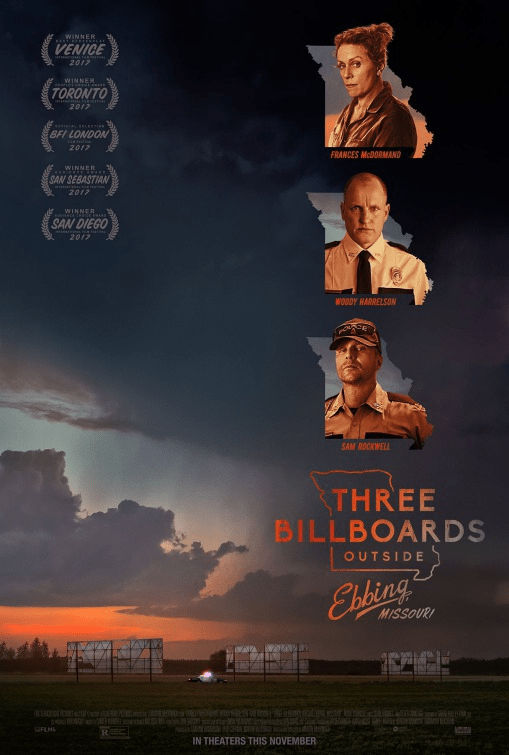

Three Billboards Outside Ebbing, Missouri

Directed by Martin McDonagh best known for 2008’s In Bruges, Three Billboards Outside Ebbing, Missouri is a terrific film with a stellar cast that expertly blends dark comedy with drama. Set in a small town in Missouri, the movie follows Mildred Hayes, played brilliantly by Oscar winner Frances McDormand, as she tries to find justice for the murder and rape of her daughter several months prior. A force not to be reckoned with, she hatches a plan to rent three abandoned billboards outside of town that directly question the police’s inability to find the culprit. A darkly funny tit-for-tat fight erupts between Mildred and the rest of the townsfolk who are sympathetic to the local police department and Chief Bill Willoughby, played by the always great Woody Harrelson. Things do not get any better with the intervention of the dim-witted and often racist Officer Jason Dixon, played wonderfully by Sam Rockwell, who does not always follow the law in protecting his chief and making sure Mildred removes the incriminating billboards. The issue over the billboards rapidly escalates into violence primarily as a result of the strong-willed and stubborn Mildred who does anything in order to avenge her daughter’s gruesome death. Even as Chief Willoughby is going through his own serious personal problem, she squarely blames the police department for not doing enough to find the perpetrator. To no avail, Mildred’s son Robbie, played by Oscar nominee Lucas Hedges, and her abusive ex-husband, played by Oscar nominee John Hawkes, insist she stop with all the shenanigans in order to prevent further shame to the family. However, she does have some strange bedfellows who encourage her, including the local slick used car salesman who happens to be a little person and excellently portrayed by Peter Dinklage. Although the background story is dramatic and depressing with it involving a rape and murder of a teenage girl, the filmmaker is remarkably able to bring some levity to the situation and allow the audience to laugh at some rather uncomfortable yet ridiculous moments of macabre humor. Overall, I found it to be one of the best films of the year because it contains such brilliant acting performances and is somehow able to effectively mix very real drama with perfectly timed dark comedy.

Lady Bird

Directed by indie actress Greta Gerwig best known for her Golden Globe-nominated performance in 2012’s Frances Ha, Lady Bird is a brilliant film featuring a refreshing take on adolescence and terrific acting performances, especially the young leading actress. A semi-autobiographical story from the first time director, the movie is set in Gerwig’s actual hometown of Sacramento and takes place during the protagonist’s 2002-2003 senior year in high school. The story follows the free-spirited and rebellious Christine McPherson, played by the extremely talented two-time Academy Award nominee Saoirse Ronan, as she navigates the often awkward and chaotic last year at a Catholic high school. The central theme throughout the plot is the sometimes fraught yet loving mother-daughter relationship between Christine, who goes by the self-ascribed nickname Lady Bird, and her equally strong-willed mother, played by Laurie Metcalf best known for her role in the TV series Roseanne. When we first meet her, Christine is somewhat of a troublemaker who constantly frustrates the nuns and does not take her schoolwork seriously. She enjoys playing around with her overweight and funny best friend Julie, but their friendship is tested when Christine desperately wants a boyfriend and hangs out with the popular rich girl at school. During the beginning, she falls for a young man named Danny, played by Academy Award nominee Lucas Hedges, who is a fellow actor in the musical she originally begrudgingly signs up for with her best friend. As she tries to fit in like a typical teenager, Christine has to deal with the repercussions of her father, played by Tracy Letts, losing his job while coping with her stressed-out mother who wants her daughter to succeed but struggles with the possibility that her only daughter may move away for college. Christine’s very strong desire to be independent causes her to act out and eventually starts to date a wild teenager from a nearby Catholic school. Throughout the film, Christine openly loathes her hometown Sacramento and makes it her goal to go to college in a different state as far away as possible from what she sees as such a boring and provincial city. Like her clingy mother, however, she eventually realizes that things in her life need to change in order to grow up. Towards the end, she finally appreciates her family and who she is and develops a sentimental attachment to Sacramento and her experiences at Catholic school. Overall, I found it to be a very impressive independent film, particularly remarkable for having a rookie director, full of excellent performances that help perfect such a hilarious and emotionally dramatic coming-of-age story. 

Last Flag Flying

Directed by Golden Globe-winning director Richard Linklater who is best known for the Academy Award-winning 2014 movie Boyhood and 1993’s Dazed and Confused, Last Flag Flying is a well-crafted and very human film that explores grief and war with powerful moments of raw emotion and levity brought to life by the extremely talented cast. Steve Carell plays former Navy Corps medic Richard “Doc” Shepherd who reunites with former Marines Sal Nealon, played by Bryan Cranston, and Richard Mueller, played by Laurence Fishburne, after he learns his son was killed in Iraq serving as a Marine. Clearly broken by the Vietnam War and the recent passing of his wife and now son, Doc contacts the two other men that he served with decades prior in Vietnam as a means of coping with the profound grief of losing his son to war. We first meet the rambunctious and wisecracking Sal overseeing his dive bar and then the soft-spoken and reformed Mueller presiding over his congregation as a Baptist minister. Eventually, Doc persuades the two very different men to pick up his son’s body from Dover Air Force Base in Delaware and take him back home in New Hampshire to be buried instead of Arlington National Cemetery. Over the course of the journey, the middle-aged men reminisce about their time as soldiers in the Vietnam War and try to rectify their prior sins. Underscoring the mixed human emotions experienced in one’s life, the characters, especially the irreverent Sal, share several moments of laughter and bonding time on their road trip despite the extremely depressing circumstances. They also grapple with their patriotism and pride of serving in the military at the same time that they disagree with the American government’s decisions to go to war in Vietnam and now Iraq. The movie works so well because of the very real chemistry that can be felt between all three brilliant actors who bring a certain level of humanity to what most people would expect to be just a sad and grim story about a father grieving over his son’s death. Overall, I found it to be an exceptional film that is both bittersweet and hopeful and provides important insights into the complexities of losing a loved one and the human toll caused by war, complete with heartwarming and heartwrenching moments. 

Murder on the Orient Express

Directed by Kenneth Branagh who is best known for his work in Shakespeare plays and film adaptations, Murder on the Orient Express is a stylish adaptation of the classic 1934 Agatha Christie novel of the same name and later adapted into a critically acclaimed movie in 1974. It feels very much like a modern update to the murder mystery genre and is jam-packed with an all-star cast, but the film largely does not live up to its predecessor and the novel itself. The always terrific Academy Award nominee Kenneth Branagh stars as Hercule Poirot, a brilliant and eccentric Belgian detective who is a recurring character in Christie’s books. While on a break between cases in the winter of 1934 in Istanbul, he is recruited to investigate a case in the UK and is offered a ticket on the world-famous luxury train the Orient Express headed to Calais, France in order to quickly reach his destination. He, along with thirteen strangers, mostly keep to themselves on an uneventful first leg of the journey. The first few scenes on the train introduce the audience to the passengers ranging from a governess, a professor, a duchess, a secretary to a mobster and are played by such famous faces as Willem Dafoe, Judi Dench, Johnny Depp, Penelope Cruz, Michelle Pfeiffer, Josh Gad, Daisy Ridley, Leslie Odom Jr., and Derek Jacobi. Things rapidly become chaotic after the Orient Express is stranded after an avalanche and a body is discovered in one of the cabins. Detective Hercule Poirot is then enlisted to help solve the murder before the train reaches its next destination. With unique cinematography, including overhead shots and long panning shots, and sumptuous detailing of the original Orient Express and 1930s costumes and decor, the meticulous detective interrogates all the passengers and tries to piece together the evidence to discover the culprit. The best part of the movie is Branagh’s portrayal of the charismatic and mysterious Poirot and the fascinating ways he is able to solve the murder mystery, all the while interacting with a terrific ensemble cast. Overall, I found it to be an enjoyable and beautifully shot movie that does not reach perfection as a result of its bloated cast, sometimes too slow pacing, and attempt to revitalize an already beloved classic murder mystery novel and film. 

Daddy’s Home 2

The sequel to the 2015 family comedy Daddy’s Home, Daddy’s Home 2 is a silly family-friendly comedy that is at times entertaining as a result of the dynamics between the talented actors but is a rather stale comedy blockbuster that is not always funny. Taking place several years after the shenanigans of the original, the manly Dusty, played by Mark Wahlberg, and the sensitive family man Brad, played by Will Ferrell, are on good terms co-parenting Dusty’s kids Megan and Dylan who live most of the time with their mother Sara, played by Linda Cardellini, who is now married to Brad. Things once again get complicated when Dusty’s macho father Kurt, played by Mel Gibson, and Brad’s kind and emotional father Don, played by John Lithgow, arrive in town for a joint Christmas between the families. Very much like the first movie, the grandfathers become competitors for who is the better parent and grandparent and thereby indulge their sons and grandchildren in order to favor love and make the other jealous. Stereotypical buffoonery and slapstick hijinks rapidly escalates, especially after Kurt comes up with the idea of celebrating Christmas in a luxurious cabin in the mountains. Along the way, we meet new characters, including Brad and Sara’s baby, Dusty’s new attractive wife Karen, Karen’s daughter Adrianna who Dusty tries to impress, and eventually Adrianna’s hunky father Roger, played by pro wrestler John Cena. With brief moments of laughter and even touching family moments mixed with a holidays theme, the film is your typical family Christmas movie that helps pass the time with family audiences during the holiday season. However, going into the movie I was not expecting what turned out to be a Christmas flick and actually thought that it was too early to release such a movie with Christmas a month and a half away. Overall, I found it to be a somewhat enjoyable and light-hearted comedy that could have been better if the all star cast was not wasted on such a frivolous and ridiculous premise: at least, the first film had some originality because the sequel feels like the filmmaker simply rehashed the original plot with only slight modifications. 

The Florida Project

Directed by Sean Baker who is best known for the 2015 independent film Tangerine, The Florida Project is a wonderfully crafted indie film that explores the largely unseen impoverished American population living in budget motels and the struggles that the adults go through while the children seem happy in the innocence of childhood. It is a fairly simple film that is more of an observant witness to the characters, predominantly a group of children, and follows their daily lives surrounded by what most people would describe as horrible living conditions. As emphasized by the movie’s title referring to the name used for Walt Disney World before it was built, the filmmaker points out the cruel irony of these innocent kids living in a rough neighborhood of Kissimmee, Florida next door to the fantastical Disney World, a place they can only dream of visiting. The main protagonist is a 6-year-old girl named Moonee, terrifically played by the charming young actress Brooklynn Prince, whose mother Halley is a troubled out-of-work single mother that goes to increasingly desperate lengths to financially support her daughter. The movie sentimentally depicts the rebellious young girl as she happily enjoys what she believes is a normal childhood playing with her group of friends and exploring her neighborhood full of run-down strip malls and motels, almost oblivious to her otherwise depressing situation. She even has a special relationship with the kind-hearted manager of her home The Magic Castle Motel, a gentle man with his own problems who becomes a father figure to the children living at the motel. Brilliantly played by Willem Dafoe in one of his best performances, the manager Bobby Hicks clearly has the kids’ best interests at heart, and he is often in the hard situation of cleaning up their parents’ messes, ranging from drug addiction to prostitution. Despite lacking a traditional plot line, the filmmaker is a master storyteller who is able to flesh out the characters through a series of small moments in their lives that add up to a powerfully empathetic portrayal of such a tragic yet hopeful underrepresented segment of our population. The audience viscerally experiences both the heartwarming and heartbreaking moments in these people’s lives: the children’s innocence lifts up our spirits while the adults’ daily challenges reminds us of the hardships of those living in poverty. Overall, I found it to be one of the best films of the year because of its captivating storytelling that feels very real and is able to illuminate a previously unexplored problem in today’s modern society in a sympathetic and non-condescending manner. 

LBJ

Directed by Rob Reiner who is mostly known for comedies, LBJ provides a fascinating historical look into the larger-than-life 36th President of the United States, unexpectedly played by Academy Award nominee Woody Harrelson, but,  unfortunately, becomes nothing more than a formulaic biopic that adds very little significance to the already robust cultural treatment of President Johnson. The movie is a series of flashbacks between the fateful days of November 1963 following President Kennedy’s assassination in Dallas and the early years of the Johnson Administration pursuing the monumental Civil Rights Act of 1964. It does a fairly good job of recreating the moments surrounding the JFK assassination, but it does not feel that remarkable since it has been depicted so many times in films and television. The main emphasis of the film is the emotional stress of LBJ witnessing the death of the American president at the same time that he finally achieves his lifelong dream of becoming president. I found the most interesting aspect to be the portrayal of the often difficult and toxic relationships between LBJ, JFK, and members of JFK’s inner circle, especially his brother Bobby who was the attorney general. When he finally ascends the presidency, LBJ must work all legislative and executive options to pass the controversial Civil Rights Act, which potentially alienates him from his former Democratic colleagues from the South serving in the Senate and House, including the more conservative Georgia Senator Richard Russell, played by Academy Award nominee Richard Jenkins, and more liberal Texas Senator Ralph Yarborough, played by Bill Pullman. The movie does a superficial job of delving into the emotions of LBJ and only provides a little insight into his special relationship with his wife Lady Bird Johnson, played by Jennifer Jason Leigh. Overall, I found it to be intriguing only for providing additional stories about such a complicated figure as LBJ, and the film feels lacking in providing a fuller picture of such a charismatic and dynamic president by just focusing on two very specific moments in the life of LBJ.

Suburbicon

Directed by George Clooney, Suburbicon is a strange movie mixing satire, murder mystery, and racial social commentary that ultimately fails its great potential with such a stellar cast of actors and famous writers and director. Going into the movie, I was fully prepared for a zany and eccentric experience since it is partly written by Joel and Ethan Coen, both highly-skilled writers and filmmakers known for oddball humor and satire. The movie starts like a stereotypical vintage infomercial for a bizarrely exaggerated picturesque and quiet suburban community with a 1950s-sounding narrator and imagery associated with that era. I was almost immediately reminded of the 1998 movie Pleasantville, which effectively captured the 1950s and was mostly shot in black-and-white. We first meet the protagonist Gardner Lodge, played by Matt Damon, who appears to be a gentle and normal middle class suburban father and husband in the relatively new predominantly white town of Suburbicon. Coinciding with the first African-American family moving into the community, much to the consternation of the white neighbors, Gardner, his wife Rose, played by Julianne Moore, their young son Nicky, and Rose’s twin sister Margaret, also played by Julianne Moore, are robbed by two mysterious strangers. Rose who is bound to a wheelchair after a recent car accident is subsequently killed during the robbery. Gardner, in a peculiar calm fashion, tries to return to a life of normalcy and asks Margaret to stay and help with raising Nicky. Reinforcing that not all is well in the seemingly perfect Suburbicon, the residents’ hatred and problems arise as their discomfort with the black family becomes a race riot. With such chaos surrounding them, suspicions about the robbery and Rose’s death are raised by the police and the life insurance company Gardner is trying to collect from his wife’s death. To make matters worse, a slick insurance agent named Bud Cooper, played by Oscar Isaac, arrives at the Lodge residence aggressively investigating the life insurance claim and if the death of Rose was orchestrated to defraud the insurance company for money. Chaos rapidly engulfs this supposedly idyllic town where everybody gets along, and the increasingly violent acts expose the hypocrisy and true nature of the residents, especially Gardner and Margaret. Unexpectedly, the movie becomes predominately a murder mystery almost immediately after the satirical opening act and does not have as much dark comedy as the promotional material would have you believe. Overall, I thought that the film tries too hard to blend several genres together to provide biting social commentary, and, unfortunately, fails to capitalize on the terrific talent involved and thereby becomes a wholly different movie than expected. 

Thor: Ragnarok

Directed by New Zealand filmmaker Taika Waititi who is best known for the brilliant 2016 comedy Hunt for the Wilderpeople, Thor: Ragnarok is a wildly entertaining and hilarious comic book superhero movie that is unlike most of the other sixteen films in the Marvel Cinematic Universe. In the third installment of the Thor franchise, we first meet Thor, played by Chris Hemsworth, as a prisoner on a fiery planet who eventually escapes to return to his home planet Asgard to discover that his father and ruler of the realm Odin, played by Anthony Hopkins, is living on Earth and his trickster brother Loki, played by Tom Hiddleston, is the de facto leader. Both brothers learn from their father that there is a prophecy soon to take place known as Ragnarok that says that Asgard will be destroyed. Soon afterwards, Thor meets his secret evil sister Hela, played by the particularly devious Cate Blanchett, whose appearance will hasten Ragnarok through her destruction and enslavement of those living on Asghar. On a desperate mission to get rid of his powerful sister, Thor finds himself on an extremely colorful alien planet called Sakaar, which serves as the garbage planet for the universe, where he is captured by the female bounty hunter Scrapper 142, played by Tessa Thompson. She turns over Thor to the comically over-the-top ruler of the planet known as the Grandmaster, played by a perfectly cast Jeff Goldblum, who forces Thor to participate in a gladiator-like tournament against the dim-witted yet strong Hulk, voiced by Mark Ruffalo, who appeared with Thor in The Avengers movies. After several funny reunion scenes with Thor and Hulk, they team up with Scrapper 142 who turns out to be from Asgard and embark on a joy ride adventure to save Asgard and kill the deadly Hela. Reminding me of the equally comedic Guardians of the Galaxy films and the vulgar Deadpool movie, the film is chock-full of self-deprecating humor that pokes fun at superhero franchises and references to the other movies as well as today’s pop culture. It also includes completely random and unexpected cameos that further conveys a fun and sometimes ridiculous atmosphere. Overall, I found it to be one of the more entertaining Marvel movies and thereby provides a refreshing reboot of the increasingly stale comic book superhero genre. Even if you are not a fan of comic book superheroes, I would highly recommend going to the film if you are looking for an amusing and good old time at the movies.