The Souvenir

Written and directed by critically acclaimed British independent filmmaker Joanna Hogg known for making movies that partly reflect her own life, The Souvenir is a very artsy indie film about a budding film student who enters into a troubled relationship with a slightly older man, and it is remarkable for the terrific acting performances and the unique filmmaking techniques and writing. A slow burn of a movie, the almost philosophical movie revolves around the main character Julie, played by the talented young newcomer Honor Swinton Byrne who is the daughter of Oscar winner Tilda Swinton, who tries to distance herself from her upper middle-class family, including her mother played by Tilda Swinton, by joining a small film school and obsessing over making a movie with a very vague topic. Eventually, she begins a romantic relationship with the mysterious and quintessentially posh Anthony, played by the mesmerizing English actor Tom Burke, who is in a constantly dark place and is revealed to have some serious addiction problems. Similar to Julie, he very much goes against what is expected of him, and it is rather a surprise to learn that his family is from a working class and laid-back background. Often, the film feels like a personal project that is a very meta exploration of filmmaking, romance, class status, and toxic relationships. Yes, it can be a difficult-to-watch and confusing movie, but somehow it leaves a deep impression upon the viewer and reveals itself to be more like a piece of artwork that should be cherished for its complexity and beauty. Overall, I found it to be one of those rare films that I did not initially know whether I liked it or not; it was only after watching the movie did I realize how much it affected me. Only now do I appreciate it as one the best movies of the year as a result of how the filmmaker and actors were able to craft such a superb cinematic experience from an occasionally frustratingly opaque story.

Photograph

Written and directed by critically acclaimed Indian filmmaker Ritesh Batra best known for 2013’s The Lunchbox, Photograph is a charming and insightful romantic movie that follows the usual patterns of a Hollywood romantic comedy but goes beyond the genre by incorporating subtle messages about Indian society, particularly the color and caste systems. With predominantly Hindi dialogue, the film explores an unexpected relationship between two very different people from separate parts of society in Mumbai, an unusual bond started with a chance encounter at the tourist landmark Gateway of India. Rafi, played by Nawazuddin Siddiqui, lives in poverty and works as a street photographer taking pictures of tourists in order to repay his family debts back home in his native village. As is the case in most of Indian families, he is constantly urged to settle down and marry an Indian woman. To appease his very insistent grandmother, he eventually decides to pretend that he is in a romantic relationship with a younger shy woman that he took a picture of at the Gateway of India. Over time, he is able to convince the young woman named Miloni, played by Sanya Malhotra, to play along and meet his grandmother who has just arrived from her small village to see this supposed girlfriend of her grandson. Miloni comes from a middle-class background and is currently studying to become an accountant at the insistence of her parents who she still lives with at home. Similar to Rafi, she is a fairly quiet person who is looking for a way out of her rather mundane life. The best part of the movie is the rather funny and persistent performance given by Rafi’s strong-willed yet sweet grandmother who is played by Farrukh Jaffra. Despite the two main characters’ diverging class status and family background, they begin to become fond of one another and spent time alone together outside of trying to convince his grandmother of their potential marriage. Overall, I found it to be a bittersweet romance that, although at times can be slow, is very touching and has a lot to say about the contemporary issues facing Indian society and culture as a whole, all the while relying on beautiful cinematography to capture the essence of Mumbai.

Dark Phoenix

The 12th installment in the X-Men movie franchise first started in 2000 and a direct sequel to 2016’s X-Men: Apocalypse, Dark Phoenix is a remarkably bad superhero comic book film that is very predictable and full of dull moments in which the undoubtedly talented cast give rather lackluster performances. The movie follows the younger version of the X-Men from an alternate reality separate from the original X-Men movies headlined by Patrick Stewart and is set in the year 1992 when the X-Men mutants with extraordinary powers are sent on a rescue mission in space to save NASA astronauts. Primarily focused on the character Jean/Phoenix who has telekinetic powers and is played by Sophie Turner of Game of Thrones fame, the film delves deep into the circumstances of Jean finding herself among the X-Men and her transformation into a much more powerful mutant after being exposed to an extraterrestrial solar flare. She is joined by fellow X-Men led by Charles Xavier, played by Golden Globe nominee James McAvoy, Professor Xavier’s right-hand man Hank/Beast, played by Nicholas Hoult, one of the older X-Men Raven/Mystique, played by Oscar winner Jennifer Lawrence, Jean’s love interest Scott/Cyclops, played by Tye Sheridan, as well as younger X-Men still learning. Jean becomes a danger to all of her friends as well as the rest of humanity when she absorbs the full power of what we later learn is a super powerful extraterrestrial being that an alien race of shapeshifters are looking for their own benefit. This is alien group is led by Vuk in the form of a female human, played by Oscar nominee Jessica Chastain, who is hell-bent on harnessing Jean’s superpowers. Eventually, the X-Men team up with Charles Xavier’s arch-nemesis Erik/Magneto, played by Oscar nominee Michael Fassbender, whose powers are needed to save and protect Jean from her own power and the aliens who are hunting her down for it. The movie does have several very typical CGI action sequences in which the X-Men use their fantastical strengths, but the scenes in between are rather mundane and lacking in any real emotions for such a character-driven movie. Overall, I was truly surprised by how much of a misfire the movie was for being part of the highly popular superhero genre, and it felt like a truly unnecessary addition to the already expansive X-Men franchise.

All Is True

Directed by critically acclaimed actor and director Kenneth Branagh best known for his Shakespearean film adaptations, All Is True is a beautifully acted and filmed historical drama that provides a fictionalized account of William Shakespeare returning home to retirement after writing his last play. Set in 1613 immediately after the Globe Theatre in London burned down, the world’s most famous playwright William Shakespeare, played by Oscar-nominated British actor Kenneth Branagh, decides to return to his family in his hometown of Stratford-upon-Avon and tries to settle down in a life of retirement. He reconnects with his wife Anne Hathaway, played by Oscar-winning British actress Dame Judi Dench, and his daughters Judith and Susanna after he has been away in London writing plays for extended periods of time. Reminiscent of a staged performance, the movie is fairly slow-paced in very intimate settings with elaborate costumes and flowery monologues between the characters. The story attempts to explore Shakespeare’s mental state by showing his preoccupation with the death of his son Hamnet many years ago and his negligence of his daughters after believing that the wrong child died; he thought his son was a genius like himself and thereby still cherishes the only supposed writings of the young Hamnet. He tries to live out a peaceful existence and even decides to create a garden in his son’s memory. However, things quickly do not going according to plan as a result of a scandal involving his married daughter Susanna and the rebellious ways of his other daughter Judith still living at home without a prospect of a husband. In one of the best moments of the film, the Earl of Southampton, played by Oscar-nominated British actor Ian McKellen also known for his Shakespearean acting, pays a visit to Shakespeare at his home and privately discuss what some believe was their romantic relationship. Overall, I found it to be yet another enriching fictionalized account of the one and only William Shakespeare and his mysterious personal life, and I was particularly taken by the terrific acting performances enhanced by the sumptuous costumes and historical attention to detail.

Godzilla: King of the Monsters

The 35th installment in the Godzilla movie franchise first started in 1954 in Japan and the third Godzilla production from a Hollywood studio, Godzilla: King of the Monsters is a summer blockbuster that has everything expected from a monster movie, especially a film about the iconic Godzilla, full of spectacle and CGI chaos but light on story despite a stellar cast of well-known talented actors. The movie, which is a sequel to 2014’s Godzilla, follows scientist Dr. Emma Russell, played by Oscar nominee Vera Farmiga, and her daughter Madison, played by Millie Bobby Brown best known for her role in the Netflix TV series Stranger Things, who are kidnapped by a shadowy eco-terrorist group led by Alan Jonah, played by the terrifically villainous Charles Dance best known for his role in the HBO TV Series Game of Thrones. Dr. Russell has developed a machine that can attract and control the large God-like monsters known as the Titans that are seen as a threat by governments across the world and are under surveillance and guarded by the secretive zoological organization known as Monarch, which Dr. Russell and her husband Dr. Mark Russell, played by Emmy winner Kyle Chandler, worked for as scientists and researchers. Over the course of the film, several of these Titans are released and inflict widespread destruction with Jonah’s idea that it would restore the Earth’s ecological balance with humans. Monarch tries to track down these monsters and prevent them from causing more chaos. This expansive classified agency is led by an expert team of scientists, including a Japanese scientist and the de facto leader played by Ken Watanabe, a paleozoologist played by Oscar nominee Sally Hawkins, a technology expert played by Thomas Middleditch best known for his role in the HBO TV series Silicon Valley, and a wisecracking crypto-sonographer played by Bradley Whitford best known for his role in the TV series West Wing. It will surely delight fans of the Japanese kaiju monster genre with the appearance of such iconic large-scale creatures as Mothra, Rodan, Ghidorah, and Godzilla. Initially referred to as Monster Zero, Ghidorah is an extremely powerful three-headed monster who acts as Godzilla’s arch rival and is often shown in huge battles with Godzilla over who will be the apex predator. Godzilla becomes a sort of ally of the human race and the Monarch scientists as a result of his ability to defeat the other monsters and restore balance to the planet without further disaster. The best part of the movie is the CGI fight sequences between the humongous creatures as they lay waste to such major cities as Boston, and the filmmakers make the rather unusual decision to have the footage appear darker and granier to perhaps provide a dire atmosphere. Overall, I found it to be a fun and silly entertaining popcorn flick that provides enough monster mayhem to make for a suitable Godzilla film, and it should not be criticized so severely because its overall intention is not to take itself too seriously.

The Biggest Little Farm

Directed by Emmy Award-winning filmmaker John Chester who is best known for his short films, The Biggest Little Farm is a surprisingly entertaining and uplifting documentary about nature that explores the ups and downs of running an organic farm. The movie begins with the filmmaker and his wife Molly finally deciding to pursue their life-long dream of owning and operating a farm based on natural organic principles. With the help of their friends and investors, they purchase the failing Apricot Lane Farms an hour outside of Los Angeles and are very much overwhelmed with the amount of work that must be done on the 200 acres. Eventually, they hire an expert on organic farming who gives them invaluable advice and also becomes a very close friend, and, over time, the crops and animals flourish. The film does an excellent job of showing the life of a growing farm by including footage over the course of eight years in which their progress in one area results in a serious problem in a different area of the farm. For instance, their goal of creating an organic farm in which all of nature is in complete coexistence with a large variety of crops and animals makes them face such challenges as dealing with coyotes eating their chickens and insects destroying their crops without pesticides. The documentary is also a love story about nature and includes such poignant moments as the bonding between Emma the pig and a lonely rooster named Greasy. Overall, I found it to be one of the best nature documentaries as a result of its engrossing story and quite beautiful cinematography that left me inspired by the majesty and ever-changing world we live in, complete with its pitfalls and complexities.

Aladdin

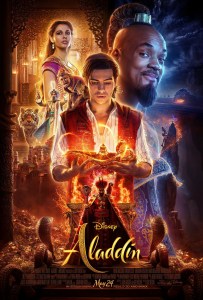
Directed by Guy Ritchie best known for such comedy crime films as 1998’s Lock, Stock and Two Smoking Barrels and 2000’s Snatch, Aladdin is a live-action remake of the classic Disney animated movie released in 1992 that is full of CGI spectacle but does not come close to the original with its remarkable voice acting of Robin Williams. Set in a fictional Middle Eastern kingdom, the story follows the street thief Aladdin, played by Canadian actor of Egyptian ancestry Mena Massoud, who falls in love with the Sultan’s daughter Princess Jasmine, played by English actress of Indian ancestry Naomi Scott. After he is led to a secretive cave by the villainous advisor to the sultan Jafar, played by the Dutch actor of Tunisian ancestry Marwan Kenzari, Aladdin comes into possession of a magical lamp after he steals it from the power-hungry Jafar. Aladdin soon discovers that the lamp contains the powerful and magical Genie, played by a blue colored Will Smith, who enjoys putting on a show and making jokes but also has the ability to grant Aladdin three wishes. However, Will Smith’s character comes off way too silly and does not even come close to replicating the comedic genius of Robin Williams’ Genie. Aladdin decides to use the wishes to better pursue Princess Jasmine as his love interest and one way to do that is to magically become a prince from an unheard-of land. Despite the helpfulness of Genie who is obviously the comic relief of the movie, the situation becomes complicated especially with interference from Jafar who wants to become Sultan by all means. Similar to the original, the movie is filled with sometimes random musical numbers that are not quite as effective as they were in the animated version. Overall, I found it a mildly entertaining film that does a good job of creating a fantastical world while also importantly using a cast largely composed of actors of Middle Eastern descent, but it also beg the questions of why did the classic animated feature need to be remade and whether Guy Ritchie and Will Smith were the right fit for this particular movie.

Booksmart

Directed by actress Olivia Wilde in her directorial debut, Booksmart is an excellent and exceedingly funny coming-of-age movie that takes a refreshingly new spin on the rather tired genre by relying on a talented young cast and comedy that is updated for modern culture and social norms. The film follows two best friends Amy, played by Kaitlyn Dever best known for her role on the sitcom Last Man Standing, and Molly, played by Beanie Goldstein best known for her role in 2017’s Lady Bird, on the eve of their high school graduation. Focused on academics for much of their school years in order to get into Ivy League colleges, they quickly realize that their fellow party-going classmates also were able to get into the same good schools. As a result, they decide to have some fun and go to parties that they have missed out on before they graduate and go on to college. At first blush, it feels like your typical vulgar high school comedy and a girl version of 2007’s Superbad. However, it is a very different movie that is full of heart by exploring the two protagonists’ lifelong friendship and presents a non-judgmental view of female sexuality as well as Amy’s homosexuality that is shown as not a big deal when talking about her crush on a fellow female classmate. The night is full of unexpected antics in which they encounter their classmates who are quite the characters but are generally nicer than what they appear to be at school. Most of the actors are relatively unknown, which helps the movie have a more realistic feel, but the film also includes such veteran actors as Jason Sudeikis who plays their principal, Lisa Kudrow who plays Amy’s mother, and Will Forte who plays Amy’s father. Undoubtedly, the terrific acting performances given in the movie by the many young actors will help launch their careers much like Superbad did for Jonah Hill and Michael Cera. Overall, I found it to be a surprisingly smart and kind-hearted teenage comedy that is the perfect showcase for the truly talented cast and first-time director Olivia Wilde. If you are looking for a highly entertaining movie, albeit one that can be inappropriate at times, then this first-rate comedy is right up your alley and should be seen as soon as possible.

Trial by Fire

Directed by critically acclaimed filmmaker and Oscar-winning producer Edward Zwick best known for 1989’s Glory and 1995’s Legends of the Fall, Trial by Fire is a well-crafted drama with terrific acting performances from the two main characters and a deeply compelling plot about a man on death row for a crime that he probably did not commit. Based on a true story, the film follows Cameron Todd Willingham, played by the talented British actor Jack O’Connell, as he goes through the flawed Texas justice system and eventually meets an unexpected supporter of his case for exoneration. In the beginning of the movie, we witness his trial which leads to his conviction and being sent to death row for the arson and murder of his three young daughters in Corsicana, Texas in December 1991. As a poor and uneducated individual living in rural Texas with tattoos and a love of heavy metal music, he quickly discovers that he has not received the same level of legal representation and thereby is more susceptible to a miscarriage of justice. He spends most of his twelve years on death row learning the judicial system in order for him to try and petition for a retrial or exoneration as a result of several investigative blunders and negligent lawyers. As the years pass, he develops a very close relationship with a single mother of two kids living in Houston who comes to visit him numerous times before deciding to help out on his case. Played by Golden Globe winner Laura Dern, Elizabeth Gilbert becomes a strong advocate for Willingham even as family members question her motivation for trying to free a convicted murderer. Over the course of the film, it becomes readily apparent that he is innocent or at least not deserving of the death penalty and therefore the movie becomes much more of a anti-death penalty film critical of the justice system. Overall, I found it to be a powerful movie by a filmmaker who does an excellent job of showing the emotional rollercoaster that someone like Willingham must go through as he faces certain death by the state while providing a unique perspective from the most unexpected source of Elizabeth Gilbert.

Tolkien

Directed by critically acclaimed Finnish director Dome Karukoski, Tolkien is a well-intentioned biopic, that is slightly disappointing, about one of the most important 20th century authors J. R. R. Tolkien and tries to explore what possibly inspired him to write the famous fantasy books The Hobbit and The Lord of the Rings series. Living a difficult childhood as an orphan living in impoverished Birmingham, England, Tolkien, played by Nicholas Hoult best known for 2002’s About a Boy and 2015’s Mad Max: Fury Road, is heavily influenced by a close group of friends he meets while studying at a prestigious school sponsored by the local Catholic Church. Eventually, because of his high marks, he goes on to study at Oxford University where he discovers his love for languages and continues to pursue his love interest Edith Bratt, played by Lily Collins who is the daughter of English musician Phil Collins. The movie is interspersed with flashbacks to his horrific experiences as a soldier in the trenches during World War War I in which some of his best friends are killed in action. The filmmaker makes the case that the creative and idealistic Tolkien was partly inspired by his wartime experiences to craft his later high fantasy books about the struggle between good and evil mixed in with magic and heroism. The movie sometimes goes overboard on focusing on the events and objects in his life that are visually connected to the characters and themes of his published works. Many of the references may go over most audience’s heads, but I could see how it would be a treat for fans of The Hobbit and The Lord of the Rings book series. Overall, despite the historical visual aesthetic and commendable acting performances, I found the film to be sometimes too slow and not really geared for general audiences as a result of the constant inundation of reference points in the otherwise fascinating story of Tolkien’s life.