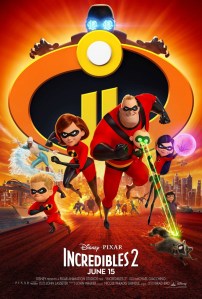
The long-awaited sequel of the wildly successful 2004 animated superhero movie The Incredibles, Incredibles 2 is yet another excellent Pixar Disney movie that comes close to the original with its unique retro style and family-friendly fun. Set shortly after the first movie, the story follows the Parr family in which each family member has a superpower but have not been able to publicly remain superheroes since they have recently been outlawed. In a publicity ploy to help legalize superheroes by the wealthy tech entrepreneur Winston Deavor, voiced by Emmy winner Bob Odenkirk, along with his brilliant sister Evelyn, voiced by Oscar nominee Catherine Keener, Helen who is the superhero Elastigirl, voiced by Oscar winner Holly Hunter, is recruited to serve as a positive image of a superhero saving lives. Her husband Bob who is the superhero Mr. Incredible, voiced by Emmy winner Craig T. Nelson, begrudgingly becomes a stay-at-home dad and is unable to use his superhuman strength in public because it is deemed too destructive. He is depicted as a stereotypical father who is in over-his-head while also dealing with three kids who happen to have superpowers. Violet, voiced by comedian and writer Sarah Vowell, is your typical teenage daughter with the exception that she can become invisible and project a protective force field. The middle son nicknamed Dash is a rebellious middle schooler who has superhuman speed. The most entertaining and funny moments occur with the baby Jack-Jack who we find out has some fairly unusual superpowers that are both cute and dangerous. Eventually, Elastigirl heroically fights off a new supervillain named Screenslaver who is hypnotizing citizens and ultimately other superheroes to commit crimes. Towards the end of the movie, we discover that the true villain is actually somebody completely unexpected. Overall, I found it to be a highly entertaining computer animated family movie that appeals to both kids and adults alike as a result of its exciting and sometimes funny action coupled with creative writing and look.

 Directed by critically acclaimed filmmaker Ron Howard who won the Academy Award for 2002’s A Beautiful Mind, Solo: A Star Wars Story is an entertaining movie in the Star Wars saga with plenty of adventure and CGI-enhanced action sequences but underwhelms compared to the original and most recent installments. As the second standalone anthology film in the series, the movie is more of a origin story that follows the early exploits of Han Solo, played by the up-and-coming charismatic Alden Ehrenreich, and how he evolved into the famous character portrayed by Harrison Ford in the original trilogy. We first meet Han trying to escape a criminal organization with his girlfriend Qi’ra, played by Emilia Clarke of Game of Thrones fame, and travel to another planet where he can pursue his dream of becoming a pilot. For a time, he is a soldier for the Empire, but he eventually becomes a deserter to join forces with a group of criminals led by Tobias Beckett, played by Oscar nominee Woody Harrelson. He also meets his future famous copilot Chewbacca, and they enter in their friendly rapport with humorous back-and-forth as depicted in the first movies. The rest of the movie follows the formula of a heist film in which Han and his new outlaw friends must steal the valuable so-called hyperfuel coaxium for yet another criminal syndicate known as the Crimson Dawn led by Dryden Vos, played by Paul Bettany. Things get increasingly complicated for Han, and he must team up with the notorious smuggler Lando Calrissian, played by Emmy winner Donald Glover, who provides him the means of piloting the well-known Millennium Falcon spaceship. Towards the end of the film, there are a few plot twists and not all of the characters are as they appeared in the beginning. The story appeases Star Wars fans with the appearance of characters and new details that refer to the nine other installments and may not have as much significance for general audiences. Overall, I found it to be a satisfying cinematic experience that had enough excitement to make up for the shortcomings of being sometimes too formulaic and not adding much depth to the already complex Star Wars franchise.

 Based on the best-selling 2011 novel of the same name written by Ernest Cline, Ready Player One is entertaining science fiction fantasy that effectively recreates the video game experience with its frenetic pace and overabundance of CGI. The plot revolves around Wade Watts, played by Tye Sheridan, who lives in a futuristic Columbus, Ohio in 2045 and finds himself on an adventure in the so-called OASIS, a virtual reality world that most people tap into to escape their dystopian real lives. Wade whose avatar is named Parzival is what is known as a Gunter and searches for the Easter eggs that the creator James Halliday, played by Oscar winner Mark Rylance, hid within OASIS after his death. The person that discovers the three keys will become the sole owner and operator of the massive virtual world in addition to receiving $500 billion from Halliday’s estate. With the possibility of such immense power, the villainous CEO of the video game corporation IOI Nolan Sorrento, played by Emmy winner Ben Mendelsohn, enlists an army of indebted OASIS users to discover the clues left behind in order to take control. Wade races to discover all of the Easter eggs before Sorrento and eventually teams up with a group of other avatars known as the “High Five,” including the young and beautiful Art3mis whose real name is Samantha Cook, played by Olivia Cook, and Wade’s virtual best friend Aech, played by Lena Waithe who is best-known for her role in the Netflix series Master of None. The movie feels very much like the audience is alongside Wade as he battles through what is essentially an elaborate video game, with the telltale graphics of a modern first-person shooter and the presence of avatars and Easter eggs. Besides the spectacular and almost seizure-inducing special effects and action sequences, the film is remarkable for its nostalgia and homage to vintage and contemporary video gaming as well as past pop culture, in particular the 1980s and even to the director Steven Spielberg’s earlier movies. Overall, I found it to be a unique and creative cinematic experience that, for better or worse, feels like a video game nerd’s fever dream brimming with so much insider geeky knowledge to be almost too overwhelming for general audiences.
 KEITH on Reels