
Sully

Directed by Clint Eastwood, Sully is a well-crafted movie that tells the amazing true story of the Miracle on the Hudson when Captain Chesley ‘Sully’ Sullenberger safely landed US Airways Flight 1549 on the Hudson River in New York City on January 15, 2009. With its relatively short runtime and attention to detail on what happened during and after the flight, the film feels more like a documentary. Much of the story takes place after the incident during the investigation when Captain Sullenberger, played by the always terrific Tom Hanks, is being questioned by the National Transportation Safety Board. The movie is particularly fascinating because it delves into largely unreported details of the bureaucratic aftermath of the miraculous water landing. It shows the various attempts of trying to recreate his actions on a flight simulator and the criticisms of what he did as a pilot despite the survival of all 155 passengers and crew members. The overly officious aviation officials take up the role of the archetypal bad guys while the audience cheers for Sully to be rightly recognized for his heroism. The film is particularly effective in dramatizing the actual incident and the realtime reactions of Sully and First Officer Jeffrey Skiles portrayed by Aaron Eckhart. Interspersed with the technical aspects of what happened, there are personal scenes of Sully having flashbacks and nightmares and emotional encounters with his family and total strangers praising him as a hero. The audience comes away with the feeling that Captain Sullenberger is a very humble man who feels the attention is not merited because he was simply doing his job. Overall, I found the film to be a particularly powerful case study of heroism and that the world, despite all of its problems, is full of amazing people and inspirational stories. It reminded me of the 2012 movie Flight because it also focused on the actions of a pilot saving many lives but also under the microscope of an investigation. However, in this case, Sully is unquestionably a moral man while Denzel Washington’s character is deeply flawed with substance abuse issues.
Snowden

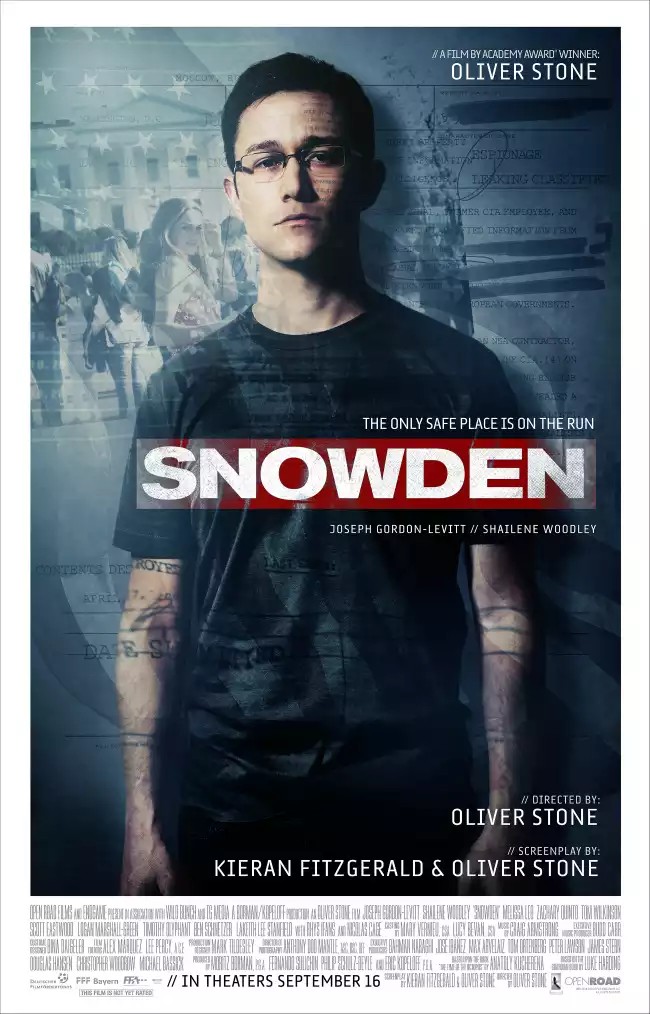
Directed by Oliver Stone, Snowden is a fascinating dramatization of the true life story of Edward Snowden and the largest leak in American intelligence history. Although obviously biased in favor of Snowden’s actions, the film is surprisingly less heavy-handed and controversial than what would be expected from such a famous provocateur as Oliver Stone. Much of the movie is a series of flashbacks to Snowden’s past during an interview with the journalists that publicized the damning allegations that he revealed about the US government in 2013. In fact, the interview was the basis for the 2014 Academy award-winning documentary Citizenfour. This film feels like another way to tell the all-too-familiar story, packaged as a gripping thriller about a complicated figure with a unusual background. Starting with his experience at bootcamp as an idealistic Army recruit, the movie chronicles Snowden’s progression through the CIA, NSA, and intelligence defense contractors. At the same time, the viewer is presented with a love story: the ups and downs of Snowden’s relationship with his long-time girlfriend Lindsay Mills played by Shailene Woodley. As a result, Oliver Stone tries to humanize the story in a way in which we can sympathize with Edward Snowden the human who struggles with his conscience and allegiance to his country. Joseph Gordon-Levitt is what makes the film really stand out with his terrifically realistic performance, complete with having an eerily similar voice as the real-life Edward Snowden. This authenticity becomes clear in the seamless transition to the actual Snowden appearing from an undisclosed location in Russia in the film’s stirring epilogue. Overall, I found the film to effectively present an intriguing intricate web of international espionage and the ethical implications of far-reaching surveillance. Unlike some of his other movies laden with conspiracy theories, Oliver Stone is on the side of proven facts, for the most part, and simply interprets the information in his uniquely creative way. 

Florence Foster Jenkins

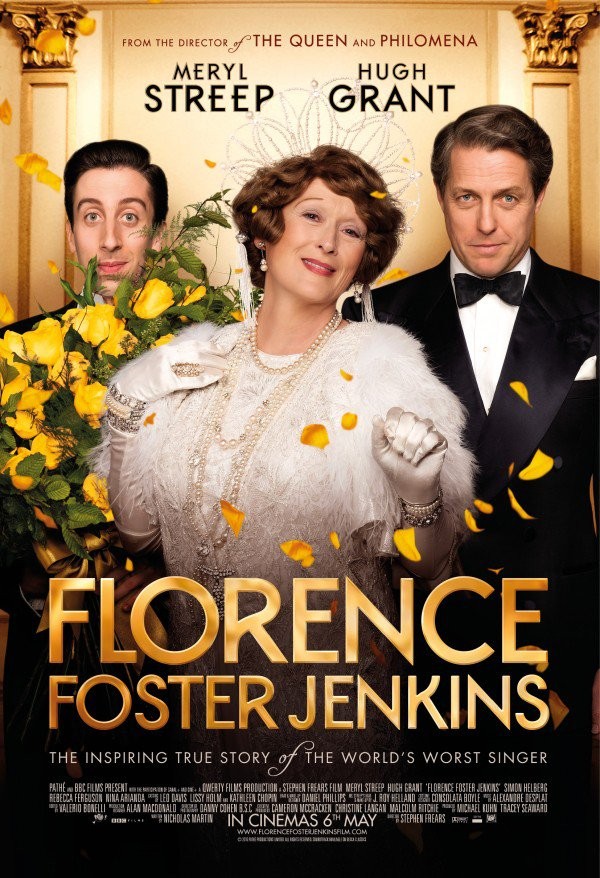
Directed by Stephen Frears who also directed The Queen and Philomena, Florence Foster Jenkins is a delightful film about a New York socialite who happened to be a terrible singer. Surrounded by enablers who simply wanted to profit from her wealth, Jenkins played by the always marvelous Meryl Streep tries to fulfill her dream of becoming a classical singer. Hugh Grant portrays her husband and British Shakespearean actor St. Clair Bayfield who encourages her passions while shielding her from critics knowing that she is not a great singer. His intentions are somewhat ambiguous: it is not readily apparent whether he is with her for her money or true love. The movie has charmingly funny interactions with bemused yet complicit professional vocal coaches and musicians, including her well-compensated pianist Cosmé McMoon played by Simon Helberg of The Big Bang Theory fame. Bayfield’s and others’ ruse runs amok when she books a public performance at Carnegie Hall with the naïve belief that she has the talent to sing at such a prestigious venue. Despite predominantly being a comedy, the film has a heartfelt undertone that supports one’s pursuit of a lifelong dream against all odds. The movie is particularly effective in conveying its high society 1940s New York setting with sumptuous costumes and elaborate sets. It feels especially nostalgic with its traditional film technique of a vertical line wipe transitioning from one scene to the next. Overall, I found the film to be an amusing and entertaining glimpse into a largely unheard of and rather unusual story of a woman with larger-than-life ambitions.

Backdrop

As part of a new addition to the blog, “Backdrop” will provide pertinent historical context and tidbits about the film reviewed.

Born in 1868 to a wealthy Pennsylvania family, Florence Foster Jenkins was a talented pianist who at a young age performed for President Rutherford B. Hayes at the White House. After her father refused to pay for her musical education, she left home and married Dr. Frank Jenkins in 1885. However, the relationship did not last long when she learned she had contracted syphilis from her husband. Syphilis may have been a contributing factor to her hand injury that prevented her from continuing to play the piano. In New York in 1909, she met St. Clair Bayfield, with whom she began a lifelong romance even though they never actually married. That same year, she received a large inheritance after her father passed away. She then pursued her singing ambitions in New York social clubs and eventually Carnegie Hall as portrayed in the film. The renowned composer and songwriter Cole Porter was a devoted follower of Jenkins and reportedly had to jab his cane into his foot so as not to laugh out loud during her performances. Several recordings of her singing were widely released by RCA Victor beginning in the 1950s, and several CD reprints have been produced since then. Only weeks after her famous Carnegie Hall debut in 1944, Jenkins died at the age of 76. She was survived by her beloved Bayfield who died in 1967.
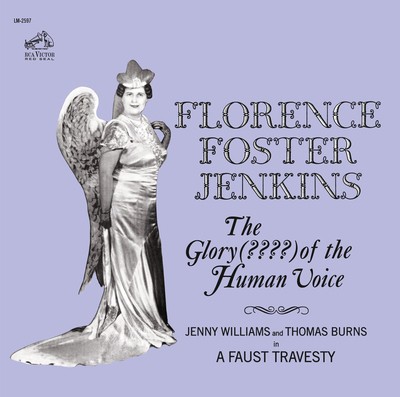
For an actual audio recording of her singing, check out the following link: https://youtu.be/qtf2Q4yyuJ0

Free State of Jones

image

Starring Academy Award winner Matthew McConaughey, Free State of Jones tells a truly fascinating overlooked true story of the American Civil War and Reconstruction in the South. McConaughey portrays Newton Knight, a larger-than-life figure who is still controversial to this day, who started a small uprising against the Confederacy in the rural Mississippi county of Jones. After enduring the bloody brutality of such battles as the Siege of Corinth in 1862, Knight deserted the Confederate Army and returned home to a dire situation. Many of the local poor white farmers were burdened with high taxes that deprived them of badly needed food supplies. Feeling targeted by the Confederacy and to escape prosecution, Knight hid in the swamp with escaped slaves and other deserters and eventually formed what would be known as the Knight Company. As the group grew with more disenfranchised farmers, they became surprisingly effective in repelling the Confederate authorities. However, General Sherman and the Union Army refused to help the group since they were perceived as simply a small group of bandits with no real power. The movie is unique in that it conveys an alternate message about the Confederate South: a thoroughly white Southerner like Knight has no qualms working with blacks and even fights for their rights during Reconstruction. Through the use of on-screen text giving historical context, the film gives an important historical lesson about the Civil War, its aftermath, and the suppression of black civil rights. The film’s only major drawback is that it tries to fit too much information into a relatively short amount of time. For instance, it almost randomly flashes forward 85 years to a trial when Knight’s descendant is questioned for committing the crime of interracial marriage. Such scenes help to tell the totality of racial discrimination in Mississippi. The movie would feel more coherent if it just focused on the Knight Company around the time of the Civil War. Matthew McConaughey gives an authentic performance as a gritty yet preacher-like rebel leader with a controversial personal life. Overall, I found the film intriguing for telling a noteworthy and powerful piece of history but whose storytelling could be more tightly woven.

Genius

image
Based on a true story, Genius follows the complicated relationship between the famed literary editor Maxwell Perkins played by Colin Firth and acclaimed novelist Thomas Wolfe played by Jude Law. Already a well-regarded editor at Scribner’s of such authors as F. Scott Fitzgerald and Ernest Hemingway, Perkins faces his biggest challenge of working with the often irksome Wolfe. First meeting in 1929, he agrees to edit Wolfe’s extremely long first manuscript of the novel Look Homeward, Angel, which had been rejected by all other publishing houses. The film provides a unique glimpse into the often unseen process of book editing and how it can be painstakingly difficult for both editor and author. Workaholics by nature, both men’s personal lives are adversely affected by their work. Perkins struggles to juggle his career with his family life, especially his wife played by Laura Linney, an aspiring playwright who feels underappreciated. Wolfe’s prodigious writing habits also alienates his love life with a married costume designer played by Nicole Kidman: his wild temperament provokes jealousy and neglect. After the first novel is published, Perkins faces an even greater challenge when Wolfe, who has become his friend in a albeit tumultuous relationship, presents him with literally crates full of his latest manuscript. Numbering about 6,000 pages and constantly added to by Wolfe, it takes more than two years to publish what would become the 1935 novel Of Time and the River. Filmed in grayer tones and with outbursts of ragtime-sounding jazz, the film accentuates the early 20th century setting and the characters’ emotional rollercoaster rides. Colin Firth’s performance evokes a rather straitlaced yet very talented office dweller who only takes off his bowler-style hat during particularly intense scenes. Jude Law is the polar opposite: he gives a manic performance of a uncouth, often drunk writer who happens to be one of the greatest novelists. Overall, the movie is fairly well done and tells a quite interesting story of the inner workings of the literary world and how genius often comes at a price. Complete with actual readings from Thomas Wolfe’s writings and cameos of Fitzgerald and Hemingway as characters in the storyline, the film should surely delight fans of great American literature.

The Idol

image

Based on a true story, The Idol is a Palestinian film that tells the inspiring tale of Mohammed Assaf played by the Arab-Israeli actor Tawfeek Barhom. He overcomes the struggles of being a Palestinian living in the squalor of Gaza to become an international popstar after winning the second season of Arab Idol in 2013. The first half of the movie follows Assaf as a child when he forms a small music group with his sister and two close friends. Although pop music is frowned upon in their largely conservative society more concerned with survival, Assaf’s childhood band scrapes together whatever they can to follow their passion of playing music. Assaf perseveres to pursue a better life even in the midst of personal tragedy, poverty, and the threat of war. The movie’s second half fast-forwards to Assaf’s late teens and early twenties when he realizes that the new music competition television show Arab Idol, a recent offshoot of American Idol, may lead to his musical breakthrough. However, he discovers that as a Palestinian it will not be easy to even simply audition like other contestants. The harsh realities of Gaza are powerfully represented by the film juxtaposing bombed-out buildings and other images of decades-long warfare against the modern and glitzy television show. The rise of Assaf who eventually captures the hearts of all Palestinians against all odds is a potent message of inspiration. By following one Palestinian’s journey, the movie humanizes the tragic and complicated circumstances of the Middle East in a politically subtle yet evocative manner. It tells a remarkably uplifting story of how hope and perseverance can prevail over adversity and help fulfill one’s dreams. Overall, the film feels like a Palestinian version of Slumdog Millionaire, with its similar plot of an impoverished young man navigating the obstacles of a largely hostile environment to achieve fame through a television contest.

All The Way

image

Based on the Tony Award-winning play, All The Way is a phenomenal HBO movie about LBJ in his first year as president following JFK’s assassination in 1963. It is a first-rate political drama drawing the curtains on the inner workings of LBJ’s determination to pass the Civil Rights Act of 1964. LBJ is brilliantly portrayed by Bryan Cranston who won the Tony Award for his performance in the theatrical version. It is exhilarating to watch Cranston as he uncannily transforms into LBJ, complete with his physical appearance, mannerisms, and sharp wit. He is effectively able to show the nuances of LBJ, a complex larger-than-life character with deep convictions about making America a better place. The film chronicles LBJ’s deft political acumen to enact legislation through sometimes controversial tactics and compromise with his political enemies. In order to achieve his ends, LBJ was also forced to confront his political allies, including MLK and the Dixiecrats, even at the risk of hurting his chances in the 1964 presidential election. Although depicted in a largely positive light, the movie touches on his ultimately disastrous decision to escalate the Vietnam War. LBJ is also vividly shown as a regular man with a folksy, often profane wit and humor. He comes across as a simple Texas country boy from humble beginnings who truly wants to make a difference. Besides Cranston’s skillful performance, the film has a star-studded cast, including Anthony Mackie as MLK, Bradley Whitford as Hubert Humphrey, Frank Langella as Senator Dick Russell, and Melissa Leo as Lady Bird Johnson. Overall, the movie is a must-see for its terrific performances, especially Bryan Cranston, and its well-crafted portrayal of a politician during a time when compromise was not a dirty word. It is an refreshing look into how politics should work unlike today with the Congressional gridlock and the rise of political demagoguery.

The Man Who Knew Infinity

image
Following the conventions of a more traditional biopic film, The Man Who Knew Infinity is based on the true story of the brilliant mathematician Srinivasa Ramanujan, played by Dev Patel famous for his breakout role in Slumdog Millionaire, who travels from his native India to study with a famous British mathematician, played by the always terrific Jeremy Irons, at Trinity College within Cambridge University. Completely self-taught with neither formal education or financial means from a foreign culture and religion, Patel’s character must confront the prejudices of the British academic elite, including Irons’ character who acts as his eventual mentor. The film is very much a fish out of water story, a tale in which the main character overcomes adversity to be accepted by others. Patel’s character must leave the only world that he has known, including his new bride and very resistant mother, in order to fulfill his dream of revealing his mathematical formulas to the world. The movie effectively discusses the ideas of conflict, including conflict between belief in God and nature, between colonialism and culture, and between academic elitism and natural genius, all while in the face of military conflict with the events occurring at the onset of World War I. I found the film to be a deeply fascinating look at a man that many have never heard of in a field that many would find difficult to understand. The fairly standard structure of the film as a biopic is overcome by the strength of the performances by Dev Patel and Jeremy Irons.

Miles Ahead

image
Following the exploits of Miles Davis as he tries to recover a stolen sessions tape, Miles Ahead provides a glimpse into the life of a tortured genius. We meet the legendary jazz trumpeter Miles Davis in 1979 in the midst of his five-year break from the music, a period marked by heavy drinking and drug abuse. The film is anchored by an exceptional performance from Don Cheadle who portrays Davis as he dives into moments of sheer madness, including several scenes involving gunfire, while being informally interviewed by a Rolling Stone writer played by Ewan McGregor. It is not a typical biopic but rather a mishmash of flashbacks to the relatively sane years when he was at the top of his fame and alternating with his chaotic adventure to reclaim his music. Miles Ahead is a film brimming with energy reflected by Miles Davis’s musical brilliance despite his personal demons and Don Cheadle’s nuanced depiction of a truly larger-than-life jazz legend.