Beatriz at Dinner

A particularly relevant story during such a time of political divisiveness, Beatriz at Dinner is an incisive dark comedy with important social commentary about social class and income inequality problems facing contemporary America. Played by the Mexican actress Salma Hayek in a terrific performance, Beatriz is a humble and kind-hearted Mexican immigrant who works as a holistic healer and masseuse for cancer patients and wealthy clients like the characters Cathy and Grant. After a session with Cathy at her and her husband Grant’s palatial mansion in upscale Orange County, Beatriz’s car breaks down and Cathy offers her to stay for a dinner party while she waits for her ride. Eventually, two other couples whose husbands have business interests with Grant arrive and practically ignore Beatriz’s presence, which leaves her in a very awkward position. However, she becomes vocally appalled by one of the guests, Doug Strutt who is played brilliantly by John Lithgow and is an extremely wealthy real estate tycoon with questionable legal and ethical practices. After learning more about what he actually does, Beatriz, who comes from a poor Mexican Village and exudes positivity, argues with Doug and berates him for his smug contempt and sheer meanness in his misguided pursuit of wealth at all costs. She is particularly disgusted by his showing off to the dinner guests of hunting a large animal on a recent African safari. You also get the sense that the hosts and the rest of the guests are out-of-touch with the real world because they talk about petty things and the accumulation of wealth rather than expressing sincere personal emotion and passion for taking care of others like Beatriz. The film in the form of Doug’s character eerily reminds the viewer of Donald Trump who, like Doug, is a brash real estate billionaire on his third wife. Overall, I found it to be a remarkable movie that touches on so many of today’s important societal issues in a fascinating fashion by recreating a supposedly simple dinner party through the eyes of an “outsider.”

The Wedding Plan

An Israeli film with dialogue spoken in Hebrew, The Wedding Plan is a romantic comedy that is able to transcend the genre by providing a unique and creative twist and a charismatic performance by the lead actress. Michal, portrayed by the Israeli actress Noa Koler, is an Orthodox Jewish woman in her early thirties who is finally about to get married after so many desperate years but encounters a serious problem a month before the wedding when her husband calls it off. Adamant to not be single, she decides to leave her fate up to God by continuing to plan to get married on the day that was she was supposed to have her wedding. Despite the urging of her mother and sister not to go ahead with the quite unusual plan, Michal keeps the wedding hall booking in Jerusalem even though she does not have a groom because she has full faith that God will provide her a suitable match in time. Her outlandish decision leads to several comic moments as she employees two Jewish matchmakers who set her up on several blind dates with some fairly unusual men. At one point during the movie, she takes a pilgrimage to Ukraine at the tomb of a famous rabbi where she runs into a dreamy yet unsuitable famous Israeli pop star who eventually falls in love with her. Her family becomes increasingly nervous as the day approaches, but Michal remains confident that everything will work out due to her fervent religiosity. On the day of her planned wedding, the 200 invited guests, along with a now very nervous Michal, awkwardly wait and see if a man will show up to marry her. Everyone is eventually greeted with an unexpected surprise that makes the festivities possible. Overall, I found it to be an interesting and sometimes funny film that mixes religion and romance in unorthodox fashion and showcases the acting performance of an actress who must portray a sometimes contradictory and overly zealous character. 

Paris Can Wait

Written and directed by first-time feature filmmaker Eleanor Coppola who is married to Academy Award-winning director Francis Ford Coppola, Paris Can Wait is a light-hearted romantic comedy that takes the audience on a frivolous yet pleasant journey through the beautiful French countryside. Diane Lane plays Anne who is married to an aloof successful movie producer, played by Alec Baldwin, and unexpectedly takes a two-day road trip from Cannes to Paris with her husband’s suave and charming French associate. Jacques, played by the French actor Arnaud Viard, is an easy-going debonair aficionado of fine wine, food, and art who takes Anne on a wonderfully scenic tour of his favorite parts of France and stops at exquisite restaurants and quintessentially French landmarks. Initially, she wants to get to Paris as soon as possible and feels awkward participating in such romantic activities with a flirtatious bachelor while she is married. Over the course of the film, she welcomes Jacques’ suggestions after realizing that the trip provides a much-needed distraction from her secretly unhappy life and largely unfulfilled marriage with her busy husband, a typical Alec Baldwin character. The movie reminds me of several other Diane Lane movies, particularly 2003’s Under the Tuscan Sun in which she leads a carefree existence in a beautiful foreign country. Overall, I found it to be a pleasing film full of joy and beauty that provides a welcome respite to the viewer’s dull daily life; it is a nice little movie that should not be taken too seriously. 

Their Finest

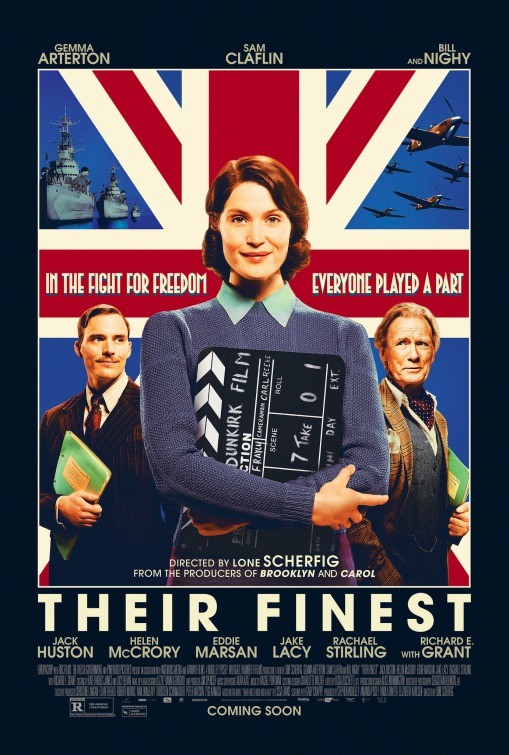
Set in 1940 in the midst of World War II in London, Their Finest is an entertaining wartime film blending charming characters with the serious plotline of creating cinematic propaganda to help the British war effort against the Nazi. The vibrant and nuanced Gemma Arterton plays a young secretary who finds herself becoming a screenwriter for British films promoting the Allied cause. Although she is in a complicated relationship with a struggling artist, she develops a close bond with the main screenwriter, played by Sam Claflin. They are enscripted to work on a dramatic romance revolving around the massive evacuation of British troops from Dunkirk in the summer of 1940. Greenlit by the British Ministry of Information, the film is able to add star power by encouraging an older and rather pompous actor, played brilliantly by Bill Nighy, who is struggling to find work after enjoying great success many years ago. Arterton’s character eventually falls in love with Claflin’s character while on location on the British coastline with a large group of witty and eccentric actors and crew members. Despite containing elements of comedy and endearing romance, the movie makes the audience aware that it is a story set during war by showing the tragic impact of the German bombardment of London and emphasizing the characters’ roles in creating propaganda to help defeat the Axis powers. Overall, I found it to be a thoroughly engaging film that highlights an often overlooked aspect of World War II and effectively develops sympathetic and charismatic characters, especially those of Gemma Arterton and Bill Nighy.

The Last Word

The Last Word is a fairly generic comedy drama about an unexpected friendship
that has moments of wit and charm and is anchored by the strong acting performances from the always terrific Shirley MacLaine and relative newcomer Amanda Seyfried. Shirley MacLaine plays Harriet Lauler, a retired highly successful businesswoman and a curmudgeon not really liked by anyone in her community and family, who feels like she is at the end of her life and decides to commission her own obituary even before her death. Eventually, she enlists the obituary writer at the local newspaper and an aspiring writer,
played by Seyfried, to research her life and interview many people from throughout her life in order to write an appealing obituary. However, the young writer realizes that almost nobody is willing to talk to her about Harriet since so many have hated her for her grumpy and strict attitudes. After being faced with this reality, Harriet makes it her mission to craft the perfect obituary by creating new memories and trying to create positive relationships with others. Therefore, the final half of the film becomes a redemption story for Harriet who discovers her passion for music by becoming a DJ at a local independent radio station, becomes a mentor for a poor African-American girl, and eventually develops a close kinship with Seyfried’s character. My favorite part
of the movie is Shirley MacLaine who gives her typically perfect performance as a curmudgeon committing unintentionally funny antics but gradually comes to understand the meaning of life and tries to reform her ways before her inevitable death. Overall, I found it to be a cute film that had its moments of morbidity as should be the case with a movie about a elderly woman and her obituary, but the film would probably not work were it not for Shirley MacLaine’s spot on acting.

Get Out

Written and directed by Jordan Peele who is best known as the co-creator of the hit sketch comedy series Key & Peele, Get Out is a surprisingly phenomenal film that expertly crafts the comedy and horror genres to create an incisive social satire about contemporary racism. The plot follows black photographer Chris Washington, played by Daniel Kaluuya, as he goes to the suburbs to visit the parents of his white girlfriend Rose Armitage, played by Allison Williams. Rose not telling her parents that her boyfriend is black makes Chris worried about their reaction when he first meets them. However, he is pleasantly surprised by the warm welcome of her father and neurosurgeon Dean, played by Bradley Whitford, and her mother and psychiatrist Missy, played by Catherine Keener. After spending more time with the family and meeting their black maid Georgina and black groundskeeper Walter who both act zombie-like, Chris senses there is something peculiar about the Armitages and their white neighbors. The film rapidly evolves into a horror thriller after Missy hypnotizes Chris, and he learns more about what is actually going on in the neighborhood. He relays his concerns to his black friend Rod who works for the TSA and serves as comic relief, with his exaggerated reactions and outlandish theories about what Chris is experiencing. Things get even weirder when Chris tells Rose about his suspicions and that they both must get out immediately. The film’s ending intensifies as plot twists abound and the audience finally figures out the sinister secrets of the neighborhood. What makes the movie so good is Peele’s ability to perfectly time scary and funny moments in order to keep the viewer engaged. By using the horror genre in which everything is not as it seems, Peele also cleverly devises a way to comment on society as a whole. He uses film to highlight the fact that racism still exists today even if people claim that we are in a post-racial society the result of Obama’s election. For instance, the Armitages, seemingly the epitome of white liberalism who say they would vote a third time for Obama, and their white suburban neighbors have a dark side that may counter their belief that they are far from being racists. Thereby, as evidenced by current race relations, actions and beliefs do not have to be overt in order to make somebody racist, but unrecognized subtle acts of prejudice can have a little-by-little detrimental affect on another race. Overall, I found it to be a highly entertaining experience, despite my general dislike of scary movies, that unexpectedly provides a profoundly important message about racism. 

La La Land

From Damien Chazelle who received a Academy Award nomination for best director for 2014’s Whiplash, La La Land is a vibrantly energetic film that revives the musical genre to its former glory. At its heart, it is an ode to old Hollywood and the thriving contemporary metropolis of Los Angeles. The movie follows a young woman named Mia, terrifically portrayed by the fresh-faced Emma Stone, who has moved to Los Angeles to pursue a career in acting. Like many other young actors and actresses, she has dreams of hitting it big time, but she has the typical experience of being rejected and stuck in a dead-end job to make ends meet. Through a series of chance encounters, she meets an equally aspiring young artist named Sebastian, played by the brilliant and handsome Ryan Gosling, and they began a whirlwind romance told through exuberant musical numbers. Sebastian himself is an old school jazz pianist who has difficulty breaking through the highly commercialized music industry, and he has dreams of opening an old fashioned jazz club. Like the film’s style and genre, both characters feel like they are from a bygone era and remain idealistic despite the challenges they face in their respective rapidly changing and business-oriented entertainment industries. This new paradigm is reflected by John Legend who plays a musician catering to contemporary taste simply to make a buck and forces Sebastian to face the harsh realities of the music business. What makes the movie so special is its interspersal of wildly energetic and magically shot sequences in which the characters sing and dance in highly choreographed fashion, reminiscent of Fred Astaire musicals. The film employed the rather clever technique of dimming the lights around the characters as they began a musical sequence. Not particularly a fan of musicals, I was pleasantly surprised that the filmmaker only used musical numbers when it was necessary and not too over-the-top to be distracting from the storyline. Overall, I found it to be one of the more joyful and exciting experiences I have had at the movies: the musical elements were effusively entertaining and the plot was well-crafted nostalgia. I would recommend it to those looking for a light-hearted time that harks back to the heyday of old Hollywood romance and musicals. 

Rules Don’t Apply

Directed by Academy Award-winning director Warren Beatty, Rules Don’t Apply is a light-hearted film presenting a glorified look into early Hollywood through a fictionalized romance between a starlet and driver in the employ of billionaire Howard Hughes. Set in 1950s and 1960s Hollywood, the story follows the young and religious Frank Forbes, portrayed by rising star Alden Ehrenreich, who moves to Los Angeles in hopes of getting a wealthy benefactor to finance a real estate project. As the driver for many young actresses under contract with Hughes’ movie studio, Forbes falls in love with one of these women, a young and naive actress named Marla, played by the fresh-faced Lily Collins. While this budding romance, strictly forbidden by their boss, surreptitiously unfolds, we witness the hilariously absurd behavior of the notoriously peculiar Howard Hughes, played by Warren Beatty in his first acting role in almost 15 years. Over the course of the movie, Forbes, along with another driver played by Matthew Broderick, becomes a close confidant to the obscenely wealthy business executive, aviator, and movie producer who is evidently plagued with a whole host of mental problems. Much of the film’s charm comes from the zany and often laughable antics of Hughes, whether it be ordering several hundred gallons of banana nut ice cream or hiding away in a hotel suite. At times, the plot seems to be all over the place and too reliant on poking fun of Hughes. Although it looks nice on camera and is filled with a wide range of Hollywood A-listers, the movie does not feel as polished and satisfying as some of Warren Beatty’s other works. It comes across as more of a piece of nostalgia harking back to the pinnacle of Beatty’s career as an international sex symbol in the 1960s and 1970s. It also seems like a platform for many famous actors and actresses to simply have the opportunity to cameo in a movie alongside such a highly respected figure as Warren Beatty. Overall, the film does contain entertaining moments that work as cheap laughs deriving from the quirky nature of Hughes, but it ultimately falls short of the high expectations set by the return of such a talent as Warren Beatty. It should not be treated as more than a superficially amusing comedy whose greatest asset is Beatty’s depiction of the exceptionally strange historical figure Howard Hughes.

The Edge of Seventeen

Starring Oscar-nominated actress Hailee Steinfeld, The Edge of Seventeen is a surprisingly good coming-of-age movie about a teenage girl facing the typical pitfalls of an American highschooler. Steinfeld plays an insecure seventeen-year-old named Nadine who feels overshadowed by her handsome and popular older brother and has only one true friend. Like most teenage comedies, the film follows the often awkward and, in retrospect, laughable experiences that a typical teenager goes through in average American society. Feeling like she has no place especially after experiencing a personal tragedy several years prior, she tries to fit in with her high school peers by trying to become popular while grappling with her social awkwardness, sexuality, and emotional instability. Throughout the film, she turns to her rather dour yet ultimately motivational history teacher, portrayed by Woody Harrelson, who almost begrudgingly gives her advice on life, with a realistic perspective. She is unable to truly connect with her mother, played by Kyra Sedgwick, who seems to favor her older brother and has her own personal problems to deal with following the family tragedy. Nadine is particularly upset after she learns that her best friend is dating her brother and her crush appears to be completely oblivious to her existence. She appears to take actions that are completely out of her character as a means of coming to terms with her complicated life. Towards the end of the movie, she comes to a better realization of who she is and develops an unexpected bond with a fellow classmate. Overall, I found the film to be much more than your typical high school comedy as a result of its stellar performances and terrifically original screenplay. As other critics have remarked, it is strikingly similar to the classic 1980’s John Hughes films, including Sixteen Candles and The Breakfast Club, and breathes new life to the teen angst comedy drama genre.

A Man Called Ove

Based on a 2012 best-selling Swedish novel, A Man Called Ove is a well-crafted darkly funny movie with a powerfully bittersweet message about the loss and unexpected discovery of love and friendship. Brilliantly portrayed by the Swedish actor Rolf Lassgård, Ove is a grumpy old man who lives alone in a suburban development where he tries to strictly control the homeowners association. He rarely associate with his neighbors but, when he does, he is usually reprimanding them for various relatively small infractions. With the arrival of an Iranian immigrant and her Swedish family in the close-knit community, things begin to change for the extremely guarded and unfriendly Ove. The film shows how he became such a curmudgeon by flashing back to his challenging past when he had some semblance of happiness with his wife. In morbidly humorous fashion, he reflects on his earlier life during his absurdly unsuccessful suicide attempts, which are largely interrupted by his new well-intentioned neighbors. Through the course of the movie, the viewer comes to sympathize with Ove who is largely the way he is because of profound grief he experiences ever since his beloved wife’s death. His Iranian neighbor develops an initially unwanted close relationship with him and helps him come to grips with the loss of his true love. Eventually, they become friends, and he learns from her to be a better neighbor and overall person. The film is so effectively able to be endearing due to its remarkable balance between moments of sentimentality and comedy, all without being an overly melodramatic depiction of grief. Overall, I found it to be a very refreshing movie attesting to the goodness of human nature while keeping the audience entertained through its rather dry sense of humor. It is another superb example of why foreign language films with subtitles should not be so readily disregarded by popular audiences; you will sorely miss a great movie full of powerfully uplifting emotions.