 The sixth installment of the Death Wish movie franchise and a direct remake of the original released in 1974, Death Wish is an average action flick that relies heavily on the stale genre conventions of the revenge/vigilante action thriller and ultimately feels like an unnecessary exercise in re-creating the original movie starring Charles Bronson. An aging Bruce Willis plays Dr. Paul Kersey, a talented emergency surgeon living in Chicago, who one day becomes a vengeful vigilante after a home invasion leaves his wife Lucy, played by Elizabeth Shue, dead and his high school senior daughter Jordan, played by Argentinian model Camilla Morrone, comatose. Angry that the police led by Detective Kevin Raines, played by Dean Norris of Breaking Bad fame, is unable to fully investigate the crimes and identify the culprits, Dr. Kersey transforms into a typical Bruce Willis character who takes justice into his own hands and eventually discovers those responsible. He keeps his violent retaliations secret even from his brother Frank, played by Vincent D’Onofrio, and becomes known by the public as the Grim Reaper, either vilified as an unjustified killer or lionized as a justice warrior. Typical of the director Eli Roth’s oeuvre as a well-known horror filmmaker and producer of such films as 2005’s Hostel, the movie contains some graphically violent scenes that sensationalizes vicious acts involving weapons and overall brutality. Overall, I did not find it to be a particularly satisfying moviegoing experience and was underwhelmed by the simple premise of a revenge thriller that has been used far too many times; furthermore, the glorification of violence and assault rifles comes at a particularly bad time as a result of the recent mass shootings occurring just prior to the film’s release.
Drama
A Fantastic Woman
 Directed by acclaimed Chilean filmmaker Sebastián Lelio who is best known for the 2013 Oscar-nominated film Gloria, A Fantastic Woman is a truly fantastic drama that explores the very timely issues surrounding the transgender community and is very much worthy of its 2018 Oscar nomination for Best Foreign Language Film. The plot follows a young transgender woman named Marina, played by the revelation of a star Daniela Vega in her acting debut, who is in a relationship with a businessman named Orlando, played by Chilean actor Francisco Reyes, who is almost 30 years her senior. After a romantic evening celebrating her birthday, Marina’s life is turned upside down after Orlando becomes seriously sick and passes away after Marina rushes him to the hospital. Already going through a different sort of transition filled with its own set of hardships, her grief is exasperated by the doctors and police who are suspicious of her due to her status as a transgender woman. Further complicating matters, Orlando’s ex-wife and grown-up children want nothing to do with Marina and have always held a discriminatory view of her and what they term as her perverse relationship with Orlando. The film is a beautifully somber portrayal of a misunderstood segment of the population and shows that transgender people experience the same love and pain as “normal” individuals. Vega imbues her absolutely mesmerizing performance with a subtlety and emotional power that helps create a very sympathetic and fierce character that courageously pushes through the ups and downs of life, especially the downs experienced as a result of the prejudiced attitudes held against the LGBT community. Like in his previous work, the filmmaker is remarkably effective in creating strong-willed and mold-breaking female characters whose daily struggles and romantic lives are vividly portrayed without excessive flourish. Overall, I found it to be a terrifically empowering and insightful movie that may very well change many people’s minds about transgender individuals, almost completely owing to newcomer Daniela Vega who gives one of the best acting performances of the year.
Annihilation
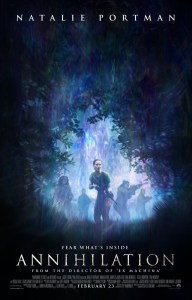 Directed by Alex Garland who is best known for the 2015 Oscar-nominated film Ex Machina, Annihilation is a visually dazzling and thought-provoking sci-fi movie notable for its rather strange and frightening story and a terrific performance from Oscar-winner Natalie Portman. Based on the acclaimed 2014 novel of the same name written by Jeff VanderMeer, the plot revolves around Portman’s character Lena who is a biologist and former American soldier that unexpectedly becomes involved in a highly classified mission to study and prevent the spread of a scientifically unexplained phenomenon known as The Shimmer located along the American coast in a rapidly expanding region known as Area X. After her husband Kane, played by Golden Globe nominee Oscar Isaac, mysteriously returns a year after going missing on an expedition into Area X, Lena is recruited to go on another mission to study The Shimmer and determine whether it is earthly or extraterrestrial. It is a particularly dangerous operation because no one besides her husband has ever returned after that many failed attempts. Led by the stone-faced psychologist named Dr. Ventress, played by Jennifer Jason Leigh, the all-female group of scientists is comprised of a paramedic named Anya, played by Gina Rodriguez, a physicist named Josie, played by Tessa Thompson, and a surveyor and geologist named Cass, played by Tuva Novotny. Immediately after venturing into Area X, Lena and the rest of the team notice that things are very abnormal, including the plants and animals exhibiting perplexing biological mutations. The filmmaker mystifies the audience through the realistic and often beautiful depictions of these strange creatures; towards the end, reality and the laws of nature become further blurred as emphasized by the ever increasing mind-blowing imagery witnessed by the characters. Not just purely science fiction, the film contains several suspenseful and often terrifying moments that could come from a horror flick, especially the scenes involving mutated animals and the psychoses experienced by the team members. Overall, I found it to be a riveting and creative work of science fiction that surprisingly delves deep into philosophical issues of humanity and our relationship to the environment, while also catering to fans of sci-fi and horror with its mesmerizing visual effects and creation of horrifying creatures.
The 15:17 to Paris
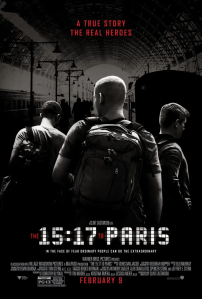
Directed by Academy Award-winning filmmaker and actor Clint Eastwood, The 15:17 to Paris is a well-intentioned movie remarkable for its use of the actual people that the true story is based upon but ultimately fails fairly miserably as a result of its poor writing and risky casting choices. The story revolves around a group of three American friends who unexpectedly become heroes while on a European vacation after they prevent a terrorist attack on a train from Amsterdam to Paris on August 21, 2015. We first meet Spencer Stone, Alek Skarlatos, and Anthony Sadler as troublesome middle schoolers at a Christian school in California where they become close friends interested in the United States military. The movie fast forwards several years later when the men, all played by themselves, are in their 20s still friends but living separate lives. It primarily focuses on Spencer who decides to join the Air Force in the Pararescue division and Alek who is deployed to Afghanistan as a soldier in the Oregon Army National Guard. In a rather lackluster build-up to the incident, we see all three friends join together on a stereotypical American vacation across Europe filled with drunken nights and sightseeing. The stilted dialogue does not really add much to a greater understanding of the moments leading up to their heroics. Also, the movie sometimes inexplicably switches back and forth between snippets of the action-packed train sequence and the rather mundane activities of their trip. Finally, towards the end, the movie reaches its climax when it details the men boarding a high-speed train from Amsterdam, the interlude as typical passengers, and the remarkable moments when they face off against a radical Islamic terrorist set on killing everyone aboard the train. Spencer makes the quick-fire decision to tackle the terrorist whose gun luckily jams, and a bloody fight ensues between the two men with Spencer sustaining injuries. At the same time, Alek and Anthony along with other brave passengers help to subdue the gunman until the train reaches its next stop where the police can take him into custody. Unquestionably an amazing story of courage, the creative use of the real people in a dramatized motion picture unfortunately backfires and does not really do justice to what happened. Overall, I found it to be a wasted opportunity to pay tribute to three American heroes who undoubtedly saved many lives; therefore, the story would have been better served by a documentary or a more conventional movie with real professional actors.
Call Me by Your Name

Nominated for the 2018 Oscar for Best Picture, Best Actor, and Best Adapted Screenplay, Call Me by Your Name is a beautifully crafted film flowing with powerful emotions about forbidden love between a teenager and a young graduate student during the summer of 1983 in the Italian countryside. Elio Perlman, played wonderfully by Timothée Chalamet who is nominated for an Oscar for his performance, is a seventeen-year-old Jewish American-Italian who lives in a rural Italian villa during the summers with his Italian mother and American father who is an archaeology professor, played by the always terrific Golden Globe nominee Michael Stuhlbarg. A very bright young man, Elio spends most of his time alone idyllically reading books and transcribing classical music until the arrival of American graduate student Oliver, played by Armie Hammer who was nominated for a Golden Globe for his performance, who lives with the family for six weeks to help Professor Perlman with his academic work. While in a quasi-romantic relationship with a girl his age named Marzia, Elio is still exploring his love life and embarks on a journey of self-discovery as he becomes closer and closer to the older and handsome Oliver. Initially, the two are rather distant, but, over the course of the slow yet mesmerizing plotline, they begin to fall in love as they leisurely spend time together cycling through the countryside or swimming while engaged in intellectual conversations. Although at first he is somewhat confused by his emotions and homosexual attraction to Oliver, the remarkably mature Elio embraces his romantic and sexual desires by subtly making advances on the carefree and flirtatious Oliver. Through the use of gorgeous cinematography, beautifully subdued music, and immersion in very emotional moments, the acclaimed Italian director Luca Guadagnino expertly portrays an evocative romance, complete with the typical ups and downs experienced by any heterosexual couple. In one of the most poignant scenes, Elio’s compassionate father tries to comfort Elio as he grapples with the heartbreak of the inevitable conclusion to his time with Oliver as Oliver returns home where it would be extremely difficult to continue their amorous relationship. His father displays a complete understanding of Elio’s touching romance with another man and tells him that he too experienced pain over forbidden love. His advice to his son is to cherish the fact that he was lucky enough to share such great joy with Oliver. Overall, I found it to be a truly remarkable movie made possible by stellar acting performances and a heartwarming story with a powerful message about love set against the breathtaking beauty of Italy.
The Insult

Nominated for the 2018 Academy Award for Best Foreign Language Film, The Insult is a riveting and emotionally evocative Lebanese drama about the complicated nature of the Middle Eastern debate over the Palestinians, particularly those living as refugees in neighboring countries such as Lebanon. The plot revolves around a seemingly trivial argument between a Lebanese Christian nationalist and a Palestinian refugee living in Beirut that rapidly escalates into a nasty legal fight resulting in mass demonstrations across Lebanon. The Christian nationalist Tony is upset when the Palestinian construction foreman Yasser attempts to repair Tony’s illegal drainage pipe after which Yasser uses profanity to insult Tony. Coming from different backgrounds in which both were victimized by religious and political hatred in both Lebanon and Israel, the two men never back down and Tony takes Yasser to court for Yasser not apologizing for the insult and assaulting Tony after he makes inflammatory remarks about Palestinians. Eventually, it becomes a sensationalized court case between two stubborn individuals and the issues being fought over spark outrage among the many different factions in Lebanon who either sympathize with the Palestinian cause or consider the Palestinian refugees a drain on Lebanese society. The filmmaker does an excellent job of developing a gripping courtroom drama that becomes even more intriguing after we learn that the powerful right-wing lawyer representing Tony is actually the father of the more liberal female lawyer representing Yasser. Throughout the course of the story, we also witness that the personal lives of the men and their loved ones are adversely affected by the drawn-out dispute, especially Tony’s wife who has a complicated pregnancy. The real power of the film is that it vividly represents the real animosity between certain religious and ethnic groups in the Middle East and how small matters can reveal complicated issues of pride and victimization. Overall, I found it to be a terrific movie with powerful performances that somehow expounds upon a relatively small argument to delve into the central matters surrounding the still heated Palestinian conflict.
In the Fade

Winner of the 2018 Golden Globe Award for Best Foreign Language Film and directed by acclaimed Turkish-German filmmaker Fatih Akin, In the Fade is a terrific dramatic thriller remarkable for the superb acting performance from German actress Diane Kruger. The tragic story follows a German woman named Katja Sekerci, played by Kruger who is best known for her performance in the 2009 Quentin Tarantino film Inglourious Basterds, whose Kurdish husband Nuri and son Rocco are killed by a bomb placed outside her husband’s office in a predominantly Turkish neighborhood of Hamburg, Germany. Clearly ravaged by grief and anger, she all but gives up on her own life immediately following her family’s deaths and turns to using illicit drugs after the police insinuate that her convicted felon husband may have been murdered as part of his prior connection to the drug underworld. She also feels alienated from her parents and her in-laws who never really approved of their marriage as a result of their very different backgrounds. When the two young suspects with connections to the neo-Nazi movement are apprehended and put on trial, Katja who is represented by her lawyer friend Danilo becomes very involved with the trial in order to seek justice for her husband and son. She is promised several times by prosecutors and her lawyer and becomes convinced herself that the trial will end with easy murder convictions and possible life imprisonment for the racist couple. Towards the end of the movie, Katja heartbreakingly realizes that she may have to take her own revenge at a high cost outside the judicial system. Overall, the film through mesmerizing acting did an excellent job of portraying grief and loss and the emotional tumult and sheer anger experienced by those whose loved ones die through violent means. Diane Kruger’s emotionally raw and heartfelt performance really brings to life what it must be like to undergo incomprehensible heartbreak caused by the hands of those filled with hatred.
12 Strong

Based on the 2009 non-fiction book Horse Soldiers written by Doug Stanton, 12 Strong is a fairly typical war movie whose main strength is telling a fascinating true story about one of the first military operations in Afghanistan following the September 11th attacks. It follows a group of twelve United States Army Special Forces soldiers who are sent to Afghanistan on a covert mission known as Task Force Dagger in October 2001 to combat the Taliban harboring the al-Qaeda terrorist group responsible for the deadliest attack on American soil. The group known as Operational Detachment Alpha 595 within the elite 5th Special Forces Group are commanded by Captain Mitch Nelson, played by Chris Hemsworth, on his first leadership role in combat and is tasked with joining Afghan General Abdul Rashid Dostum and his Northern Alliance fighters. Their mission is to recapture the Taliban stronghold of Mazar-i-Sharif, a Northern Afghan city strategically vital to the Americans in the forthcoming war, and eliminate Taliban and al-Qaeda soldiers in the region. Once they arrive in Afghanistan, the American troops, including soldiers played by Oscar nominee Michael Shannon and Michael Peña, discover they are outnumbered by the Taliban heavily armored with tanks and rocket launchers. Earning their nickname the Horse Soldiers, the men are surprised to learn they must ride horses into combat due to the rough terrain. As to be expected from a Jerry Bruckheimer production, the film contains several well-coordinated and thrilling action sequences involving the Special Forces on horseback firing machine guns at the relentless Taliban and al-Qaeda forces. Overall, despite the talented cast and spectacular scenes of modern warfare, the movie never transcends the generic formula of an action flick as a result of the lack of character development and the bloated runtime. Unfortunately, it does not really do justice to the truly remarkable story of one of the first military responses to the terrorist attacks of September 11, 2001, an operation that up until recently was classified.
Phantom Thread

Directed by Academy Award-nominated filmmaker Paul Thomas Anderson who is best known for 1997’s Boogie Nights, 2007’s There Will Be Blood, and 2012’s The Master, Phantom Thread is a beautifully crafted arthouse film with outstanding acting performances, sumptuous cinematography, and a terrific script revolving around a rather unusual and evocative story. Set in 1950s London, the plot follows a famous couture dressmaker named Reynolds Woodcock, stupendously played by three-time Academy Award winner Daniel Day-Lewis, who lives a rather lonely and sheltered life obsessed with his work to make the finest dresses for the rich and famous. The only person he really shares his life with is his no-nonsense sister and fashion partner Cyril, played by British actress Lesley Manville, who insulates him from the harsh outside world and very much babies him to satisfy his peculiar habits. While eating at a restaurant near his country home, Reynolds becomes enamored with a beautiful young waitress named Alma, played by a revelation of a star Vicky Krieps, who he insists must go to dinner with him. Over time, she becomes his muse and is invited to live with him and his sister at their London fashion house where they embark on a rather unorthodox romantic relationship. As Alma gets closer and closer to Reynolds and learns more about the high fashion world, Cyril becomes weary of Alma and the disruption that she causes for her needy and obsessive compulsive brother. Throughout the film, the relationship between Alma and Reynolds fluctuates between emotionally and physically intimate and brutally distant as he focuses on his meticulous work making outfits. Underscoring their bizarre romance, the plot veers into unexpected territory with a puzzling ending. Daniel Day-Lewis, like his other equally terrific work over the years, delves deep into his role as evidenced by the realistic great care that his character takes for fashion and believably taking on the neuroses of his character. His mesmerizing performance is greatly enhanced by the talents of Paul Thomas Anderson who creates a beautifully meditative and emotionally delicate story with impressively detailed cinematography, musical scoring, and costuming. Overall, I found it to be a terrific work of art and a perfect ode to the fabulous Daniel Day-Lewis in what may be his last acting role.
The Commuter

Directed by Jaume Collet-Serra best known for 2016’s The Shallows and collaborating with Liam Neeson on such action thrillers as 2014’s Non-Stop, The Commuter is a fairly typical action thriller in the spirit of Liam Neeson’s Taken movie series that does not really add much to the genre. Oscar nominee Liam Neeson plays an insurance agent named Michael MacCauley who finds himself mixed up in criminal intrigue on his daily train commute back home from Manhattan. He meets a mysterious woman named Joanna, played by Oscar nominee Vera Farmiga, who promises him $100,000 if he finds a particular person she is looking for that is out of place on the train. While interacting with several other people he has gotten to know over their daily commutes, including Walt who is played by Jonathan Banks of Breaking Bad fame, Michael surreptitiously tries to uncover the person he is tasked with finding. Similar to other action movies starring Liam Neeson, he uses a particular set of skills to fight much younger men and race against time before Joanna and the secret organization she works for harms his wife and teenage son. Eventually, towards the end of the movie, he discovers a criminal conspiracy in which not everyone is as they seem, and he himself is suspected to be a criminal or terrorist by authorities, including two police officers played by Patrick Wilson and Sam Neill who Michael knew when he was a NYPD detective. Overall, I found it to be a mediocre and silly action thriller that is good to pass the time with an entertaining performance from Liam Neeson but ultimately fails to transcend the stale stereotypes of an action flick.
 KEITH on Reels