Creed II

The eighth installment in the Rocky movie series first released in 1976 and the sequel to the 2015 spinoff movie Creed, Creed II is a rather formulaic boxing movie that follows closely in the footsteps of the genre-defining film Rocky but is able to remain entertaining by being updated to follow the sports world of today. Taking place several years after the first Creed movie, the plot follows boxer Adonis Creed, played by Emmy-nominated actor Michael B. Jordan, who is the son of Apollo Creed featured in the original Rocky films and killed in a fight in 1985’s Rocky IV. The beginning of the film shows the young Creed capturing the world heavyweight title, but he is faced with an even greater challenge by Viktor Drago who is the son of Russian boxer Ivan Drago, played by Dolph Lundgren, last seen as the nemesis in Rocky IV. At first, the aging boxer Rocky Balboa, played by Oscar-nominated actor Sylvester Stallone, refuses to help train Creed because he is worried that he will suffer the same fate as his father fighting the much more powerful young Drago. He goes on to fight Drago in a match that leaves him badly injured, which particularly upsets his new fiance Bianca, played by Tessa Thompson. Creed’s mother Mary Anne, played by Phylicia Rashad, becomes a supportive influence on her adopted son Creed in helping navigate his relationship with Bianca and preparing to fight her husband’s son’s killer. While Creed is dealing with his own issues, Bianca is following a similar trajectory by being a musician suffering from a progressive hearing disorder that she fears will be passed on to their newly expected daughter. Eventually, Rocky decides to help Creed in the final major rematch that will take place in Moscow against Drago, and the movie follows the typical cinematic device of having a training montage that shows the progress that Creed makes in preparation for the fight of his life, quite possibly literally. The actual boxing sequences are effectively well done and keeps the audience engaged through thrilling and highly stylistic dramatic vicious fighting. Overall, I found it to be an enthralling addition to the already rich Rocky franchise that somehow finds a way to stay relevant despite the predictable outcomes as a result of the terrific acting performance given by the star Michael B. Jordan.
Green Book

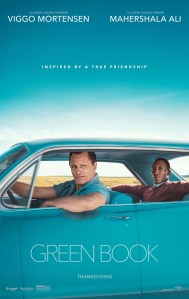
Directed by Peter Farrelly who along with his brother Bobby is best known for such comedic films as 1994’s Dumb and Dumber and 1998’s There’s Something About Mary, Green Book is a heart-warming comedic drama about an unusual road trip through the South in the 1960s with a famous black musician and a rough Italian-American driver. Inspired by a true story, ill-mannered tough guy Tony ‘Tony Lip’ Vallelonga, played by two-time Oscar nominee Viggo Mortensen, is a Manhattan bouncer looking for a job and eventually lands a job as a driver for the sophisticated and proper African American jazz pianist Dr. Don Shirley, played by Oscar winner Mahershala Ali. Despite their mutual misgivings mostly as a result of their ethnic differences, Shirley is told that the strong-willed Tony would probably be best suited for a journey through the extremely hostile South for black men like himself. Tony’s wife Dolores, played by Emmy nominee Linda Cardellini, encourages her hesitant husband to take the job. At first, both men really do not understand each other at least from a cultural and ethnic perspective, with Tony feeling that Shirley is really not black enough according to the day’s stereotypes. In almost a role reversal, at least according to the prejudices at the time, Shirley objects to the profane and often irreverent mannerisms of Tony who has never really left his comfort zone of New York City. Most of the road trip is smooth sailing with the exception of several incidents in which a few racist Southerners verbally and physically attack Shirley simply due to the color of his skin. Ironically, Shirley who is an extremely talented classically-trained pianist with impeccable manners is often barred from patronizing the same clubs and other venues where he is performing as they venture deeper and deeper into the Jim Crow South. Although at times the film glosses over the much more inhumane treatment that Shirley would likely have experienced as a black man in the South, the story evolves into a bittersweet buddy comedy in which Tony and Shirley look past their differences and develop a friendship that would last a lifetime. Emphasizing the racial underpinnings of the movie, the title itself refers to the actual travel guide known as the Green Book that directed black motorists to the black friendly establishments in the Deep South. In a rather jarring moment for Tony, he seems confused by receiving this book because he did not know that its existence was required for someone as respected as Shirley just because he is black. Overall, I found it to be an endearing and entertaining buddy road trip film that largely promotes interracial harmony evolving over an extended trip between two different men from two very different backgrounds. Furthermore, the movie works so beautifully as a result of the terrific chemistry between such acclaimed actors as Viggo Mortensen and Mahershala Ali.

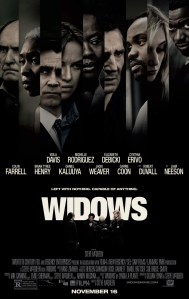
Widows

Directed by critically acclaimed filmmaker Steve McQueen who won the Oscar for 2013’s 12 Years a Slave, Widows is a powerful character-driven heist thriller that relies less on action sequences and more on the slow burn drama surrounding the climax and is remarkable for its stellar ensemble cast. The plot follows a group of women who plan a robbery following the deaths of their criminal husbands during a job and find themselves intertwined with the corrupt politics of Chicago and competing criminal organizations. Veronica Rawlings, played by Oscar winner Viola Davis, becomes the leader of the bereaved women following in the footsteps of her husband Harry, played by Oscar nominee Liam Neeson, who was the leader of their husbands’ criminal enterprise. She discovers her husband’s notebook outlining their next robbery and recruits the other women to go through with the heist in order to pay back the criminal boss and alderman candidate Jamal Manning, played by Emmy nominee Brian Tyree Henry. Jamal, along with his brutal associate and brother played by Oscar nominee Daniel Kaluuya, threaten the women whose husbands they claim stole millions of dollars from them. Eventually, Veronica is able to recruit Linda, played by Michelle Rodriguez, Alice, played by Elizabeth Debicki, and Linda’s babysitter Belle, played by Cynthia Erivo, to participate in the heist that could be worth up to five million dollars, enough to pay back Jamal. Only one of the widows Amanda, played by Carrie Coon, decides not to help out because she has a newborn baby. Their plans are complicated by the corrupt Chicago politician Jack Mulligan, played by Golden Globe winner Colin Farrell, who is running for alderman against Jamal. Jack and his vicious and equally corrupt father Tom Mulligan, played by Oscar winner Robert Duvall, are wary of Veronica because they made illicit deals with her husband Harry. Although there are several action sequences that take place during the actual heist scenes, most of the film shows the trauma and grief of the women losing their husbands, as well as their desire to avenge their deaths by meticulously planning an elaborate robbery of their own. They are portrayed as almost feminist anti-heroes who commit a crime that all the male criminals and corrupt politicians believe is not possible for women. The movie also contains several shocking twists and turns that make for a much more entertaining and thought-provoking experience. Overall, I thought it was a well-crafted and superbly acted action drama that creatively breaks the mold of a typical heist thriller by focusing on character development and creating a foreboding atmospheric drama.

Boy Erased

Written and directed by Golden Globe-nominated Australian actor Joel Edgerton who is best known for 2015’s The Gift and 2016’s Loving, Boy Erased is a powerfully-acted drama that explores gay conversion therapy and its negative impact on the LGBT participants. The story follows the emotionally fragile Jared Eamons, played by the terrific young Oscar-nominated actor Lucas Hedges, who is sent to a religious-oriented gay conversion therapy program by his deeply religious parents living in small town America. His father Marshall, played by Oscar winner Russell Crowe, is a local car dealer and a Baptist preacher who is horrified to learn that his son is homosexual, while his mother Nancy, played by Oscar winner Nicole Kidman, is equally shocked but slightly more sympathetic. In a series of flashbacks, the audience witnesses Jared’s struggles with his sexual orientation in which he tries to deny it as a result of his religious and conservative upbringing. Eventually, he comes to terms with who he is after a particularly traumatic experience in college and decides to come out to his indignant parents who believe that he can be cured at a gay conversion therapy center. While undergoing so-called treatment under the guidance of the leader Victor Sykes, played by Golden Globe nominee Joel Edgerton, the predominantly young men undergo verbal and emotional abuse supposedly designed to help them overcome their homosexuality. Jared becomes friends with the other participants and comes to resent Victor and the other employees who lack the sympathy to understand what they are going through in a society that tells them that they are morally wrong and deficient. Through his subtle yet emotionally provocative performance, Lucas Hedges brings a level of realism that allows the audience to truly understand how damaging and ineffective gay conversion therapy is on the LGBT participants who are sometimes forced to remain at the facility against their will. The fact that the movie is based on a true story and countless other experiences makes it even more heartbreaking to see the level of torment many of the victims go through during and after what is described as helping homosexuals become straight. Overall, I found it to be a truly extraordinary and harrowing account of the inner workings of gay conversion therapy and how it does nothing besides scarring those who undergo this so-called therapy; the stellar acting performances from the extremely talented cast helps to humanize the LGBT participants or victims as well as their well-intentioned but flawed family members.

The Front Runner

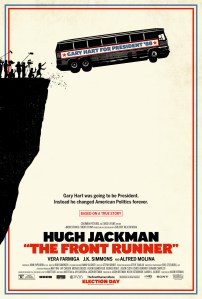
Directed by Academy Award-nominated filmmaker Jason Reitman who is best known for 2007’s Juno and 2009’s Up in the Air, The Front Runner is a fascinating political drama about the Democratic rising star politician Gary Hart whose aspirations for the presidency came crashing down after the revelation of a scandal during the election of 1988; the film is marked by a terrific ensemble cast led by Hugh Jackman. We first meet the charismatic and Kennedy-esque Colorado Senator Gary Hart, played by the terrific Academy Award nominee Hugh Jackman, after his failed bid for the Democratic nomination in the 1984 presidential election. Buoyed by support from the youth and the more liberal wing of the Democratic Party, Gary Hart decides to run again in 1988 and quickly emerges as the front runner for the nomination and even the presidency. Alongside his strong wife Lee, played by Academy Award nominee Vera Farmiga, he embarks on a refreshing political campaign in which he has a deep understanding of the issues and is able to convey it to enthusiastic voters. His highly energetic campaign is run by his officious and highly skilled campaign manager Bill Dixon, played by Academy Award winner J.K. Simmons, whose job becomes increasingly difficult once a story in the Miami Herald goes public revealing that he is having an extramarital affair with a young woman he meets on a chartered yacht out of Miami. The story is discovered by ambitious journalist Tom Fielder working for the Miami Herald who is eventually given the go-ahead to publish the story by the editor played by Kevin Pollak. Fielder along with another journalist played by comedian Bill Burr travel to DC to confront Senator Hart in the alley outside his townhome to ask him questions about the alleged affair. At the time, the personal lives of politicians were largely kept out of the media, and the publication of the story set the precedent for investigating the private lives of politicians, especially if it involves a scandal. Becoming more of a movie about journalism, the film also explores the initial hesitancy of the Washington Post and its famed editor Ben Bradlee, played by Alfred Molina, to follow up on the Miami Herald article that was at first deemed tabloid material and beneath the national press. Gary Hart’s campaign with the help of his hard-working manager goes into crisis mode and tries to figure out how to revive the flailing aspirations of Senator Hart. The movie does a good job of portraying his mistress Donna Rice, played by Sara Paxton, in a sympathetic light and shows how she had to go into hiding in order to avoid the media who continually harasses her for information about her affair. It also explores the intense relationship between Gary Hart and his strong-willed wife who expresses her anger at his indiscretions but tries to stay at his side as his campaign goes off the rails. Although the script sometimes veers off-course and could have explored the important issues in greater depth, the film itself becomes a good starting point for discussing the issues at hand that are even more relevant in today’s society with the prevalence of cable news and social media affecting modern politics. In addition, Hugh Jackman brings his greatest performance to the screen by embodying a flawed yet talented politician who appears remorseful for cheating on his wife and actually caring about the direction of the United States even after his presidential hopes are dramatically and publicly dashed. Overall, I found it to be a intriguing political and journalism movie that kept me engaged as a result of its true life aspects about such a transformative scandal that still has repercussions to this day, and I felt it was made even better by the truly top-notch acting performances, especially from Hugh Jackman.

The Girl in the Spider’s Web

Based on the 2015 book of the same name written by David Lagercrantz as part of the Millennium novel series begun by the late Swedish author Steig Larsson beginning in 2005 with the posthumous publication of The Girl with the Dragon Tattoo, The Girl in the Spider’s Web is an average reboot of the 2011 American version of The Girl with the Dragon Tattoo, which itself is a remake of the 2009 Swedish feature film, that relies too heavily on its action sequences and not enough on the fascinating main character who has now been played by three different actresses. The story follows the exploits of a punk hacker with a complex background named Lisbeth Salander, played by Golden Globe-winner Claire Foy in a truly mold-breaking performance, who finds herself caught in the web of an international criminal conspiracy to steal a software program that gives the user complete control of the world’s nuclear arsenal. With the help of her longtime partner and investigative journalist Mikael Blomkvist, played by Icelandic actor Sverrir Gudnason, she discovers that the developer of the potentially catastrophic program who previously worked for the American National Security Agency named Frans Balder, played by British actor Stephen Merchant, and his brilliant young son are in danger and must be protected against Lisbeth’s enemies. At the same time, a special agent with the NSA named Edwin Needham, played by LaKeith Stanfield, travels to Sweden to search for the missing program known as Firefall before it falls into the wrong hands. Eventually, Edwin and Lisbeth team up to find out who is really behind the theft of the powerful software tool, and she discovers that her estranged sister who was abused by their father may have been involved as the head of a criminal organization. The film scratches the surface of the personal life of the enigmatic Lisbeth who is able to elude authorities for many years despite her striking appearance, and it also explores her vigilante feminism in which she targets male abusers caused by her past sexual abuse and bisexual tendencies. However, unlike the original Swedish books and movies, the audience does not fully grasp who she really is, outside of being a righteous hacker and action heroine. A majority of the film is comprised of elaborate action sequences in which Lisbeth is chased by authorities and criminals through the streets of Stockholm on her motorcycle. Overall, I came away with the feeling that this most recent adaptation does not add much to the already rich literary and cinematic canon about the deeply compelling and complicated character of Lisbeth Salander; unfortunately, the film devolves into a rather typical action flick that tries too hard to reboot such a famous character.

Viper Club

Directed by Iranian-American filmmaker Maryam Keshavarz best known for the critically acclaimed 2011 film Circumstance, Viper Club is a surprisingly unsatisfying dramatic film about a mother coming to grips with her son being taken hostage as a freelance war correspondent, and the only bright spot of the movie is the acting given by Susan Sarandon. The story follows a longtime emergency room nurse named Helen, played by Oscar-winning actress Susan Sarandon in definitely not her best role, desperate to free her son who has been captured by a terrorist group while on assignment in the war-torn Middle East. It follows her quest to plead with American government officials, especially the FBI, to assist with her son’s case by either paying the ransom or authorizing military action to rescue him. Since it is illegal for the government or any American citizen to pay ransom to terrorists, Helen eventually gets in touch with a secret group of fellow journalists and wealthy benefactors who offer to help her meet the demands of her son’s hostage takers. Known as the Viper Club, the organization’s de facto leader is a wealthy woman whose son was also held for ransom named Charlotte, played by Emmy Award-winning actress Edie Falco best known for her role in the HBO TV series The Sopranos, and the logistics are run by the formidable Sam, played by Golden Globe-nominated actor Matt Bomer. Throughout much of the film, Helen struggles with keeping her son’s dire situation secret even from her closest coworkers and family members and figuring out a way to go around the government to finally free her only child from captivity. Although the Viper Club is able to raise a significant amount of money given by sympathetic wealthy donors towards paying the ransom, Helen eventually realizes that her son may never return home and that she may have to live with the knowledge that her son could be murdered as a result of his extremely dangerous passion to pursue a career in war journalism. Overall, I was somewhat disappointed by the high expectations that I had for the movie, with its unique and fascinating plot and well-known cast, and came away from the movie wanting more action and drama that I assumed would be part of the storytelling; the obviously talented Susan Sarandon gave her best, but ultimately her performance was not enough to pull off a compelling film.

A Private War

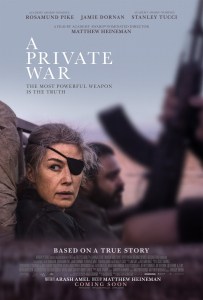
Directed by Oscar-nominated documentarian Matthew Heineman best known for 2017’s City of Ghosts and 2015’s Cartel Land, A Private War is one of the most powerful films depicting the horrors of war brilliantly told through the eyes of a real-life war correspondent and is elevated by the extraordinary acting performances. The story tells the true story of famed American journalist Marie Colvin, played by Oscar-nominated British actress Rosamund Pike in a career-best performance, who works for the London-based Sunday Times covering foreign wars throughout the world over the course of several decades. The film itself chronicles her riveting story from the year 2000 and through the climax of the movie in 2012 as Colvin perilously journeys to the war-ravaged city of Homs during the brutal Syrian Civil War that is still ongoing today. The talented filmmaker whose documentaries explored violent conflicts in Syria and Mexico expertly crafts what feels like extremely realistic portrayals of the hellish nature of war. Although she was not as recognized in her native country the United States, Marie Colvin was considered one of the greatest war correspondents who courageously went into extremely dangerous combat situations in order to report back to the world of the atrocities perpetrated during wartime. One of the first battle sequences shows her working in Sri Lanka in 2001 when she throws caution to the wind by being in the middle of a gunfight in which a grenade explodes resulting in her losing her left eye. Eventually, over the course of other conflicts, including the war in Iraq, she meets the famed war photographer Paul Conroy, played by Jamie Dornan, and enlists him as her partner and photographer. The true impact of the film involves the personal struggles that Colvin experiences on her trips back home to London and while on assignment as a result of her immersion in horrific conflicts. She most likely has PTSD which manifests itself in her inability to maintain romantic relationships and her propensity to drink too much alcohol. Pike’s remarkable performance shows just how fearless and complicated a figure that Marie Colvin was: she often wore a eyepatch and designer bras and could easily blend in in the high society parties of London as well as conversing with brutal dictators such as the Libyan president Muammar Gaddafi. Similar to her lifestyle, the audience is taken on an emotional roller coaster between action-packed traumatic war sequences and her somewhat more normal life back in London even though she experiences nightmares and self-medicates with alcohol. Her romantic relationships are equally as complicated as she sporadically continues a sexual relationship with her ex-husband and begins a new love affair with the wealthy Tony Shaw, played by Stanley Tucci. Showing her bravado, she often ignores the safety concerns of her editor Sean Ryan, played by the terrific British actor Tom Hollander, and ventures into increasingly life-threatening situations. In one of the most affecting war sequences in cinematic history, the heart-wrenching movie concludes with the intensely violent and catastrophic siege of the Syrian city Homs, which resulted in the deaths of thousands of innocent civilians caused by the Assad regime. Tragically, Marie Colvin becomes the subject of what could have been one of her many stories about the personal effects that war has on its victims. Overall, I found it to be a top-notch movie about journalism, in particular the thankless job of war correspondents who put their lives at risk on a daily basis, that is brought to life by the magnificent acting from Rosamund Pike who gives an Oscar-worthy performance. The film’s subject matter is particularly significant at a time when journalists are criticized during today’s highly divisive political climate, and it shows the importance of journalists who often risk everything in order to get a story.

Wildlife

Directed by first-time filmmaker Paul Dano who is best known as a critically acclaimed actor in such films as 2006’s Little Miss Sunshine and 2007’s There Will Be Blood, Wildlife is a slow burn emotionally subdued independent drama revolving around a dysfunctional marriage and is marked by terrific acting performances from the leads. Beautifully set in the 1960s in the small town of Great Falls, Montana, the film follows a young married couple Jeannette, played by the Oscar-nominated British actress Carey Mulligan, and Jerry Brinson, played by the Oscar-nominated American actor Jake Gyllenhaal, who are undergoing extreme marital difficulties after Jerry gets fired from his job as a golf pro. Much of the film is from the eyes of their fourteen-year-old son Joe, played by newcomer Ed Oxenbould, who is witnessing the disintegration of his parents’ marriage as he is coming of age himself in a new community trying to make his own friends. Metaphorically representing the slowly faltering marriage, a large looming wildfire is encroaching on the town, which forces Jerry to haphazardly decide to become a firefighter fighting the large fire in the open wilderness of Montana. As he is away from the family during an extended time, the increasingly restless Jeannette rebelliously decides to have her own life even at the peril of neglecting her son. Consequently, she begins a romantic relationship with a wealthy and much older car dealer named Warren Miller, played by Emmy Award-nominated actor Bill Camp, and rather brazenly reveals her extramarital affair to the confused Joe. To a rather remarkable degree, the first-time director deftly crafts an intimate glimpse into a disintegrating marriage that has profound effects on the child, all set against the backdrop of the open spaces of Montana in which wildlife and wildfires are as destructive as the flawed relationships depicted in the film. The movie takes a careful route that details what it must feel like to be in a slowly dying marriage in which the separation evolves over time and does not occur in drastic fashion, similar to what it must be like be in real life. Overall, I found it to be the ultimate actors’ film that allows the extremely talented actors to shine in a well-crafted drama that is neither over-the-top or sensational; the top-notch performances allow the filmmaker to portray the tragic and unavoidable consequences of being in a hopelessly irreparable romantic relationship.

Bohemian Rhapsody

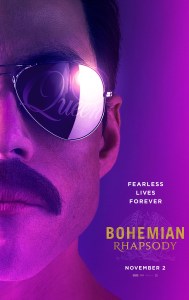
Directed by Bryan Singer who is best known for 1995’s Usual Suspects and several X-Men comic book film adaptations beginning in 2000, Bohemian Rhapsody is an entertaining biopic about the hugely successful pop rock band Queen with particular focus on the eccentric and talented lead singer Freddie Mercury who is brilliantly played by the lead actor Rami Malek. We first meet the Indian-British Parsi Farrokh Bulsara, the real birth name of Freddie Mercury played by the mesmerizing Malek who is best known for his Emmy Award-winning performance on the TV series Mr. Robot, working a dead end job at London’s Heathrow Airport, and he happens upon his favorite local band Smile in 1970 who are looking for a new lead singer. The film then follows the meteoric rise of the band after it changes its name to Queen and explores the flamboyant Freddie Mercury’s relationship with the other band members, including the lead guitarist Brian May who is played by Gwilym Lee, the drummer Roger Taylor who is played by Ben Hardy, and the bass guitarist John Deacon who is played by Joseph Mazzello. Following the stereotypical formula of a movie about musicians, the story chronicles the often contentious issues surrounding the different personalities of the band members and the desire for the lead singer Freddie Mercury to control the band and eventually embark on a solo career. It also explores the behind-the-scenes business decisions that ultimately allows Queen to become an international sensation: the one-time manager John Reid, played by Aidan Gillen who is best known for his role on the HBO TV series Game of Thrones, and their lawyer and eventual manager Jim Beach, played by critically acclaimed British actor Tom Hollander, fight with the studio EMI about what music should be released on the radio. In a fun twist, the executive Ray Foster who does not think that the hit song Bohemian Rhapsody should be played on the radio is played by Mike Myers, who himself supported the idea of using the song in the 1992 comedy Wayne’s World despite the studio’s hesitation. Since it mostly follows Freddie Mercury and his complicated personal life, the script reveals his unusual relationship with his girlfriend Mary Austin, played by Lucy Boynton, who suspects that Freddie Mercury may in fact be gay. Eventually, he does fully embrace his lifestyle and begins a sexual relationship with his personal manager Paul Prenter while, at the same time, his outfits become increasingly outrageous and gender fluid. The movie does suffer at times from a lack of a cohesive narrative direction, punctuated by well-choreographed concert scenes in which the band’s greatest hits are played by the energetic Freddie Mercury. The whole film feels like it leads up to the best part of the film when the reunited band members come together to play a truly extraordinary concert at the internationally broadcast benefit concert series Live Aid in 1985 in front of a live audience of over 70,000 at Wembley Stadium in London and a television audience of over 1 billion. During this exhilarating final sequence, Malek transforms himself into the role of Freddie Mercury and sings and dances eerily similar to the real Freddie Mercury at the summit of his career. Overall, I found it to be a fascinating look into the origins of the world famous rock band Queen who helped to define music throughout the 1970s and 80s, and whose main asset was the outstanding performance given by the extremely talented actor Rami Malek.