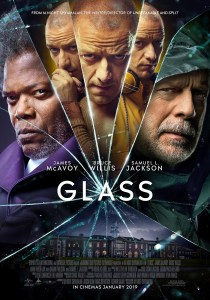
Written and directed by M. Night Shyamalan best known for 1999’s The Sixth Sense, Glass is a thriller that tries hard to recapture the innovative and entertaining aspects of 2000’s Unbreakable and 2016’s Split, which are directly part of a trilogy that ends with this film. Unfortunately, the rather high expectations for the movie leads the audience astray and the hallmark suspense and unexpected twists of a M. Night Shyamalan movie fall flat as a result of the slow pacing and preposterous ending. We first meet the complicated anti-heroes eluding authorities as they continue to use their supernatural powers straight from a comic book. Eventually, all three of the protagonists are captured and are confined in a old psychiatric hospital: David Dunn, played by Golden Globe winner Bruce Willis and reprising his role from Unbreakable, who is unable to be physically harmed, Elijah Price, played by Oscar nominee Samuel L. Jackson and reprising his role from Unbreakable, who has enhanced intellectual abilities but breaks bones easily, and Kevin Crumb, played by Golden Globe nominee James McAvoy and reprising his role from Split, who has multiple personalities and can transform into a super strong beast. They are all held under the auspices of receiving treatment from the mysterious Dr. Ellie Staple, played by Golden Globe nominee Sarah Paulson, who argues they are suffering from a mental disorder giving them delusions of grandeur making them believe they are really superheroes. The first half of the film is quite intriguing and thereby entertaining because we get to see the three extremely fascinating and enigmatic characters interact with one another. My favorite part is witnessing James McAvoy’s brilliant acting ability to spontaneously morph into a wide range of personas, including one of a nine-year-old boy, a devious middle-aged woman, and a terrifying creature with supernatural strength. The movie does a commendable job of unraveling a mystery and over time the audience comes to better understand the motivations of the characters, including the doctor. The revelation of shocking truths comes to the forefront when the three heroes, or villains depending on your perspective, confront each other in a final climactic battle after they use their wits and strengths to attempt to achieve freedom. With its somewhat unexpected twists and turns in the storyline, the film is classic M. Night Shyamalan who has made his career based on twist endings. However, the conclusion to the almost two-decade-long trilogy is very much a letdown with a rather lame and shockingly uncreative twist. The filmmaker is also too heavy-handed in trying to make the movie a powerful metaphor for comic books and humanity’s desire for heroes with superpowers to save the day. The potential is there for the movie to be one of his masterpieces that has a greater message than just entertaining the masses, but, unfortunately, the filmmaker’s almost singular focus on surprising the audience clouds his judgement on truly developing the characters and a coherent plotline. Overall, the build-up to an epic conclusion to M. Night Shyamalan’s years-in-the-making trilogy does not pan out and therefore can be best described as yet another disappointment in his hit-or-miss filmmaking career.


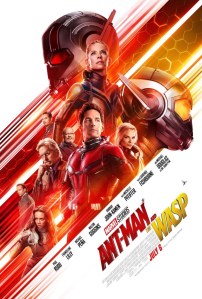 The sequel to the highly successful 2015 movie Ant-Man and the twentieth installment in the Marvel Cinematic Universe, Ant-Man and the Wasp is a highly entertaining and creative film that takes itself less seriously than a majority of the other superhero movies and thereby is filled with much more humor and fun. The story takes place several years after the original in which the protagonist Scott Lang, played by the humorous Paul Rudd, is under house arrest after a mission as his superhero alter ego Ant-Man. He is a more sympathetic and well-rounded superhero because of his poignant relationship with his young daughter and having fairly usual problems in real life. Just days before his house arrest is over, he is in clear violation by getting in contact with the brilliant inventor of the Ant-Man outfit Hank Pym, played by Oscar winner Michael Douglas, and his smart and beautiful daughter Hope van Dyne, played by Evangeline Lilly, whose superhero alter ego is the Wasp. Hank discovers there may be a way to rescue his wife Janet, played by Golden Globe winner Michelle Pfeiffer, who is stuck in the subatomic quantum realm, and he must enlist Scott to become Ant-Man again to help develop a device to enter the quantum realm. However, the trio find themselves in trouble after trying to broker a deal with the black-market dealer Sonny Burch, played by the villainous Walton Goggins, who double-crosses them in order to steal Hank’s advanced technology. To complicate things even further, they encounter the mysterious Ghost, played by Hannah John-Kamen, who is suffering from quantum and molecular instability and is desperate to find the technology to alleviate her problem. Throughout the movie as the characters engage in the typical action sequences of any comic book superhero production, Scott along with his buddies, especially Michael Peña’s character Luis, bring a certain levity to the story through their often ridiculous and hilarious antics. Much of the humor derives from the conceit of the film: the filmmakers play around with the ability of the characters to shrink and enlarge themselves and everyday objects, including an entire building shrunk down to the size of a briefcase and a life-size Pez dispenser that becomes a weapon. Overall, I found it to be one of the more enjoyable cinematic experiences found in the innumerable Marvel superhero movies as a result of its lighthearted approach while still retaining thrilling CGI-enhanced action scenes.
 Based on the best-selling 2011 novel of the same name written by Ernest Cline, Ready Player One is entertaining science fiction fantasy that effectively recreates the video game experience with its frenetic pace and overabundance of CGI. The plot revolves around Wade Watts, played by Tye Sheridan, who lives in a futuristic Columbus, Ohio in 2045 and finds himself on an adventure in the so-called OASIS, a virtual reality world that most people tap into to escape their dystopian real lives. Wade whose avatar is named Parzival is what is known as a Gunter and searches for the Easter eggs that the creator James Halliday, played by Oscar winner Mark Rylance, hid within OASIS after his death. The person that discovers the three keys will become the sole owner and operator of the massive virtual world in addition to receiving $500 billion from Halliday’s estate. With the possibility of such immense power, the villainous CEO of the video game corporation IOI Nolan Sorrento, played by Emmy winner Ben Mendelsohn, enlists an army of indebted OASIS users to discover the clues left behind in order to take control. Wade races to discover all of the Easter eggs before Sorrento and eventually teams up with a group of other avatars known as the “High Five,” including the young and beautiful Art3mis whose real name is Samantha Cook, played by Olivia Cook, and Wade’s virtual best friend Aech, played by Lena Waithe who is best-known for her role in the Netflix series Master of None. The movie feels very much like the audience is alongside Wade as he battles through what is essentially an elaborate video game, with the telltale graphics of a modern first-person shooter and the presence of avatars and Easter eggs. Besides the spectacular and almost seizure-inducing special effects and action sequences, the film is remarkable for its nostalgia and homage to vintage and contemporary video gaming as well as past pop culture, in particular the 1980s and even to the director Steven Spielberg’s earlier movies. Overall, I found it to be a unique and creative cinematic experience that, for better or worse, feels like a video game nerd’s fever dream brimming with so much insider geeky knowledge to be almost too overwhelming for general audiences.
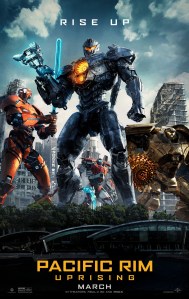 Produced by Academy Award-winning filmmaker Guillermo del Toro who directed the original Pacific Rim released in 2013, Pacific Rim: Uprising is a preposterous yet sometimes entertaining sequel that falls short of the original’s creativity and fun. The film takes place ten years after the first movie when the extraterrestrial monsters known as Kaiju are defeated by the Pan-Pacific Defence Corps and their gigantic fighting machines known as Jaegers. The story follows Jake Pentecost, played by John Boyega of Star Wars fame, who as the son of the fallen hero and leader of the PPDC Stacker Pentecost is forced to reenlist as a Jaeger pilot instructor after he is arrested dealing in the black market. He must begrudgingly work with his former copilot Nate, played by Scott Eastwood, and train the young new recruits, including a young orphan named Amara, in case the Kaiju return to earth to wreak havoc. With the world at peace, the Jaeger program is under assault with the rise of a drone program developed by the wisecracking scientist Dr. Newt Geiszler, played by the highly entertaining Charlie Day, and the Shao Corporation based in China. Eventually, the Kaiju present an imminent threat and Jake and his cohorts are relied upon to pilot the Jaegers to prevent widespread destruction. The PPDC are assisted by the odd genius Dr. Hermann Gottlieb, played by the highly believable Burn Gorman, who discovers that Kaiju blood is highly reactive and could be used to kill off humanity. Similar to the Transformers movie franchise and the long line of Godzilla-like monster films known in Japan as Kaiju, the movie is chock-full of elaborate CGI fight sequences between building-sized creatures and robot in which wide swaths of cities are wiped out in over-the-top fashion. Overall, I found it to be a rather typical Hollywood blockbuster sci-fi movie overflowing with rather silly action scenes; the only true asset to the film is its almost tongue-in-cheek view of itself as a popcorn flick that should not be taken too seriously.
 KEITH on Reels