
Directed by Debra Granik who is best known for the 2010 Oscar-nominated film Winter’s Bone that helped bring Jennifer Lawrence to stardom, Leave No Trace is a somber and beautiful movie that encapsulates the bond between father and daughter and is marked by top-notch acting performances. The story follows a veteran suffering from PTSD named Will, played by the terrific Ben Foster, who lives off-the-grid in the forested wilderness outside Portland, Oregon with his young teenage daughter Tom, played by the captivating New Zealand actress Thomasin Harcourt McKenzie. After years of living a peaceful existence with bare necessities and very little human contact, they are eventually discovered by local authorities who place them in social services since it is illegal to live on public land and Tom has not been attending school. The separation between the extremely close father and daughter becomes almost unbearable because they have become dependent on one another living on their own in the wild. When they are given an opportunity to live a more normal lifestyle on a tree farm in rural Oregon, Will struggles and over time decides that they need to return to the wilderness despite Tom’s increasingly strong desire to remain a normal teenager living among her peers. She mostly goes along with her father because she knows that he is suffering from his traumatic experiences while he served in the military. He is unable to cope with being around a lot of seemingly normal people who do not understand his experiences, and he simply wants to shut off reality. Heightening the emotional impact of such a heartwarming yet heartbreaking story, the filmmaker makes the excellent choice to portray the narrative in a slow burn fashion in which the unusual premise has room to grow and not become over-dramatized. Furthermore, it enhanced the feeling of being surrounded by the quiet and magnificent wilderness that leads to a slow pace of life. Overall, I found it to be one of the more powerful films I have seen in recent memory because it contains such a thought-provoking and simple story of father-daughter love and is very much an actor’s movie in which the two lead actors give brilliantly nuanced performances.
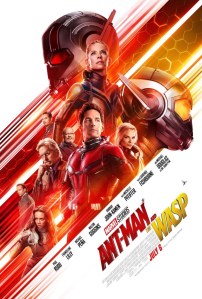 The sequel to the highly successful 2015 movie Ant-Man and the twentieth installment in the Marvel Cinematic Universe, Ant-Man and the Wasp is a highly entertaining and creative film that takes itself less seriously than a majority of the other superhero movies and thereby is filled with much more humor and fun. The story takes place several years after the original in which the protagonist Scott Lang, played by the humorous Paul Rudd, is under house arrest after a mission as his superhero alter ego Ant-Man. He is a more sympathetic and well-rounded superhero because of his poignant relationship with his young daughter and having fairly usual problems in real life. Just days before his house arrest is over, he is in clear violation by getting in contact with the brilliant inventor of the Ant-Man outfit Hank Pym, played by Oscar winner Michael Douglas, and his smart and beautiful daughter Hope van Dyne, played by Evangeline Lilly, whose superhero alter ego is the Wasp. Hank discovers there may be a way to rescue his wife Janet, played by Golden Globe winner Michelle Pfeiffer, who is stuck in the subatomic quantum realm, and he must enlist Scott to become Ant-Man again to help develop a device to enter the quantum realm. However, the trio find themselves in trouble after trying to broker a deal with the black-market dealer Sonny Burch, played by the villainous Walton Goggins, who double-crosses them in order to steal Hank’s advanced technology. To complicate things even further, they encounter the mysterious Ghost, played by Hannah John-Kamen, who is suffering from quantum and molecular instability and is desperate to find the technology to alleviate her problem. Throughout the movie as the characters engage in the typical action sequences of any comic book superhero production, Scott along with his buddies, especially Michael Peña’s character Luis, bring a certain levity to the story through their often ridiculous and hilarious antics. Much of the humor derives from the conceit of the film: the filmmakers play around with the ability of the characters to shrink and enlarge themselves and everyday objects, including an entire building shrunk down to the size of a briefcase and a life-size Pez dispenser that becomes a weapon. Overall, I found it to be one of the more enjoyable cinematic experiences found in the innumerable Marvel superhero movies as a result of its lighthearted approach while still retaining thrilling CGI-enhanced action scenes.
 Adapted from the critically acclaimed 2009 book of the same name written by well-known author Jonathan Safran Foer, Eating Animals is a powerful and thought-provoking documentary that delves into the issues surrounding large-scale factory farming of animals for human consumption. Narrated by vegan activist and Oscar winner Natalie Portman, the film provides a brief history of the early days of farming and how it evolved into an assembly line production mostly owned by such large corporations as Tyson Foods and Perdue Farms. Unlike many other environmentalist and vegan-promoting exposes, it provides a more nuanced view of the current state of animal farming by presenting interviews with a variety of farmers, including those adversely affected by working in the corporate realm and local conscientious farmers who are trying to bring back the old heritage methods of farming. Furthermore, the movie focuses on all of the implications that the mass production poultry and cattle industries has on humankind: the irresponsible dumping of animal byproducts and fertilizers that harm the environment, the corporate takeover of farms that harm the economic interests of the local farmer, and the public health hazards of consuming animals processed and filled with antibiotics. The documentary also features disturbing footage of the mistreatment of animals living in overcrowded and dangerous conditions and have become deformed as a result of practices promoting rapid growth and mass production. However, the purpose of the film is not just to encourage people to stop eating meat but to help inform the audience about ways to consume meat in a more responsible manner by purchasing from so-called heritage farms who care for the animals in a more traditional, healthy way. Overall, I found it to be an enlightening glimpse into the often unseen world of animal farming and a extremely important film that taught me that there are ways to be a more ethical meat consumer without becoming a vegetarian or vegan.



 KEITH on Reels