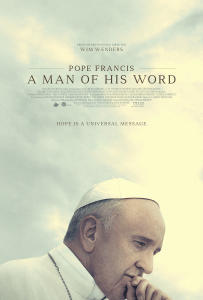
Directed by acclaimed German filmmaker Wim Wenders best known for the award-winning 1984 film Paris, Texas, Pope Francis: A Man of His Word is a fascinating documentary that explores the central tenets of Pope Francis and his views on Catholic theology in the context of the ever-evolving modern world. Becoming the pope in 2013 after serving as the Archbishop in his hometown Buenos Aires, Argentina, Pope Francis arose as a remarkable choice for the Catholic Church as a result of being a Jesuit from South America and his unique decision to take the name Francis in honor of Saint Francis. A majority of the film is essentially a wide-ranging sermon given by Pope Francis to the audience through a series of interviews with the filmmaker who also acts as the narrator. The documentary also contains several dramatic reenactments of Saint Francis of Assisi who lived in 13th century Italy to illuminate why Pope Francis was the first pope to choose the name Francis and how Pope Francis’ theology derives from the humble and nature-focused Saint Francis. Interspersed with footage of his many visits to the people around the world, the interviews touch on the most pressing issues of his papacy, including economic inequality, the environment, global peace, and respect for all humanity no matter their religion. It is important to note that the movie is not a biographical documentary about his life but rather has the main purpose of promoting the positive messages of Pope Francis. Unlike almost any other pope in history, Pope Francis is massively popular to his followers and those of all faiths as a result of his progressive ideas on religion and philosophy in today’s chaotic world. Overall, I found it to be a deeply insightful documentary about one of the most powerful religious figures and powerfully illustrates Pope Francis’ radical departure from previous popes to provide a more inclusive and optimistic theology. Even if you are not Catholic or even a Christian, the viewer comes away with a greater appreciation of Pope Francis and his hopeful mission.
 Directed by critically acclaimed filmmaker Ron Howard who won the Academy Award for 2002’s A Beautiful Mind, Solo: A Star Wars Story is an entertaining movie in the Star Wars saga with plenty of adventure and CGI-enhanced action sequences but underwhelms compared to the original and most recent installments. As the second standalone anthology film in the series, the movie is more of a origin story that follows the early exploits of Han Solo, played by the up-and-coming charismatic Alden Ehrenreich, and how he evolved into the famous character portrayed by Harrison Ford in the original trilogy. We first meet Han trying to escape a criminal organization with his girlfriend Qi’ra, played by Emilia Clarke of Game of Thrones fame, and travel to another planet where he can pursue his dream of becoming a pilot. For a time, he is a soldier for the Empire, but he eventually becomes a deserter to join forces with a group of criminals led by Tobias Beckett, played by Oscar nominee Woody Harrelson. He also meets his future famous copilot Chewbacca, and they enter in their friendly rapport with humorous back-and-forth as depicted in the first movies. The rest of the movie follows the formula of a heist film in which Han and his new outlaw friends must steal the valuable so-called hyperfuel coaxium for yet another criminal syndicate known as the Crimson Dawn led by Dryden Vos, played by Paul Bettany. Things get increasingly complicated for Han, and he must team up with the notorious smuggler Lando Calrissian, played by Emmy winner Donald Glover, who provides him the means of piloting the well-known Millennium Falcon spaceship. Towards the end of the film, there are a few plot twists and not all of the characters are as they appeared in the beginning. The story appeases Star Wars fans with the appearance of characters and new details that refer to the nine other installments and may not have as much significance for general audiences. Overall, I found it to be a satisfying cinematic experience that had enough excitement to make up for the shortcomings of being sometimes too formulaic and not adding much depth to the already complex Star Wars franchise.




 KEITH on Reels