In the Fade

Winner of the 2018 Golden Globe Award for Best Foreign Language Film and directed by acclaimed Turkish-German filmmaker Fatih Akin, In the Fade is a terrific dramatic thriller remarkable for the superb acting performance from German actress Diane Kruger. The tragic story follows a German woman named Katja Sekerci, played by Kruger who is best known for her performance in the 2009 Quentin Tarantino film Inglourious Basterds, whose Kurdish husband Nuri and son Rocco are killed by a bomb placed outside her husband’s office in a predominantly Turkish neighborhood of Hamburg, Germany. Clearly ravaged by grief and anger, she all but gives up on her own life immediately following her family’s deaths and turns to using illicit drugs after the police insinuate that her convicted felon husband may have been murdered as part of his prior connection to the drug underworld. She also feels alienated from her parents and her in-laws who never really approved of their marriage as a result of their very different backgrounds. When the two young suspects with connections to the neo-Nazi movement are apprehended and put on trial, Katja who is represented by her lawyer friend Danilo becomes very involved with the trial in order to seek justice for her husband and son. She is promised several times by prosecutors and her lawyer and becomes convinced herself that the trial will end with easy murder convictions and possible life imprisonment for the racist couple. Towards the end of the movie, Katja heartbreakingly realizes that she may have to take her own revenge at a high cost outside the judicial system. Overall, the film through mesmerizing acting did an excellent job of portraying grief and loss and the emotional tumult and sheer anger experienced by those whose loved ones die through violent means. Diane Kruger’s emotionally raw and heartfelt performance really brings to life what it must be like to undergo incomprehensible heartbreak caused by the hands of those filled with hatred.

Maze Runner: The Death Cure

The final installment in The Maze Runner trilogy that was first released in 2014, Maze Runner: The Death Cure is a fairly typical action movie based on a series of young adult books about a dystopian future, reminiscent of the wildly successful Hunger Games franchise. The plot follows a group of young people led by Thomas, played by Dylan O’Brien, who are immune to a virus that has killed off much of humanity and become members of The Right Arm rebellion against the all-powerful organization known as WCKD who experiment and torture those who are immune to find a cure. Thomas along with characters Frypan and Newt, played by Thomas Brodie-Sangster, go against the orders of The Right Arm leaders Vince, played by Barry Pepper, and Jorge, played by Giancarlo Esposito of Breaking Bad fame, by breaking into the heavily fortified Last City, one of the few remaining uninfected cities and home to the headquarters of WCKD led by Patricia Clarkson’s character, to rescue one of their immune friends Minho. After meeting up with the resistance forces outside the city walls led by Lawrence, played by Walton Goggins, the group are reunited with their friend Gally, played by Will Poulter, who can help them fight their way in against the vicious leader of WCKD troops Janson, played by Aidan Gillen of Game of Thrones fame. They must also convince a previous member of the group Teresa who now works for WCKD to align with the rebels to undermine the malevolent organization. However, things get more complicated after Teresa discovers that Thomas may help lead to a cure for the deadly virus. Overall, I found it to be a somewhat entertaining film that helps pass the time but ultimately does not add much to the already bloated genre of young adult dystopian movies.

12 Strong

Based on the 2009 non-fiction book Horse Soldiers written by Doug Stanton, 12 Strong is a fairly typical war movie whose main strength is telling a fascinating true story about one of the first military operations in Afghanistan following the September 11th attacks. It follows a group of twelve United States Army Special Forces soldiers who are sent to Afghanistan on a covert mission known as Task Force Dagger in October 2001 to combat the Taliban harboring the al-Qaeda terrorist group responsible for the deadliest attack on American soil. The group known as Operational Detachment Alpha 595 within the elite 5th Special Forces Group are commanded by Captain Mitch Nelson, played by Chris Hemsworth, on his first leadership role in combat and is tasked with joining Afghan General Abdul Rashid Dostum and his Northern Alliance fighters. Their mission is to recapture the Taliban stronghold of Mazar-i-Sharif, a Northern Afghan city strategically vital to the Americans in the forthcoming war, and eliminate Taliban and al-Qaeda soldiers in the region. Once they arrive in Afghanistan, the American troops, including soldiers played by Oscar nominee Michael Shannon and Michael Peña, discover they are outnumbered by the Taliban heavily armored with tanks and rocket launchers. Earning their nickname the Horse Soldiers, the men are surprised to learn they must ride horses into combat due to the rough terrain. As to be expected from a Jerry Bruckheimer production, the film contains several well-coordinated and thrilling action sequences involving the Special Forces on horseback firing machine guns at the relentless Taliban and al-Qaeda forces. Overall, despite the talented cast and spectacular scenes of modern warfare, the movie never transcends the generic formula of an action flick as a result of the lack of character development and the bloated runtime. Unfortunately, it does not really do justice to the truly remarkable story of one of the first military responses to the terrorist attacks of September 11, 2001, an operation that up until recently was classified.

Phantom Thread

Directed by Academy Award-nominated filmmaker Paul Thomas Anderson who is best known for 1997’s Boogie Nights, 2007’s There Will Be Blood, and 2012’s The Master, Phantom Thread is a beautifully crafted arthouse film with outstanding acting performances, sumptuous cinematography, and a terrific script revolving around a rather unusual and evocative story. Set in 1950s London, the plot follows a famous couture dressmaker named Reynolds Woodcock, stupendously played by three-time Academy Award winner Daniel Day-Lewis, who lives a rather lonely and sheltered life obsessed with his work to make the finest dresses for the rich and famous. The only person he really shares his life with is his no-nonsense sister and fashion partner Cyril, played by British actress Lesley Manville, who insulates him from the harsh outside world and very much babies him to satisfy his peculiar habits. While eating at a restaurant near his country home, Reynolds becomes enamored with a beautiful young waitress named Alma, played by a revelation of a star Vicky Krieps, who he insists must go to dinner with him. Over time, she becomes his muse and is invited to live with him and his sister at their London fashion house where they embark on a rather unorthodox romantic relationship. As Alma gets closer and closer to Reynolds and learns more about the high fashion world, Cyril becomes weary of Alma and the disruption that she causes for her needy and obsessive compulsive brother. Throughout the film, the relationship between Alma and Reynolds fluctuates between emotionally and physically intimate and brutally distant as he focuses on his meticulous work making outfits. Underscoring their bizarre romance, the plot veers into unexpected territory with a puzzling ending. Daniel Day-Lewis, like his other equally terrific work over the years, delves deep into his role as evidenced by the realistic great care that his character takes for fashion and believably taking on the neuroses of his character. His mesmerizing performance is greatly enhanced by the talents of Paul Thomas Anderson who creates a beautifully meditative and emotionally delicate story with impressively detailed cinematography, musical scoring, and costuming. Overall, I found it to be a terrific work of art and a perfect ode to the fabulous Daniel Day-Lewis in what may be his last acting role.

The Commuter

Directed by Jaume Collet-Serra best known for 2016’s The Shallows and collaborating with Liam Neeson on such action thrillers as 2014’s Non-Stop, The Commuter is a fairly typical action thriller in the spirit of Liam Neeson’s Taken movie series that does not really add much to the genre. Oscar nominee Liam Neeson plays an insurance agent named Michael MacCauley who finds himself mixed up in criminal intrigue on his daily train commute back home from Manhattan. He meets a mysterious woman named Joanna, played by Oscar nominee Vera Farmiga, who promises him $100,000 if he finds a particular person she is looking for that is out of place on the train. While interacting with several other people he has gotten to know over their daily commutes, including Walt who is played by Jonathan Banks of Breaking Bad fame, Michael surreptitiously tries to uncover the person he is tasked with finding. Similar to other action movies starring Liam Neeson, he uses a particular set of skills to fight much younger men and race against time before Joanna and the secret organization she works for harms his wife and teenage son. Eventually, towards the end of the movie, he discovers a criminal conspiracy in which not everyone is as they seem, and he himself is suspected to be a criminal or terrorist by authorities, including two police officers played by Patrick Wilson and Sam Neill who Michael knew when he was a NYPD detective. Overall, I found it to be a mediocre and silly action thriller that is good to pass the time with an entertaining performance from Liam Neeson but ultimately fails to transcend the stale stereotypes of an action flick.

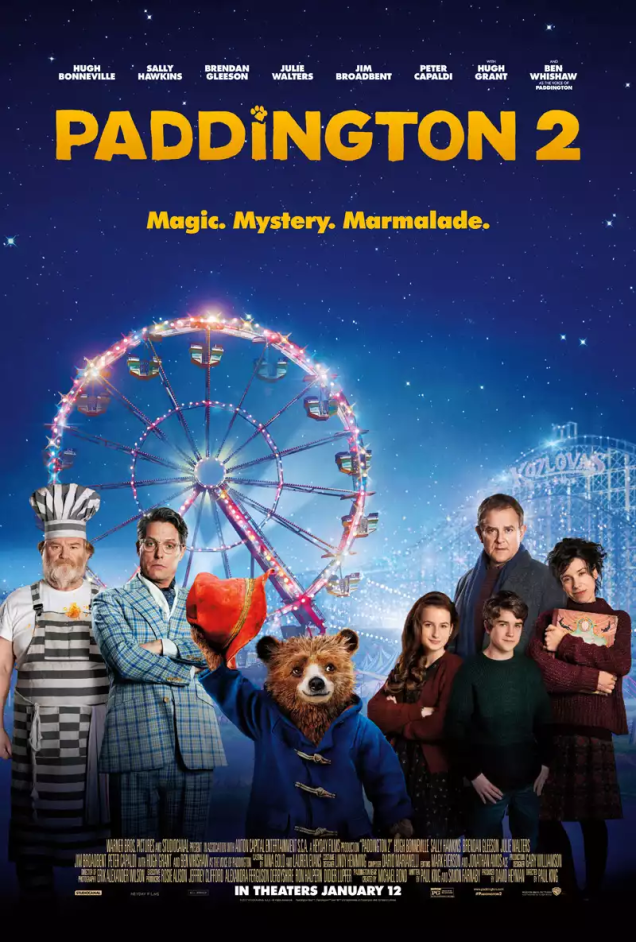
Paddington 2

A follow-up to the successful 2014 original film based on the classic British children’s character Paddington Bear created by Michael Bond, Paddington 2 is a wonderful children’s movie appealing to all ages with an abundance of charm in storytelling and visuals that makes for a feel-good moviegoing experience. Taking place several years after becoming a member of the Brown family in London, the plot revolves around the lovable talking bear Paddington, voiced by Ben Whishaw, trying to find the perfect gift for his Aunt Lucy back in Peru but somehow finds himself entangled in a mysterious crime. He discovers at an antique shop run by his friend Samuel Gruber, played by Oscar winner Jim Broadbent, a marvelous pop-up book about London landmarks and decides to take out several odd jobs to pay for the expensive book as a birthday gift for his beloved Aunt Lucy. However, the pop-up book is stolen by a mysterious thief, and Paddington is accused and convicted of the crime. He is sent to prison where he befriends several inmates, including the cook known as Nuckles and played by Golden Globe nominee Brendan Gleeson. In several funny scenes, Paddington helps to bring cheerfulness to the prison with a large helping of his favorite food: marmalade sandwiches. His human family headed by insurance agent Henry Brown, played by Hugh Bonneville of Downton Abbey fame, and the sweet Mary Brown, played by Oscar nominee Sally Hawkins, try to solve the theft in order to prove Paddington’s innocence. Suspicions are raised about a local narcissistic actor named Phoenix Buchanan, played by a superbly villainous Hugh Grant, who has an unusual habit of dressing up as his most famous costumed characters. Once Paddington and the Browns discover the true culprit, they are led on a wild goose chase brimming with British charm and wit. Somewhat reminiscent of a Wes Anderson production, the filmmakers pay great attention to detail in creating stereotypically British and whimsical sets and an overall cute atmosphere. Overall, I thought it was a magical and clever movie with a heartfelt story and full of excellent British actors that feels quintessential British and is overflowing with lighthearted charm.

Hostiles

Directed by Scott Cooper who is best known for 2009’s Crazy Heart and 2015’s Black Mass, Hostiles is a beautifully shot Western with terrific acting performances from the main protagonists and provides a more nuanced view of the violent struggles between Native Americans and the American government. Set in 1892 at the height of the Indian Wars, the story follows U.S. Army Captain Joseph Blocker, played by Oscar winner Christian Bale, who is ordered to take the recently imprisoned Cheyenne war chief Yellow Hawk, played by the wonderful Cherokee actor Wes Studi, and his family back to their home in Montana. Blocker who is notorious for his brutal tactics against Native Americans is at first very hesitant to follow orders to help an Indian who was responsible for the death of several of his comrades in the past. Accompanied by a group of other American soldiers, the group are unexpectedly joined by Rosalie Quaid, terrifically played by Rosamund Pike, whose family was just brutally murdered by a group of Comanche in New Mexico. Along the perilous journey, the party must grapple with the violence and injustices perpetrated by both white Americans and Native Americans. Both sides have lost many lives, and the usually hardline Captain Blocker eventually comes to terms with the fact that the United States’ vicious and sustained campaign against Native Americans may have caused many of the problems between the two fighting groups. The challenges shared by everyone on the expedition helps create bonds between Blocker and his soldiers, Yellow Hawk and his family, and Quaid despite their justifiably grave misgivings about each other. Although there are several violent episodes, most of the film is almost a meditative experience for the characters as they cross spectacular Western scenery on horseback and come to understand one another. Overall, I found it to be a well-crafted movie with some of the most beautiful cinematography and gives a very important message about reconciliation between enemies during a very violent point in American history.

The Post

Directed by Steven Spielberg who won the Oscar for best director for 1994’s Schindler’s List and 1998’s Saving Private Ryan, The Post is a terrific film about the importance of journalism and is full of brilliant performances from an all-star cast under the guidance of one of the greatest filmmakers with a well-crafted script. Set in the early 1970s as the Vietnam War became increasingly unpopular, the movie tells the true story of the release of the so-called Pentagon Papers, which documented the failures and cover-ups of the war in Vietnam by the United States government. It is about the fierce competition between The New York Times and the relatively small Washington Post to get the scoop on such consequential classified documents. The plot follows the groundbreaking female publisher and owner of The Washington Post Katharine Graham, played by Oscar winner Meryl Streep, and the well-respected editor-in-chief Ben Bradlee, played by Oscar winner Tom Hanks, as they struggle to raise the newspaper’s national profile as they begin the process of going public to raise funds to keep the paper running. When they catch wind of the Pentagon Papers leaking, they along with their journalists desperately try to get the full report and publish stories about the secret government report that The New York Times has been barred from publishing because of a government injunction. Eventually, the Post journalist Ben Bagdikian, played by Golden Globe nominee Bob Odenkirk, is given thousands of pages of the Pentagon Papers from one of its authors, a government contractor for the Rand Corporation named Daniel Ellsberg, played by Emmy nominee Matthew Rhys. Graham and Bradlee must grapple with the legal implications of publishing confidential government records, which could result in jail time and the newspaper going bankrupt, and the journalistic duty of informing the public in a country with freedom of the press. Although it is a historical snapshot of a crucially important time in journalism, the filmmakers effectively allude to the parallels in today’s society, with the current president of the United States criticizing the free press and calling for the prosecution of leakers. The movie very much reminds me of the 1976 movie All the President’s Men, perhaps the greatest movie ever made about journalists, by focusing on the investigative reporting at The Washington Post during the Nixon era. Both films powerfully shed light on the significance that journalism has on holding the American government and president accountable for their actions. A spiritual prequel to the Robert Redford and Dustin Hoffman movie in which the story takes place almost immediately after the Pentagon Papers, Spielberg’s work is much more about the leadership at The Washington Post and its conflict with the judicial system. Overall, I found The Post to be one of the most relevant movies made about America’s current political and journalistic environment and stands by itself as an excellent movie due to its marvelous ensemble cast with almost too many great actors to name directed by the great Steven Spielberg.

Molly’s Game

Directed by Aaron Sorkin who is best known for creating the Emmy Award-winning TV series The West Wing and writing the Oscar-winning screenplay for the 2010 movie The Social Network, Molly’s Game is a well-crafted film from a talented screenwriter in his directorial debut that tells a remarkable story and is marked by terrific acting performances and a first-rate script. The plot revolves around the true story of Molly Bloom, brilliantly played by Oscar nominee Jessica Chastain, who runs one of the most exclusive high stakes poker games after a career-ending injury as a Olympic-level skier. She finds herself desperate for a job after moving to Los Angeles and is enlisted by her jerk of a boss to help put on a weekly poker game attended by Hollywood actors, powerful businessmen, and other influential men. The movie is a series of flashbacks recounting her rise from this first arrangement and through the high stakes poker community to establishing her own game first in Los Angeles and later in Manhattan. She narrates her own life story to her defense attorney Charlie Jaffey, played by the always outstanding Golden Globe winner Idris Elba, after she finds herself in trouble with the FBI for possible connections to the Russian mafia. Much of her legal problems stem from the fact that she published a memoir about her days in the legally dubious poker world. Because of her position in the world of gambling, Molly’s wealth garnered from poker is frozen by the government, and she must convince authorities she was unaware of the most damaging allegations, particularly the involvement of several criminal organizations. Besides telling her fascinating story, the filmmaker also does an excellent job of providing a glimpse into the shadowy world of high stakes poker and its popularity with power brokers and well-known celebrities. For instance, the character known as Player X, played by Michael Cera, is supposed to represent a composite of Leonardo DiCaprio, Tobey Maguire, Ben Affleck, and other Hollywood actors who likely attended Molly’s poker games. The movie’s energy is greatly enhanced by the hallmarks of an Aaron Sorkin production: many scenes comprise of clever and fast-paced dialogue to underscore the high-stakes that Molly faces gambling with powerful men and the federal government. Overall, I found it to be an entertaining movie that tells a truly unbelievable story about the largely unknown world of underground poker and is captivating for most of the time despite some rather slow and drawn-out moments.

All the Money in the World

Directed by Oscar-nominated filmmaker Ridley Scott who is best known for 1979’s Alien, 1982’s Blade Runner, 2000’s Gladiator, and 2015’s The Martian, All the Money in the World is a well-crafted and gripping thriller about the kidnapping of a grandson of one of the world’s wealthiest men in the 20th century. The story takes place in 1973 when the 16-year-old grandson of billionaire oil businessman J. Paul Getty, terrifically played by Academy Award winner Christopher Plummer who replaced the disgraced Kevin Spacey only one month before release, is taken hostage by an Italian criminal organization in Rome. They ask for a ransom of $17 million for the life of J. P. “Paul” Getty III, played by Charlie Plummer, from his mother Gail Harris, played by the brilliant Academy Award nominee Michelle Williams, who is now divorced from Getty’s troubled son. Without a financial settlement from the divorce and without help from her former father-in-law, she is distraught because she does not have the money to save her son’s life. As a result, she has no other recourse but to ask Getty who she greatly despises to help pay the ransom, but he refuses as a ruthless tactic to avoid having his other grandchildren being kidnapped and costing him money. The movie portrays Getty as a vicious tycoon who will do anything to keep his money even though he is worth over a billion dollars. To avoid paying a single penny, he eventually enlists a former CIA operative and negotiator for Getty Oil named Fletcher Chase, played by Mark Wahlberg, to figure out a way to free Paul from his captors. Chase is also told to remain in contact with Gail about the kidnapping and report everything back to Getty. The best moments of the film show Getty making rather brutal comments about his family and apparent lack of interest in helping his grandson and much hated former daughter-in-law even while he continues to spend millions of dollars on his art collection. To further illustrate the cruelty of Getty, the story dramatically captures the anguish and anger of Gail while her son is wasting away partly as a result of her former father-in-law’s actions. As Chase and the authorities get closer and closer to finding Paul and capturing his kidnappers, the movie evolves into more of a standard crime thriller full of riveting chases and shootouts. Overall, I found it to be a quite entertaining and truly fascinating film full of top-notch acting performances and thrills about a story I really did not know much about and am now quite surprised that the unbelievable true story has not been made into a movie earlier.