Thank You For Your Service

Directed by Jason Hall who is the Academy Award-nominated screenwriter of 2014’s American Sniper, Thank You For Your Service is a powerful film that takes a raw unflinching into the life of soldiers suffering from post-traumatic stress disorder after being deployed and its effects on their lives back home. Based on true life stories, the movie follows three recently deployed soldiers in Iraq who have returned home but with horrific emotional scars. The main character Staff Sergeant Adam Schumann, played terrifically by Miles Teller, tries to be the good soldier and hide his emotional distress from his loving wife, played by Haley Bennett, and their two young kids. Although broken himself, he becomes the core emotional support for two other soldiers from the same unit who are suffering much more visibly. American Samoa-born Specialist Tausolo Aieti, played by Beulah Koale, has a particularly challenging time acclimating to civilian life and the news that his wife is pregnant with their first child. He suffered traumatic brain injury after withstanding several bomb blasts while on tour in Iraq. Along with Schumann, he tries to get help from the VA but discovers that receiving medical attention is a much more complicated and lengthy process due to the backlog and bureaucracy of the VA. They are particularly desperate to receive help after helplessly witnessing the rapid downward spiral of the other soldier that returned home with them, Billy Waller, played by Joe Cole. His tragic mental breakdown is accelerated after learning that his fiance has left him when he was deployed. As he tries to alleviate the other soldiers’ suffering, Schumann must grapple with his nightmarish flashbacks and guilt over possibly causing additional harm to a soldier with a grave head injury after an accident while trying to save his life. Eventually, Schumann realizes he also must face his own mental health issues caused by PTSD since his marriage is strained and his depression could lead to suicidal thoughts. Unlike most other movies dealing with war, the film is effectively able to focus on the often overlooked and stigmatized effects that war has on soldiers, especially debilitating mental health problems and PTSD. Yes, it is heartbreakingly depressing watching the movie but, I feel, that everyone should see it as it relays such an important message about soldiers and veterans. It vividly reveals how many of them are suffering without insufficient help from the overburdened and underfunded VA. The filmmaker puts faces to the truly shocking statistics about the increasingly large number of soldiers and veterans suffering from mental health illnesses and committing suicide. Overall, I found it to be a highly evocative movie that is sometimes depressing and anger-inducing about such an important issue as PTSD and whose stories are brought to life as a result of the brilliant acting performances. 
Geostorm

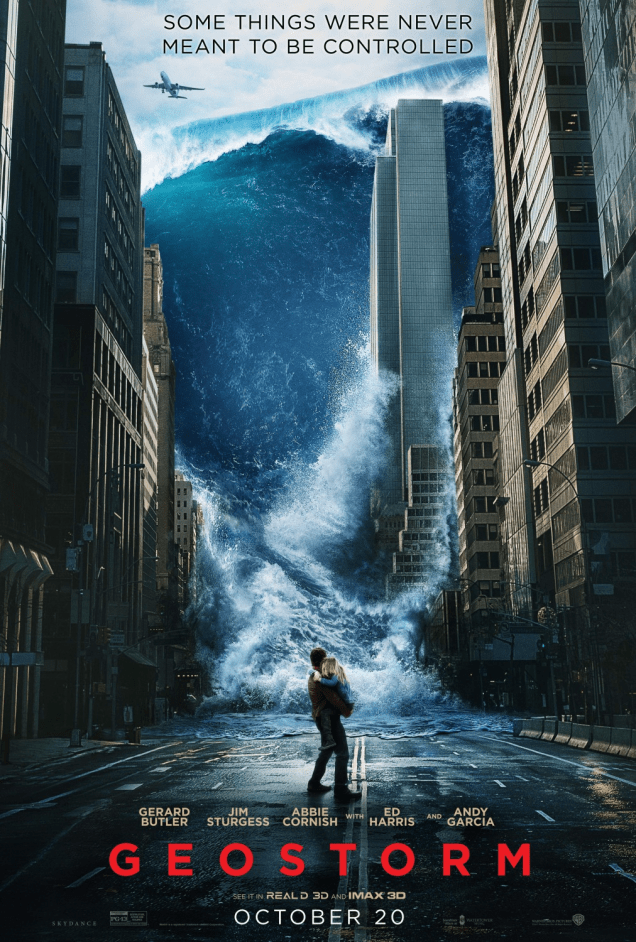
Written and directed by Dean Devlin who is best known for writing 1996’s Independence Day and 1998’s Godzilla, Geostorm is a ridiculous and cheesy movie that tries to be an epic blockbuster disaster film but largely fails through a combination of underwhelming writing and acting and a laughably improbable premise. The story involves the cataclysmic failure of a massive space satellite program created to control the weather that has increasingly become extreme as a result of climate change. Played by Gerard Butler, Jake Lawson is a brilliant scientist and the creator of the program known as Dutch Boy but is removed from his position as a result of his reckless behavior in front of American government officials. Several years later, with his brother Max, played by Jim Sturgess, as the head of the program, Dutch Boy is to be handed over to be controlled by an international coalition of climate scientists and government officials. However, the satellites controlled from the International Climate Space Station malfunctions and results in extreme weather events that kill hundreds of people and poses an existential threat of creating what is known as a geostorm, a massive storm enveloping the entire Earth. Jake reluctantly returns to the program to help investigate the problems and travels to the space station where he works with a female commander named Ute Fassbinder. Themselves in danger as the space station self-destructs, they begin to unravel a vast conspiracy that may involve the President of the United States, played by Andy Garcia, and the powerful Secretary of State who is played by Ed Harris. The film becomes a race against time as the Earth is beset by colossal tornadoes, flooding, and other natural disasters. After a while, the obviously CGI-enhanced disaster sequences become tedious as a result of the low quality visual effects used and the preposterous situations. The movie concludes with a overly dramatic climax in which some high-ranking officials prove to be untrustworthy for self-gain. Overall, I found it to be a rather generic disaster blockbuster that never really provided the necessary thrills for a truly entertaining experience. The film could actually have been somewhat interesting because of its timely premise about climate change and the science fiction solutions that could be used to fix such a massive issue. However, it never gets past the sloppy writing and acting skills that made the movie more of a comedic disaster. 

Goodbye Christopher Robin

Directed by Simon Curtis who is best known for 2011’s My Week with Marilyn, Goodbye Christopher Robin is a fascinating glimpse into the personal life of the creator of Winnie the Pooh and what inspired him to create such an iconic children’s character. Played by Domhnall Gleeson, A. A. Milne is a talented and well-respected writer who struggles with his next project after serving as a soldier during World War I and still suffering from post-traumatic stress. He decides it would be good for his mental health to move out of London and live in East Sussex in the English countryside with his beautiful wife Daphne, played by Margot Robbie, and his young son Christopher Robin who they nickname Billy Moon. Clearly experiencing horrific flashbacks and ridden with guilt and depression, he is largely an absent father and has a sometimes difficult married life. As a result, Christopher Robin is primarily raised by his loving nanny Olive, played by Kelly Macdonald best known for her role in HBO’s TV series Boardwalk Empire. Eventually, Milne becomes inspired during a long weekend alone with his son when he comes up with fantastical stories about Christopher Robin’s toys, particularly his teddy bear, while they play in the nearby woods. With the help of a friend and illustrator, he comes up with the character Winnie the Pooh, named after a bear from Winnipeg in the London Zoo and a swan named by his son as Pooh, and other characters that would be later first published as a children’s book in 1926 and a second book released in 1928. After such a catastrophic war, Winnie the Pooh becomes an inspirational distraction for the British public and helps heal the emotional wounds suffered. The international success of the character Winnie the Pooh and his fictional friend Christopher Robin does renew his literary career but at the expense of his family. His son Christopher Robin, who is the basis for the boy in the stories, essentially becomes a marketing tool and becomes too busy to experience a normal childhood because of his own fame. Milne realizes the mistakes he has made in exposing his son to such publicity at such a young age when the real Christopher Robin grows up and enlists in the military at the outbreak of World War II. Overall, I found it to be a well acted film that does a good job of providing insight into the creation of one of the most beloved children characters and its positive and negative effects on the author and his family. However, the movie at times felt conflicted about whether it should be a sentimental story about childhood or a dramatic story about the ills of war and celebrity. 

Professor Marston and the Wonder Women

Based on a rather unusual true story, Professor Marston and the Wonder Women follows the personal life of the creator of comic book character Wonder Woman and his unorthodox relationship with his wife and lover who would  provide inspiration for his famous superhero. We first meet Dr. William Moulton Marston, played by Luke Evans who has appeared in several Fast and Furious movies and the 2016 live action remake of Beauty and the Beast, in 1947 as he is testifying to the Child Study Association of America who is concerned that Wonder Woman is exposing children to lesbianism and sadomasochism. The testimony is used as a reference to the many flashbacks that make up most of the film. In 1928, Marston and his brilliant wife Elizabeth, played by Rebecca Hall, are both professors of psychology at Harvard and Harvard’s all-female college Radcliffe who develop theories to understand human behavior. Marston is particularly struck by the beauty and intelligence of one of his students named Olive Byrne, played by Bella Heathcote, and recruits her to assist in the Marstons’ research. After they use their research to invent the lie detector test, Marston and his wife Elizabeth as well as Olive must grapple with the fact that they all three love each other. Due to the conservative values of the time, they must hide their polyamorous and highly sexualized relationship but, eventually, the rumors about the Marstons’ love life gets them fired from Harvard and Radcliffe. All three of them move to suburban New York where they raise Elizabeth’s and Olive’s kids with Marston while trying to make ends meet with Elizabeth as a secretary and Marston as an out-of-work psychologist. Inspired by their free love and penchant for sadomasochism with the underlying assumption of empowering women, Marston comes up with the idea of a comic book character sharing these attributes and calls her Wonder Woman. Over time, his work that also furthers his psychological theories is published under the pseudonym Charles Moulton by Max Gaines, played by Oliver Platt, who discovered Superman and would later become part of DC Comics. Marston tries to balance his increasingly complicated domestic life with the great success he enjoys with the creation of Wonder Woman. The revelation of their peculiar secret poses a real threat to their family staying together and his career as the creator of Wonder Woman. Overall, I found it to be a well-crafted film that provides unique and sometimes surprising insight into the origins of such a famous superhero as Wonder Woman, and it presents an unvarnished look into the largely unknown and often taboo issues surrounding polyamorous relationships. The excellent acting skills of the three protagonists help to enliven the truly fascinating story and lends the movie a sense of realism.

Marshall

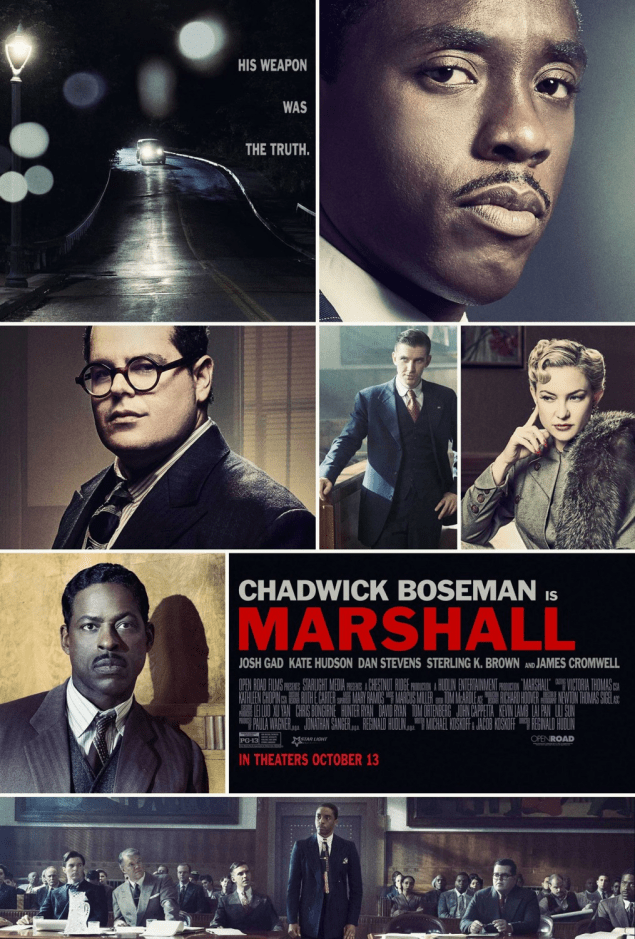
Based on a true story, Marshall is a well-crafted biopic about the early years of the first African-American Supreme Court Justice Thurgood Marshall during his time as a lawyer for the NAACP representing a black man accused of raping a white socialite. We first meet Marshall, played by Chadwick Boseman best known for his role as Jackie Robinson in 2013’s 42, as a crusading lawyer working for the then relatively small African-American civil rights organization known as the NAACP. As only one of the few full-time lawyers on staff, he is sent throughout the United States to represent falsely accused black defendants who are on trial primarily the result of racial discrimination. In 1941, the head of the NAACP recruits him to represent a black chauffeur named Joseph Spell, played by Emmy Award winner Sterling K. Brown, charged with raping the wealthy white woman he works for in the predominantly white town of Greenwich, Connecticut. Played by Golden Globe winner Kate Hudson, Eleanor Strubing claims that while her wealthy husband was away she was brutally assaulted, repeatedly raped, and thrown off a bridge by Spell. Unable to directly represent Spell as an out-of-state attorney, the brilliant Marshall must work with the reluctant local white lawyer Sam Friedman, played by Josh Gad, to develop a case and find evidence disputing the crime that Spell repeatedly says he did not commit. The filmmaker shows the meticulous and extremely smart detective and legal skills of Marshall to uncover the truth while being bombarded with racist attacks from the white community. Although the time away from his wife is often challenging, he bravely embraces his dangerous job because of his passion for equality under the law and respecting the Constitution. Racism was so prevalent at the time that even the prosecuting attorney Loren Willis, played by Dan Stevens of Downton Abbey fame, and Judge Foster, played by James Cromwell, clearly do not respect Marshall as a black man and blindly trust the evidence and witness accounts despite not crossing the legal threshold of beyond a reasonable doubt. Over the course of the trial, Friedman becomes a friend to Marshall and understands what African-Americans go through on a daily basis after he is attacked for helping Marshall and being a Jewish immigrant. The movie is also an excellent example of a tense courtroom drama that slowly builds up suspense to the verdict. Overall, I thought the film provides unique insight into the legendary Thurgood Marshall by presenting a relatively unheard-of case in his early career and how it forms the rest of his highly successful career leading up to his appointment as a Supreme Court Justice in 1967. The quality acting performances and writing creates an inspirational and compelling portrayal of the early Civil Rights Movement and the role of Thurgood Marshall and the NAACP. 

Only the Brave

Based on a true story, Only the Brave is an emotionally powerful and dramatic movie with a terrific ensemble cast that tells the heroic story of the Granite Mountain Hotshots, an elite group of wildfire firefighters based out of Prescott, Arizona who were involved in the tragic Yarnell Hill Fire in June 2013. Leading up to the events of the summer of 2013, the film follows this small group of firefighters working for the Prescott Fire Department and led by supervisor Eric Marsh, played by Academy Award-nominated actor Josh Brolin, as they try to get certified as the first municipal interagency hotshot firefighting crew. Not just filled with thrilling action scenes, it goes deeper by providing an intimate glimpse into the personal lives of those brave men who decide to fight the extremely volatile wildfires. For instance, we see the challenges faced by Eric’s wife Amanda, played by Academy Award winner Jennifer Connelly, as she tries to deal with his dangerous job that strains their marriage and ability to have a family. Eric is portrayed as a good man who gives chances to troubled young men, including Miles Teller’s character Brendan McDonough who is recovering from a drug addiction and has a newborn with his ex-girlfriend. The other firefighters, including Taylor Kitsch’s character, at first do not respect McDonough, but eventually they become like brothers as they all have the same mission to save lives. This ragtag group, with the encouragement of Jeff Bridges’ character who holds a leadership position in the fire department, is able to prove they have the talent and skills to being on the front lines of wildfires throughout the United States as hotshots. The filmmaker does an excellent job of showing how firefighters contain wildfires through the use of digging trenches and setting small fires in an attempt to extinguish rapidly advancing flames primarily caused by lightning. In late June of 2013, the crew is sent on a routine mission to contain a wildfire referred to as the Yarnell Hill Fire not too far away from Prescott. However, conditions rapidly deteriorate, and the now highly respected Granite Mountain Hotshots are faced with the horrific situation of being surrounded by an out-of-control wildfire. Although there are some heartbreaking moments, the movie creates a fuller and surprisingly personal picture of those brave men who take great pride in fighting wildfires in order to protect their communities. Overall, I definitely thought it was not just a great firefighter movie but a highly evocative and inspirational film about the trials and tribulations of those who courageously serve a greater good. The filmmaker, with the help of the terrific cast, effectively balances the emotional side of the characters with harrowing and heart-stopping realistic action sequences.

Breathe

Directed by first-time director Andy Serkis best known for his CGI work as Gollum in The Lord of the Rings movie series, Breathe is a heartwarming and inspirational movie based on the true story of Robin Cavendish who became one of the first polio patients on a respirator to leave the confines of a hospital. At the beginning, Robin, played by Academy Award-nominated actor Andrew Garfield, falls in love with his a beautiful young woman named Diana, played by Golden Globe winner Claire Foy from the 2016 Netflix series The Crown. Eventually, they both lead an adventurous life living in Africa after they get married. Unexpectedly, in late 1958 at the age of 28, Robin is diagnosed with polio that leaves him paralyzed and fully dependent on a ventilator. Even after the birth of his Jonathan, he descends into a great state of despair over having to spend the rest of his life, which doctors tell him may only last a few months, in a hospital bed without any way of escaping to the outside world. Diana tries to encourage him to have the will to live for the sake of their new son. Against the doctor’s orders that he would be risking his life, Robin decides to leave the hospital and move back home with his wife and son where he can use the ventilator at home. A so-called responaut, he even dares to go outside his house and travel places. He asks his good friend and Oxford professor Teddy Hall, played by Downton Abbey’s Hugh Bonneville, who is also an inventor to design a wheelchair that could also include a ventilator. With his newfound freedom, Robin becomes an advocate for the severely disabled in the UK and even travels to a conference in Germany where all the experts and medical professionals are astonished that he is out in the world and are deeply fascinated by his groundbreaking wheelchair. The film is especially heartbreaking when the audience sees how many of the paralyzed polio patients at the time are placed in iron lungs, which allows them to breathe but essentially trap them in a coffin unable to ever leave the hospital wards. Robin along with other disability advocates help to raise finances to provide the specialized wheelchairs to those needing a ventilator, including his other friends still at the hospital. Besides being a movie about Robin’s courageous struggle to live, it also tells a poignant story of the constancy of love between Robin and Diana that always remained in spite of the difficulties associated with caring for somebody with a disability. Robin is able to reach a point in life in which he is happy to be alive and grateful to be with his beloved wife and see his son grow up. Overall, I found to be one of the more inspirational stories about those with disabilities and how one person can help drastically change those suffering and have the will to live. Although the movie was slow at times, the dynamic and beautiful acting performances of the two main characters help to create a genuinely emotional cinematic experience.

Viceroy’s House

Directed by Gurinder Chadha who is best known for 2002’s Bend It Like Beckham, Viceroy’s House is a fascinating historical drama about the final days of British Imperial rule of India and gives a behind-the-scenes look at the predominantly Indian staff who work for the last British Viceroy of India at his palatial estate in Delhi. The well-respected Lord Mountbatten, played by Hugh Bonneville of Downton Abbey fame, along with his strong wife Edwina, played by Gillian Anderson of X-Files fame, arrive in India in 1947 as the British Empire begins the complicated  process of turning over power to an Indian government. They are portrayed as sympathetic to the plight of many Indians who are extremely divided between the majority Hindu population and the minority Muslim population. Lord Mountbatten first advocates a unified India in which both religions live together as one nation, but, ultimately, he discovers that the issues are much more contentious and that a possible two-state solution of India and Pakistan may be the only option to prevent further violence. The Hindu political leader Jawaharlal Nehru, as well as Mahatma Gandhi, personally petition Lord Mountbatten to push for a single nation while the Muslim political leader Muhammad Ali Jinnah urges the Viceroy to create Pakistan as a separate Muslim-majority country. To dramatize the very real tensions between Hindu and Muslim, the movie follows a new Hindu servant at the Viceroy’s House named Jeet who is in love with the Muslim servant Aalia who has been arranged to marry another Muslim. With violent riots erupting across India over whether to partition the post-colonial nation, Jeet fears for the safety of his family and particularly his love Aalia. As the day of independence approaches, the conflicted Lord Mountbatten announces India will be partitioned in hopes of easing tensions; he learns that it was always the British government’s plan to create the nation of Pakistan and has been secretly supported by his Chief of Staff Lord Ismay, played by the terrific Michael Gambon. Subsequently, like the rest of India, Lord Mountbatten’s staff are forced to claim their allegiance either to India or Pakistan and will have to move their families accordingly after British rule officially ends. Jeet and Aalia, along with their families, must also make this extremely difficult decision. Overall, I thought the filmmaker did an excellent job of providing the audience with a greater understanding of the challenges caused by the Partition of India and its massive human toll, including over 1 million deaths and almost 15 million people migrating between the two new countries. One issue I had with the movie is the romance between the two major Indian characters did not feel necessary to tell the story and was almost as if it was thrown in at the last minute just for dramatic effect. 

The Foreigner

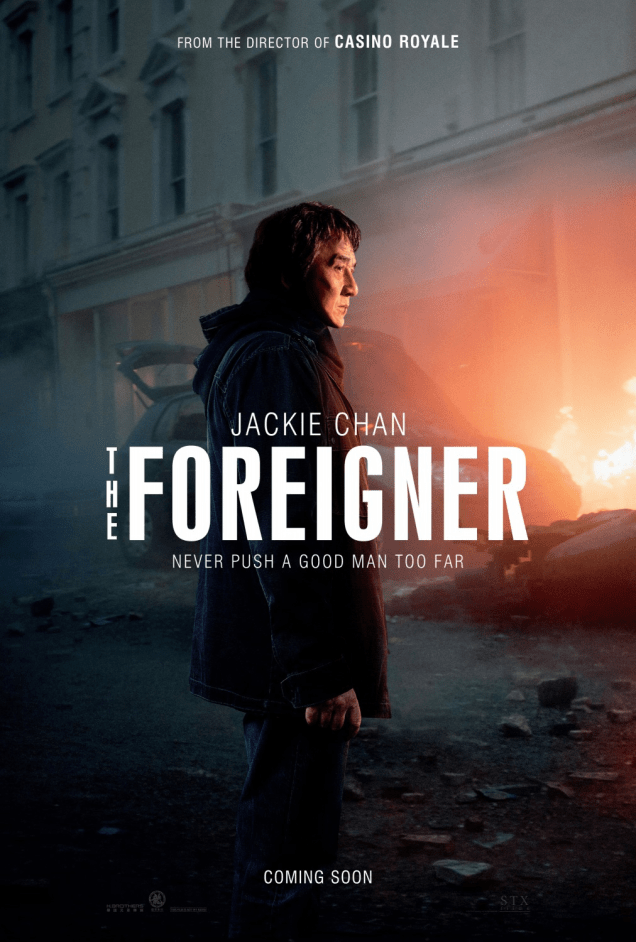
Directed by Martin Campbell who is best known for the 2006 James Bond film Casino Royale, The Foreigner is a fairly typical yet entertaining action thriller significant for the dramatic acting performance given by the usually funny martial arts superstar Jackie Chan. The aging Chan plays Ngoc Minh Quan, a hard-working Chinese restaurant owner in London whose beloved teenage daughter Fan is killed in a bombing claimed by a group of terrorists sympathetic to the anti-British IRA movement in Ireland and Northern Ireland. After his wife and other children were murdered as they migrated to England years ago, the death of his only remaining family member sets Quan on a path to find those responsible and enact revenge. He approaches the Irish Deputy Minister Liam Hennessy, played by a dramatic Pierce Brosnan, who Quan believes knows the perpetrators. Hennessey is suspicious because he was once a powerful figure in the IRA who still has connections with active members despite his apparent allegience to the United Kingdom. Chan’s character rapidly escalates his anger at Hennessy by bombing his office in Belfast and systematically terrorizing him at his farmhouse. Throughout the entire conflict, Hennessy claims he has no knowledge about the bombing in London and actually investigates it himself to see if any of his former IRA associates were involved. As he tries to find the culprits and smooth over relations with the central British government, Hennessy tasks his bodyguards, including his ruthless nephew Sean, with hunting down Quan who we learn has a particular set of skills as a former Special Ops trained by the Americans during the Vietnam War. Towards the end of the movie, things get more complicated with surprising twists on who was really involved in the London bombing. As with any other Jackie Chan film, there are several well choreographed fight sequences in which Jackie Chan uses his martial arts skills to the fullest. However, I was surprised by the relatively few scenes involving Jackie Chan; the promotional material gives the impression that his character would be the central focus and that Pierce Brosnan’s character would be less of a major character. Overall, I found it to be an enjoyable but fairly formulaic action thriller whose strengths include the dramatic turn of Jackie Chan and the uniquely fresh take on the IRA.
The Mountain Between Us

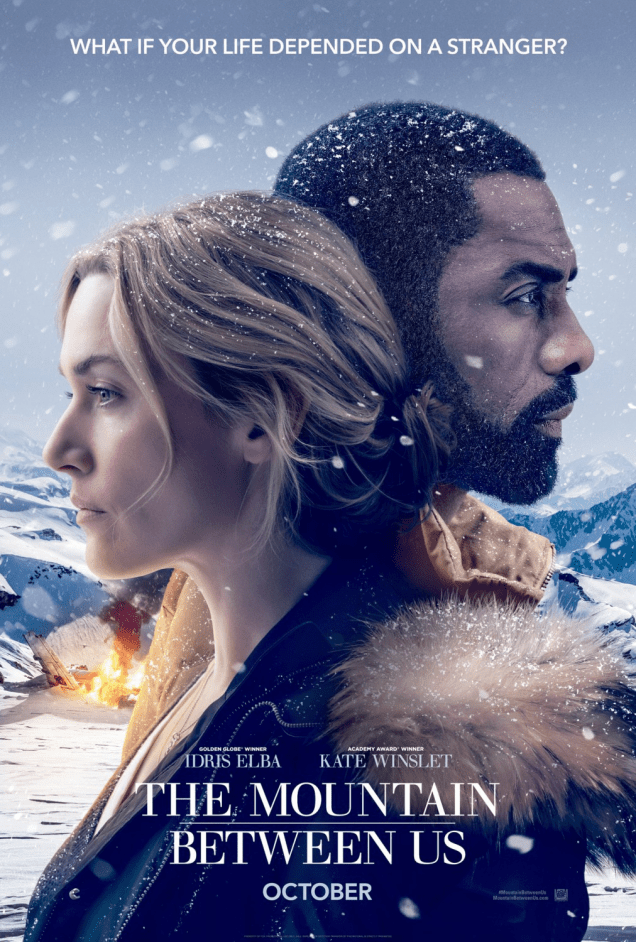
Based on a novel of the same name written by Charles Martin in 2011, The Mountain Between Us is an interesting take on the romance genre by fashioning it as a survival movie and whose greatest asset is the always terrific acting performances of Golden Globe winner Idris Elba and Academy Award winner Kate Winslet. Both are strangers who find themselves chartering a small plane out of Idaho because they need to be somewhere after flight cancelations. Dr. Ben Bass, played by Elba, is a talented neurosurgeon who must be back in Baltimore to perform an emergency pediatric surgery, while Alex Martin is an acclaimed photographer who must be home for her wedding the next day. Piloted by Beau Bridges’ character and accompanied by his loyal dog, their small aircraft crashes in the extremely remote mountains of the High Uintas Wilderness somewhere in Utah en route to Denver. Both Ben and Alex, along with the dog, survive the crash but quickly realize that they are stranded because no flight plan was filed and none of the radios and cell phones are working. The more pragmatic and cautious Ben urges Alex who injured her leg that they must stay at the crash site in hopes that rescuers will come to them. Despite her condition, the much more adventurous and emotional Alex decides that it would be in their best interest to hike down the mountains to find civilization and survive. Eventually, they decide to venture through the increasingly brutal wilderness even with the full knowledge that it could lead to their deaths. Throughout the ordeal, they discuss fairly intimate details of their lives, including Ben’s wife and Alex’s engagement and marriage ceremony that she is missing. Their unique bond caused by the human desire to survive over time leads to a romantic spark, which puts their future lives into question if they make it out of the mountains alive. For better or worse, the movie is a relatively simple romantic story of two strangers coming together and finding love in the most unusual way possible. Overall, I was expecting more of a survival movie with thrilling adventures and came feeling like something was lacking to create a movie worthy of the immense talents of the two actors.