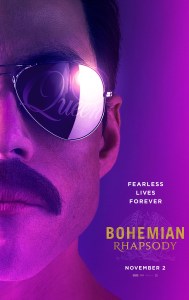
Bohemian Rhapsody

Directed by Bryan Singer who is best known for 1995’s Usual Suspects and several X-Men comic book film adaptations beginning in 2000, Bohemian Rhapsody is an entertaining biopic about the hugely successful pop rock band Queen with particular focus on the eccentric and talented lead singer Freddie Mercury who is brilliantly played by the lead actor Rami Malek. We first meet the Indian-British Parsi Farrokh Bulsara, the real birth name of Freddie Mercury played by the mesmerizing Malek who is best known for his Emmy Award-winning performance on the TV series Mr. Robot, working a dead end job at London’s Heathrow Airport, and he happens upon his favorite local band Smile in 1970 who are looking for a new lead singer. The film then follows the meteoric rise of the band after it changes its name to Queen and explores the flamboyant Freddie Mercury’s relationship with the other band members, including the lead guitarist Brian May who is played by Gwilym Lee, the drummer Roger Taylor who is played by Ben Hardy, and the bass guitarist John Deacon who is played by Joseph Mazzello. Following the stereotypical formula of a movie about musicians, the story chronicles the often contentious issues surrounding the different personalities of the band members and the desire for the lead singer Freddie Mercury to control the band and eventually embark on a solo career. It also explores the behind-the-scenes business decisions that ultimately allows Queen to become an international sensation: the one-time manager John Reid, played by Aidan Gillen who is best known for his role on the HBO TV series Game of Thrones, and their lawyer and eventual manager Jim Beach, played by critically acclaimed British actor Tom Hollander, fight with the studio EMI about what music should be released on the radio. In a fun twist, the executive Ray Foster who does not think that the hit song Bohemian Rhapsody should be played on the radio is played by Mike Myers, who himself supported the idea of using the song in the 1992 comedy Wayne’s World despite the studio’s hesitation. Since it mostly follows Freddie Mercury and his complicated personal life, the script reveals his unusual relationship with his girlfriend Mary Austin, played by Lucy Boynton, who suspects that Freddie Mercury may in fact be gay. Eventually, he does fully embrace his lifestyle and begins a sexual relationship with his personal manager Paul Prenter while, at the same time, his outfits become increasingly outrageous and gender fluid. The movie does suffer at times from a lack of a cohesive narrative direction, punctuated by well-choreographed concert scenes in which the band’s greatest hits are played by the energetic Freddie Mercury. The whole film feels like it leads up to the best part of the film when the reunited band members come together to play a truly extraordinary concert at the internationally broadcast benefit concert series Live Aid in 1985 in front of a live audience of over 70,000 at Wembley Stadium in London and a television audience of over 1 billion. During this exhilarating final sequence, Malek transforms himself into the role of Freddie Mercury and sings and dances eerily similar to the real Freddie Mercury at the summit of his career. Overall, I found it to be a fascinating look into the origins of the world famous rock band Queen who helped to define music throughout the 1970s and 80s, and whose main asset was the outstanding performance given by the extremely talented actor Rami Malek.

Can You Ever Forgive Me?

Based on the 2008 confessional memoir of the same name written by the film’s subject Lee Israel, Can You Ever Forgive Me? is a deeply fascinating real life story about a desperate writer who resorts to criminal literary forgery and is a well-crafted movie remarkable for its incredible acting, especially from the comedian Melissa McCarthy who puts on an Oscar-worthy performance that reveals her to be an extremely talented dramatic actress. We first meet the previously best-selling biography author Lee Israel, played by the popular Oscar-nominated comedic actress Melissa McCarthy, in the 1990s at a low point in her career when not even her agent is interested in her new work and is willing to do practically anything for cash to support her lonely existence with her aging cat. With her sarcastic wit and overall unpleasantness, Lee devises a plan to embellish and later outright forge letters from famous writers and sell them to local New York City book sellers interested in literary artifacts. Her criminal enterprise grows rapidly after she realizes that she can make hundreds of dollars from just one letter supposedly written by the likes of deceased literary giants as Dorothy Parker and Noël Coward. The movie becomes somewhat of a dark comedy after the sardonic Lee begrudgingly befriends a fellow witty loner and drunkard named Jack Hock, played by the fabulous critically acclaimed British actor Richard E. Grant. They both engage in drunken escapades through the seedy streets and dive bars of Manhattan, and eventually Lee tells Jack about her forgeries and decides to enlist Jack to help her as her accomplice. As Lee gets deeper and deeper into her criminal activities and becomes increasingly careless, both Lee and Jack engage in witty and often ribald banter and are unafraid to talk about their homosexuality. The film simply works as a result of the magnetic chemistry between the two talented actors who bring a certain level of realism and brutal sarcasm that is irresistible to watch. Despite the fact that Lee is quite the curmudgeon and appears unapologetic about her miscreant behavior, the audience is somehow drawn to the character and comes to empathize with her desperation which led to her being investigated by the FBI. Towards the end of the movie, she does face serious consequences for her forgeries after being tipped off by sellers to the FBI and is even betrayed in a much more personal way that ultimately leads to her conviction. Overall, I found it to be a truly captivating movie that leaves the audience wanting more from the compelling dynamic characters that help fashion an extraordinary tragic comedy, and one of its greatest achievements is showing the versatile and skillful work from Melissa McCarthy who proves to be a force to be reckoned with in serious dramatic roles.

Beautiful Boy

Based on the memoirs Beautiful Boy written by David Sheff in 2008 and Tweak written by Nic Sheff in 2007, Beautiful Boy is a heartbreaking and emotionally powerful film about a troubled relationship between a father and his drug-addicted son, that is brought to life by extraordinary acting performances. The movie begins with Nic Sheff, played by the terrific Oscar nominee Timothée Chalamet, going missing, and, after returning from using drugs, his father who is the well-known writer for Rolling Stone David Sheff, played by comedian and Oscar-nominated actor Steve Carell, forces his son to enter rehab. Throughout the course of the film, Nic struggles with his addiction to such illicit drugs as meth and heroin and fluctuates between periods of sobriety and serious relapse as he bounces between rehab and home. Starting a new family with two young kids after marrying his second wife Karen, played by Golden Globe winner Maura Tierney, David has trouble balancing helping out the very troubled Nic and making sure that his new wife and young kids have normal and happy lives. At one point, he is even sent to his rather hands-off mother Vicki, played by Oscar nominee Amy Ryan, in Los Angeles to see if a change in environment could get Nic sober with the help of a sponsor there. The filmmaker does an excellent job of exploring the horrific impact that drugs have on the users and their families by showing the many complicated steps that Nic and his father must take in order for Nic to become a fully recovering addict. Almost like grieving for his son who has been lost to the drug underworld, David goes through a mixed bag of emotions, including anger that his son would put the family through so much, depression that he is not able to help his son, and guilt that he allowed his son to even get to such a dark place. The audience is also a witness to the heartbreaking and tragic circumstances of drug addiction: David eventually giving up on his son and refusing to give him money, and Nic breaking into his family home in Northern California for drug money. For a while, nothing seems to help, but he is able to get to a better place after seeing the overdose of a close friend and his own almost fatal overdose. Overall, I found it to be a very profound drama that, although at times feels uneven, is a showcase for the mesmerizing acting abilities of Timothée Chalamet and Steve Carell.

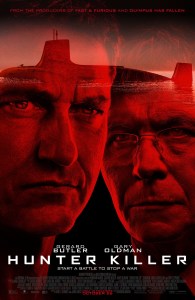
Hunter Killer

Directed by South African filmmaker Donovan Marsh in his first major feature film, Hunter Killer is a subpar submarine action movie that never floats above the surface as a result of its lackluster acting performances and cheesy and extremely formulaic storyline. The plot opens with the mysterious disappearance of an American submarine off the coast of Russia in the Arctic, and the unorthodox submarine Commander Joe Glass, played by Gerard Butler, is given command of the USS Arkansas to help investigate the circumstances surrounding the USS Tampa Bay disappearance. Working from the command room in the Pentagon, Rear Admiral John Fisk, played by actor musician Common, eventually convinces the Chairman of the Joint Chiefs of Staff played by Oscar winner Gary Oldman that a possible coup by the Russian military is underway and that a nuclear war is imminent. He comes to this conclusion after the USS Arkansas reports back that the USS Tampa Bay was torpedoed and that a nearby Russian submarine was likely destroyed as a result of internal sabotage. At the hesitance of his superiors, Fisk orders a team of Navy SEALs to the Russian naval base where the Russian president has been taken prisoner by the Russian defense minister. As the submarine commanded by Glass makes its way to the same Russian base after destroying another Russian submarine that attacked them, the Navy SEALs are tasked with the very dangerous mission of rescuing the Russian president so that he can inform his military leaders not to engage with the Americans because there is a coup underway. Towards the end of the movie, the action picks up some steam when the USS Arkansas is engaged with the military forces under the command of the rogue Russian defense minister. However, caution must be taken as a direct assault on the Russian Navy would likely result in an all-out war between the Russians and Americans. The film attempts to be a blockbuster popcorn action flick but ultimately fails to live up to the name of previous submarine movies. Even the minor appearance of such a good actor as Gary Oldman cannot save the rather silly and stale action movie from drowning to the bottom of the sea. Overall, I found it to be a film that is not really worth your money and only would be if you are looking to pass the time with mild entertainment.

The Hate U Give

Based on the best-selling 2017 young adult novel written by Angie Thomas, The Hate U Give is an emotionally profound film about the timely issue of the shooting of black men by police and is brought to life by the terrific acting performances and a well-written script that delves deep into the unexplored complexities of the central problem surrounding police brutality. The plot follows a female black teenager named Starr Carter, played by Amandla Stenberg who is best known for her role in 2012’s The Hunger Games, who lives a double life by living in a predominantly African-American neighborhood while attending a wealthy private high school in a predominantly white neighborhood where she met her white boyfriend Chris. In order to fit in in both settings, she has to “code switch” between the slang and outfits more commonly associated with each respective community. Her parents want a different life for her and her other siblings away from the violence of their neighborhood: her father Maverick, played by the excellent Russell Hornsby, was once a member of a powerful gang and thereby makes sure his children do not end up like him in his past, and her mother Lisa, played by Regina Hall, is a nurse who simply wants the best for her kids. On one fateful night, Starr’s worlds collide after she witnesses her unarmed black childhood friend Khalil getting fatally shot by a white police officer during a routine traffic stop. Not really feeling fully a part of the white or black community, she hesitates to come forward as the witness and speak on the behalf of her murdered friend in fear that she will alienate members of either community. The movie is so effective because it explores the horrific effects experienced by a witness to police brutality and how difficult it is to come forward with their story. By having the protagonist stuck in two worlds, the filmmaker is able to show the reactions of those who typically support the police side of the story and those who typically support the other side of the story; it shows the difficulty in navigating both sides when you are friends with all of them. In one particularly poignant scene, her uncle Carlos, played by actor musician Common, who also happens to be a black police officer tries to explain the feelings and circumstances that many police officers face when confronting a possibly dangerous individual, and he even goes so far to say that unfortunately black men like himself are targeted sometimes unjustly. Eventually, with the help of a black activist played by HBO star Issa Rae, Starr decides to become more active and tell the public her side of the story in hopes of bringing her friend’s killer to justice. Overall, I found it to be a brilliant movie that transcends the young adult genre to become a much more realistic and socially important cinematic experience exploring such a complicated current issue as police brutality.

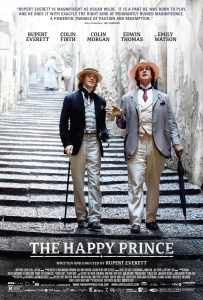
The Happy Prince

Written and directed by the talented actor Rupert Everett in his directorial debut, The Happy Prince is a terrifically well-crafted independent film exploring the tragic final days of the world-renowned playwright and author Oscar Wilde brought to life by the transformative performance of Rupert Everett. The plot tells the mostly untold story of Oscar Wilde’s downfall after being imprisoned with hard labor for two years in 1895 when the United Kingdom found him guilty of committing homosexual acts, which at the time was illegal, and it would not be until 2017 that Oscar Wilde along with 50,000 other convicted gay men would be pardoned. Exiled to Europe following his release in 1897, Wilde, played by Rupert Everett in his greatest performance of his career, tries to scrape by after clearly being tormented in prison and is continually vilified by those back in the UK. He lives for a time in Naples, Italy with his former young and handsome lover Lord Alfred “Bosie” Douglas, played by Colin Morgan, who was part of the reason that Wilde was caught and convicted for being a homosexual. At the same time, another former lover and his current literary executor Robbie Ross, played by Edwin Thomas, tries to find sympathetic people who can financially support Oscar Wilde’s life, and he encourages him to avoid scandal for business and personal reasons. Robbie is also somewhat jealous of Alfred who captivates the notoriously wild Wilde’s attention once again. Although these two men in addition to the novelist Reggie Turner, played by Academy Award winner Colin Firth who has collaborated in several other movies with Everett, do their best to keep him out of trouble, his life quickly spirals out of control. Towards the end of his life, he lives off the streets of Paris after being disinherited by almost everyone, including his estranged wife played by Emily Watson. The movie also includes several flashbacks to Oscar Wilde’s better days when he was a warmly embraced celebrity throughout the world; these scenes illustrate the juxtaposition of how far such an illustrious writer as Oscar Wilde can be brought down by society’s disdainful view of homosexuality. Neither a happy story or one about a charming prince, the film is truly noteworthy for the astounding Rupert Everett who is drastically different from his usual role as the handsome and vivacious character in such movies as 1997’s My Best Friend’s Wedding for which he received a Golden Globe nomination. Everett is fully immersed in his performance and is almost physically unrecognizable as a downtrodden, overweight, and sickly man nearing the end of his troubled life. Overall, I found it to be a fascinating glimpse into one of the most important writers in history and the often overlooked tragedies that he experienced in his life realistically portrayed by the magnificent Rupert Everett. On another note, I had the privilege of seeing Rupert Everett in person who provided great insight into how this film has been a passion project for him, especially as a homosexual man, and the difficulty of capturing the famously witty Oscar Wilde without becoming a caricature.

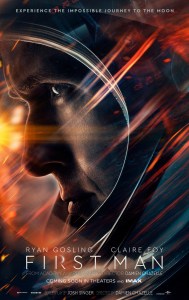
First Man

Directed by Damien Chazelle who is best known for 2014’s Whiplash and 2017’s La La Land for which he won the Academy Award for Best Director, First Man is a terrific biographical movie that explores the personal side of Neil Armstrong and the Apollo 11 mission and is anchored by excellent acting performances and dramatic cinematography. We first meet Neil Armstrong, played by Golden Globe winner Ryan Gosling, in 1961 as he is attempting an extremely dangerous test flight at Edwards Air Force Base where he is a military test pilot. At the time, he and his wife Janet, played by Golden Globe winner Claire Foy, are struggling with the sickness of their young daughter Karen who is undergoing treatment for cancer; her memory will later serve throughout the film as a sort of metaphor for the personal life of Armstrong as he becomes world-famous for being the first man on the moon. Eventually, he is accepted to the NASA astronaut program and becomes one of the astronauts in Project Gemini, the space program that would lead into the Apollo missions with the goal of a lunar landing. Living in Houston in 1965, he develops close friendships with fellow astronauts, especially his neighbor Ed White, played by talented actor Jason Clarke, and his wife befriends the other astronaut wives who also have young children. While much of the film focuses on the more personal aspects of Armstrong and his family coping with his hazardous job, the filmmaker does an excellent job of recreating the very tense rocket launches in which the slightest problem could be catastrophic for Armstrong and the other astronauts aboard. Leading up to the climax of the film, Armstrong learns from NASA’s Chief of the Astronaut Office Deke Slayton, played by Emmy Award winner Kyle Chandler, that he will be the commander on Apollo 11, the mission selected for the first landing on the moon, and will be joined by the often lighthearted Buzz Aldrin, played by Cory Stoll best known for his role in the Netflix series House of Cards, and the Command Module Pilot Michael Collins. Before he is selected for the historic mission, tragedy strikes NASA on January 27, 1967 when a fire during a routine test for Apollo 1 engulfs the capsule resulting in the death of three astronauts, including Armstrong’s close friend Ed White and one of the original astronauts Gus Grissom, played by Shea Whigham best known for his role in the HBO series Boardwalk Empire. The final scenes of the movie revolve around the actual mission of Apollo 11, complete with the dramatic takeoff, four-day flight to the moon, undocking the Lunar Module, and finally landing on the moon’s surface on July 20, 1969 with hundreds of millions of people watching around the world. After becoming the first human to touch the moon, Armstrong’s immortal moon walk is portrayed as a much more introspective personal look into his life and what led up to such a historical event for all of mankind. He makes a touching tribute to his beloved daughter Karen, which helps bring the movie back to the beginning as he begins to lose his child to cancer. Overall, I found it to be one of the more memorable movies that effectively takes a quite different and more emotional approach to the space movie genre, that was elevated by the talented performances given by Ryan Gosling and Claire Foy, and kept the audience on the edge of their seats during the magnificent spaceflight sequences. The film must now be included in the historical space movie canon, joining the likes of The Right Stuff and Apollo 13 with each contributing a different aspect to the story of humans in space. For instance, the seminal 1983 movie The Right Stuff provided more of a historical background by showing Chuck Yeager breaking the sound barrier and the early efforts of the Mercury program that ultimately led the United States to the moon. On the other hand, the 1995 Ron Howard movie Apollo 13 was much more of a thriller in which the characters must figure out a way to survive after a catastrophic failure and focuses more on the actual mission.

Free Solo

Directed by documentary filmmakers and married couple Elizabeth Chai Vasarhelyi and Jimmy Chin who are best known for the award-winning 2015 mountain climbing movie Meru, Free Solo is an extremely fascinating and visually arresting documentary that follows the rock climber Alex Honnold as he plans to climb El Capitan in Yosemite National Park using the free solo technique. Alex is a thrill-seeker who is regarded as one of the foremost free soloists in which he climbs cliffs by himself and without any ropes or other safety equipment; an extremely dangerous sport in which the smallest slip will result in certain death. Besides showing the actual preparations and the free solo climb that takes place on June 3, 2013, the documentarians, who are skilled climbers and outdoor enthusiasts themselves, also attempt to explore Alex’s personal life and background without really questioning why he pursues such a risky passion. Rather unexpectedly, Alex is a very quiet and somber individual who has difficulty expressing his emotions, and he really does not feel alive except when he is on a mountain. For several years and during most of the film, he lives out of a van and leads a very solitary life without many close friends or family members outside of the climbing community. Even when he talks about the deaths of fellow mountain climbers and free soloists that he knew fairly well, Alex rather nonchalantly brushes off their fates as part of the thrill. The tragic ends of these friends does very little to dissuade him from tackling the seemingly impossible task of making a free solo ascent of the notoriously difficult El Capitan mountain. The only obstacle that he faces is the pressure he feels from his new girlfriend who tries to help Alex transition into a more normal lifestyle and even encourages him to purchase a house in Las Vegas. Despite her trepidations, he goes full steam ahead and, in some rather harrowing sequences, he goes on several practice runs with the traditional safety mechanisms before the climax of the film in which he free solos the almost 3,000-foot sheer cliff. The filmmakers do an excellent job of presenting the spectacular yet terrifying climbs of Alex through the use of skilled mountain climbing cameramen and drones, all giving the thrilling effect that the viewer is actually there alongside Alex. At several points during his final climb, even the documentarians and crew members are petrified that they may be filming the final moments of their new friend Alex and so several of them have to look away. Overall, I found it to be one of the more gripping documentaries I have ever seen as a result of its effective ability to explore the largely unthinkable extreme sport of free solo rock climbing through the mesmerizing and quite frankly scary footage of Alex Honnold as he fulfills his daredevil passions.

Bad Times at the El Royale

Directed by Drew Goddard who is best known for writing 2008’s Cloverfield, 2013’s World War Z, and 2015’s The Martian in which he was nominated for the Academy Award for Best Adapted Screenplay, Bad Times at the El Royale is a dark and stylish mystery thriller that contains many elements of a popcorn flick but is elevated by strong acting performances. The unique storytelling and violence very much reminded me of Quentin Tarantino’s 2015 movie The Hateful Eight: both take place in a isolated location involving a relatively small cast of mysterious figures together for largely unexplained reasons. The plot takes place over the course of one very eventful night in 1969 at the once celebrity hideout and very 1950s retro hotel called the El Royale straddling the border of California and Nevada near Lake Tahoe. At the beginning of the film, we meet the slick Southern gentleman vacuum salesman Laramie Sullivan, played by Golden Globe winner Jon Hamm, who is on a regular stopover and greets fellow travelers Father Daniel Flynn, played by Oscar winner Jeff Bridges, and African-American lounge singer Darlene Sweet, played by Tony Award winner Cynthia Erivo who uses her beautiful singing voice. Eventually, they are able to rouse the only employee at the empty hotel Miles Miller, played by fresh-faced young actor Lewis Pullman, after encountering yet another peculiar hotel guest named Emily Summerspring, played by the somber Dakota Johnson. All of the characters do not really know what is going on with each other and do not find out until the increasingly violent climax that takes place with the appearance of a handsome cult leader named Billy Lee, played by the shirtless Chris Hemsworth, and his ruthless crew. Without giving much of the plot away, suffice it to say that no one is who they seem to be and the hotel itself is full of mysterious and creepy surprises. The filmmaker makes the rather unusual narrative technique of using flashbacks that are clearly marked with title cards using each character’s room number and reveal the immediate events that led them to the El Royale. Most of the guests were involved in criminal or rather shady circumstances and figured that the remote hotel would be a good refuge from their troubles. Unlike most modern-day thrillers, the film does not heavily rely on action-packed sequences but rather focuses on character development that slowly evolves over the course of the almost two and a half hour duration. Overall, I found it to be an entertaining and not-too-serious thriller that is full of enough mystery, violence, and well-acted character backstories to keep audiences on the edge of their seats, even if the movie probably lasted too long.

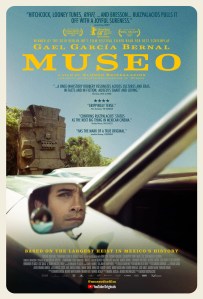
Museo

Directed by critically acclaimed Mexican filmmaker Alonso Ruizpalacios in his second feature, Museo is a very creative and exciting heist movie that works beautifully as a result of its unique storytelling and terrific acting performances. The Mexican film, with Spanish dialogue and English subtitles, tells the true story of the greatest art heist in Mexican history that took place on Christmas Eve in 1985 at the National Museum of Anthropology in Mexico City by a pair of amateur thieves. The plot follows two best friends who are leading rather unremarkable lives outside Mexico City in the middle-class suburb Satellite City: the mastermind and the black sheep of his family Juan, played by Golden Globe winner and celebrated Mexican actor Gael García Bernal, and the film’s narrator and mustached partner in crime Wilson, played by Leonardo Ortizgris. After working part-time at the Museum and witnessing the value of the prehistoric artifacts, Juan hatches a plan to break into the Museum late at night when the security guards are distracted and steal mostly Mayan archaeological pieces that they then hope to sell on the black market. The filmmaker makes a highly effective decision to present the actual heist scenes as a artful collection of montage sequences in which the duo are shown meticulously removing each artifact and the camera freezes on each stolen piece as the actors try to remain still. This dazzling filmmaking effect reflects the artworks that are being stolen from the architecturally contemporary museum so important to the pre-Columbian Mesoamerican heritage of Mexico. They are able to pull off the robbery rather easily as a result of it taking place at a time before the widespread use of security cameras and alarms, and they are even able to return to their families’ Christmas celebrations unnoticed. Things begin to unravel when the clearly unprepared young thieves quickly discover that they may not be able to sell any of the almost 150 artifacts because they are priceless and any art collector would not be stupid enough to purchase them as they would be easily detected. Towards the end of the movie, the story becomes more of a comic misadventure in which a pair of bumbling criminals desperately try to offload their illicit goods and eventually come to the conclusion that none of their crimes may have been worth anything. Overall, I found it to be a gripping film that artistically presents a truly fascinating story filled with excellent performances, especially from the always terrific Bernal, and, therefore, allows it to stand out among the countless number of heist movies.