Battle of the Sexes

Directed by Jonathan Dayton and Valerie Faris who are best known for the 2006 indie smash hit Little Miss Sunshine, Battle of the Sexes is a highly entertaining and inspirational film about the true story of the famed tennis match between Bobby Riggs and Billie Jean King in 1973. In one of her best performances to date, Academy Award-winning actress Emma Stone portrays the feminist and sports icon Billie Jean King who we first meet fighting for equal pay for female tennis players and eventually helps form the all-female Virginia Slims Circuit with the promoter Gladys Heldman, played by comedian Sarah Silverman. The impetus for breaking off from the major tours was the chauvinism showed by the male-dominated sports community best represented by former number one tennis player and legendary tennis commentator and promoter Jack Kramer, played by Bill Pullman. Along with the other star women, King, the reigning number one female player and winner of multiple Grand Slam titles, has success on the female circuit and is depicted as having fun yet healthy competition with the other players. Eventually, the self-proclaimed male chauvinist and perpetual showboating former number one tennis player Bobby Riggs, played by Steve Carell, tries to reclaim the spotlight by proposing to play a female tennis player. Already way past his prime at the age of 55, Riggs is finally able to woo the 29-year old Billie Jean King to participate in the so-called Battle of the Sexes at the height of the feminist movement. While dealing with the pressures of the cultural phenomenon that the match has become, King grapples with her sexual orientation while being married to a man and must push back on the pervasive sexism in society. During the tour, she begins a relationship with a carefree female hairdresser named Marilyn Barnett, played by Andrea Riseborough, who encourages King to embrace being a lesbian at a time when it was taboo. Despite the serious issues raised, the film is able to keep audiences entertained as a result of the buffoonery of Bobby Riggs who does anything to promote himself and has a playful back-and-forth with King until the tides shift during the actual match. The movie does an excellent job of building up the tension to the much-hyped exhibition between man and woman, which takes place in Houston at the Astrodome on September 20, 1973. I came away from the film feeling even more the unpleasant truth that sexism was so pervasive at that time, and that it was normal for male commentators to make clearly chauvinistic comments in public without much rebuke. Overall, I thought the filmmakers were expertly effective in portraying the trials and tribulations of such a trailblazing figure in American history as Billie Jean King, all the while keeping the audience fully engaged with moments of humor and levity.
Blade Runner 2049

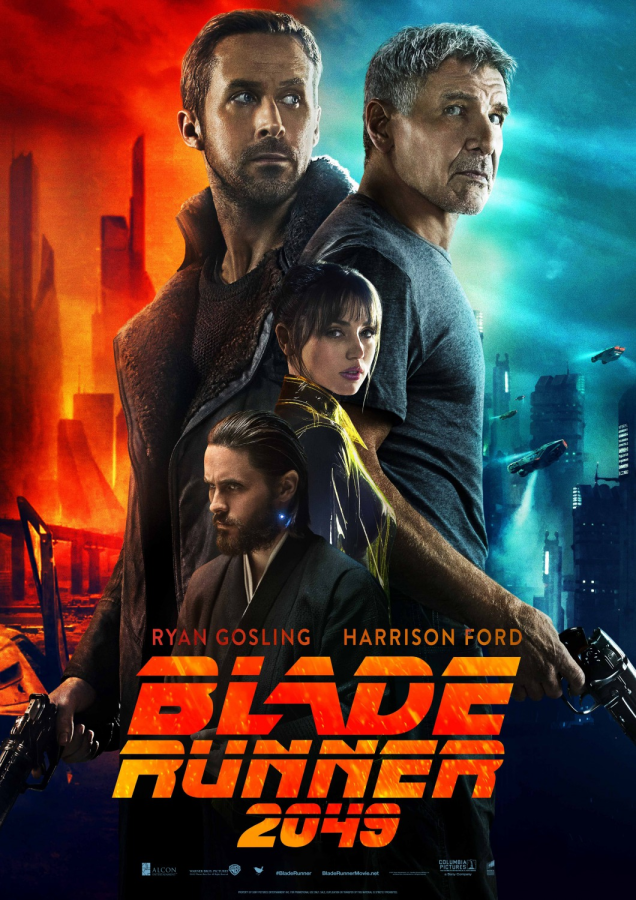
Directed by Denis Villeneuve who is best known for the 2016 Oscar-nominated movie Arrival, Blade Runner 2049 is an extraordinary film that lives up to its predecessor, the science fiction cult classic Blade Runner released in 1982 and based on a 1968 Philip K. Dick novel. Heavily influenced by the first movie’s director Ridley Scott who is one of the producers of the sequel, the film remarkably recreates the dystopian hallmarks of the original with beautiful cinematography of a bleak yet futuristic world of monolithic skyscrapers illuminated by extravagant neon signage rising above a rain-soaked suffering population. The story takes place thirty years after the first Blade Runner and follows an officer with the LAPD officer named K, played by Ryan Gosling, who is sent on a secret mission by his boss Lieutenant Joshi, played by Robin Wright, to discover the truth behind the discovery of a mysterious skeleton. K is what is known as a blade runner whose job it is is to hunt down and destroy renegade replicants, human-like robots originally created by the now defunct Tyrell Corporation featured in the original. Officer K is a replicant himself but of a more advanced and better controlled version built by the all-powerful Wallace Corporation led by the vicious Niander Wallace, played by the especially creepy Jared Leto. The Wallace Corporation is intrigued by the LAPD’s investigation because it may lead to a key development in their replicant program. Throughout the slow burn and sometimes complex esoteric scenes, K questions his own existence and whether he is in fact a human and not a replicant with implanted memories. The very nature of what it means to be human is the core of the film’s deep dive into the philosophical exploration of humanity and artificial intelligence. Eventually, Gosling’s character comes to a greater understanding of who he is after encountering Rick Deckard, the main character from the original played by a particularly gruff Harrison Ford. Deckard is a replicant who has been on the run over the past thirty years and had a romantic relationship with another replicant named Rachael who may have had a very unique capability desired by Wallace. Overall, although the heavy dose of sci-fi and philosophical elements may not appeal to all viewers, the movie is without a doubt a cinematic masterpiece as a result of being a visual marvel presenting a stylized dystopia complete with a very futuristic-sounding soundtrack emphasizing the dark and moody themes. If you are a fan of the original Blade Runner or any other sci-fi flick, you will not be disappointed by this long-awaited sequel. 

Victoria and Abdul

Directed by Academy Award-nominated British filmmaker Stephen Frears who is best known for 2006’s The Queen also about a famous British female monarch, Victoria and Abdul is the fascinating untold true story of Queen Victoria’s unlikely relationship with an Indian servant. Clearly, the film’s greatest strength is the magnificent acting performance from Dame Judi Dench, already well-regarded for her portrayal of Queen Victoria in 1997’s Mrs. Brown and her Oscar-winning role as Queen Elizabeth I in 1998’s Shakespeare in Love. Celebrating her golden jubilee commemorating 50 years on the throne in 1887, the Queen is sent two Indian servants as representatives of British-ruled India and begins a fond relationship with one of the men named Abdul Karim, played by Indian actor Ali Fazal. Eventually, he becomes a close confidant of the lonely Victoria who lost her husband Albert many years ago and invites Abdul to palace functions and is even taught his native Indian language. Abdul also is given a house on Royal property and is able to bring his Indian wife and mother-in-law to England. The film does an excellent job of realistically depicting what it must have been like at Queen Victoria’s residences, mostly because it was filmed at the real Osborne House on the Isle of Wight where much of the movie takes place. As Abdul becomes increasingly closer to Victoria, the Royal household and Victoria’s successor and son Prince Bertie, played by Eddie Izzard, continue to get fed up with her unorthodox friendship to a man that they believe is racially inferior and a simple-minded servant unworthy of her attention. Her real deep connection with Abdul forces her to fight back against her own family and royal duties and defends him until her death in 1901. Apparent by the story of Abdul not being uncovered until only recently, there was a actual animosity evidenced by Bertie ordering the destruction of all records pertaining to Abdul immediately after he takes the throne. Overall, I was particularly intrigued by the film’s plot and especially struck by Judi Dench’s terrific performance; however, it was too full of cliches to transcend the genre and was much more of a sad story than the promotional materials lead the viewer to believe.

American Made

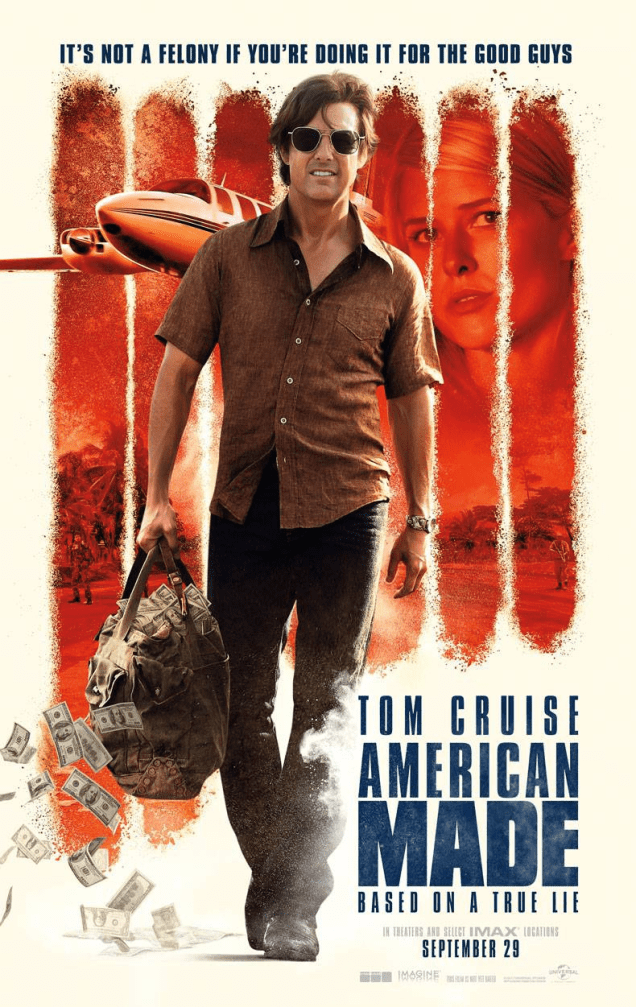
Directed by Doug Liman who is best known for 2002’s The Bourne Identity and 2014’s The Edge of Tomorrow, American Made is an entertaining and thrilling drama loosely based on real events and stars Tom Cruise in one of his better performances from the past couple of years when he had a string of poorly received movies. The plot follows the unbelievable life story of Barry Seal, played by Cruise, who was a pilot recruited by the CIA in the 1970s and later worked for the Medellin Cartel led by Pablo Escobar as well flying secret American missions to support the anti-communist Contras hoping to overthrow several Central American socialist governments. We first meet Barry as a wild TWA pilot who lives in Baton Rouge with his beautiful wife and young children in the 1970s. One day, he is approached by the CIA operative Monty Schafer, played by Domhnall Gleeson, and asks Barry to work for the CIA to fly reconnaissance missions over Central America. Eventually, he is recruited to do increasingly dangerous and questionably legal activities for the CIA, including acting as a covert courier between the American government and General Manuel Noriega who would eventually become the authoritarian leader of Panama and delivering weapons and supplies to the rebel Contra militias who President Reagan secretly supported. However, as he is helping the American government, he finds himself flying cocaine out of Columbia to Louisiana for Pablo Escobar’s drug cartel and makes millions of dollars in the process. To help protect Barry, Monty sends him and his family to a small town in Arkansas named Mena where he can continue his operations out of a private airstrip. Although he is mostly shielded from arrest for drug trafficking because of his CIA connection, things begin to unravel after the arrival of his troubled brother-in-law JB. Towards the end of the movie when it takes place during the 1980s, the involvement with the CIA and particularly the Medellin Cartel ends poorly for Barry. Overall, I found it to be a fun and energetic movie that tells a hard to believe story that is somewhat based on reality, but I thought that the rest of the film’s pieces fell short of my expectations. It felt like a continuation of the hit Netflix TV series Narcos, which superbly dramatizes the rise and fall of Pablo Escobar as well as other Colombian drug cartels throughout the 1980s and 1990s.

Kingsman: The Golden Circle

The sequel to the widely successful 2015 film Kingsman: The Secret Service from the director Matthew Vaughn, Kingsman: The Golden Circle is a crowd-pleasing action spy comedy that like its predecessor has an irreverent twist and is brimming with comically over-the-top violence. It takes place a year after the original and follows Eggsy, played by Taron Egerton, as a newly recruited member of the secret British intelligence agency known as Kingsman. Towards the beginning, he is still dealing with the loss of his mentor and fellow agent Galahad, played by Colin Firth, when the entire Kingsman organization is obliterated after missile strikes on its safehouses, including its London headquarters at a high-end tailor. Eggsy along with the only other surviving agent Merlin, played by Mark Strong, are confronted with a vengeful former recruit and a secretive criminal organization known as The Golden Circle. They must activate the so-called Doomsday protocol, which connects them with a similar secret American organization based out of a whiskey distillery in Kentucky called Statesman and led by Jeff Bridges’ character Champagne. Eggsy and Merlin must join forces with the very Western Statesman agents Whiskey, played by Channing Tatum, and Tequila, played by Pedro Pascal from the hit Netflix TV show Narcos, and are subsequently taken on a globe-trotting, shootout-filled mission to save millions. They are put into action after a previously unknown and extremely powerful drug trafficker named Poppy, played by Julianne Moore, has laced her illicit drugs with a deadly poison that will kill millions of drug users throughout the world unless the President of the United States agrees to legalize drugs at which point she will release the antidote. One of the more bizarre characters, Poppy is portrayed as ridiculously vicious and lives in a 1950s-themed headquarters in the jungles of Cambodia where she also has Elton John held captive. Eggsy learns that no one can be truly trusted and must also please and protect his beautiful girlfriend who happens to be the Crown Princess of Sweden during some particularly inappropriate missions. Overall, I found it to be an entertaining movie that contains some of the same elements of fun and thrills as the original, but, unfortunately, falls short of the first film’s originality and hilarity and is hampered by its bloated two and a half hour runtime. 

American Assassin

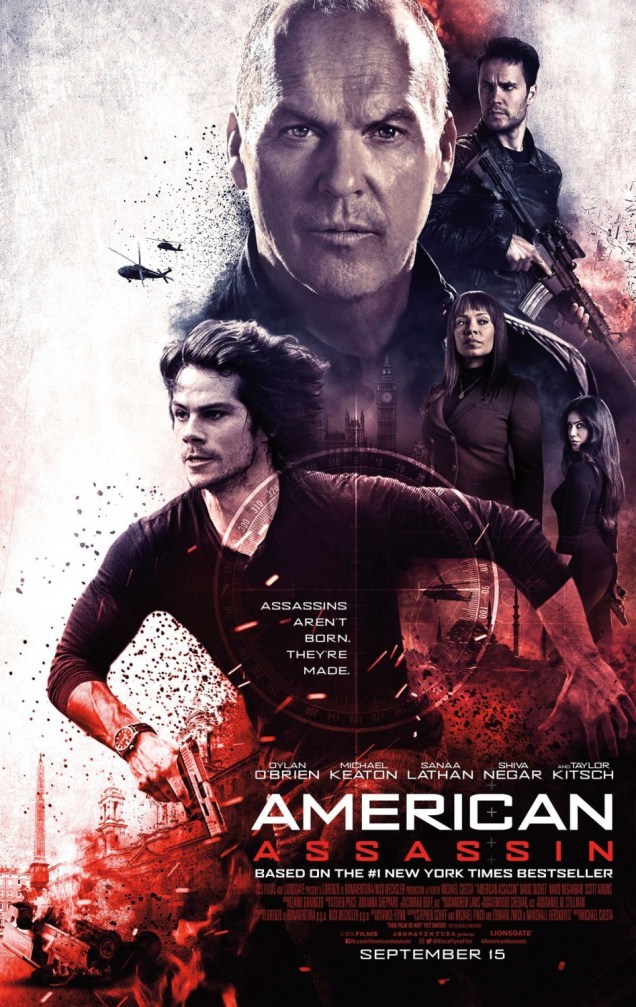
Based on the 2010 novel of the same name written by Vince Flynn, American Assassin is a mediocre spy thriller that follows a fairly formulaic plot line and does not contribute much to the genre. Played by the young actor Dylan O’Brien best known for his role in 2014’s The Maze Runner, Mitch Rapp is living a normal happy life until he and his girlfriend vacation in Ibiza, Spain during a terrorist attack in which many tourists, including his beautiful girlfriend, are killed. After this traumatic incident, he goes on a quest to infiltrate the Islamic terrorist organization responsible for the attack in hopes of enacting some sort of vengeance. As he is about to meet the leader of the cell in Libya, U.S. Special Forces ambush and take Mitch into custody to ascertain his involvement. Eventually, he is recruited into a secretive black ops unit known as Orion run by the unconventional former Naval Seal Stan Hurley, played by Michael Keaton. Mitch’s first mission is to intercept a nuclear device missing from Russia that is be purchased from the radical faction of the Iranian government in order to make a nuclear weapon. However, the team is unexpectedly faced with a former member of Orion who is now a dangerous mercenary helping the Iranians retrieve the weapon. Played by Taylor Kitsch who is best known for the 2012 box office flop John Carter, this mercenary known as Ghost takes Hurley hostage in Rome where he also takes possession of the now fully-working nuclear weapon in order to attack the U.S. Navy’s 6th Fleet. Overall, I was expecting a better spy thriller but came away sorely disappointed because the story seemed contrived and unoriginal. 

War for the Planet of the Apes

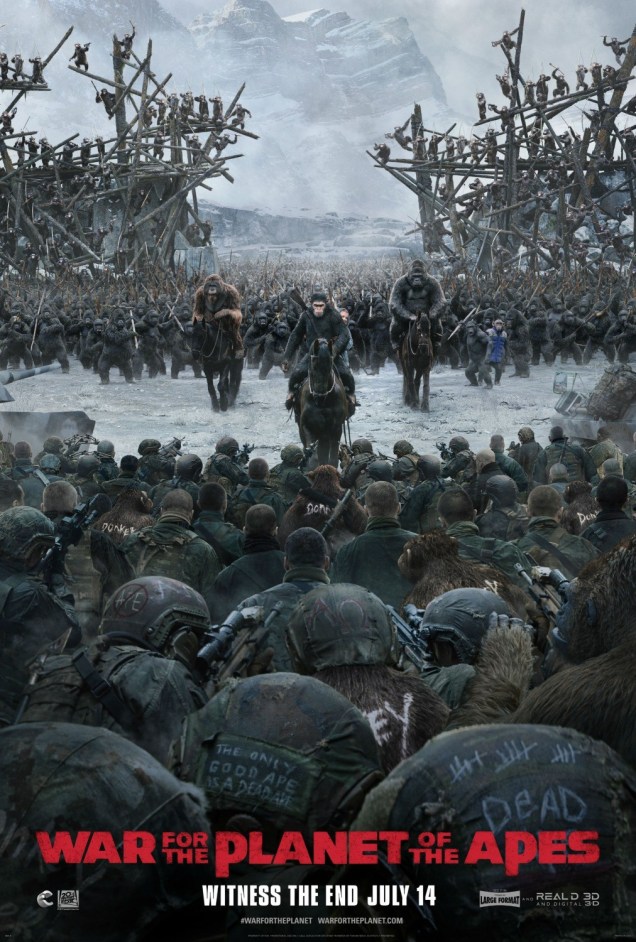
The third installment of the third movie series franchise that began with 1968’s Planet of the Apes starring Charlton Heston and was revamped in the current series starting with 2011’s Rise of the Planet of the Apes, War for the Planet of the Apes like the previous two films represents a dramatic tonal and quality shift, arguably for the better. The movie takes itself much more seriously and delves into the negative impacts of modern science and the oppression of the unknown other. Portrayed by the great CGI motion capture artist Andy Serkis who is best known for creating the Gollum character in The Lord of the Rings trilogy, the first real intelligent ape Caesar is the leader in hiding with the remaining faction of apes in Northern California. Caesar’s desire for peace is destroyed by a renegade unit of the American military trying to eradicate the Simian Flu that has decimated the human population and made the apes intelligent. Serving as a prequel to the original 1968 film before the apes take over the world, Caesar and his followers are portrayed as sympathetic downtrodden minorities that are brutally oppressed by mankind out of fear. The plot line follows Caesar who suffers a tragedy at the hands of the humans and tries to lead his group to safety in the desert far away from humans. To protect the other apes and avenge the murder of his family, Caesar breaks off into a small group to enact “gorilla” warfare on the barbaric human militia, including its ruthless leader simply known as the Colonel, played by the terrifically vicious Woody Harrelson. Along with a orphaned young girl suffering from a mysterious ailment, Caesar’s ragtag group discover that the Colonel has imprisoned the remaining apes that were supposed to escape to the desert. The apes who prove to be smarter than the humans must figure out a way to rescue those enslaved at the remote former military outpost on the California border. The Colonel’s forces are also faced with an attack from a different group of soldiers to the North that has a more sympathetic view of the apes. Although it may sound strange, the movie does an excellent job of humanizing the apes through the emotionally powerful script and the remarkable magic of CGI to create realistic human-like apes. Overall, I found it to be a very high-quality blockbuster that brings a certain level of seriousness and cinematic beauty wholly unexpected from a story about talking apes.

Ingrid Goes West

Winner of the screenwriting award at the 2017 Sundance Film Festival, Ingrid Goes West is a dark comedy that glimpses into the societal ills associated with the rise of social networking like Facebook and Instagram. Ingrid Thorburn, played by the terrific Aubrey Plaza, is a mentally disturbed young woman who just lost her mother and is put in a mental hospital after stalking somebody on Instagram that she falsely believes is her friend in real life. After being released from the mental hospital, she decides to change her life and moves to Los Angeles in hopes of a better life. However, she becomes obsessed with an Instagram star named Taylor Sloane, played by the brilliant young actress Elizabeth Olsen, and she forces her way into a friendship with Taylor under false pretenses. A perpetual liar who is fully engrossed with being liked by popular society, especially on Instagram, Ingrid does whatever she can to impress Taylor and her cool friends. At the same time, she develops a relationship with her young black landlord Dan Pinto, played by O’Shea Jackson Jr. best known for his role as Ice Cube in 2015’s Straight Outta Compton. With the arrival of Taylor’s arrogant and obnoxious brother Nicky, Ingrid begins to lose favor with Taylor. Eventually, Ingrid’s sketchy past and questionable friendship with Taylor comes back to haunt Ingrid and possibly destroy her already fragile life. Overall, I found it to be an extremely incisive study of the problems perpetuated by the millennial generation oversaturated by social media and shows how today’s heightened societal pressures affect the mental well-being of individuals. In addition to its important social messages, the film itself can be highly entertaining and is especially well-crafted with excellent writing and acting performances. 

Dunkirk

Written and directed by the acclaimed Christopher Nolan who is best known for 2008’s The Dark Knight and 2010’s Inception, Dunkirk is a top-notch war movie crafted by Nolan at his finest and joints the ranks of the greatest war films, including Steven Spielberg’s 1998 modern classic Saving Private Ryan. The remarkable true story chronicles one of the most pivotal moments of World War II: the British surrender and massive evacuation at Dunkirk, France beginning in late May and ending in early June of 1940. Up to 400,000 mostly British soldiers representing almost the entirety of the British military were stranded on the beaches of Dunkirk with no real way of crossing the English Channel and reaching home even though it was within sight across the shore. With outstanding cinematography, greatly enhanced by the all-encompassing IMAX 70mm format, the film uses spectacular and often horrifying imagery to follow all the major aspects of the massive operation led by the British Commander Bolton, played by the Oscar-nominated actor Kenneth Branagh. The wide sweeping shots of the thousands upon thousands of war-weary soldiers waiting to be rescued while being constantly bombarded by the German air force reinforce the unbelievable scope of the evacuation. There are also mesmerizing dogfighting sequences between the strained British Royal Air Force, represented by a particularly heroic pilot played by Tom Hardy, and German warplanes and bombers targeting the vulnerable British troops. Further underscoring the horrors of war and the difficulty of evacuating so many men are the scenes showing jubilant soldiers finally getting on British Naval vessels after surviving the battle, only to be killed after many of their ships are torpedoed or bombed by the Germans. Throughout the film, Nolan is able to effectively recreate what it must have been like at Dunkirk and thereby engenders an anxiety-inducing cinematic experience. The visceral reaction is not only created by the stunning visuals but also by the simple yet effectual soundtrack, which is mostly composed of what sounds like a ticking clock to heighten the nerve-wracking situations the characters are facing. Besides speaking to the hell that is war, the film also presents the hopeful and inspirational aspect of the evacuation of Dunkirk: the massive flotilla of ordinary Brits using their fishing and pleasure boats who journey to Dunkirk in the face of danger to help evacuate the many thousands of soldiers and bring them back home safely. To develop a personal connection with these unlikely heroes, the film also follows a father, played by Oscar-winning actor Mark Rylance, and son and a local teenager as they venture their way on their civilian boat to pick up survivors from Dunkirk. They themselves face the harsh reality of warfare when they rescue a severely shell-shocked soldier, played by the Irish actor Cillian Murphy, who is adamant that he must not return to Dunkirk. Overall, I found it to be one of the more engrossing and emotionally powerful depictions of war and was nothing short of a cinematic masterpiece from the auteur filmmaker Christopher Nolan. His remarkable attention to detail and beautiful cinematography is probably the closest a filmgoer can get to experiencing war, both the horrific and inspirational qualities. The uplifting moments appeal to what many Brits still affectionately refer to as the Dunkirk spirit, the forces for good during times of adversity.

Crown Heights

Based on a true story chronicled in a 2005 episode of the NPR radio show This American Life, Crown Heights is the heartbreaking tale of a young man living in the Crown Heights neighborhood of Brooklyn, New York who spends many years in prison after being wrongfully convicted of a homicide in 1980. The talented young actor Lakeith Stanfield plays an 18-year-old immigrant from the Caribbean island nation of Trinidad and Tobago named Colin Warner who leads a troubled life as a petty criminal. After a young man is shot to death in broad daylight, Warner gets caught up in the corrupt and negligent justice system eager for convictions in crime-ridden 1980’s New York. As a result of false testimonies given by predominately young immigrants pressured by the police, he is quickly ushered through the court system and sentenced to 15 years to life for the murder of someone he had never heard of, along with a likely guilty co-defendant who is sentenced to less time as a juvenile. Disgusted by the injustice in which he was convicted and later lost appeals, Warner’s close friend Carl ‘KC’ King, played by former NFL Pro Bowler Nnamdi Asomugha, tirelessly makes it his mission to prove his childhood friend’s innocence and get him released from prison. The film does an excellent job of providing an intimate glimpse into prison from the perspective of an innocent man, including the difficult moments resulting in angered violence and coming to the harsh belief that he may be behind bars for the rest of his life for a crime he did not commit. King remains tenaciously hopeful even when Warner is despondent and spends day and night learning the legal system with the occasional help of a generous criminal defense attorney, played by Bill Camp best known for the 2016 HBO miniseries The Night Of. With his new knowledge, King investigates and interviews witnesses in order to create a compelling appeal for Warner’s exoneration. Over the course of the movie, the filmmaker expertly contextualizes the sometimes injust justice system in the United States by inserting newsreel montages depicting the government crackdown on crime for each decade Warner spends in prison. Overall, I found it to be a truly enlightening and emotionally powerful film about some of the problems with the criminal justice system, including the depressing statistic that up to 120,000 innocent people may be currently incarcerated.