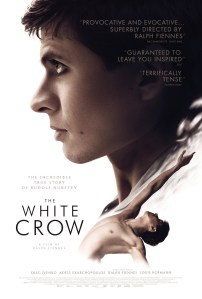
The White Crow

Directed by British actor Ralph Fiennes in his third film as director, The White Crow is a fascinating movie about one of the most famous ballet dancers and focuses on the seminal moment of his life in which he defects from the Soviet Union. Based on his real life, the film follows Rudolf Nureyev, played by Oleg Ivenko, and three distinct phases of his life: his early life in a struggling rural Soviet family, early career at a famous St. Petersburg ballet school, and his defection occurring during his company’s visit to Paris. The stereotypical tortured genius, he often exhibits egotistical behavior in which he does not shy away from berating his instructors, but his brilliant and unique talents are always desired by the Soviet ballet elite. The middle part of his life revolves around his relationship with the famed ballet teacher Alexander Ivanovich Pushkin, played by Oscar-nominated actor Ralph Fiennes, and his increasingly personal and strange relationship with Pushkin’s wife. The more contemporary chapter in his life is a rather slow-paced depiction of his falling in love with Western culture and society when his Soviet ballet company has a weeks-long residency at the Paris Opera in 1961 at the height of the Cold War. Nureyev enjoys the nightlife of Paris with his new-found French friends, and he eventually decides that he needs to defect from the Soviet Union in order to pursue a career in the West with much more freedom as an artist and individual. The one major problem area of the film is the often convoluted setup of having the story switch back and forth between three different time periods. Overall, I found it to be a very compelling story about a true genius against the backdrop of the Cold War that, despite the movie’s few flaws, feels like a very authentic portrayal of Rudolf Nureyev as a result of the film’s use of Russian dialogue and several beautiful dance sequences.

John Wick: Chapter 3 – Parabellum

The third installment in the John Wick franchise with the release of its first movie in 2014 and directed by Chad Stahelski who was Keanu Reeves’ stunt double in The Matrix franchise, John Wick: Chapter 3 – Parabellum is a high octane and over-the-top action movie that rises above the rest of the genre as a result of its magnificent choreographed fight sequences and creative storyline. It follows the titular character John Wick, played by Keanu Reeves, who is an internationally-known assassin working under the secret organization known as The High Table but is excommunicado, an unprotected status in which the other assassins can kill him for a bounty, after an unauthorized killed in the previous movie. He is no longer given immunity while staying at the hotel for assassins in New York City known as The Continental run by the manager Winston, played by Ian McShane, and the concierge Charon, played by Lance Reddick. Eventually, a very large contingent of assassins chase John Wick in order to get the 14 million dollar bounty on his head. Over the course of the film, he is engaged in very stylistic and elaborately choreographed fights in which he kills off many men using a variety of tactics, including gunplay, knife fights, and martial arts. Eventually, he travels throughout the world trying to get protection from a powerful criminal leader played by Anjelica Huston and later a fellow assassin played by Halle Berry. Eventually, John Wick teams up with Winston and a fellow assassin leader known as the Bowery King, played by Laurence Fishburne, who are both punished by The High Table and its representative The Adjudicator and hunted down by a group of hitmen led by the ruthless assassin Zero, played by Mark Dacascos. What sets the movie apart is the heavy use of practical stunt work instead of the usual CGI bloat common with superhero movies, all the while taking place in a very different world that is extremely stylish and filled with secret organizations. Overall, I found the third movie in the franchise to be as good as the original as well as the sequel, and I still believe it to be one of the best action movie series due to the martial arts talents of the subdued Keanu Reeves and the unique yet violent visual style.

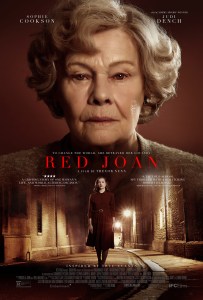
Red Joan

Based on the 2013 novel of the same name written by Jennie Rooney that was inspired by the real-life story of the British civil servant and Soviet spy Melita Norwood, Red Joan is a disappointing film that somehow makes the deeply fascinating material rather boring and bland, with the only bright spot being Judi Dench’s performance, albeit with very little screen time. The story starts in modern-day England when a elderly grandmother named Joan Stanley, played by Oscar winner Dame Judi Dench, is arrested on suspicion of espionage on behalf of the Soviet Union following World War II. However, most of the film takes place in flashbacks that portray the young and idealistic Cambridge physics student Joan Stanley, played by the beautiful young British actress Sophie Cookson, falling in love with a Soviet sympathizer named Leo, played by Tom Hughes best known for his work on the British TV series Victoria. After graduating, she works for a secret British nuclear weapon program run by the brilliant scientist Professor Max Davis, played by British actor Stephen Campbell Moore, and is eventually recruited by the Soviet KGB through her connections with Leo to become a spy passing highly classified information about the British nuclear program. At times, it is a fairly typical romantic drama in which Joan falls in love with the mysterious and ultimately dangerous Leo while also developing feelings for her boss Professor Davis. The rest of the film explores the intriguing case of Joan becoming a Soviet spy and her struggle between her allegiance to her native Britain and her disdain for her government’s developing nuclear weapons, particularly after learning the horrific details of the American bombing of Hiroshima and Nagasaki. To the movie’s detriment, the filmmaker relies on telling the story in a unusually slow and stale pace and does not use the talents of Judi Dench very much as a result of his emphasis on the character’s younger life. Overall, I was hoping for a prestige British historical drama that would better encapsulate one of the more interesting stories in espionage history, but, unfortunately, the execution is extremely lacking for such a terrific filmpremise.

The Hustle

A female-led remake of the 1988 movie Dirty Rotten Scoundrels that itself was a remake of the 1964 movie Bedtime Story, The Hustle is a shockingly bad and largely unfunny movie that had great potential with its casting of Anne Hathaway and Rebel Wilson but somehow the filmmaker and screenwriter failed miserably to use their proven acting and comedic talents. The plot revolves around a first-rate con artist living in the south of France named Josephine, played by Oscar winner Anne Hathaway with a fake and annoying accent, who uses her sexuality and wits to swindle wealthy men. Her work as a con artist is interrupted by a foul-mouthed Australian small-time con artist named Penny, played by the usually funny Rebel Wilson, who is also preying on the same gullible targets. They enter in a competition to see who can convince a young tech millionaire to give them half a million dollars. A majority of the movie is filled with the stupid and gag-worthy antics the women use, some of which are borderline offensive by using humor about the blind. Eventually, they discover that they themselves are possibly victims of an even more elaborate scheme and must find a way to work together to avenge their losses. The only part of the film that is somewhat enjoyable is the beautiful scenery and fancy houses and cars that are stereotypical for the wealthy enclaves of the French Riviera. Overall, I found the film to be rather disastrous for a project featuring two normally talented actresses and would not recommend people waste their money at the theaters but, if you must see it, wait until it is released for free at home.

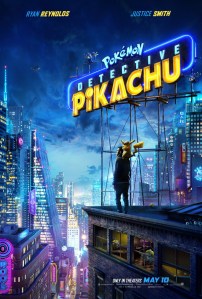
Pokémon Detective Pikachu

Based on the internationally popular Japanese fantasy video game and television franchise Pokémon first created in 1995 and the 2016 video game also named Detective Pikachu, Pokémon Detective Pikachu is a light-hearted and cute family film that will surely delight fans of Pokémon while also appealing to other audiences looking for silly and funny entertainment. It takes place in a fantastical world where Pokémon, adorable creatures with special powers, and humans live together in which most everybody has a Pokémon companion. The movie follows a young insurance salesman named Tim Goodman, played by Justice Smith, who always had the dream of becoming a trainer for Pokémon to fight in battle against other Pokémon. When he learns that his estranged father who is a well-respected detective has disappeared, Tim finds himself in Ryme City where humans and Pokémon live harmoniously together to gather his father’s belongings but eventually is caught up in a mystery to discover what really happened to his father. Unexpectedly, a talking Pikachu Pokémon, voiced by the perfectly casted Ryan Reynolds, appears to Tim at his father’s apartment, and the bewildered Tim discovers that the very sassy Pikachu is his father’s partner. The rest of the film takes the audience on a colorful adventure where we meet a wide variety of Pokémon and evolves into a fairly funny movie with the comedic witticisms of Ryan Reynolds’ Pikachu character. The duo meet up with a young intern hoping to be a reporter named Lucy Stevens, played by Kathryn Newton, who helps them progress in their investigation of Tim’s father’s disappearance. The case leads them to a mysterious scientific lab run by a company owned by the wealthy founder of Ryme City named Howard Clifford, played by Bill Nighy. Overall, I found it to be a surprisingly entertaining and charming movie as a result of the wisecracking Ryan Reynolds performance and the whimsical world of Pokémon enhanced by fantastical CGI.

Peterloo

Written and directed by critically acclaimed filmmaker Mike Leigh who is also a well-known playwright and director of theater, Peterloo is a very British historical drama with a great amount of oratory that tells the true story of the 1819 Peterloo Massacre of peaceful protesters against the British government in Manchester, England. The film’s events take place after the famous Battle of Waterloo in which British forces defeated the French led by Napoleon Bonaparte, and one young soldier who returns home to poverty-stricken Manchester where there is talk of rebellion against the aristocratic British government. Much of the first part of the movie follows the young soldier’s family as well as other political activists demanding more voting rights and reform in the Parliament. Eventually, a group of Manchester leaders of the protest movement convince the notorious activist Henry Hunt, played by the terrific Rory Kinnear, to give a fiery reformist speech in front of tens of thousands in Manchester in hopes of forcing the British government to take action. Closely watched by local political and police officials hostile to the protesters, up to 60,000 people gather at St. Peter’s Fields to hear Henry Hunt’s speech. However, the local British forces and militia stir up chaos in which the thousands of protesters are scrambling for cover, and, ultimately, as many as fifteen bystanders may have been killed by the British in the melee. Overall, I found the film to be an historically interesting film that, at times, felt rather dry with the abundance of highfalutin dialogue but did an excellent job of depicting the horrific Peterloo Massacre on its 200th anniversary.

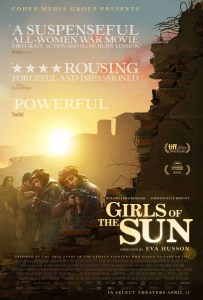
Girls of the Sun

Directed by French filmmaker Eva Husson in her second feature film, Girls of the Sun is a surprisingly less-than-remarkable war drama that has the best of intentions by telling the story of a group of Kurdish female soldiers fighting ISIS. The all-female battalion led by the tough former lawyer Bahar is based on the remarkable Yazidi female soldiers from Iraqi Kurdistan fighting alongside their male counterparts in defeating the brutal ISIS regime that had taken hold of their territory. In a rather disjointed way in which the plot swerves rapidly between characters, the film follows this group of women who were compelled to fight after being freed from ISIS captivity as sex slaves and many of their husbands and sons were either killed or captured. The movie unnecessarily chooses to present their story through the eyes of a Westerner, specifically a veteran French war correspondent named Mathilde who is embedded with the unit for several days. Over the course of several days in which the film takes place, we witness the female soldiers trying to take back their small village in the Kurdish territory of Iraq and are engaged in several well-shot battle sequences. At random intervals, the filmmaker attempts to take a closer glimpse of the characters by presenting flashbacks of mostly the main character Bahar who is showed being taken captive, sexually assaulted, and searching for her son. Overall, I was disappointed in the cinematic treatment of such a compelling and important story about a group of courageous and powerful women; the narrative incoherence and lack of character development does not do any justice to the truly remarkable protagonists.

Long Shot

Directed by Jonathan Levine best known for 2011’s 50/50 and 2017’s Snatched, Long Shot is an amusing comedy about an unlikely romance between two completely different people while also having the feel of the popular HBO comedy Veep with its humor involving a strong female politician vying for power. The film follows the highly respected and powerful United States Secretary of State Charlotte Field, played by Oscar winner Charlize Theron, who is contemplating launching a presidential campaign after her dim-witted boss, the president of the United States who is played by Bob Odenkirk decides not to run for re-election. Everything seems to go smoothly, with the help of her serious and straight-laced female chief of staff and male assistant, until she meets the profane journalist Fred Flarsky, played by Seth Rogen, who she used to babysit when he was a 13-year-old. After leaving his job as a journalist at a small newspaper after it is bought out by a large media conglomerates run by the conniving Rupert Murdoch-esque Parker Wembley, played by Andy Serkis disguised by grotesque makeup, the stereotypical stoner and relaxed Fred unexpectedly runs into Charlotte after being invited to an exclusive party by his wealthy best friend Lance, played by O’Shea Jackson, Jr. Eventually, against the wishes of her aides, Charlotte hires Fred to be one of her speech writers as she gears up for her presidential run. What happens next is rather unexpected for both of the main characters as they begin a whirlwind romance in which they fall in love as Fred travels the world with Charlotte who is busy with her job as Secretary of State. The movie very much reminds me of one of Seth Rogen’s breakthrough movies, 2007’s Knocked Up in which he enters into a romantic relationship with a beautiful woman out of his league. However, the film relies much less on the vulgar stoner humor typical of Seth Rogen and evolves into a multifaceted comedy subtly mocking current political affairs as well as following the more traditional romantic comedy genre. Overall, I found it to be an entertaining movie that brings out the seemingly realistic chemistry between Seth Rogen and Charlize Theron in a fun movie that makes a slight yet effective twist on stereotypical romantic comedies.

Family

Written and directed by Laura Steinel in her directorial debut, Family is a terrifically funny comedy about a workaholic and non-people person who is unexpectedly asked to babysit her adolescent niece by her estranged and more normal brother and what ensues is a very chaotic yet ultimately touching relationship between aunt and niece. Kate, played by the wonderfully comedic Taylor Schilling best known for her role in the hit Netflix TV series Orange Is the New Black, has difficulty relating to people and therefore very begrudgingly agrees to babysit the socially awkward Maddie for one night that eventually turns into a week-long stay. Kate definitely does not have a filter so she quite frankly tells her niece to not be as weird and try to fit in by learning how to deal with bullies in a very non-constructive way. Having to deal with her high stress job that is very much her only life, she initially hates having to take care of Maddie and is a fairly irresponsible babysitter who allows her to hang out with a very odd teenager working at a gas station and become a juggalo, a notoriously wild and sometimes violent fan of the music group Insane Clown Posse. In between some really hilarious scenes, the two begin to have a very loving bond over them both being rather outcasts in society, and Kate finally discovers the importance of family and having a life outside of work. The rest of the cast is surprisedly full of A-listers, including Kate McKinnon, Brian Tyree Henry, and Matt Walsh, who are integral in making a first-rate comedy. Overall, I found it to be an extremely amusing independent comedy that uses the full potential of the extremely talented performers to craft a brilliant debut feature film that will surely launch the career of the filmmaker.

Avengers: Endgame

The twenty-second installment in the Marvel Cinematic Universe that first began in 2008 with Iron Man and the final film in Marvel’s so-called Infinity Saga, Avengers: Endgame is a terrific superhero movie that is both epic in scope and full of bittersweet emotions in which the audience feels a deep connection to the characters that have been part of Hollywood for over a decade. It follows the previous Avengers film in which the supervillain Thanos has vanquished half of the world’s population as well as half of the Avengers after he gains possession of the six Infinity Stones. Having the feel of a drama about losing loved ones, the majority of the first half of the film shows the comic book heroes in great despair and feeling hopeless in bringing back those who have vanished. Eventually, the surviving Avengers that include Iron Man, Captain America, Hulk, Thor, Black Widow, War Machine, and Rocket devise a plan involving time travel to rescue the other Avengers and the millions of people lost. Although it does include the typical CGI-enhanced action sequences, the movie, unlike the rest of the franchise, is a very personal one in which all of our favorite characters are reunited and give very real human emotions as they cope with grief. At first blush, the three-hour runtime seems like it would be excessive, but the filmmakers are able to craft a very entertaining and sentimental movie that has just the right amount of time to explore some of the most memorable superheroes in what perhaps will be their last appearance together. Also, it does not always take itself too seriously by including some rather hilarious and fun moments that is reminiscent of some of the more comedic installments such as Guardians of the Galaxy. Overall, I found it to be a quite surprisingly heartfelt and emotionally powerful film that is very much a welcome relief from the stereotypical superhero comic book movies produced by Marvel, while also including elements of action and entertainment that has made the films so popular.