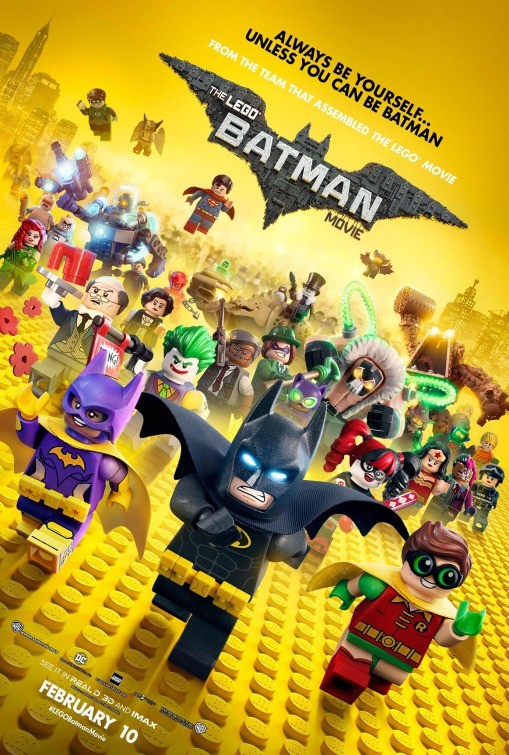
The Lego Batman Movie

A spinoff of the hugely successful The Lego Movie released in 2014, The Lego Batman Movie lives up to its predecessor as a hugely entertaining film that delights kids and adults alike as a result of its clever use of animation and a script full of irreverent humor. Taking place several years after The Lego Movie in which Batman played a role, Batman, voiced perfectly by the deep-voiced comedian Will Arnett, feels lonely without family and is always eager to be the lone hero of Gotham City. The film humorously shows him moping throughout Wayne Manor and the Batcave accompanied by Alfred, voiced by Ralph Fiennes, who, among other things, prepares Batman’s favorite meal of microwaved Lobster Thermidor. Batman is overjoyed to be put back in action when the Joker, voiced by Zach Galifianakis, returns with a crew of famous villains to wreak havoc on Gotham City in order to become Batman’s most hated villain. The rest of the movie follows Batman in his madcap adventure to stop the Joker and is begrudgingly assisted by Robin, voiced by Michael Cera, and the daughter of recently retired Commissioner Gordon who herself was just promoted to police commissioner, voiced by Rosario Dawson. I particularly enjoyed the self-referential and very much irreverent humor: the character Batman makes fun of himself and refers to the many portrayals of Batman in TV and film. For instance, he refers to the speech bubbles with random words during a fight, an obvious ode to the famously cheesy original Batman TV show. Furthermore, I thought it was especially creative to depict villains from other Hollywood films, including King Kong, the Wicked Witch from the West from The Wizard of Oz, Lord Voldemort from Harry Potter, and Sauron from The Lord of the Rings. Overall, I found it to be a terrifically fun-filled movie that perfectly blends spectacular animation with extreme wit and humor to make for a wonderful cinematic experience even for adults hesitant to see an animated film involving Legos.

John Wick: Chapter 2

Following the surprise success of the original John Wick released in 2014, John Wick: Chapter 2 is a terrifically fun and slick action thriller that puts most sequels to shame because it is equally good if not better than the original. In a continuation of his rebirth as an action star since his breakout role of Neo in The Matrix films, Keanu Reeves plays John Wick, a particularly skilled assassin rightfully nicknamed The Boogeyman, who is forced out of retirement still dealing with his wife’s death several years prior. He is part of an international underground society of assassins known as The Continental and is bound to one more assignment by a blood oath to a high-ranking Italian gangster. The assassination that he is tasked with takes him to Rome where his impressive fighting skills are used to dispatch an army of bodyguards, including a particularly brutal assassin played by Common. Eventually, the tables are turned on Wick, and he spends the rest of the movie evading a trove of Continental members across Rome and back in New York City. Almost perfectly typecasting the famously subdued Reeves, Wick has very little dialogue and fights and kills with Zen-like precision even as he suffers bloody injuries. Already reminiscent of The Matrix with its highly choreographed martial arts fighting sequences, the film reunites Keanu Reeves with Laurence Fishburne who, like Morpheus in The Matrix series, plays a philosophizing leader of the criminal underground. I particularly enjoyed the absurdly out-of-place old-fashioned formalities of The Continental headquartered at classically luxurious hotels in which the prim and proper concierge arranges services for well-dressed assassins. Furthermore, the leader of the New York branch who acts more as a hotel manager, named Winston and portrayed by Ian McShane, runs a tight ship and ensures that no business is conducted on the premises at the risk of a member’s execution or excommunication. Overall, I found the movie to be a stylish and inventive take on the increasingly stale action genre and takes the audience on a thoroughly entertaining joyride.

Rogue One: A Star Wars Story

Directed by Gareth Edwards who directed the 2014 Godzilla remake, Rogue One: A Star Wars Story is a well-crafted Hollywood blockbuster that blends the right amount of science fiction, explosive action, and hallmarks of the Star Wars universe to create a highly entertaining cinematic experience. Its style and narrative hark back to the original three films under George Lucas and is thankfully much better than the more recent prequels. Like its other Disney predecessor Star Wars: The Force Awakens from 2015, the movie is effectively able to recapture the original spirit and creativity that has made Star Wars such a wildly successful sci-fi franchise. Although within the same narrative universe of the other films, it is very much a standalone side project with a whole slew of new characters and planets and can be loosely called a prequel to the originals and a sequel to the prequels. In the movie, Oscar-nominated actress Felicity Jones plays a young woman named Jyn Erso whose absent father, portrayed by the fabulous Danish actor Mads Mikkelsen, is a brilliant engineer forced to design a deadly weapon for the powerful dictatorship of the Galactic Empire. After being held captive by a Rebel fighter depicted by Forest Whitaker, she is allowed to join forces with the Rebel Alliance in the hopes of preventing her father’s weapon from being deployed by the Empire and Director Orson Krennic portrayed by the terrifically evil Ben Mendelssohn. She teams up with Captain Cassian Andor, portrayed by Mexican actor Diego Luna, and the wisecracking reprogrammed Imperial robot K-2SO to steal the plans for what we come to learn is the Death Star and find a way to disable it. As with any other Star Wars movie, there are plenty of dogfights between Imperial and Rebel starfighters in outer space, in addition to land battles involving phaser blasters and Stormtroopers. These skirmishes are beautifully CGI-enhanced but not too over-the-top in order to keep with the appropriate continuation of the earlier films from several decades ago. The filmmakers made the right stylistic choice to mimic the now antiquated CGI set designs and relatively low budget custom designs from the original 1970s versions. The now well-known Star Wars iconography and storylines are kept intact despite the addition of so many new characters. To the delight of both avid fans and casual viewers, there are cameos of many beloved characters, including a certain villainous heavy breather and some friendly robots. Overall, I found this latest installment in the Star Wars saga to be a highly enjoyable joyride that does not skimp on good storytelling and nuanced acting performances from up-and-coming actors. If this movie is any indication, I very much look forward to the future Star Wars films that have already been planned for years to come.

Allied

Directed by Robert Zemeckis who is best known for the 1994 Academy Award-winning film Forrest Gump, Allied takes an unusual twist on the World War II-set Hollywood blockbuster by making it a predominantly romantic movie. The film starts in Nazi-controlled French Morocco in 1942 where we meet a Canadian intelligence officer, played by Brad Pitt, who is on a secret mission to assassinate a high-ranking German official. As part of his cover, he works closely with a beautiful French Resistance fighter, played by the Oscar-winning French actress Marion Cotillard. Eventually, they fall in love and get married after moving to London several months after their operation. Besides the constant bombardment of London from German bombers, the couple leads a rather normal life and even become parents to a daughter amidst an air raid. However, things begin to go awry after Pitt’s character is informed by his British military intelligence boss that his beloved wife may in fact be a Nazi spy. Extremely wary of what he is told about the woman he loves, he breaks protocol and decides to take matters into his own hands by personally uncovering the truth. Over the course of the movie, there are several thrilling scenes resembling a traditional war film, especially during their mission and the bombing of London, but, at its heart, it is a love story. Although with much higher stakes, it is essentially about times when one’s relationships are tested and who can one really trust when several allegiances overlap. Undoubtedly two good-looking people who are international superstars, Brad Pitt and Marion Cotillard lend the film a certain quality of sexiness, which makes their on-screen chemistry even more appealing. Overall, I found it to be an enjoyable cinematic experience that was surprisingly more of a romance than I expected from a movie about German spies at the height of World War II.

Doctor Strange

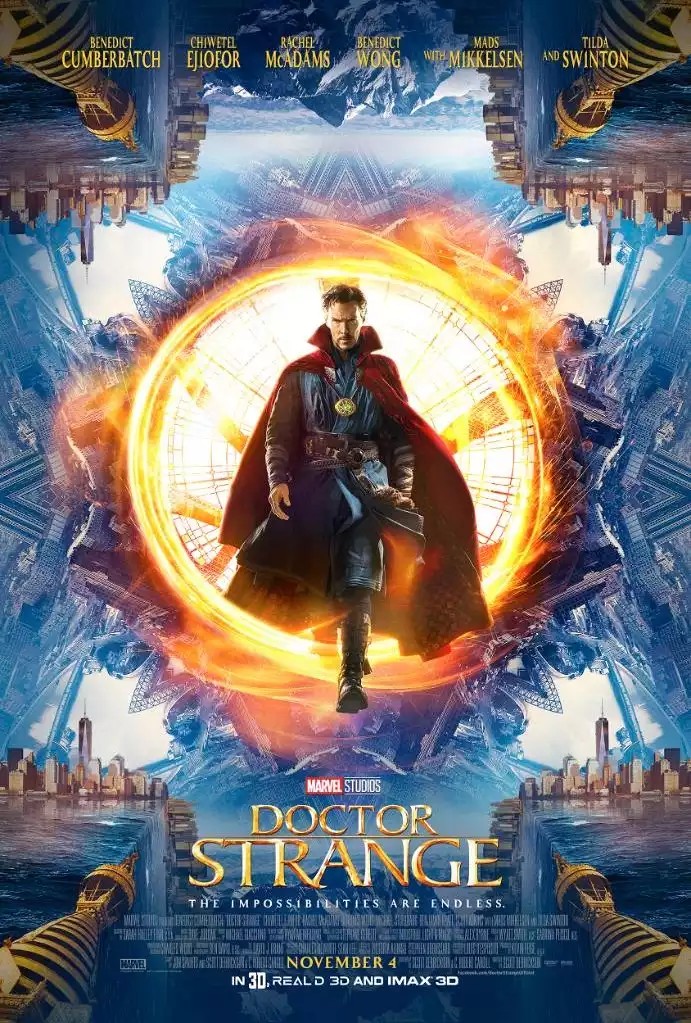
Yet another comic book-based installment in the seemingly endless Marvel Cinematic Universe, Doctor Strange is a entertaining film that takes a refreshingly new approach to the superhero genre by telling a rather peculiar story in a visually stunning fashion. The movie starts out as a typical comic book origin story in which the audience is shown how the protagonist originally attains his superpowers. We first meet the brilliant yet arrogant neurosurgeon Dr. Stephen Strange who goes along with his normal life until a fateful accident. Played by the talented British actor Benedict Cumberbatch, Doctor Strange becomes desperate after losing most function in his hands so vital to being a surgeon and sacrifices practically everything in order to find a medical solution. Nowhere else to turn, he ends up in Kathmandu, Nepal where he meets a mystical teacher known as the Ancient One who says he can be healed through the spiritual realm. He is taught ways to tap into his mind to unleash hidden supernatural powers by reading ancient texts and being mentored by the Ancient One, portrayed by the otherworldly looking Tilda Swinton, and her followers. Eventually, he is thrust into protecting Earth from a mysteriously malevolent dark power. He must help battle a devotee of this evil force who used to be a disciple of the Ancient One, a character played by the brilliantly creepy Mads Mikkelsen. As a novice sorcerer endowed with mystical powers, Doctor Strange finds himself in mind-bending fight sequences that defy the laws of physics. The filmmaker does a terrific job of creating visually arresting scenes that feel straight from M.C. Escher, where any sense of up or down is jumbled together. With its deeply spiritual undercurrent and heavy use of spectacular visual effects, the movie very much reminded me of Christopher Nolan’s 2010 film Inception. As a result of its unusual qualities, it is a radical departure from any other Marvel adaptation, which tend to be formulaic and more of the same. However, there are a few hallmarks of the more traditional Marvel movie: it includes a crossover of characters from the rest of the Marvel Cinematic Universe and the characters crack self-aware jokes. Overall, I found the film to be thoroughly enjoyable and filled with enough creativity for it to stand out from what has been expected in the innumerable superhero movies. There is no doubt that this will not be the last time we see Doctor Strange as the character’s strange storyline is ripe for a very lucrative movie franchise.

Inferno

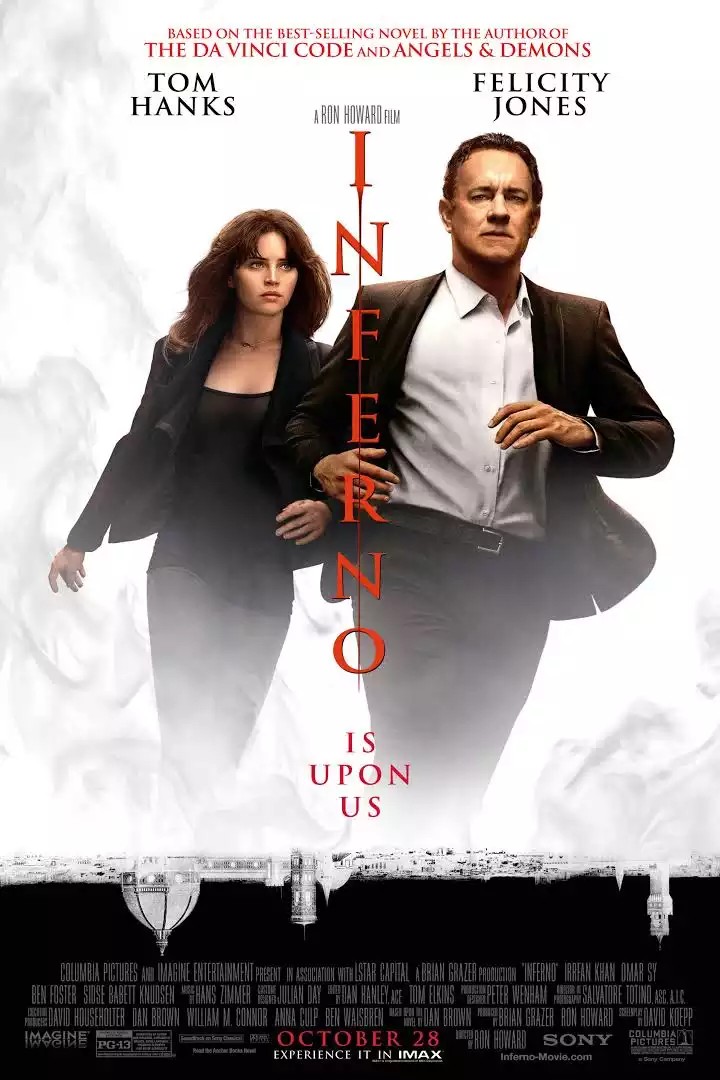
Based on the novel written by Dan Brown in 2013, Inferno is an average mystery thriller that is largely a retread of the previous Ron Howard productions of the Robert Langdon series. Like the previous adaptations of The Da Vinci Code in 2006 and Angels and Demons in 2009, the film stars Tom Hanks as Robert Langdon, the renowned fictional Harvard professor of symbology who finds himself entangled in yet another international conspiracy. We first find Professor Langdon waking up in a hospital in Florence, Italy and suffering from short-term memory loss as a result of a mysterious head injury. With the assistance of a British expat working as an emergency room doctor, portrayed by Felicity Jones, he gradually remembers details of the past 48 hours and is forced to embark on a wild goose chase to prevent a sinister plot from unfolding. While experiencing vivid nightmarish visions, he uses his vast knowledge of ancient symbols to decrypt a series of clues hidden in famous museum artifacts throughout Florence. As the title suggests, many of the mysteries are somehow connected to the 14th century Florentine poet Dante Alighieri and his famous work The Divine Comedy and its first part known as Inferno, which gave us our modern understanding of hell. Professor Langdon discovers that there is an eccentric billionaire named Zobrist who hatches a plan to solve overpopulation by secretly creating a disease to kill off half of the world’s population. Much of the film has a frenetic and fast-paced feel that sometimes too quickly jumps from one clue to the next across increasingly exotic locations throughout Europe. The real problem with the movie is that much of it is too cryptic, making it hard to digest all the details crammed into two hours. Also, unfortunately, much of the action is too preposterous and convoluted to take seriously. It is a film that is really more of the same and already has been done more adequately in the prior installments. Overall, it is a movie better suited to readers of Dan Brown’s novels and casual fans of frivolous mystery thrillers. The redundant cliches that we have already seen led me to believe that it was simply made as a cash cow for the studio, desperate for another Brown-Howard-Hanks blockbuster co-production.

Jack Reacher: Never Go Back

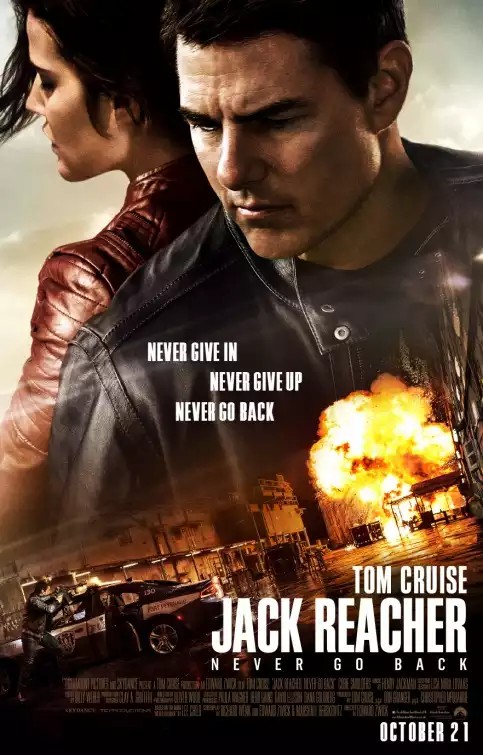
Based on a long-running series of novels written by the British author Lee Child, Jack Reacher: Never Go Back is a rather uninspired crime thriller filled with so many cliches that is hard to keep count. Even though it features the international superstar Tom Cruise, the film feels more like a B-movie, more in line with a Steven Segal or Chuck Norris production. It is a formulaic sequel to 2012’s Jack Reacher in which Cruise reprises the role of Jack Reacher, a recently retired major in the United States Army Military Police who remains on the hunt for criminals. The movie follows Reacher as he tries to uncover the truth surrounding the false accusation that a top commanding officer is a spy. There is an element of a love interest between Reacher and the officer who happens to be a beautiful young woman played by Cobie Smulders. Eventually, he stumbles upon an international conspiracy involving a large defense contractor for the United States military and its possible shady dealings. While running on a wild goose chase, Reacher must also protect a troubled teenage girl who is supposedly his daughter that he did not know he had with an unknown girlfriend from many years ago. Like any other action flick, it contains many fairly average gun battles, explosions, and hand-to-hand combat sequences. Overall, I found it to be an unoriginal and unstimulating average or even below-average action thriller that does not contribute much to the genre except simply providing Hollywood another Tom Cruise blockbuster. Befitting the title itself, the movie proves that it is a sequel that one should never go back to, unless you are an avid fan of Tom Cruise or stereotypical action films. 

The Accountant

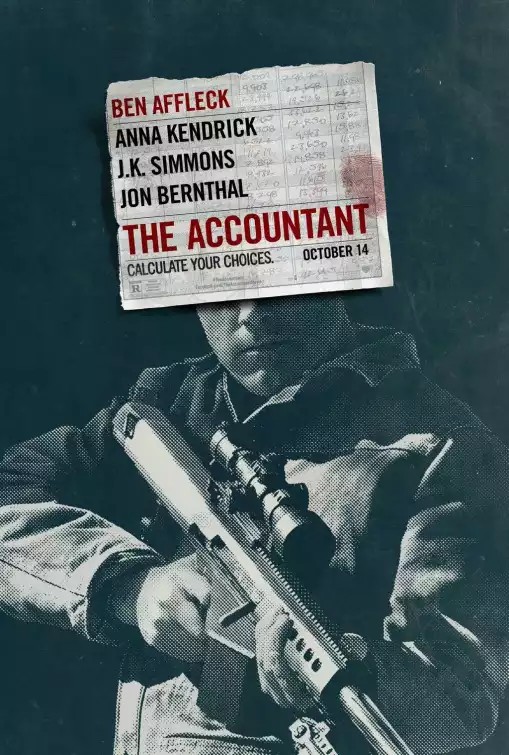
The Accountant is an entertaining action thriller that is noteworthy because of Ben Affleck’s performance and the unique twist of having the gun-toting protagonist autistic. The film starts when Affleck’s character, who later goes by the alias Christian Wolff, is a child suffering from severe autism whose parents become increasingly frustrated with his inability to act “normally.” Interspersed with flashbacks to his difficult youth with a particularly strict military father, the film follows Christian as an adult with a secretive and sinister career. Due to his proficiency with math and anti-social tendencies, he becomes an accountant illegally cooking the books for drug traffickers, terrorists, and other major criminals. Part of his cover, he takes a job as a financial consultant at a cutting-edge robotics company, hired to discover a large mysterious loss of money. With the aid of the company’s internal accountant played by Anna Kendrick, he discovers something nefarious at the company owned by John Lithgow’s character. All the while, Christian who is simply known as “The Accountant” is being pursued by the gung-ho director of financial crimes at the Treasury Department, played by J.K. Simmons. Towards the film’s conclusion, it becomes much more of an action flick after the weapons proficient Christian encounters a hitman and his highly militarized personal army. Christian is highly sought-after because of his involvement with many criminal organizations and his association with the robotics company. Overall, I found the movie to be an interesting take on the action genre, albeit a little preposterous in its premise involving an autistic criminal and assassin. I was most surprised by its seemingly accurate portrayal of people with autism, complete with the character being highly sensitive to loud noises and light. It is worthy to note that the subject matter involving autism may be controversial but the filmmakers try to present Christian’s struggles fairly and how external forces, particularly his cruel father, took advantage of him.

Deepwater Horizon

Based on the incredible true story of what is commonly referred to as the BP oil spill, Deepwater Horizon follows the largely untold story of the workers on the Deepwater Horizon drilling rig who fought for their lives after a devastating blowout on April 20, 2010. It is directed by Peter Berg who is known for the 2013 true story war film Lone Survivor, which also starred Mark Wahlberg as the main hero. The first part of the film follows what happened before the disaster, predominantly from the perspective of Wahlberg’s real character Mike Williams who was the Chief Electronics Technician on Deepwater Horizon. The viewer gets a glimpse of his personal life, particularly his relationship with his daughter and wife played by Kate Hudson. What fascinated me the most was the actual details of what it’s like to live and work on a massive rig 5,000 feet above the sea floor and 52 miles off the Louisiana coast. It also provided important context: I never before realized that Deepwater Horizon was not actually an oil rig but was rather used to explore and drill the holes for more permanent oil rigs. Unlike other rigs, it was essentially a boat that had thrusters allowing it to float in a stationary position on the surface of the Gulf of Mexico. The film delves into the technical aspects of offshore drilling and the safety apparatuses used to prevent the buildup of pressure that ultimately caused the accident. As depicted in the film, BP who leased the rid and was represented by two of its visiting executives and a supervisor, played by John Malkovich, attempted to cut corners on safety to speed up on beginning the extraction of an estimated 200 million gallons of oil a year. To no avail, several workers for Transocean, the operator of Deepwater Horizon, and Offshore Installation Manager Jimmy Harrell, portrayed by Kurt Russell, warned that the concrete supporting the newly drilled hole could be insufficient. The rest of the story becomes more of an action thriller after the safety mechanisms fail and explosions engulf the entire rig in an inferno. The filmmaker vividly recreates the disaster in such great detail that the viewer is left on the edge of their seats despite knowing the outcome. It shows the heroics of the workers, particularly Mark Wahlberg’s character, as they try to save as many fellow workers as possible and prevent an ecological calamity. As poignantly described by the actual survivors in the film’s epilogue, the Deepwater Horizon catastrophe ended up being the worst oil disaster in American history, with 11 deaths and 200 million gallons spilled over the course of 87 days. Overall, I found the film to be well worth seeing due to its technical insight and exhilarating action sequences captivating the heroics of everyday workers at a time of peril.

The Magnificent Seven

Directed by Antoine Fuqua who is best known for 2001’s Training Day, The Magnificent Seven is a fairly well done Western that fits in the unique category of a remake of a remake. It is a modern update to the 1960 classic Western of the same name starring Steve McQueen and Yul Brynner and directed by John Sturges who was inspired by the Japanese masterpiece Seven Samurai directed by Akira Kurosawa in 1954. Like the originals, the plot revolves around a posse of seven men recruited to save a village from a band of ruthless criminals. In this particular case, the leader of the group is played by Denzel Washington who is enlisted to ward off a gang paid by a mining magnate deviously portrayed by Peter Skarsgaard. The first part of the movie follows Washington’s character as he encounters each of the six other man as they are asked to join the fight. As is the case with the original The Magnificent Seven, the characters are played by Hollywood A-listers, including Ethan Hawke, Chris Pratt, and Vincent D’Onofrio. Each character is given a brief introductory scene, and the actors are set up rather typecasted, especially Chris Pratt who is used throughout the film as comic relief. Outside of their one-liners, the characters are never fully developed, which is understandable due to the size of the cast and the relatively short runtime. Therefore, I was pleasantly surprised by the second half of the film in which the scene is set for an epic battle, which, in turn, shifts into more of an action or war movie. The final action sequence is extremely well-crafted, with terrific cinematography and filled with countless bullets and explosions. There are even some unexpected twists to the conventional Hollywood ending. Also, in line with contemporary action flicks, the body count is ridiculously large: undoubtedly, more than even both of its predecessors combined. Overall, I found the film to be entertaining and full of enough action scenes to leave most moviegoers satisfied. However, as a movie buff, I came away from the theater thinking whether it was really necessary to remake something that has already been made twice terrifically, films that have stood the test of time as true cinematic classics.