Directed by Gareth Edwards who directed the 2014 Godzilla remake, Rogue One: A Star Wars Story is a well-crafted Hollywood blockbuster that blends the right amount of science fiction, explosive action, and hallmarks of the Star Wars universe to create a highly entertaining cinematic experience. Its style and narrative hark back to the original three films under George Lucas and is thankfully much better than the more recent prequels. Like its other Disney predecessor Star Wars: The Force Awakens from 2015, the movie is effectively able to recapture the original spirit and creativity that has made Star Wars such a wildly successful sci-fi franchise. Although within the same narrative universe of the other films, it is very much a standalone side project with a whole slew of new characters and planets and can be loosely called a prequel to the originals and a sequel to the prequels. In the movie, Oscar-nominated actress Felicity Jones plays a young woman named Jyn Erso whose absent father, portrayed by the fabulous Danish actor Mads Mikkelsen, is a brilliant engineer forced to design a deadly weapon for the powerful dictatorship of the Galactic Empire. After being held captive by a Rebel fighter depicted by Forest Whitaker, she is allowed to join forces with the Rebel Alliance in the hopes of preventing her father’s weapon from being deployed by the Empire and Director Orson Krennic portrayed by the terrifically evil Ben Mendelssohn. She teams up with Captain Cassian Andor, portrayed by Mexican actor Diego Luna, and the wisecracking reprogrammed Imperial robot K-2SO to steal the plans for what we come to learn is the Death Star and find a way to disable it. As with any other Star Wars movie, there are plenty of dogfights between Imperial and Rebel starfighters in outer space, in addition to land battles involving phaser blasters and Stormtroopers. These skirmishes are beautifully CGI-enhanced but not too over-the-top in order to keep with the appropriate continuation of the earlier films from several decades ago. The filmmakers made the right stylistic choice to mimic the now antiquated CGI set designs and relatively low budget custom designs from the original 1970s versions. The now well-known Star Wars iconography and storylines are kept intact despite the addition of so many new characters. To the delight of both avid fans and casual viewers, there are cameos of many beloved characters, including a certain villainous heavy breather and some friendly robots. Overall, I found this latest installment in the Star Wars saga to be a highly enjoyable joyride that does not skimp on good storytelling and nuanced acting performances from up-and-coming actors. If this movie is any indication, I very much look forward to the future Star Wars films that have already been planned for years to come.
Adventure
Fantastic Beasts and Where to Find Them
Written by J.K. Rowling, the author of the Harry Potter book series, Fantastic Beasts and Where to Find Them is the spiritual prequel to the hugely popular Harry Potter movie series but stands on its own as a technically marvelous cinematic experience about magic. It stars the Academy Award winner Eddie Redmayne as Newt Scamander, a British wizard who arrives in New York City in 1926 on his quest to discover and document the otherworldly magical creatures that live hidden in the human world. During a time when the so-called Magical Congress of the United States is attempting to neutralize threats from the wizardry world, Newt unwittingly befriends a desperate potential bakery owner named Jacob, a regular human without powers, known as a No-Maj. Jacob, rather comically, becomes Newt’s accomplice in trying to evade arrest from the powerful Magical Congress while becoming ensnared in a hunt for a malevolent force known as an Obscurus potentially destructive to all of mankind. Eventually, they also team up with a young woman trying to move up in the rankings at the Magical Congress and her beautiful young sister who can read minds. The special effects enhanced by CGI were beautifully crafted and help to create a highly imaginative world in which truly fantastical beasts look and feel real. The film was even more dazzling with its attention to detail and setting in the 1920’s, an era in American history marked by remarkable engineering achievements and a feeling of exuberance despite the Prohibition. The movie has one major drawback: it is sometimes overly complicated and uses lingo and concepts that may not be readily understood by nonreaders of the Harry Potter universe. Overall, it is an entertaining film full of technical wizardry and ripe with a vast array of characters and details that can be readily explored in future installments. It is an experience that will surely delight all the millions of Harry Potter fans in addition to casual viewers of fantasy.
Doctor Strange
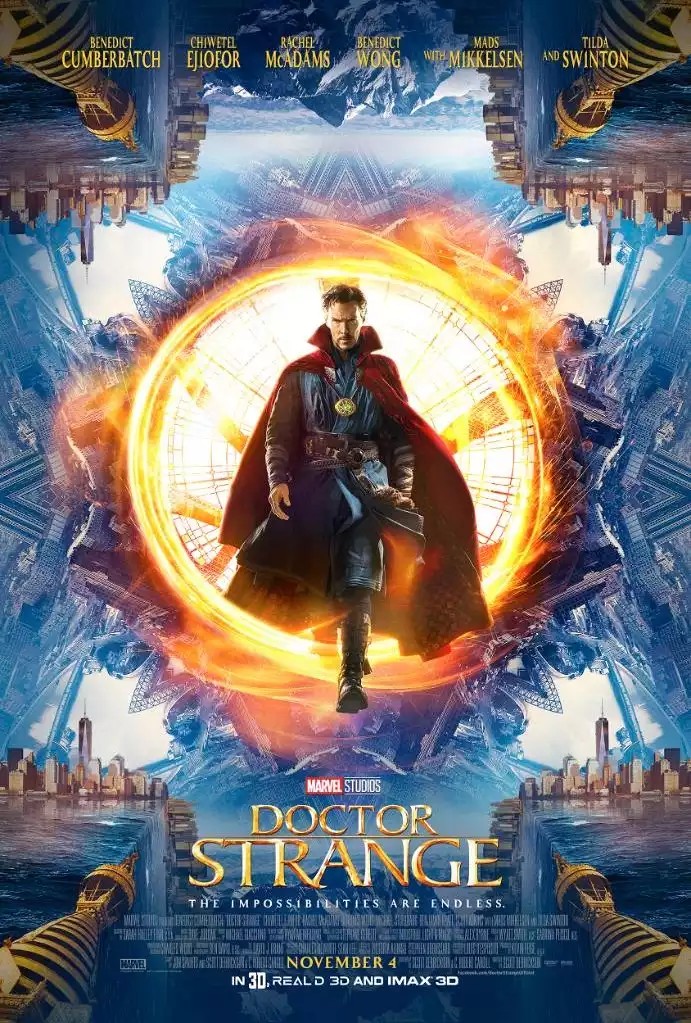
Yet another comic book-based installment in the seemingly endless Marvel Cinematic Universe, Doctor Strange is a entertaining film that takes a refreshingly new approach to the superhero genre by telling a rather peculiar story in a visually stunning fashion. The movie starts out as a typical comic book origin story in which the audience is shown how the protagonist originally attains his superpowers. We first meet the brilliant yet arrogant neurosurgeon Dr. Stephen Strange who goes along with his normal life until a fateful accident. Played by the talented British actor Benedict Cumberbatch, Doctor Strange becomes desperate after losing most function in his hands so vital to being a surgeon and sacrifices practically everything in order to find a medical solution. Nowhere else to turn, he ends up in Kathmandu, Nepal where he meets a mystical teacher known as the Ancient One who says he can be healed through the spiritual realm. He is taught ways to tap into his mind to unleash hidden supernatural powers by reading ancient texts and being mentored by the Ancient One, portrayed by the otherworldly looking Tilda Swinton, and her followers. Eventually, he is thrust into protecting Earth from a mysteriously malevolent dark power. He must help battle a devotee of this evil force who used to be a disciple of the Ancient One, a character played by the brilliantly creepy Mads Mikkelsen. As a novice sorcerer endowed with mystical powers, Doctor Strange finds himself in mind-bending fight sequences that defy the laws of physics. The filmmaker does a terrific job of creating visually arresting scenes that feel straight from M.C. Escher, where any sense of up or down is jumbled together. With its deeply spiritual undercurrent and heavy use of spectacular visual effects, the movie very much reminded me of Christopher Nolan’s 2010 film Inception. As a result of its unusual qualities, it is a radical departure from any other Marvel adaptation, which tend to be formulaic and more of the same. However, there are a few hallmarks of the more traditional Marvel movie: it includes a crossover of characters from the rest of the Marvel Cinematic Universe and the characters crack self-aware jokes. Overall, I found the film to be thoroughly enjoyable and filled with enough creativity for it to stand out from what has been expected in the innumerable superhero movies. There is no doubt that this will not be the last time we see Doctor Strange as the character’s strange storyline is ripe for a very lucrative movie franchise.
Inferno
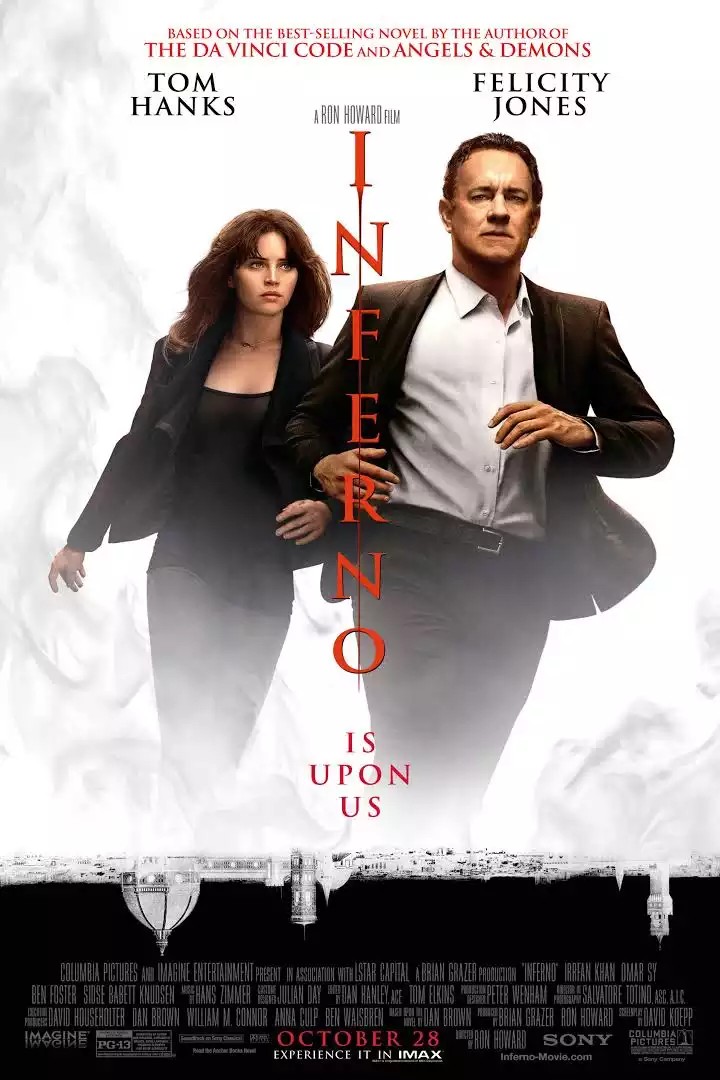
Based on the novel written by Dan Brown in 2013, Inferno is an average mystery thriller that is largely a retread of the previous Ron Howard productions of the Robert Langdon series. Like the previous adaptations of The Da Vinci Code in 2006 and Angels and Demons in 2009, the film stars Tom Hanks as Robert Langdon, the renowned fictional Harvard professor of symbology who finds himself entangled in yet another international conspiracy. We first find Professor Langdon waking up in a hospital in Florence, Italy and suffering from short-term memory loss as a result of a mysterious head injury. With the assistance of a British expat working as an emergency room doctor, portrayed by Felicity Jones, he gradually remembers details of the past 48 hours and is forced to embark on a wild goose chase to prevent a sinister plot from unfolding. While experiencing vivid nightmarish visions, he uses his vast knowledge of ancient symbols to decrypt a series of clues hidden in famous museum artifacts throughout Florence. As the title suggests, many of the mysteries are somehow connected to the 14th century Florentine poet Dante Alighieri and his famous work The Divine Comedy and its first part known as Inferno, which gave us our modern understanding of hell. Professor Langdon discovers that there is an eccentric billionaire named Zobrist who hatches a plan to solve overpopulation by secretly creating a disease to kill off half of the world’s population. Much of the film has a frenetic and fast-paced feel that sometimes too quickly jumps from one clue to the next across increasingly exotic locations throughout Europe. The real problem with the movie is that much of it is too cryptic, making it hard to digest all the details crammed into two hours. Also, unfortunately, much of the action is too preposterous and convoluted to take seriously. It is a film that is really more of the same and already has been done more adequately in the prior installments. Overall, it is a movie better suited to readers of Dan Brown’s novels and casual fans of frivolous mystery thrillers. The redundant cliches that we have already seen led me to believe that it was simply made as a cash cow for the studio, desperate for another Brown-Howard-Hanks blockbuster co-production.
Jack Reacher: Never Go Back
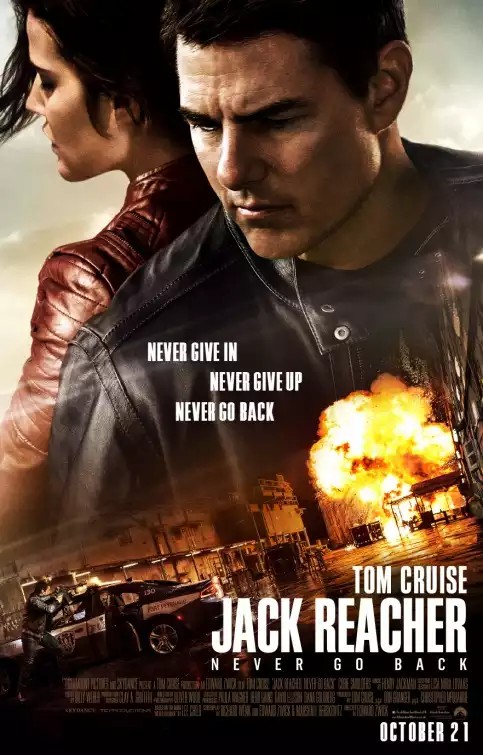
Based on a long-running series of novels written by the British author Lee Child, Jack Reacher: Never Go Back is a rather uninspired crime thriller filled with so many cliches that is hard to keep count. Even though it features the international superstar Tom Cruise, the film feels more like a B-movie, more in line with a Steven Segal or Chuck Norris production. It is a formulaic sequel to 2012’s Jack Reacher in which Cruise reprises the role of Jack Reacher, a recently retired major in the United States Army Military Police who remains on the hunt for criminals. The movie follows Reacher as he tries to uncover the truth surrounding the false accusation that a top commanding officer is a spy. There is an element of a love interest between Reacher and the officer who happens to be a beautiful young woman played by Cobie Smulders. Eventually, he stumbles upon an international conspiracy involving a large defense contractor for the United States military and its possible shady dealings. While running on a wild goose chase, Reacher must also protect a troubled teenage girl who is supposedly his daughter that he did not know he had with an unknown girlfriend from many years ago. Like any other action flick, it contains many fairly average gun battles, explosions, and hand-to-hand combat sequences. Overall, I found it to be an unoriginal and unstimulating average or even below-average action thriller that does not contribute much to the genre except simply providing Hollywood another Tom Cruise blockbuster. Befitting the title itself, the movie proves that it is a sequel that one should never go back to, unless you are an avid fan of Tom Cruise or stereotypical action films.
Miss Peregrine’s Home for Peculiar Children
Based on the 2011 young adult novel of the same name written by Ransom Riggs, Miss Peregrine’s Home for Peculiar Children is a visually well-crafted fantasy film about a group of children with magical and mysterious powers. It is directed by Tim Burton and has his trademark unique creativity that can border on the macabre. The plot follows Jack, played by Asa Butterfield, who tries to discover the true background of his grandfather, portrayed by Terence Stamp. It eventually leads him to a small isolated island off the coast of Wales and a home for orphaned children with unusual gifts. Jack realizes the orphanage run by Miss Peregrine, played by Eva Green, is trapped in an alternate universe set in 1943 on a certain day that is continuously repeated on a “loop.” Eventually, Jack is tasked with protecting the children from an evil secret group of beings who need to eat the eyes of Peculiar Children to become human. They are led by the creepy white-eyed Mr. Barron, depicted by Samuel L. Jackson, who also controls invisible creatures known as hollowgasts. Jack learns he is endowed with his own power making him particularly well suited to fight Mr. Barron’s forces. The movie is filled with many of the elements you would expect from Tim Burton, particularly nightmarish monsters that appear to come directly from his other films like The Nightmare Before Christmas. Overall, I found it to be a visually dazzling film that would appeal to any fan of Tim Burton but, for my taste, I thought it was a little too peculiar. At the beginning, it reminded me of my favorite Tim Burton movie Big Fish, with its story revolving around a aging character’s mysterious past leading the main protagonist on a fantastical adventure. I also found it probably to be a little too creepy for younger audiences, namely children under 10, one of the targeted demographics.
The Magnificent Seven

Directed by Antoine Fuqua who is best known for 2001’s Training Day, The Magnificent Seven is a fairly well done Western that fits in the unique category of a remake of a remake. It is a modern update to the 1960 classic Western of the same name starring Steve McQueen and Yul Brynner and directed by John Sturges who was inspired by the Japanese masterpiece Seven Samurai directed by Akira Kurosawa in 1954. Like the originals, the plot revolves around a posse of seven men recruited to save a village from a band of ruthless criminals. In this particular case, the leader of the group is played by Denzel Washington who is enlisted to ward off a gang paid by a mining magnate deviously portrayed by Peter Skarsgaard. The first part of the movie follows Washington’s character as he encounters each of the six other man as they are asked to join the fight. As is the case with the original The Magnificent Seven, the characters are played by Hollywood A-listers, including Ethan Hawke, Chris Pratt, and Vincent D’Onofrio. Each character is given a brief introductory scene, and the actors are set up rather typecasted, especially Chris Pratt who is used throughout the film as comic relief. Outside of their one-liners, the characters are never fully developed, which is understandable due to the size of the cast and the relatively short runtime. Therefore, I was pleasantly surprised by the second half of the film in which the scene is set for an epic battle, which, in turn, shifts into more of an action or war movie. The final action sequence is extremely well-crafted, with terrific cinematography and filled with countless bullets and explosions. There are even some unexpected twists to the conventional Hollywood ending. Also, in line with contemporary action flicks, the body count is ridiculously large: undoubtedly, more than even both of its predecessors combined. Overall, I found the film to be entertaining and full of enough action scenes to leave most moviegoers satisfied. However, as a movie buff, I came away from the theater thinking whether it was really necessary to remake something that has already been made twice terrifically, films that have stood the test of time as true cinematic classics.
Pete’s Dragon
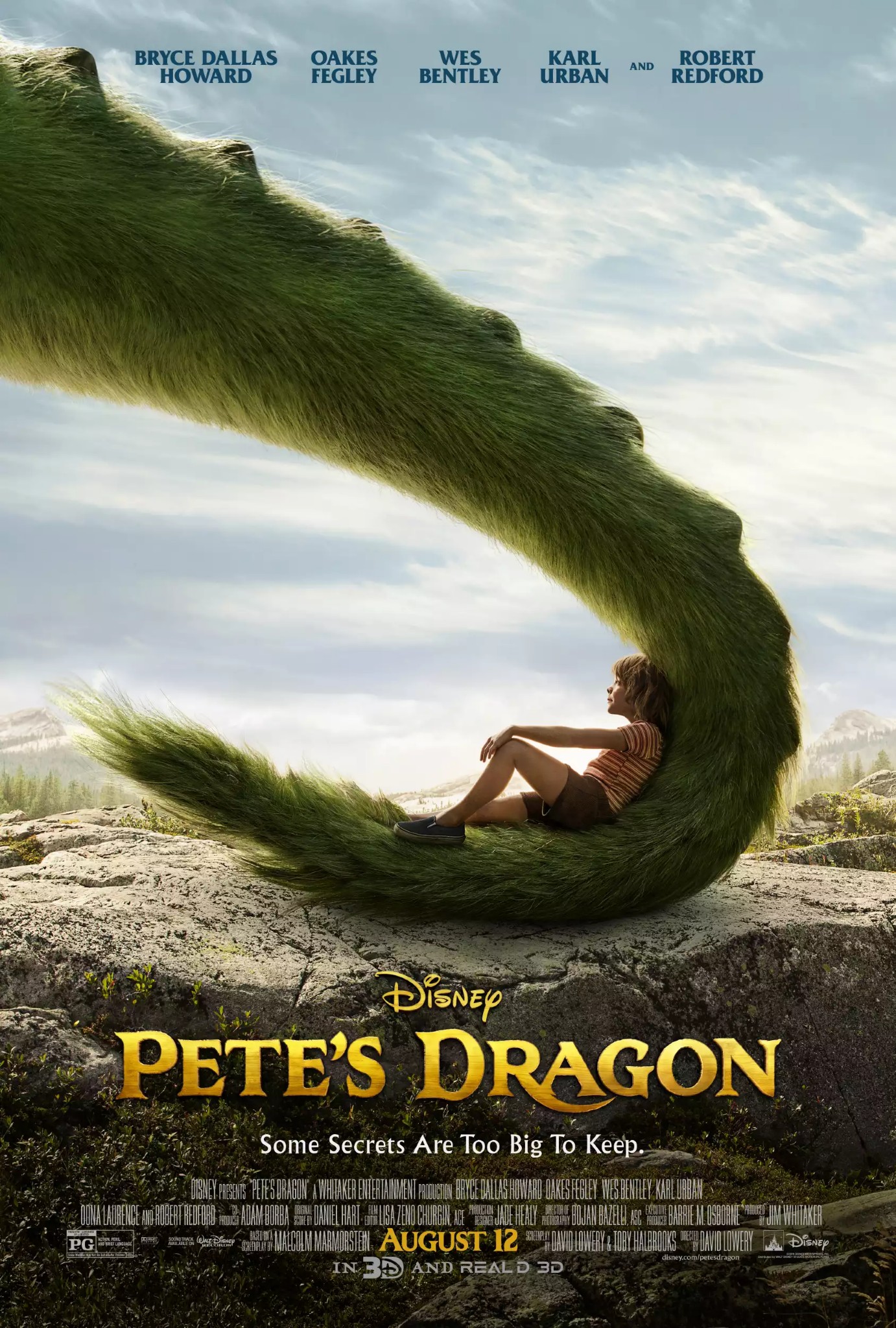
Based on the Disney animated movie of the same name released in 1977, Pete’s Dragon follows in the recent succession of Disney remaking classic animated movies into well-crafted live action films. The plot revolves around Pete who loses his parents in a car accident and is left alone in the forested wilderness where he survives with the help of a friendly dragon. The film takes place six years after the opening scene when Pete and eventually the dragon named Elliot are discovered by a crew of lumberjacks and a local park ranger played by Bryce Howard Dallas. Pete, portrayed by the terrific young actor Oakes Fegley, must figure out a way to live in civilization and away from the only companion that he has ever really known, a large furry green dragon that everyone believes is a figment of his imagination. The only true believer is the scruffy old outdoorsman played by Robert Redford who has been claiming for years that he saw a dragon in the woods. When Elliot is finally discovered, many of the lumberjacks and residents of the nearby Pacific Northwest town of Millhaven overreact and try to hunt him down as a threat. At the heart of the film is a charming and inspirational tale of overcoming personal tragedy and finding familial bonds with the most likely of people and, in this particular case, creatures. The film is not only a family story, but it is a particularly well-done movie marked by beautiful cinematography, an atmospheric soundtrack, and a great cast. The whole experience is tinged with nostalgia harking back to the original film and other family-friendly classics. In addition, the film has an undercurrent relevant to contemporary issues of environmentalism. It can be seen as an allegory for preserving nature as it is: the conflict between the timber industry and park ranger service, as well as whether to allow Elliot to live in his native wild habitat or be held in captivity like a zoo animal. Overall, I thought the movie was better than the original animated version due to its creative blending of wholesome adventure, magical whimsy, endearing charm, and important lessons about family and nature.
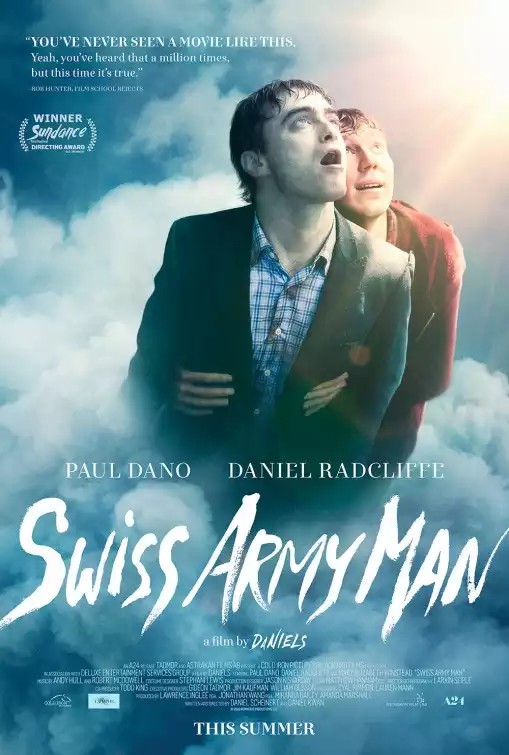
Swiss Army Man
Winner of the directing award at the 2016 Sundance Film Festival, Swiss Army Man is surely one of the strangest yet most creative movies that you will see this year and maybe even in your lifetime. The film has been known for audiences walking out in the middle who find the subject matter too absurd and disgusting. Despite this fact, it has still been applauded as one of the more unique and surprisingly captivating cinematic experiences. Paul Dano plays the despondent Hank who we first meet stranded on a desert island all by himself and about to hang himself. However, out of nowhere, he sees a corpse washing ashore that makes him decide against committing suicide. To his amazement, the body shows signs of life: it has persistent and explosive flatulence. Hank discovers that he can use the corpse’s gas to propel himself off the island and to an unknown densely forested land. He soon learns the body, which is portrayed by Daniel Radcliffe, possesses magical powers that allow for partial reanimation. Almost like a baby, the corpse named Manny begins to talk nonsense and must learn from Hank what it means to live. Having lost all hope and love in life, Hank teaching Manny the basics of living, including sexuality, becomes a cathartic experience. To better explain human interaction to Manny, Hank constructs elaborate sets resembling the real world from repurposed trash found in the forest. For instance, he replicates a bus where Manny supposedly first meets his true love Sarah, a fact that he cannot remember from before his death. Already peculiar enough that a corpse is talking, the movie gets even more bizarre in the ways that Manny becomes an “multi-purpose tool” for Hank’s survival. Rather repulsively, such things include a certain body part acting as a compass, his mouth pouring out freshwater, and his posterior shooting objects like a gun. Paradoxically, the film’s ludicrous premise does not prevent it from becoming an endearing story of friendship and what it truly means to be a human. The message is that one must continue to have hope even when it feels like all is lost. As such, Hank was able to discover the first real person that he could emotionally connect with and love, only after the lowest point in his life when he was contemplating suicide. Overall, I was surprised that a movie with such extremely ridiculous and downright perplexing moments could be so full of meaning. I would recommend it to those looking for a truly distinct movie and can look past its gross-out surrealism.
Hunt for the Wilderpeople

A truly original comedy from New Zealand, Hunt for the Wilderpeople is an oddball adventure story about a juvenile orphan from the city named Ricky Baker, played brilliantly by the young New Zealand actor Julian Dennison. Bouncing from one foster home to another after committing various misdemeanors, Ricky finds himself adopted by an older couple living in the wilderness. He eventually develops an affectionate relationship with the effusive and doting Aunt Bella but finds difficulty get close to the grumpy and gritty Uncle Hec played by the always terrific Sam Neill. Clearly out of his element as a self-described gangster, Ricky gets lost in the “bush” with Hec, and they must find a way back home. All the while, a nationwide manhunt, led by the overly officious child welfare officer Paula and her dimwitted police companion, is underway for Ricky who is mistakenly believed to have been kidnapped by his adoptive uncle. The film evolves into a hilarious wild goose chase in which Ricky and Hec encounter truly “out-there” characters living in the wilds of New Zealand. The comic effect is reinforced by the absurdly over-the-top militaristic police force, especially the gung-ho antics of Paula. Besides being an uproariously good time of a movie, the film paints a rather endearing picture of a troubled orphan who is acting out as a form of crying out for help. After experiencing the adventure of getting lost, Ricky finally finds a semblance of family with Hec who teaches him how to survive in nature. Of indigenous New Zealand Maori heritage from the city, Ricky discovers familial love in the most unexpected place with Hec, a white backwoods curmudgeon. Overall, I would highly recommend the film and rank it as one of my favorite movies of the year. It would be almost impossible for a viewer to come away from the movie without a feeling of sheer delight: it has the perfect blend of humor and charm to create a genuinely memorable moviegoing experience.