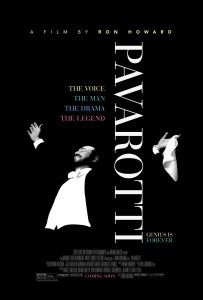
Directed by Oscar-winning filmmaker Ron Howard best known for 1995’s Apollo 13 and 2001’s A Beautiful Mind, Pavarotti is a love letter of a documentary to the legendary and larger-than-life opera singer and tenor Luciano Pavarotti, and the film does an extraordinary job of capturing the truly remarkable life story of one of the greatest voices whose persona captivated the world. It follows in the traditional mold of a documentary by telling his story through photographs, archival footage, actual concert performances, and contemporary interviews with his family and colleagues. The true magic of the deeply fascinating documentary is the subject who we first meet as a young man from a working-class family living in Modena, Italy with the improbable dream of becoming a world-class opera singer. The audience does get a glimpse of his sometimes complicated personal life, especially as it relates to his love for beautiful women, who always adored his daughters even at his most difficult points in his life. We get to witness the rise of Pavarotti as he starts his career performing in a small Italian opera company and eventually become a major recording artist who did the unthinkable for opera stars by primarily giving concerts with a selection of songs from famous operas. The largely unseen personal archival footage shows a big-hearted giant of a man who exuded natural charisma and generosity while always enjoying the good things in life, including fine wine and Italian food. His desire to help those in need throughout the world began in earnest after he teamed up with fellow famous tenors Plácido Domingo and José Carreras, establishing what would be known as The Three Tenors. The documentary gives particularly interesting insight into the relationship between the equally charismatic Three Tenors by interviewing both Domingo and Carreras who beautifully reflect on the legacy of their dear friend Pavarotti. Overall, I found it to be one of the more engrossing documentaries that I have seen in recent memory, and I would definitely recommend it to anybody who enjoys music even if you are not a fan of opera, or really anybody who enjoys a good documentary about a remarkable person such as Luciano Pavarotti.


 Directed by Academy Award-winning documentarian Michael Moore who is best known for 2002’s Bowling for Columbine and 2004’s Fahrenheit 9/11, Fahrenheit 11/9 is an entertaining and provocative documentary that is to be expected from Michael Moore who mixes comedic elements and liberal indignation to primarily criticize President Donald Trump. He delves deep into the current highly toxic political environment of the United States and is not afraid to have a no holds barred portrayal of Trump as a largely negative figure in today’s society. However, I was surprised to discover that the film covers a much larger range of topics that do not necessarily connect to President Trump, including the water crisis in Flint, Michigan, the media, the Electoral College, and even President Barack Obama. Definitely preaching to the choir, Moore goes through what led up to the election of Donald Trump in 2016 and its impact on the nation as a whole by interviewing everyday American citizens who either love or despise the rhetoric of Donald Trump. Also, at several points throughout the movie, Michael Moore visits his impoverished hometown of Flint, Michigan where he discusses the water crisis that started in 2014 and expresses anger at the state government, especially Republican Governor Rick Snyder who he believes is responsible for the negligence and apparent lack of caring that resulted in the toxic water supply that continues to this day. In typical Michael Moore fashion, the film includes a stunt in which Moore sprays Governor Snyder’s gubernatorial mansion with the lead-infused water that has come directly from the Flint water supply. At one point, he unexpectedly criticizes President Obama for his visit to Flint where he pretends to drink the water and does not entirely live up to his promise of finally solving the issue. The documentary then returns to what Moore believes is the extremely dangerous and unprecedented current presidential administration and blames the media and the outdated Electoral College for helping Trump get elected despite losing the popular vote and being counted out by the political establishment as a viable candidate. Despite most of the movie painting a rather dire picture of the current political landscape, Michael Moore tries to encourage Americans to stand up through civil discourse and voting. He discusses how ordinary people and activists are running for office, including an outspoken veteran trying to get elected to Congress as a Democrat from West Virginia. Furthermore, there is a glimmer of hope among activists as Moore describes the teacher strikes in West Virginia and its spread throughout the country demanding that public school teachers receive much-needed pay raises. Overall, although I realize that just the mention of Michael Moore will discourage most conservative audience members, I found it to be a well-meaning film that goes after both sides of the aisle, obviously with a more disdainful approach to President Donald Trump, and uses Moore’s techniques to create an effective and enjoyable documentary about today’s divided political discourse.
 Adapted from the critically acclaimed 2009 book of the same name written by well-known author Jonathan Safran Foer, Eating Animals is a powerful and thought-provoking documentary that delves into the issues surrounding large-scale factory farming of animals for human consumption. Narrated by vegan activist and Oscar winner Natalie Portman, the film provides a brief history of the early days of farming and how it evolved into an assembly line production mostly owned by such large corporations as Tyson Foods and Perdue Farms. Unlike many other environmentalist and vegan-promoting exposes, it provides a more nuanced view of the current state of animal farming by presenting interviews with a variety of farmers, including those adversely affected by working in the corporate realm and local conscientious farmers who are trying to bring back the old heritage methods of farming. Furthermore, the movie focuses on all of the implications that the mass production poultry and cattle industries has on humankind: the irresponsible dumping of animal byproducts and fertilizers that harm the environment, the corporate takeover of farms that harm the economic interests of the local farmer, and the public health hazards of consuming animals processed and filled with antibiotics. The documentary also features disturbing footage of the mistreatment of animals living in overcrowded and dangerous conditions and have become deformed as a result of practices promoting rapid growth and mass production. However, the purpose of the film is not just to encourage people to stop eating meat but to help inform the audience about ways to consume meat in a more responsible manner by purchasing from so-called heritage farms who care for the animals in a more traditional, healthy way. Overall, I found it to be an enlightening glimpse into the often unseen world of animal farming and a extremely important film that taught me that there are ways to be a more ethical meat consumer without becoming a vegetarian or vegan.

 KEITH on Reels