Hostiles

Directed by Scott Cooper who is best known for 2009’s Crazy Heart and 2015’s Black Mass, Hostiles is a beautifully shot Western with terrific acting performances from the main protagonists and provides a more nuanced view of the violent struggles between Native Americans and the American government. Set in 1892 at the height of the Indian Wars, the story follows U.S. Army Captain Joseph Blocker, played by Oscar winner Christian Bale, who is ordered to take the recently imprisoned Cheyenne war chief Yellow Hawk, played by the wonderful Cherokee actor Wes Studi, and his family back to their home in Montana. Blocker who is notorious for his brutal tactics against Native Americans is at first very hesitant to follow orders to help an Indian who was responsible for the death of several of his comrades in the past. Accompanied by a group of other American soldiers, the group are unexpectedly joined by Rosalie Quaid, terrifically played by Rosamund Pike, whose family was just brutally murdered by a group of Comanche in New Mexico. Along the perilous journey, the party must grapple with the violence and injustices perpetrated by both white Americans and Native Americans. Both sides have lost many lives, and the usually hardline Captain Blocker eventually comes to terms with the fact that the United States’ vicious and sustained campaign against Native Americans may have caused many of the problems between the two fighting groups. The challenges shared by everyone on the expedition helps create bonds between Blocker and his soldiers, Yellow Hawk and his family, and Quaid despite their justifiably grave misgivings about each other. Although there are several violent episodes, most of the film is almost a meditative experience for the characters as they cross spectacular Western scenery on horseback and come to understand one another. Overall, I found it to be a well-crafted movie with some of the most beautiful cinematography and gives a very important message about reconciliation between enemies during a very violent point in American history.


The Post

Directed by Steven Spielberg who won the Oscar for best director for 1994’s Schindler’s List and 1998’s Saving Private Ryan, The Post is a terrific film about the importance of journalism and is full of brilliant performances from an all-star cast under the guidance of one of the greatest filmmakers with a well-crafted script. Set in the early 1970s as the Vietnam War became increasingly unpopular, the movie tells the true story of the release of the so-called Pentagon Papers, which documented the failures and cover-ups of the war in Vietnam by the United States government. It is about the fierce competition between The New York Times and the relatively small Washington Post to get the scoop on such consequential classified documents. The plot follows the groundbreaking female publisher and owner of The Washington Post Katharine Graham, played by Oscar winner Meryl Streep, and the well-respected editor-in-chief Ben Bradlee, played by Oscar winner Tom Hanks, as they struggle to raise the newspaper’s national profile as they begin the process of going public to raise funds to keep the paper running. When they catch wind of the Pentagon Papers leaking, they along with their journalists desperately try to get the full report and publish stories about the secret government report that The New York Times has been barred from publishing because of a government injunction. Eventually, the Post journalist Ben Bagdikian, played by Golden Globe nominee Bob Odenkirk, is given thousands of pages of the Pentagon Papers from one of its authors, a government contractor for the Rand Corporation named Daniel Ellsberg, played by Emmy nominee Matthew Rhys. Graham and Bradlee must grapple with the legal implications of publishing confidential government records, which could result in jail time and the newspaper going bankrupt, and the journalistic duty of informing the public in a country with freedom of the press. Although it is a historical snapshot of a crucially important time in journalism, the filmmakers effectively allude to the parallels in today’s society, with the current president of the United States criticizing the free press and calling for the prosecution of leakers. The movie very much reminds me of the 1976 movie All the President’s Men, perhaps the greatest movie ever made about journalists, by focusing on the investigative reporting at The Washington Post during the Nixon era. Both films powerfully shed light on the significance that journalism has on holding the American government and president accountable for their actions. A spiritual prequel to the Robert Redford and Dustin Hoffman movie in which the story takes place almost immediately after the Pentagon Papers, Spielberg’s work is much more about the leadership at The Washington Post and its conflict with the judicial system. Overall, I found The Post to be one of the most relevant movies made about America’s current political and journalistic environment and stands by itself as an excellent movie due to its marvelous ensemble cast with almost too many great actors to name directed by the great Steven Spielberg.

Molly’s Game

Directed by Aaron Sorkin who is best known for creating the Emmy Award-winning TV series The West Wing and writing the Oscar-winning screenplay for the 2010 movie The Social Network, Molly’s Game is a well-crafted film from a talented screenwriter in his directorial debut that tells a remarkable story and is marked by terrific acting performances and a first-rate script. The plot revolves around the true story of Molly Bloom, brilliantly played by Oscar nominee Jessica Chastain, who runs one of the most exclusive high stakes poker games after a career-ending injury as a Olympic-level skier. She finds herself desperate for a job after moving to Los Angeles and is enlisted by her jerk of a boss to help put on a weekly poker game attended by Hollywood actors, powerful businessmen, and other influential men. The movie is a series of flashbacks recounting her rise from this first arrangement and through the high stakes poker community to establishing her own game first in Los Angeles and later in Manhattan. She narrates her own life story to her defense attorney Charlie Jaffey, played by the always outstanding Golden Globe winner Idris Elba, after she finds herself in trouble with the FBI for possible connections to the Russian mafia. Much of her legal problems stem from the fact that she published a memoir about her days in the legally dubious poker world. Because of her position in the world of gambling, Molly’s wealth garnered from poker is frozen by the government, and she must convince authorities she was unaware of the most damaging allegations, particularly the involvement of several criminal organizations. Besides telling her fascinating story, the filmmaker also does an excellent job of providing a glimpse into the shadowy world of high stakes poker and its popularity with power brokers and well-known celebrities. For instance, the character known as Player X, played by Michael Cera, is supposed to represent a composite of Leonardo DiCaprio, Tobey Maguire, Ben Affleck, and other Hollywood actors who likely attended Molly’s poker games. The movie’s energy is greatly enhanced by the hallmarks of an Aaron Sorkin production: many scenes comprise of clever and fast-paced dialogue to underscore the high-stakes that Molly faces gambling with powerful men and the federal government. Overall, I found it to be an entertaining movie that tells a truly unbelievable story about the largely unknown world of underground poker and is captivating for most of the time despite some rather slow and drawn-out moments.

All the Money in the World

Directed by Oscar-nominated filmmaker Ridley Scott who is best known for 1979’s Alien, 1982’s Blade Runner, 2000’s Gladiator, and 2015’s The Martian, All the Money in the World is a well-crafted and gripping thriller about the kidnapping of a grandson of one of the world’s wealthiest men in the 20th century. The story takes place in 1973 when the 16-year-old grandson of billionaire oil businessman J. Paul Getty, terrifically played by Academy Award winner Christopher Plummer who replaced the disgraced Kevin Spacey only one month before release, is taken hostage by an Italian criminal organization in Rome. They ask for a ransom of $17 million for the life of J. P. “Paul” Getty III, played by Charlie Plummer, from his mother Gail Harris, played by the brilliant Academy Award nominee Michelle Williams, who is now divorced from Getty’s troubled son. Without a financial settlement from the divorce and without help from her former father-in-law, she is distraught because she does not have the money to save her son’s life. As a result, she has no other recourse but to ask Getty who she greatly despises to help pay the ransom, but he refuses as a ruthless tactic to avoid having his other grandchildren being kidnapped and costing him money. The movie portrays Getty as a vicious tycoon who will do anything to keep his money even though he is worth over a billion dollars. To avoid paying a single penny, he eventually enlists a former CIA operative and negotiator for Getty Oil named Fletcher Chase, played by Mark Wahlberg, to figure out a way to free Paul from his captors. Chase is also told to remain in contact with Gail about the kidnapping and report everything back to Getty. The best moments of the film show Getty making rather brutal comments about his family and apparent lack of interest in helping his grandson and much hated former daughter-in-law even while he continues to spend millions of dollars on his art collection. To further illustrate the cruelty of Getty, the story dramatically captures the anguish and anger of Gail while her son is wasting away partly as a result of her former father-in-law’s actions. As Chase and the authorities get closer and closer to finding Paul and capturing his kidnappers, the movie evolves into more of a standard crime thriller full of riveting chases and shootouts. Overall, I found it to be a quite entertaining and truly fascinating film full of top-notch acting performances and thrills about a story I really did not know much about and am now quite surprised that the unbelievable true story has not been made into a movie earlier.

I, Tonya

Directed by Craig Gillespie who is best known for 2007’s Lars and the Real Girl and 2016’s The Finest Hours, I, Tonya is an incredibly entertaining dark comedy and compelling drama that is full of brilliant acting performances and shines as a result of its creative storytelling. The story revolves around the life of the infamous figure skater Tonya Harding, played by Australian actress Margot Robbie in her best performance, and her association with the brutal attack on fellow American ice skater Nancy Kerrigan. The filmmaker quite effectively reinforces the often ridiculous nature of the story by interspersing conventional film narrative with the mockumentary format by including interviews with the characters and the characters directly interacting with the audience. We first meet Tonya as a young girl forced to enter the world of competitive ice skating by her chain-smoking abusive mother LaVona, brilliantly played by Emmy Award winner Allison Janney. As Tonya progressively moves up the ranks of United States figure skating, her mother becomes increasingly vicious and does everything and anything to make sure she stays competitive at the expense of living a normal life. She eventually escapes her mother and moves in with her boyfriend and future husband Jeff Gillooly, played by Sebastian Stan, who is more supportive but ultimately turns out to be a bad influence. Coming from a rough background filled with abuse and poverty, Tonya feels she is unfairly judged at the competitions despite her almost technically perfect performances. As a result of her frustrations, she finds herself in a whole heap of trouble with the FBI after it is discovered that Jeff’s best friend and her bodyguard Shawn Eckhardt orders a pair of petty criminals to injure her fiercest competitor Nancy Kerrigan only a few weeks before the 1994 Winter Olympics in Lillehammer, Norway. Although it presents a rather tragic and complicated downfall of a truly talented athlete, the film brings a certain level of levity through the recreated contemporary interviews with the main characters who come off as either cruel, naive, or stupid. Furthermore, the preposterous circumstances and events portrayed make for some darkly hilarious moments, especially the actions of the dim-witted Shawn. Overall, I found it to be one of the most entertaining films of the year that paradoxically paints a sympathetic picture of the notorious Tonya Harding with the help of a stellar cast, particularly Margot Robbie and Allison Janney.

Downsizing

Directed by three-time Oscar nominee Alexander Payne best known for 2004’s Sideways, 2011’s The Descendants, 2013’s Nebraska, Downsizing is an intriguing yet ultimately rudderless film with a very unique twist and applaudable acting performances. I was surprisingly letdown by what was advertised as a comedy with a fun and preposterous premise and came away disappointed by the lackluster effort put forward by a very talented filmmaker. The story revolves around the scientific discovery of being able to shrink humans to only five inches tall as a way of reducing the environmental footprint of humanity. Paul, played by Matt Damon, and his wife Audrey, played by Kristen Wiig, are a middle-aged couple stuck in a rut living in Omaha who decide one day to undergo the procedure known as downsizing. They are convinced after meeting up with their high school friend Dave, played by Jason Sudeikis, who enjoys the financial benefits of living small. They are all prepared to live the rest of their days as small people living in the luxurious Leisureland community, but Audrey has grave misgivings about leaving her family. Eventually, Paul lives alone as a downsized person in a small apartment located in Leisureland after his wife decides not to downsize and files for divorce. Living a rather boring life at a dead-end job, he decides to go partying with his upstairs neighbor and Serbian playboy Dusan, played by an affable Christoph Waltz, who is wealthy from his black market dealings. Further changing his worldview, Paul runs into a Vietnamese refugee and housekeeper named Ngoc Lan Tran, played by Hong Chau whose performance is the highlight of the movie, who is very charitable to the poor residents despite her financial situation. Paul becomes close friends with her and eventually romantic feelings develop between the two. In yet another strangely abrupt and unnecessary plot shift, Paul along with his new and unusual friends embark on a journey to the original downsized community in remote Norway. They learn from the Norwegian scientist who invented the procedure that mankind is in peril as a result of the irreversible environmental impact of full-sized people. Thereby, the movie drastically shifts to becoming a drama about the environment after the first third of the film plays out like a satirical comedy. Overall, I was impressed by the filmmaker’s creativity in concocting such a bizarre concept; however, the film’s execution fails its great potential as a result of jumbled plotlines and largely unsympathetic characters besides Ngoc. 

The Disaster Artist

Directed by James Franco, The Disaster Artist is a hilarious and unexpectedly touching film about the mostly true making of the 2003 cult classic The Room, infamously known as one of the best worst movies ever made. The truly hard-to-believe yet well-crafted storytelling and terrific acting performances allow the movie to rise above its seemingly ridiculous plot to become more than just a silly comedy poking fun at a terrible film. We first meet the protagonist Tommy Wiseau, played almost perfectly by Oscar nominee James Franco, in San Francisco in the late 1990s befriending a fellow struggling actor named Greg Sestero, played by Dave Franco. A very eccentric man with an unusual accent whose background is never really known by anyone, Tommy convinces Greg to move with him to Los Angeles where they can try to pursue a career in acting. Despite his unbridled enthusiasm and passion, Tommy is unable to find any acting jobs due to his rather poor acting skills and awkward personality. Fed up with the lack of opportunity in Hollywood, Tommy decides to make his own movie and sets out to write a script for a feature-length about a complicated man and his love life, and he offers Greg a major acting part and producer credit. Tommy spends millions of dollars that seem to come from nowhere to purchase film equipment, rent out a studio, and hire a large cast and crew, including a skeptical script supervisor played by Seth Rogen. In addition to being the screenwriter, the increasingly controlling Tommy also serves as director and producer at the same time that he stars as the main character Johnny. Several funny scenes take place as the befuddled cast and crew must deal with Tommy’s poor filmmaking judgement and preposterous demands. However, quite surprisingly, the film paints a sympathetic and at times heartbreaking picture of Tommy, particularly through his occasionally tumultuous personal relationship with Greg. Tommy is fairly oblivious to the fact that the other cast and crew members constantly make fun of his passion project that he feels will be extremely successful and prove his talents to Hollywood. Overall, I found it to be a profoundly entertaining and fascinating glimpse into the making of a truly bad movie that has become a cultural phenomenon and shines as a result of the brilliant directorial and acting skills of James Franco.

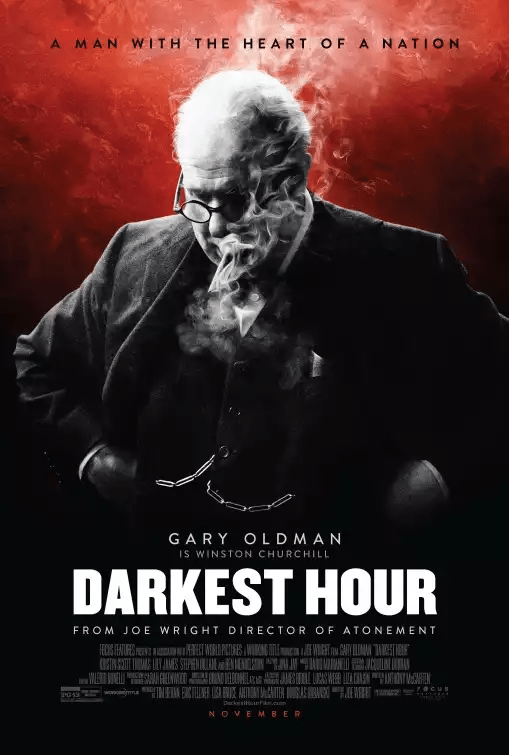
Darkest Hour

Directed by British filmmaker Joe Wright who is best known for the critically acclaimed 2005 adaptation of Pride and Prejudice and 2007’s Atonement, Darkest Hour is a superb glimpse into how the larger-than-life British Prime Minister Winston Churchill dealt with the difficult early years of World War II as hope seemed to diminish. The film’s greatest strength is the tour de force acting performance of Academy Award nominee Gary Oldman who will assuredly get an Oscar nod for his role as Churchill. It takes place near the beginning of World War II in May 1940 after the resignation of Prime Minister Neville Chamberlain who sought appeasement with Adolf Hitler and Nazi Germany and explores the early leadership of Churchill. In the midst of the Dunkirk crisis as almost the entire British Army is surrounded by the Nazis in France, the strong-willed Churchill must decide whether to initiate peace talks with Germany or to carry on with an all-out fight with Hitler’s powerful military. Feeling very much like a dramatic play, the film is mostly comprised of heated dialogue between Churchill and government members supporting negotiation with Hitler, particularly Chamberlain and Britain’s foreign minister Lord Halifax, and the primary setting is in the London underground headquarters of the British military and intelligence. The narrative also delves into Churchill’s personal relationships with his supportive wife Clementine, played by Oscar nominee Kristin Scott Thomas, dedicated secretary Elizabeth, played by Lily James, and skeptical King George VI, played by Emmy winner Ben Mendelsohn. The filmmaker is able to present a mesmerizing intimate portrayal of one of the most powerful leaders in modern history that stands out in a year in which Churchill has been depicted by three equally talented actors. In stark contrast to Churchill’s public persona as a heavy-drinking and cigar-smoking force to be reckoned with, Oldman’s performance shows the sensitive side of Churchill as a thoughtful and conflicted leader who feels compelled to do what is only best for his suffering nation. Overall, I found it to be a very absorbing and thought-provoking movie that showcases one of the best acting performances in recent memory.

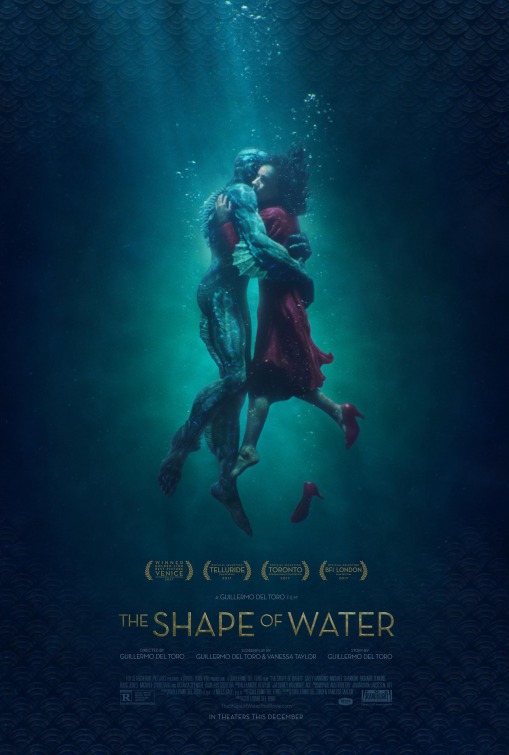
The Shape of Water

Directed by critically acclaimed Mexican filmmaker Guillermo del Toro who is best known for 2006’s Pan’s Labyrinth and 2004’s Hellboy, The Shape of Water is a beautiful and strange fantasy drama benefiting from evocative cinematography and terrific acting performances from a stellar cast. Set in early 1960s Baltimore, the story follows Elisa Esposito, played by the always brilliant Golden Globe winner Sally Hawkins, who is a lonely and compassionate mute woman working as a janitor for the mysterious Occam Aerospace Research Center. Her life dramatically changes when a new so-called Asset arrives at the laboratory after being discovered by the vicious Colonel Richard Strickland, played by the remarkably creepy Oscar-nominated actor Michael Shannon. Primarily living a quiet life alone with the exception of her charming coworker Zelda, played by Oscar winner Octavia Spencer, and eccentric neighbor Giles, played by Oscar nominee Richard Jenkins, Elisa develops a very close and warm relationship with the Asset, a sea creature that somewhat resembles a human. Strickland along with his overly officious boss General Hoyt, played by Nick Searcy, only see the Asset as a scientific experiment who can possibly help with space technology and allow the United States military to have a competitive advantage over the Soviet Union. Fully aware that the military leadership has plans to exterminate the Asset so that it cannot fall into the hands of the Soviets, Elisa devises a plan to free the Asset from the laboratory with the help of Zelda, Giles, and the secretive scientist Dr. Robert Hoffstetler, played by Michael Stuhlbarg best known for his role on the HBO TV series Boardwalk Empire. Although it is a very peculiar story and features a somewhat grotesque fantastical creature, the movie becomes something much more than simple fantasy; the dark and mysterious setting created by the mesmerizing cinematograph blends with the powerfully poignant emotions of the characters to create a very special movie. Overall, I found it to be one of the best films of the year despite probably being one of the weirdest movies that the audience will see; even though the subject matter may not be for everyone, it is definitely a very worthwhile cinematic experience.
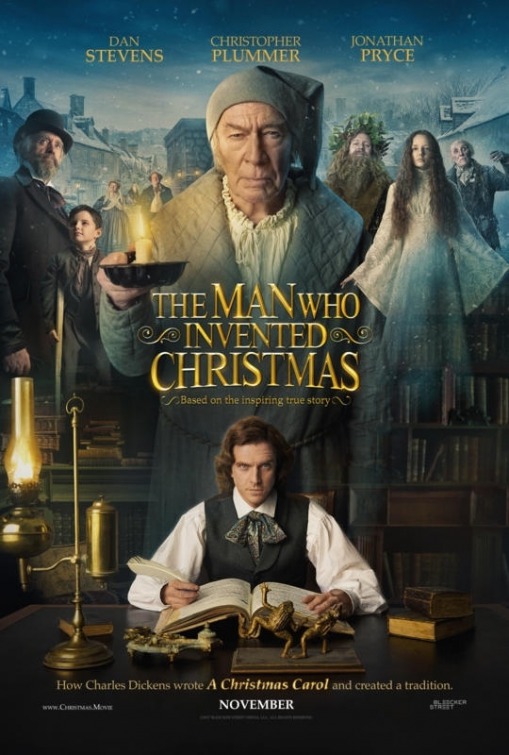
The Man Who Invented Christmas

Loosely based on a true story, The Man Who Invented Christmas is a fascinating look into the life of Charles Dickens as he writes the classic A Christmas Carol in London in 1843. The film effectively illustrates the inspirations for Dickens, played by Dan Stevens of Downton Abbey fame, by depicting the characters in the famous Christmas story as characters in the movie. We first meet Dickens ten years after the incredibly successful publication of Oliver Twist and is currently suffering from a string of unsuccessful books. To appease his publisher and maintain his fame, he sets out to write a new novel. Suffering from writer’s block, he eventually finds inspiration after witnessing several events in the daily life of impoverished Londoners and the return of his erstwhile father John Dickens, played by the terrific Jonathan Pryce. For much of the film, he is cooped up in his study where he grapples with the story and characters that will be featured in his Christmas-themed novella and interacts with the imaginary characters, especially Ebenezer Scrooge, played by Oscar winner Christopher Plummer. While struggling to finish the story in six weeks time, he asks for advice from a very unlikely source, a young housekeeper named Tara, who encourages him to make the book into a redemption story. Dickens must also deal with his father who has returned to London because of financial difficulties and becomes an imposition and a reminder of Dickens’ troubled early life, including working in a factory as a child. At the end of the movie, Dickens himself evolves into a better person and is more affectionate towards his father, somewhat like Scrooge embracing the true spirit of Christmas at the end of the book. Overall, I thought it was a well done movie that illuminates the background behind one of the greatest Christmas stories ever told, and I enjoyed the unique twist that the filmmaker used in presenting the fictional characters in A Christmas Carol to show how Charles Dickens was influenced.