Wonder

Based on the 2012 best-selling novel of the same name written by R.J. Palacio, Wonder is a well-crafted sentimental movie with a hopeful and inspirational story about a young boy suffering from a medical disorder. Played by the talented young actor Jacob Tremblay best known for his role in the 2015 movie Room, the story follows August “Auggie” Pullman as he enters fifth grade after being homeschooled by his mother Isabel, played by Julia Roberts, because of his rare genetic condition that causes facial deformities and has required many reconstructive surgeries. He is fearful that the kids at his new school will bully him for his appearance and, like most kids, whether he will fit in and make new friends. The filmmaker uses the unusual technique of starting the film with several different sequences about specific main characters. The film begins to follow the emotional journey of Auggie’s parents Isabel and Nate, played by Owen Wilson, as well as his older sister Olivia who all cope with the difficulties associated with Auggie’s condition. In the segment following Olivia, the audience learns that she is also affected by her brother who receives most of the attention in the family, and she has to deal with the pressures of high school and the distancing of her best friend. Like Auggie, she has to find a safe and happy place, which she discovers is the high school drama program where she meets her new boyfriend. Towards the middle, the movie shifts to a more traditional narrative showing Auggie adjusting to his new school run by the kind-hearted principal Mr. Tushman, played by Mandy Patinkin, and having to face the school bully Julian while developing a friendship with a nice boy his age named Jack. Eventually, Auggie finds his place and is encouraged by his inspirational homeroom teacher Mr. Browne, played by the musician Daveed Diggs. Overall, I found it to be an uplifting film that sheds a light on how severe medical disorders affect not just the sufferer but also everyone around them who must also deal with the challenges. Despite Auggie’s disability, he is able to move beyond the difficulties and become an inspirational figure for his family and classmates.
Three Billboards Outside Ebbing, Missouri

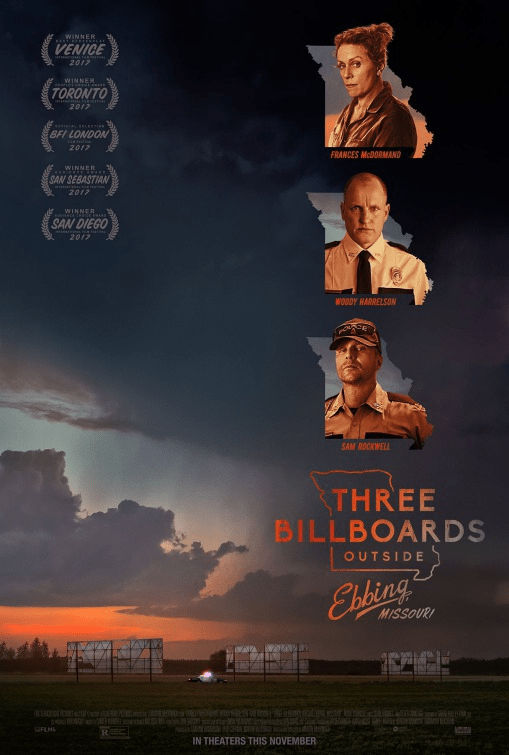
Directed by Martin McDonagh best known for 2008’s In Bruges, Three Billboards Outside Ebbing, Missouri is a terrific film with a stellar cast that expertly blends dark comedy with drama. Set in a small town in Missouri, the movie follows Mildred Hayes, played brilliantly by Oscar winner Frances McDormand, as she tries to find justice for the murder and rape of her daughter several months prior. A force not to be reckoned with, she hatches a plan to rent three abandoned billboards outside of town that directly question the police’s inability to find the culprit. A darkly funny tit-for-tat fight erupts between Mildred and the rest of the townsfolk who are sympathetic to the local police department and Chief Bill Willoughby, played by the always great Woody Harrelson. Things do not get any better with the intervention of the dim-witted and often racist Officer Jason Dixon, played wonderfully by Sam Rockwell, who does not always follow the law in protecting his chief and making sure Mildred removes the incriminating billboards. The issue over the billboards rapidly escalates into violence primarily as a result of the strong-willed and stubborn Mildred who does anything in order to avenge her daughter’s gruesome death. Even as Chief Willoughby is going through his own serious personal problem, she squarely blames the police department for not doing enough to find the perpetrator. To no avail, Mildred’s son Robbie, played by Oscar nominee Lucas Hedges, and her abusive ex-husband, played by Oscar nominee John Hawkes, insist she stop with all the shenanigans in order to prevent further shame to the family. However, she does have some strange bedfellows who encourage her, including the local slick used car salesman who happens to be a little person and excellently portrayed by Peter Dinklage. Although the background story is dramatic and depressing with it involving a rape and murder of a teenage girl, the filmmaker is remarkably able to bring some levity to the situation and allow the audience to laugh at some rather uncomfortable yet ridiculous moments of macabre humor. Overall, I found it to be one of the best films of the year because it contains such brilliant acting performances and is somehow able to effectively mix very real drama with perfectly timed dark comedy.

Last Flag Flying

Directed by Golden Globe-winning director Richard Linklater who is best known for the Academy Award-winning 2014 movie Boyhood and 1993’s Dazed and Confused, Last Flag Flying is a well-crafted and very human film that explores grief and war with powerful moments of raw emotion and levity brought to life by the extremely talented cast. Steve Carell plays former Navy Corps medic Richard “Doc” Shepherd who reunites with former Marines Sal Nealon, played by Bryan Cranston, and Richard Mueller, played by Laurence Fishburne, after he learns his son was killed in Iraq serving as a Marine. Clearly broken by the Vietnam War and the recent passing of his wife and now son, Doc contacts the two other men that he served with decades prior in Vietnam as a means of coping with the profound grief of losing his son to war. We first meet the rambunctious and wisecracking Sal overseeing his dive bar and then the soft-spoken and reformed Mueller presiding over his congregation as a Baptist minister. Eventually, Doc persuades the two very different men to pick up his son’s body from Dover Air Force Base in Delaware and take him back home in New Hampshire to be buried instead of Arlington National Cemetery. Over the course of the journey, the middle-aged men reminisce about their time as soldiers in the Vietnam War and try to rectify their prior sins. Underscoring the mixed human emotions experienced in one’s life, the characters, especially the irreverent Sal, share several moments of laughter and bonding time on their road trip despite the extremely depressing circumstances. They also grapple with their patriotism and pride of serving in the military at the same time that they disagree with the American government’s decisions to go to war in Vietnam and now Iraq. The movie works so well because of the very real chemistry that can be felt between all three brilliant actors who bring a certain level of humanity to what most people would expect to be just a sad and grim story about a father grieving over his son’s death. Overall, I found it to be an exceptional film that is both bittersweet and hopeful and provides important insights into the complexities of losing a loved one and the human toll caused by war, complete with heartwarming and heartwrenching moments. 

Murder on the Orient Express

Directed by Kenneth Branagh who is best known for his work in Shakespeare plays and film adaptations, Murder on the Orient Express is a stylish adaptation of the classic 1934 Agatha Christie novel of the same name and later adapted into a critically acclaimed movie in 1974. It feels very much like a modern update to the murder mystery genre and is jam-packed with an all-star cast, but the film largely does not live up to its predecessor and the novel itself. The always terrific Academy Award nominee Kenneth Branagh stars as Hercule Poirot, a brilliant and eccentric Belgian detective who is a recurring character in Christie’s books. While on a break between cases in the winter of 1934 in Istanbul, he is recruited to investigate a case in the UK and is offered a ticket on the world-famous luxury train the Orient Express headed to Calais, France in order to quickly reach his destination. He, along with thirteen strangers, mostly keep to themselves on an uneventful first leg of the journey. The first few scenes on the train introduce the audience to the passengers ranging from a governess, a professor, a duchess, a secretary to a mobster and are played by such famous faces as Willem Dafoe, Judi Dench, Johnny Depp, Penelope Cruz, Michelle Pfeiffer, Josh Gad, Daisy Ridley, Leslie Odom Jr., and Derek Jacobi. Things rapidly become chaotic after the Orient Express is stranded after an avalanche and a body is discovered in one of the cabins. Detective Hercule Poirot is then enlisted to help solve the murder before the train reaches its next destination. With unique cinematography, including overhead shots and long panning shots, and sumptuous detailing of the original Orient Express and 1930s costumes and decor, the meticulous detective interrogates all the passengers and tries to piece together the evidence to discover the culprit. The best part of the movie is Branagh’s portrayal of the charismatic and mysterious Poirot and the fascinating ways he is able to solve the murder mystery, all the while interacting with a terrific ensemble cast. Overall, I found it to be an enjoyable and beautifully shot movie that does not reach perfection as a result of its bloated cast, sometimes too slow pacing, and attempt to revitalize an already beloved classic murder mystery novel and film. 

The Florida Project

Directed by Sean Baker who is best known for the 2015 independent film Tangerine, The Florida Project is a wonderfully crafted indie film that explores the largely unseen impoverished American population living in budget motels and the struggles that the adults go through while the children seem happy in the innocence of childhood. It is a fairly simple film that is more of an observant witness to the characters, predominantly a group of children, and follows their daily lives surrounded by what most people would describe as horrible living conditions. As emphasized by the movie’s title referring to the name used for Walt Disney World before it was built, the filmmaker points out the cruel irony of these innocent kids living in a rough neighborhood of Kissimmee, Florida next door to the fantastical Disney World, a place they can only dream of visiting. The main protagonist is a 6-year-old girl named Moonee, terrifically played by the charming young actress Brooklynn Prince, whose mother Halley is a troubled out-of-work single mother that goes to increasingly desperate lengths to financially support her daughter. The movie sentimentally depicts the rebellious young girl as she happily enjoys what she believes is a normal childhood playing with her group of friends and exploring her neighborhood full of run-down strip malls and motels, almost oblivious to her otherwise depressing situation. She even has a special relationship with the kind-hearted manager of her home The Magic Castle Motel, a gentle man with his own problems who becomes a father figure to the children living at the motel. Brilliantly played by Willem Dafoe in one of his best performances, the manager Bobby Hicks clearly has the kids’ best interests at heart, and he is often in the hard situation of cleaning up their parents’ messes, ranging from drug addiction to prostitution. Despite lacking a traditional plot line, the filmmaker is a master storyteller who is able to flesh out the characters through a series of small moments in their lives that add up to a powerfully empathetic portrayal of such a tragic yet hopeful underrepresented segment of our population. The audience viscerally experiences both the heartwarming and heartbreaking moments in these people’s lives: the children’s innocence lifts up our spirits while the adults’ daily challenges reminds us of the hardships of those living in poverty. Overall, I found it to be one of the best films of the year because of its captivating storytelling that feels very real and is able to illuminate a previously unexplored problem in today’s modern society in a sympathetic and non-condescending manner. 

LBJ

Directed by Rob Reiner who is mostly known for comedies, LBJ provides a fascinating historical look into the larger-than-life 36th President of the United States, unexpectedly played by Academy Award nominee Woody Harrelson, but,  unfortunately, becomes nothing more than a formulaic biopic that adds very little significance to the already robust cultural treatment of President Johnson. The movie is a series of flashbacks between the fateful days of November 1963 following President Kennedy’s assassination in Dallas and the early years of the Johnson Administration pursuing the monumental Civil Rights Act of 1964. It does a fairly good job of recreating the moments surrounding the JFK assassination, but it does not feel that remarkable since it has been depicted so many times in films and television. The main emphasis of the film is the emotional stress of LBJ witnessing the death of the American president at the same time that he finally achieves his lifelong dream of becoming president. I found the most interesting aspect to be the portrayal of the often difficult and toxic relationships between LBJ, JFK, and members of JFK’s inner circle, especially his brother Bobby who was the attorney general. When he finally ascends the presidency, LBJ must work all legislative and executive options to pass the controversial Civil Rights Act, which potentially alienates him from his former Democratic colleagues from the South serving in the Senate and House, including the more conservative Georgia Senator Richard Russell, played by Academy Award nominee Richard Jenkins, and more liberal Texas Senator Ralph Yarborough, played by Bill Pullman. The movie does a superficial job of delving into the emotions of LBJ and only provides a little insight into his special relationship with his wife Lady Bird Johnson, played by Jennifer Jason Leigh. Overall, I found it to be intriguing only for providing additional stories about such a complicated figure as LBJ, and the film feels lacking in providing a fuller picture of such a charismatic and dynamic president by just focusing on two very specific moments in the life of LBJ.

Suburbicon

Directed by George Clooney, Suburbicon is a strange movie mixing satire, murder mystery, and racial social commentary that ultimately fails its great potential with such a stellar cast of actors and famous writers and director. Going into the movie, I was fully prepared for a zany and eccentric experience since it is partly written by Joel and Ethan Coen, both highly-skilled writers and filmmakers known for oddball humor and satire. The movie starts like a stereotypical vintage infomercial for a bizarrely exaggerated picturesque and quiet suburban community with a 1950s-sounding narrator and imagery associated with that era. I was almost immediately reminded of the 1998 movie Pleasantville, which effectively captured the 1950s and was mostly shot in black-and-white. We first meet the protagonist Gardner Lodge, played by Matt Damon, who appears to be a gentle and normal middle class suburban father and husband in the relatively new predominantly white town of Suburbicon. Coinciding with the first African-American family moving into the community, much to the consternation of the white neighbors, Gardner, his wife Rose, played by Julianne Moore, their young son Nicky, and Rose’s twin sister Margaret, also played by Julianne Moore, are robbed by two mysterious strangers. Rose who is bound to a wheelchair after a recent car accident is subsequently killed during the robbery. Gardner, in a peculiar calm fashion, tries to return to a life of normalcy and asks Margaret to stay and help with raising Nicky. Reinforcing that not all is well in the seemingly perfect Suburbicon, the residents’ hatred and problems arise as their discomfort with the black family becomes a race riot. With such chaos surrounding them, suspicions about the robbery and Rose’s death are raised by the police and the life insurance company Gardner is trying to collect from his wife’s death. To make matters worse, a slick insurance agent named Bud Cooper, played by Oscar Isaac, arrives at the Lodge residence aggressively investigating the life insurance claim and if the death of Rose was orchestrated to defraud the insurance company for money. Chaos rapidly engulfs this supposedly idyllic town where everybody gets along, and the increasingly violent acts expose the hypocrisy and true nature of the residents, especially Gardner and Margaret. Unexpectedly, the movie becomes predominately a murder mystery almost immediately after the satirical opening act and does not have as much dark comedy as the promotional material would have you believe. Overall, I thought that the film tries too hard to blend several genres together to provide biting social commentary, and, unfortunately, fails to capitalize on the terrific talent involved and thereby becomes a wholly different movie than expected. 

Thank You For Your Service

Directed by Jason Hall who is the Academy Award-nominated screenwriter of 2014’s American Sniper, Thank You For Your Service is a powerful film that takes a raw unflinching into the life of soldiers suffering from post-traumatic stress disorder after being deployed and its effects on their lives back home. Based on true life stories, the movie follows three recently deployed soldiers in Iraq who have returned home but with horrific emotional scars. The main character Staff Sergeant Adam Schumann, played terrifically by Miles Teller, tries to be the good soldier and hide his emotional distress from his loving wife, played by Haley Bennett, and their two young kids. Although broken himself, he becomes the core emotional support for two other soldiers from the same unit who are suffering much more visibly. American Samoa-born Specialist Tausolo Aieti, played by Beulah Koale, has a particularly challenging time acclimating to civilian life and the news that his wife is pregnant with their first child. He suffered traumatic brain injury after withstanding several bomb blasts while on tour in Iraq. Along with Schumann, he tries to get help from the VA but discovers that receiving medical attention is a much more complicated and lengthy process due to the backlog and bureaucracy of the VA. They are particularly desperate to receive help after helplessly witnessing the rapid downward spiral of the other soldier that returned home with them, Billy Waller, played by Joe Cole. His tragic mental breakdown is accelerated after learning that his fiance has left him when he was deployed. As he tries to alleviate the other soldiers’ suffering, Schumann must grapple with his nightmarish flashbacks and guilt over possibly causing additional harm to a soldier with a grave head injury after an accident while trying to save his life. Eventually, Schumann realizes he also must face his own mental health issues caused by PTSD since his marriage is strained and his depression could lead to suicidal thoughts. Unlike most other movies dealing with war, the film is effectively able to focus on the often overlooked and stigmatized effects that war has on soldiers, especially debilitating mental health problems and PTSD. Yes, it is heartbreakingly depressing watching the movie but, I feel, that everyone should see it as it relays such an important message about soldiers and veterans. It vividly reveals how many of them are suffering without insufficient help from the overburdened and underfunded VA. The filmmaker puts faces to the truly shocking statistics about the increasingly large number of soldiers and veterans suffering from mental health illnesses and committing suicide. Overall, I found it to be a highly evocative movie that is sometimes depressing and anger-inducing about such an important issue as PTSD and whose stories are brought to life as a result of the brilliant acting performances. 

Professor Marston and the Wonder Women

Based on a rather unusual true story, Professor Marston and the Wonder Women follows the personal life of the creator of comic book character Wonder Woman and his unorthodox relationship with his wife and lover who would  provide inspiration for his famous superhero. We first meet Dr. William Moulton Marston, played by Luke Evans who has appeared in several Fast and Furious movies and the 2016 live action remake of Beauty and the Beast, in 1947 as he is testifying to the Child Study Association of America who is concerned that Wonder Woman is exposing children to lesbianism and sadomasochism. The testimony is used as a reference to the many flashbacks that make up most of the film. In 1928, Marston and his brilliant wife Elizabeth, played by Rebecca Hall, are both professors of psychology at Harvard and Harvard’s all-female college Radcliffe who develop theories to understand human behavior. Marston is particularly struck by the beauty and intelligence of one of his students named Olive Byrne, played by Bella Heathcote, and recruits her to assist in the Marstons’ research. After they use their research to invent the lie detector test, Marston and his wife Elizabeth as well as Olive must grapple with the fact that they all three love each other. Due to the conservative values of the time, they must hide their polyamorous and highly sexualized relationship but, eventually, the rumors about the Marstons’ love life gets them fired from Harvard and Radcliffe. All three of them move to suburban New York where they raise Elizabeth’s and Olive’s kids with Marston while trying to make ends meet with Elizabeth as a secretary and Marston as an out-of-work psychologist. Inspired by their free love and penchant for sadomasochism with the underlying assumption of empowering women, Marston comes up with the idea of a comic book character sharing these attributes and calls her Wonder Woman. Over time, his work that also furthers his psychological theories is published under the pseudonym Charles Moulton by Max Gaines, played by Oliver Platt, who discovered Superman and would later become part of DC Comics. Marston tries to balance his increasingly complicated domestic life with the great success he enjoys with the creation of Wonder Woman. The revelation of their peculiar secret poses a real threat to their family staying together and his career as the creator of Wonder Woman. Overall, I found it to be a well-crafted film that provides unique and sometimes surprising insight into the origins of such a famous superhero as Wonder Woman, and it presents an unvarnished look into the largely unknown and often taboo issues surrounding polyamorous relationships. The excellent acting skills of the three protagonists help to enliven the truly fascinating story and lends the movie a sense of realism.

Marshall

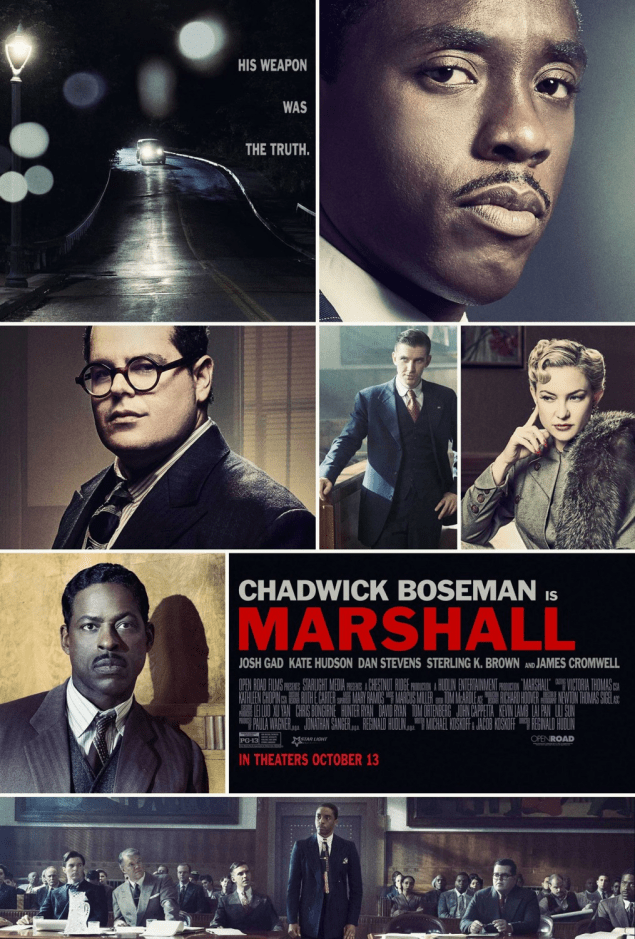
Based on a true story, Marshall is a well-crafted biopic about the early years of the first African-American Supreme Court Justice Thurgood Marshall during his time as a lawyer for the NAACP representing a black man accused of raping a white socialite. We first meet Marshall, played by Chadwick Boseman best known for his role as Jackie Robinson in 2013’s 42, as a crusading lawyer working for the then relatively small African-American civil rights organization known as the NAACP. As only one of the few full-time lawyers on staff, he is sent throughout the United States to represent falsely accused black defendants who are on trial primarily the result of racial discrimination. In 1941, the head of the NAACP recruits him to represent a black chauffeur named Joseph Spell, played by Emmy Award winner Sterling K. Brown, charged with raping the wealthy white woman he works for in the predominantly white town of Greenwich, Connecticut. Played by Golden Globe winner Kate Hudson, Eleanor Strubing claims that while her wealthy husband was away she was brutally assaulted, repeatedly raped, and thrown off a bridge by Spell. Unable to directly represent Spell as an out-of-state attorney, the brilliant Marshall must work with the reluctant local white lawyer Sam Friedman, played by Josh Gad, to develop a case and find evidence disputing the crime that Spell repeatedly says he did not commit. The filmmaker shows the meticulous and extremely smart detective and legal skills of Marshall to uncover the truth while being bombarded with racist attacks from the white community. Although the time away from his wife is often challenging, he bravely embraces his dangerous job because of his passion for equality under the law and respecting the Constitution. Racism was so prevalent at the time that even the prosecuting attorney Loren Willis, played by Dan Stevens of Downton Abbey fame, and Judge Foster, played by James Cromwell, clearly do not respect Marshall as a black man and blindly trust the evidence and witness accounts despite not crossing the legal threshold of beyond a reasonable doubt. Over the course of the trial, Friedman becomes a friend to Marshall and understands what African-Americans go through on a daily basis after he is attacked for helping Marshall and being a Jewish immigrant. The movie is also an excellent example of a tense courtroom drama that slowly builds up suspense to the verdict. Overall, I thought the film provides unique insight into the legendary Thurgood Marshall by presenting a relatively unheard-of case in his early career and how it forms the rest of his highly successful career leading up to his appointment as a Supreme Court Justice in 1967. The quality acting performances and writing creates an inspirational and compelling portrayal of the early Civil Rights Movement and the role of Thurgood Marshall and the NAACP.