Based on the Tony Award-winning play, All The Way is a phenomenal HBO movie about LBJ in his first year as president following JFK’s assassination in 1963. It is a first-rate political drama drawing the curtains on the inner workings of LBJ’s determination to pass the Civil Rights Act of 1964. LBJ is brilliantly portrayed by Bryan Cranston who won the Tony Award for his performance in the theatrical version. It is exhilarating to watch Cranston as he uncannily transforms into LBJ, complete with his physical appearance, mannerisms, and sharp wit. He is effectively able to show the nuances of LBJ, a complex larger-than-life character with deep convictions about making America a better place. The film chronicles LBJ’s deft political acumen to enact legislation through sometimes controversial tactics and compromise with his political enemies. In order to achieve his ends, LBJ was also forced to confront his political allies, including MLK and the Dixiecrats, even at the risk of hurting his chances in the 1964 presidential election. Although depicted in a largely positive light, the movie touches on his ultimately disastrous decision to escalate the Vietnam War. LBJ is also vividly shown as a regular man with a folksy, often profane wit and humor. He comes across as a simple Texas country boy from humble beginnings who truly wants to make a difference. Besides Cranston’s skillful performance, the film has a star-studded cast, including Anthony Mackie as MLK, Bradley Whitford as Hubert Humphrey, Frank Langella as Senator Dick Russell, and Melissa Leo as Lady Bird Johnson. Overall, the movie is a must-see for its terrific performances, especially Bryan Cranston, and its well-crafted portrayal of a politician during a time when compromise was not a dirty word. It is an refreshing look into how politics should work unlike today with the Congressional gridlock and the rise of political demagoguery.
Drama
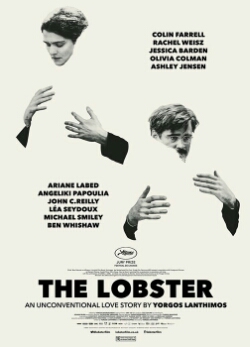
The Lobster
Winner of the Jury Prize at the prestigious Cannes Film Festival in 2015, The Lobster may be one of the strangest movies you’ll ever see and it’s definitely an acquired taste. It is an absurd, Kafkaesque film set in a dystopian world in which humans turn into animals if they do not find love. Colin Farrell plays a newcomer at a matchmaking resort known simply as the Hotel where guests must go through preposterous activities to find a mate within 45 days or be transformed into an animal of their choosing. Accompanied by his brother who has been turned into a dog, he encounters quite the characters portrayed by an impressive ensemble cast, including Olivia Colman, John C. Reilly, and Ben Whishaw. Eventually, Farrell’s character finds his true soulmate outside the confines of forced love at the Hotel. His love played by Rachel Weisz is a part of a group called the Loners that escaped the Hotel and harshly punish those making romantic gestures. The story’s ridiculousness is underscored by the intentionally stoic, unemotional performances from the actors. None of the characters bat an eye even amidst truly confounding situations and dialogue so ludicrous that the audience cannot help but laugh. The subtle comic undertones reinforce the film’s satirical and allegorical messages about the absurdities of modern romance. It suggests that love cannot be mandated and does not always conform to a strict pattern. The structure of the Hotel mimics online dating and the feeling that there is a time clock on when people should find romance and get married. Beyond the effective use of the bizarre to perpetuate satire, the cinematography is remarkable in its own right. The dreary yet naturally beautiful setting of the isolated Hotel and woods next to an alpine lake under an almost constant fog creates an eerie and mystical atmosphere. Also, the random appearance of exotic animals, representing those unable to find a partner, visualizes the absurdity of the film’s premise. The score with discordant music and sound effects further accentuates the movie’s unique tone. The creative use of all these elements fashion a film that blends the weirdness of Wes Anderson, Charlie Kaufman, and David Lynch. Overall, I felt the film to be a well-executed and biting satire so utterly strange that audiences will either love it or hate it. It is definitely something that may be more appealing to film snobs, critics, and filmmakers.
Dark Horse
Dark Horse is a fascinating documentary that tells the inspiring story of a group of working-class people working together to overcome adversity. In a sleepy Welsh town impoverished since the local mine’s closure, a barmaid decides to become a racing horse owner. She gathers together a horse syndicate comprised of fellow working-class townspeople and breed a scrappy horse named Dream Alliance. As true underdogs, they take on the elitist horse racing establishment that can spend millions per horse. The film effectively underscores the disparity by juxtaposing footage of British aristocrats in their fancy hats against Dream Alliance’s down-to-earth owners with their tattoos and missing teeth. Despite their dire situations in life, the townspeople seemed happy just to have a glimmer of hope and success. As I watched the story unfold, it felt as if I was one of the owners and cheered the horse on through its ups and downs. The documentary embodies the powerful spirit of perseverance against all odds and makes you believe in humanity. As such, I would highly recommend the movie and your spirits will definitely be uplifted after watching.
Love and Friendship
Adapted from Jane Austen’s posthumously published novella Lady Susan written around 1794, Love and Friendship is a well-crafted intellectual comedy set in 18th century England among the aristocracy. It follows the exploits of Lady Susan Vernon, marvelously played by Kate Beckinsale, after the death of her rich husband. Attempting to escape her insufferable status as a dependent widow, she unexpectedly visits her in-laws’ country estate. She uses witty and cunning charm to manipulate her way through high society and maintain status by marrying any eligible wealthy aristocrat. The language used throughout the film feels as if it comes directly from the pages of a Jane Austen novel, complete with flowery and hifalutin words. The quick back-and-forth banter filled with pithy remarks reminded me of something written by Aaron Sorkin. Along with highbrow comedy, the film effectively incorporates moments of hilarious silliness. The dim-witted well-off bachelor Sir James Martin played by Tom Bennett steals many scenes with his buffoonery, including his musings on the word Churchill and discovery of peas. As a quintessential British period piece, the movie is brimming with sumptuous costumes set amongst palatial country estates and London townhouses and scored by playful classical music. The film posits itself as a self-aware, almost satirical comedy about the frivolities of aristocratic society. For example, before the first scene, each character is introduced with their own descriptive subtitle, including Sir James Martin being labeled as “a bit of a ‘rattle.'” Overall, I would recommend the movie to all lovers of Jane Austen and those looking for a sophisticated yet whimsical period comedy.
The Man Who Knew Infinity

Following the conventions of a more traditional biopic film, The Man Who Knew Infinity is based on the true story of the brilliant mathematician Srinivasa Ramanujan, played by Dev Patel famous for his breakout role in Slumdog Millionaire, who travels from his native India to study with a famous British mathematician, played by the always terrific Jeremy Irons, at Trinity College within Cambridge University. Completely self-taught with neither formal education or financial means from a foreign culture and religion, Patel’s character must confront the prejudices of the British academic elite, including Irons’ character who acts as his eventual mentor. The film is very much a fish out of water story, a tale in which the main character overcomes adversity to be accepted by others. Patel’s character must leave the only world that he has known, including his new bride and very resistant mother, in order to fulfill his dream of revealing his mathematical formulas to the world. The movie effectively discusses the ideas of conflict, including conflict between belief in God and nature, between colonialism and culture, and between academic elitism and natural genius, all while in the face of military conflict with the events occurring at the onset of World War I. I found the film to be a deeply fascinating look at a man that many have never heard of in a field that many would find difficult to understand. The fairly standard structure of the film as a biopic is overcome by the strength of the performances by Dev Patel and Jeremy Irons.
Money Monster
Directed by Jodie Foster, Money Monster follows in the footsteps of The Big Short by providing an entertaining movie about the pitfalls of Wall Street. It is a gripping real-time thriller that blurs the line between villain and hero and that everything may not be as it seems. George Clooney, portraying a Jim Cramer-type host of a popular financial television show, is taken hostage by a desperate man, effectively played by Jack O’Connell, looking for revenge and answers after losing most of his money from a bad investment overhyped by Clooney’s character. As the man with the gun, O’Connell’s character at first blush seems to be the villain but over the course of the hostage crisis we are left feeling sympathetic for his plight. The movie resonates well with the current political and economic environment in which politicians like Bernie Sanders rail against income inequality and the perceived corruption of Wall Street. While having moments of comic relief, the film directly and indirectly addresses such serious subject matters as the implications of cable news, reality television, and the business of Wall Street. It is about a so-called journalist walking a fine line between entertainment and journalism and a violent situation that is broadcast live around the world like reality television and caused by the powerless feeling injustice at the hands of the rich and powerful. Overall, I found it to be an entertaining blockbuster that provides the right amount of thrills and smarts to make it worth watching in theaters.
Miles Ahead

Following the exploits of Miles Davis as he tries to recover a stolen sessions tape, Miles Ahead provides a glimpse into the life of a tortured genius. We meet the legendary jazz trumpeter Miles Davis in 1979 in the midst of his five-year break from the music, a period marked by heavy drinking and drug abuse. The film is anchored by an exceptional performance from Don Cheadle who portrays Davis as he dives into moments of sheer madness, including several scenes involving gunfire, while being informally interviewed by a Rolling Stone writer played by Ewan McGregor. It is not a typical biopic but rather a mishmash of flashbacks to the relatively sane years when he was at the top of his fame and alternating with his chaotic adventure to reclaim his music. Miles Ahead is a film brimming with energy reflected by Miles Davis’s musical brilliance despite his personal demons and Don Cheadle’s nuanced depiction of a truly larger-than-life jazz legend.
The Meddler

Starring Susan Sarandon, The Meddler is best described as a cute independent film that delves into touching subject matter with a mixture of comedy and romance. The acting is top-notch with Susan Sarandon playing an overly meddlesome mother to her daughter played by Rose Byrne who is dealing with a recent heartbreak. Sarandon’s character is willing to help anyone while trying to deal with heartbreak of her own that she stubbornly refuses to confront. Her character eventually becomes romantically involved with the always superb JK Simmons who plays an endearing motorcycle-riding retired cop. The Meddler is a very good light-hearted film that provides the right material for its exceptional cast to display their comedic, romantic, and dramatic range of talent.


