Never Look Away

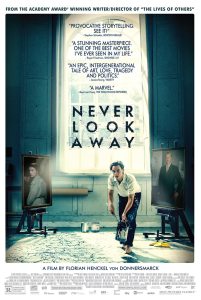
Directed by Florian Henckel von Donnersmarck best known for 2007’s The Lives of Others which won the Oscar for Best Foreign Language Film, Never Look Away is an outstanding Oscar-nominated German film that takes an epic look at the generational and personal struggles of a young artist living through Nazi Germany and later Socialist East Germany. The movie begins during World War II in the German city of Dresden where the young child Kurt Barnert is exposed to modern art, which is strictly banned by the Nazi regime, by his loving aunt Elisabeth. To his great horror, eventually Elisabeth is diagnosed with a mental disorder that can be grounds for extermination by the Nazis and is determined by a medical doctor, in this case, the SS-affiliated gynecologist Professor Carl Seeband, played by the terrific Sebastian Koch. After tragedy befalls Kurt’s family and the utter destruction of Dresden, the story jumps to several years after World War II as the older Kurt, played by Tom Schilling, lives in repressive East Germany figuring out a way to pursue his dream of becoming a painter. He ultimately enrolls in a Dresden art academy, but he is rather unhappy being forced to paint in the restrictive school of art known as Socialist Realism in which the working class is venerated and all other subjects are strictly forbidden. However, he does fall in love with a fellow art student named Elizabeth, played by Paula Beer, who, unbeknownst to Kurt, is the daughter of Professor Seeband who condemned his aunt. Without either of them knowing who each other really is, the Professor does not approve of Kurt’s relationship with his daughter and does some rather vicious things in order to prevent them from getting together and having a child. The movie again fast forwards to several years later in the 1960s when Kurt and Elizabeth decide to flee to West Germany where Kurt pursues his art career by entering a very avant-garde modern art academy in the liberal city of Dusseldorf. Vividly capturing the life of an artist, the talented filmmaker does an excellent job of taking the time to show the specific steps that Kurt uses in order to finally discover his own artistic style and medium. Overall, I found it to be a truly extraordinary cinematic experience that quite effectively weaves together a story of tragedy, past sins, forgiveness, love, creativity, and freedom against the backdrop of the very trying times of Germany and is very able to remain enthralling throughout despite its more than three hour runtime.

Miss Bala

A remake of the critically acclaimed 2011 Mexican film of the same name, Miss Bala is a fairly typical average action thriller that does not add much to the genre and is bogged down by rather underwhelming performances and a sloppy script filled with cliches. We first meet the main character and Mexican-American makeup artist Gloria, played by Golden Globe winner Gina Rodriguez best known for her role on the TV show Jane the Virgin, crossing the border from her home in the United States to help her friend Suzu who lives in Tijuana, Mexico prepare for a local beauty pageant. However, after visiting a nightclub in which a local gang attacks, Gloria is separated from her friend and desperately tries to find her. Eventually, she is told by the Las Estrellas Mexican gang that they will help locate her friend and bring her to safety if Gloria agrees to work with the gang. She enters in a rather unusual relationship with the boss who is named Lino and is convinced to participate in criminal and often violent activities as the only way to see her friend ever again. For a while, she is kept at a safe house in the outskirts of Tijuana where she meets a another woman who has been held against her will to be with the gang members as a sort of sex slave. Towards the end of the film, Gloria is forced to get involved with an assassination attempt on the Tijuana Chief of Police, played by Damián Alcázar best known for his role on the TV show Narcos. She is also secretly contacted by the DEA and a undercover CIA agent played by Anthony Mackie to help foil the activities of the Las Estrellas and its leader Lino. The movie gives Gina Rodriguez a promising start to a dramatic film career but, unfortunately, her talents are underutilized and she never really becomes a full-fledged action star expected for her role. Overall, I found it to be a mildly entertaining action thriller that somehow lacks much action or thrills, and it did not use the potential of a clearly talented Gina Rodriguez to really shine and help the film escape the tired tropes of an action movie.

Capernaum

Written and directed by critically acclaimed Lebanese actress and director Nadine Labaki, Capernaum is a beautiful and emotionally powerful film that hits you in the heart with its heartbreaking story about those living on the edge of society and life in the impoverished neighborhoods of Lebanon. The film literally translated as chaos and spoken in mostly Arabic tells the tragic life of a twelve-year-old boy named Zain, remarkably played by first-time actor Zain al Rafeea, who is largely left to his own devices on the rough streets of Lebanon. At the beginning of the movie, he decides to sue his neglectful parents for giving birth to him and allowing him to live such a miserable existence. Mostly comprised of a series of flashbacks, the story simply yet effectively follows Zain who one day leaves his overburdened and ever-growing family in search of a better life after his beloved and too young sister is married off to an older man. Eventually, he encounters an undocumented young Ethiopian female refugee named Rahil, realistically played by Yordanos Shiferaw, who asks the street smart Zain to look after her baby son Yonas, played by the adorable yet fragile Boluwatife Treasure Bankole. Through the eyes of the young Zain who struggles by himself to support the still nursing Yonas after his mother is detained, the remainder of the film depicts the horrifying and deeply depressing challenges of living in abject poverty on the chaotic streets of Lebanon. Hugely deserving of the Oscar nomination for Best Foreign Language Film, the movie is so heart-wrenching as a result of the extremely talented filmmaker’s vivid ability to scratch the surface of what life must be like for those living in very poor and quite frankly miserable places around the world. She is able to capture this so brilliantly by incorporating breathtaking cinematography presenting the underbelly of Lebanon with the use of predominantly untrained actors who really lived very much like their characters. Overall, I found it to be an utterly distressing yet necessary piece of art and storytelling; it is so realistic that I do not remember another movie over the past several years with so much impact that I thought about the characters with such a heavy heart for days after watching this truly earth-shattering film.

Cold War

Directed by Oscar-winning Polish filmmaker Paweł Pawlikowski best known for 2013’s critically acclaimed Ida, Cold War is a breathtaking romance drama that is truly remarkable for its beautiful black-and-white cinematography and outstanding lead actors who give brilliant performances as star-crossed lovers. Based on the lives of the director’s own parents, the relatively short film with mostly Polish dialogue follows the heated and complex romantic relationship between two Polish citizens, the musician and composer Wiktor, played by the terrific Tomasz Kot, and the beautiful singer Zula, played by the seductive Joanna Kulig. We first meet them in the years following World War II in the ruins of communist Poland when they are part of a traveling folk music group that later espouses the virtues of communism throughout Eastern Europe and Russia. After their romance begins behind the Iron Curtain, we follow them as individuals who get separated and reunited several times across several European countries over the course of four decades concluding in the late 1960s. Wiktor eventually escapes Poland and lives for a while in Paris as a struggling musician working in nightclubs but never really feels happy after Zula decides to remain back home in Poland. With brilliantly subtle directorial vision, the audience is able to feel the passionate and emotionally powerful romantic interactions between the two as they are reunited several times throughout the course of the plot. Furthermore, the filmmaker makes the perfect decision to make the film black-and-white with the older boxy proportions to vividly express the difficulties of those living in the rather bleak and the confining communist countries during the Cold War. At the same time, the movie depicts a truly beautiful love story with a contemporary jazz soundtrack for the times and astounding cinematography that helps bring to life both the dark and light of both sides of the Iron Curtain. Overall, I found it to be one of the most beautiful romantic movies in recent memory as a result of the first-rate acting performances and contemplative directing and cinematography, and it is thereby highly deserving of the Oscar nominations for Best Foreign Language Film, Best Director, and Best Cinematography.

Serenity

Written and directed by Oscar-nominated filmmaker Steven Knight best known for directing 2014’s Locke and writing 2007’s Eastern Promises, Serenity is a high-concept film with largely disastrous results as a result of the preposterous twists and stilted acting performances. Set on a remote tropical island, the story follows the down-on-his-luck fisherman Baker Dill, played by Oscar winner Matthew McConaughey in an unusually unremarkable performance, who along with his partner Duke, played by Oscar nominee Djimon Hounsou, take tourists on fishing expeditions out at sea. The divorced Baker who also struggles financially is fixated upon catching a particularly elusive large tuna he calls Justice and has lived on the island for years without seeing his son who lives in Florida. One day, his estranged ex-wife Karen, played by Oscar winner Anne Hathaway, shows up unannounced and propositions Baker to kill her abusive husband Frank, played by Jason Clarke, while out on a fishing trip. For the first part of the movie, it feels like a typical thriller but something feels amiss throughout much of the film, including the mysterious appearance of a businessman named Reid Miller, played by Jeremy Strong, and the almost telepathic relationship between Baker and his son Patrick who lives thousands of miles away. All of the unusual circumstances begin to make some sense towards the end of the movie with a truly bizarre and laughable twist revealing that not everything is as it seems to be in reality. It is hard not to underscore the ridiculousness of the film without giving away the major twist that the filmmaker attempts to use as a creative narrative device, which nevertheless fails epically. I found it difficult to imagine why A-list movie stars, which also includes Oscar nominee Diane Lane in a very minor and pointless role, would voluntarily sign up for such a mess of a movie. Overall, I was quite frankly astonished by the poor direction and writing, especially with such a great cast and a promising plot, and it may even rise to the level that it is so bad that it is a good movie just to watch for laughs.

Stan & Ollie

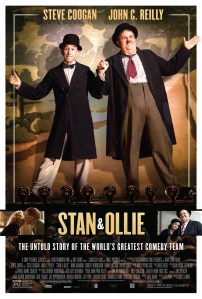
Based on the true story of one of the world’s most famous comedic duos Laurel and Hardy during their late career, Stan & Ollie is a truly wonderful little movie about the heartwarming relationship between Laurel and Hardy despite their occasional disagreements on their very last tour together across the United Kingdom. We first meet the Englishman Stanley “Stan” Laurel, played by the Oscar-nominated British comedian Steve Coogan, and the American Oliver “Ollie” Hardy, brilliantly played by Oscar-nominated American comedian John C. Reilly who was nominated for a Golden Globe for his role, toward the end of the height of their career in the 1930s making movies for the famous comedy producer Hal Roach, played by Danny Huston. Almost two decades pass before we meet the two again. Partly for financial reasons, the comedians finally get over their years-long rift over Laurel leaving Hal Roach Studios and Hardy making a movie without his longtime partner Laurel. In the twilight of their careers, they agree to embark on a rather small-time music hall tour of England and Ireland in 1953 comprised of their most famous acts in addition to several new ones that Laurel has written. Over the course of the non-stop traveling schedule, both comic legends are often at each other’s throats as a result of the disappointing crowd turnouts and the acknowledgement that their careers are inevitably ending soon. Through recreations of their bits and the behind-the-scenes rehearsals, the filmmaker is vividly able to portray the comedic genius of the larger-than-life Laurel and Hardy whose diametrically opposed personalities and physical appearances work perfectly for comedic effect. The actors, particularly John C. Reilly who is almost magically transformed into the overweight mustached Oliver Hardy, help to bring the world famous comedians to life even though they have been dead for over half a century. The film also does a terrific job of painting a much more intimate picture of the pair that explores the complicated friendship between both men in which they often argue but, at the end of the day, love one another as if they were family. Overall, I found it to be one of the most emotionally touching movies in recent memory that is only able to work as a result of the outstandingly realistic depictions of the one-and-only Laurel and Hardy given by the excellent actors; it is a much more personal and nuanced exploration of Hollywood comedy luminaries that goes beyond simply reliving their funniest bits.

Glass

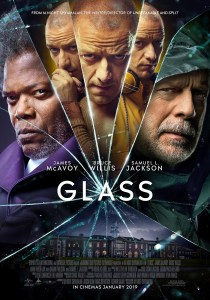
Written and directed by M. Night Shyamalan best known for 1999’s The Sixth Sense, Glass is a thriller that tries hard to recapture the innovative and entertaining aspects of 2000’s Unbreakable and 2016’s Split, which are directly part of a trilogy that ends with this film. Unfortunately, the rather high expectations for the movie leads the audience astray and the hallmark suspense and unexpected twists of a M. Night Shyamalan movie fall flat as a result of the slow pacing and preposterous ending. We first meet the complicated anti-heroes eluding authorities as they continue to use their supernatural powers straight from a comic book. Eventually, all three of the protagonists are captured and are confined in a old psychiatric hospital: David Dunn, played by Golden Globe winner Bruce Willis and reprising his role from Unbreakable, who is unable to be physically harmed, Elijah Price, played by Oscar nominee Samuel L. Jackson and reprising his role from Unbreakable, who has enhanced intellectual abilities but breaks bones easily, and Kevin Crumb, played by Golden Globe nominee James McAvoy and reprising his role from Split, who has multiple personalities and can transform into a super strong beast. They are all held under the auspices of receiving treatment from the mysterious Dr. Ellie Staple, played by Golden Globe nominee Sarah Paulson, who argues they are suffering from a mental disorder giving them delusions of grandeur making them believe they are really superheroes. The first half of the film is quite intriguing and thereby entertaining because we get to see the three extremely fascinating and enigmatic characters interact with one another. My favorite part is witnessing James McAvoy’s brilliant acting ability to spontaneously morph into a wide range of personas, including one of a nine-year-old boy, a devious middle-aged woman, and a terrifying creature with supernatural strength. The movie does a commendable job of unraveling a mystery and over time the audience comes to better understand the motivations of the characters, including the doctor. The revelation of shocking truths comes to the forefront when the three heroes, or villains depending on your perspective, confront each other in a final climactic battle after they use their wits and strengths to attempt to achieve freedom. With its somewhat unexpected twists and turns in the storyline, the film is classic M. Night Shyamalan who has made his career based on twist endings. However, the conclusion to the almost two-decade-long trilogy is very much a letdown with a rather lame and shockingly uncreative twist. The filmmaker is also too heavy-handed in trying to make the movie a powerful metaphor for comic books and humanity’s desire for heroes with superpowers to save the day. The potential is there for the movie to be one of his masterpieces that has a greater message than just entertaining the masses, but, unfortunately, the filmmaker’s almost singular focus on surprising the audience clouds his judgement on truly developing the characters and a coherent plotline. Overall, the build-up to an epic conclusion to M. Night Shyamalan’s years-in-the-making trilogy does not pan out and therefore can be best described as yet another disappointment in his hit-or-miss filmmaking career.

On the Basis of Sex

Directed by Mimi Leder best known for 1998’s Deep Impact and 2000’s Pay It Forward, On the Basis of Sex is an intriguing look at the formative years of Supreme Court Justice Ruth Bader Ginsburg that, although well-acted and with the best of intentions, fell short of capturing the truly extraordinary life of Justice Ginsburg. We first meet Ruth Bader Ginsburg, played by Oscar nominee Felicity Jones, as a first-year student at Harvard Law School in the 1950s when she is only among a handful of female students enrolled at the prestigious institution. Throughout the first half of the movie, she struggles with finding her place in the legal world primarily due to her gender and despite her being the top of her class at Harvard and Columbia. She even sacrifices some of her own academic work in order to help her cancer-stricken husband Martin, played by Golden Globe nominee Armie Hammer, to keep up with his work also at Harvard Law School. Eventually, they move to New York City where Martin works for a highly regarded law firm, and the only job that she can find is working as a law professor at Rutgers University in New Jersey. Up until this point, it is a rather paint-by-numbers biopic exploring the protagonist’s challenges that inspire the person’s later life and eventual great success. The remainder of the movie revolves around her most important case about gender discrimination, especially for women, that is brought to her attention by her loving husband Martin who is now cancer-free. At first, it seems like a rather straightforward and dry tax case until Ginsberg realizes it could provide precedent overturning the national and state laws that she argues discriminates against women and are therefore unconstitutional. The famous case involves an unmarried man named Charles Moritz living in Denver who is denied tax benefits for a caregiver for his sick older mother and must take care of her himself to his financial detriment. With the help of the ACLU lawyer Mel Wulf, played by Justin Theroux, and feminist civil rights advocate Dorothy Kenyon, played by Oscar winner Kathy Bates, the up-and-coming Ginsberg spends most of her waking hours in pursuit of appealing the tax decision and ultimately bring it up in front of the Tenth Circuit Court of Appeals to further her crusade for gender equality. In yet another biopic cliché, she must face her prior foes in the form of the formidable defense team aided by the former Harvard Law School dean, played by Oscar nominee Sam Waterston, and her former professor, played by Stephen Root, both men who made her life difficult in law school at a time when women were frowned upon becoming lawyers. The film also presents a more personal side of now Justice Ginsburg by showing her tender and supportive relationship with her husband and having to raise young children at the beginning of her hard-fought career. Overall, I found it to be a good start for exploring the remarkable accomplishments of Supreme Court Justice Ruth Bader Ginsburg, but ultimately it is bogged down by genre conventions and stereotypes. That is not to say that it is not a movie worth seeing because it is full of good acting performances and centers around a fascinating law case, but I would say that the recent 2018 documentary RBG is a much more important study of the venerable Justice Ginsburg.

Destroyer

Directed by Karyn Kusama best known for 2000’s Girlfight and 2009’s Jennifer’s Body, Destroyer is a very gritty crime drama exploring the criminal underbelly of Los Angeles and is truly remarkable for the tour de force acting performance given by an unrecognizable Nicole Kidman. Clearly living a troubled life filled with alcoholism and regrets, the downtrodden and physically weathered LAPD Detective Erin Bell, played by the extraordinary Oscar winner Nicole Kidman in a truly transformative role, finds herself intricately involved in a murder investigation of an unknown victim. A majority of the film uses the rather unusual yet extremely effective flashback narrative device, which reveals the complicated nature of Bell who at one point worked as an undercover officer for a criminal gang in Los Angeles almost fifteen years before the present day. We witness her and her partner Chris, played by Sebastian Stan, pretending to be criminals involved in a bank robbery for a gang headed by the dangerous Silas, played by Toby Kebbell. Bell and Chris’s relationship becomes much more close than they expected and their involvement with the eventual robbery becomes something more than just an undercover investigation. During the present day, Bell encounters several of the key gang members to find the whereabouts of Silas who may still be alive. Underscoring her gritty life, she is a rather terrible mother to her deeply troubled teenage daughter and has a contentious relationship with her ex-husband Ethan, played by Scoot McNairy, who tries his best to take care of the daughter. The filmmaker does an excellent job of developing a rather unlikeable character whose motivations we never really know by presenting side-by-side the character’s messy and morally ambiguous personal and professional lives. It is definitely a depressing movie and is not for the faint of heart as Detective Bell does some legally dubious interrogations of criminals, including a wealthy money launderer, played by Emmy winner Bradley Whitford and Silas’ drug-addicted girlfriend Petra, played by Emmy winner Tatiana Maslany. Overall, I found it to be a deeply compelling crime drama that provides enough twists and turns to make for a wholly unique movie that defies the crime genre and is the perfect showcase for Nicole Kidman who is somehow made ugly and gives one of her best performances in her already illustrious career.

The Upside

A remake of the highly successful and acclaimed 2011 French film The Intouchables that itself is based on a true story, The Upside is a comedy drama about an unlikely friendship between a wealthy quadriplegic and a struggling African American who becomes a caregiver. Phillip Lacasse, played by Oscar nominee Bryan Cranston, is a rather grumpy and depressed billionaire living in a New York City penthouse who is in need of a caregiver after becoming a quadriplegic several years prior. His personal and financial affairs are run by the strict by-the-book Yvonne, played by Oscar winner Nicole Kidman, who is horrified to learn that Phillip hires a convicted felon named Dell Scott, played by comedian Kevin Hart in a somewhat more serious role, as his personal caregiver after an extensive search with much more experienced candidates. Dell is trying to keep down a job in order to support his young son and his mother who are living in a public housing development, as well as staying out of jail on parole. Like the original, their relationship is more transactional at first, but, over time, the two men with drastically different backgrounds begin to develop a close friendship. Dell encourages Phillip to go out in the world more and to pursue a female pen pal who Phillip is interested in romantically but too shy to reveal himself as disabled. There are moments of humor that help to personalize the unique relationship between Dell and Phillip, but, unfortunately, the film is filled with a number of somewhat patronizing clichés that prevent the audience from truly understanding Phillip and how having a disability has affected his life. For instance, there was a rather unnecessary scene involving a catheter that is primarily used as a gag to elicit cheap laughs. As someone who is disabled, I do appreciate the fact that Hollywood decided to make such a movie about the disabled, but I kept on debating with myself whether it was the appropriate casting choice to have a able-bodied person play someone with a disability. Overall, I did find it to be an occasionally endearing depiction of the extraordinary relationship between the disabled and their caregivers; although I applaud its efforts to raise awareness about disabilities, I came away questioning whether the movie was necessary at all because the original is so much better. If you enjoy the basic story of this film, I would highly recommend going back and watching the original French movie with an equally talented cast.