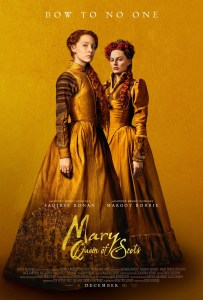
Written by Beau Willimon who is best known for creating the critically acclaimed Netflix TV series House of Cards, Mary Queen of Scots is an enticing historical drama about a unique time in British history in which two strong female leaders vied for control over the British monarchy, and the film itself is anchored by two terrifically powerful actresses. As to be expected from the creator of the political thriller House of Cards, much of the movie is a series of sometimes convoluted acts of palace intrigue and outright violent conflict in order to decide who would be the rightful ruler of the United Kingdom. The story is set around the year 1569 after Mary Stuart, played by Oscar nominee Saoirse Ronan, has returned to her native Scotland from France following the death of her first husband. With the support of the Scots and British Catholics, she claims legitimacy to take over the throne from the reigning monarch and her cousin Queen Elizabeth I, played by Oscar nominee Margot Robbie. In London, Elizabeth is surrounded in court by competing factions made up of her advisers, including William Cecil who is played by Guy Pearce and her lover Robert Dudley, played by Joe Alwyn. On the other side in Scotland, Mary who is proclaimed Mary Queen of Scots also has to deal with her own palace intrigue, including her second husband Lord Darnley who is played by Jack Lowden, at the same time dealing with the firebrand Protestant minister John Knox who is played by David Tennant. Tensions between the two intensify after Mary has a child who could make a legitimate claim to being an heir, while Elizabeth remains childless without a strong desire to marry a husband. Although at times the script can seem uneven and be complicated to the casual viewer, the true strength of the film is the brilliant acting performances from the lead actresses who give off an air of royalty and their costumes and makeup look very realistic for the time. Overall, I found it to be an enjoyable historical drama that albeit slightly flawed is a movie worthy to watch if you are a fan of the historical film genre and looking for tour-de-force acting performances.


 Directed by Wash Westmoreland best known for the 2014 movie Still Alice in which Julianne Moore received an Oscar for her role, Colette is a fascinating period drama about one of France’s most renowned writers and is quite remarkable for its terrific acting, especially the dazzling performance given by Keira Knightley. The film is based on the real-life story of the French author Sidonie-Gabrielle Colette, played by twice Academy Award-nominated Knightley in arguably her greatest performance, who moves from the French countryside in the late nineteenth century to the artistic center of the world at the time Paris after marrying a well-known writer referred to as simply Willy, played by the twice Golden Globe-nominated British actor Dominic West. After witnessing her remarkable writing talents first-hand, Willy encourages her to write novels in which he would be fully credited for writing them. They come upon a great success with the publication of a novel loosely based on Colette’s early life revolving around a French country girl named Claudine and her daily life and adventures in rural France. Over the course of the film, Colette becomes increasingly distant from her controlling husband and decides she would like to write for herself with her real name instead of his. The filmmaker does an excellent job of creating a beautiful and realistic depiction of early twentieth century Paris through the use of high-fashion costuming and sumptuous Parisian scenery in which the arts and high society are highly valued. Amidst this exciting backdrop, Colette evolves into a much more independent individual who explores her own sexual expression by entering into a sexual relationship with a beautiful young socialite, played by Eleanor Tomlinson best known for her role in the BBC television series Poldark. She becomes quite the sensation and even causes a riot in an already liberalized Paris with her extremely progressive views and unorthodox artistic expressions through her fashion and writing, including performing a risqué mime act in which she kisses a masculine woman. At the same time, she faces her sometimes cruel and desperate husband whose finances are rapidly collapsing. It becomes quite clear that his own career will never be as successful after Colette refuses to write anymore Claudine novels that have become such a cultural phenomenon throughout France, and, as a result, he becomes a shell of himself and their marriage begins to disintegrate. Overall, I found it to be a truly wonderful film that is brought to life by the dynamic performances of the lead actors, in particular Keira Knightley, and is especially relevant to today’s society in which sexual and artistic expression is accepted and women are using their platforms to speak up for gender equality, just like Colette did in her time.
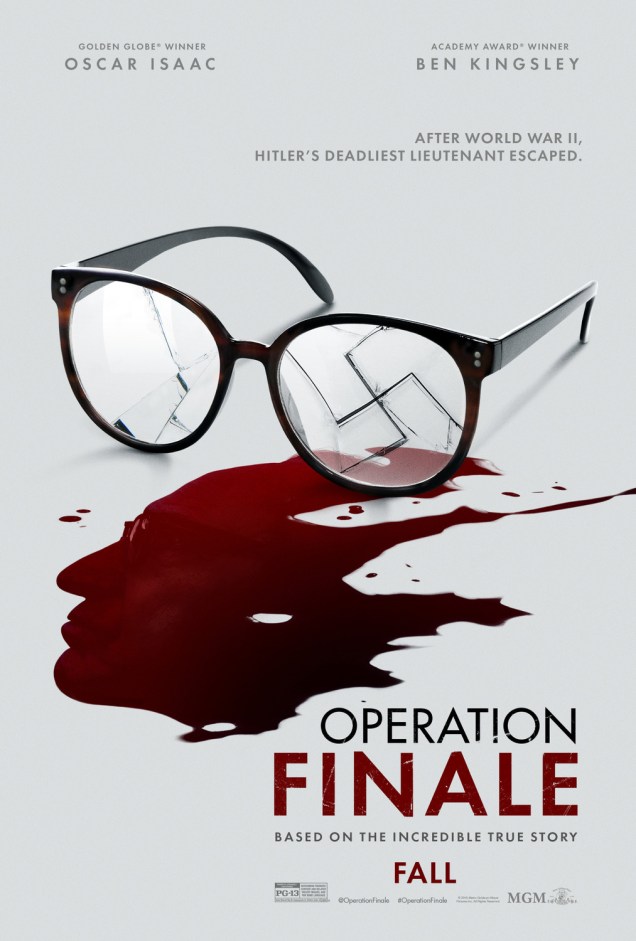 Directed by Chris Weitz who is best known as the cowriter of 2002’s About a Boy and 2016’s Rogue One: A Star Wars Story and the director of 2007’s The Golden Compass and 2009’s The Twilight Saga: New Moon, Operation Finale is based on the true life story of the hunt for and capture of one of the most notorious Nazi officers Adolf Eichmann, played by the always terrific Academy Award winner Ben Kingsley. Although the film does not fully live up to its expectations and can be at times slow, its greatest appeal is its fascinatingly real life story that may not be widely known. The story takes place in 1960 and follows a group of agents and officers in the Israeli intelligence agency Mossad and security agency Shin Bet as they travel to Argentina after learning that Eichmann who is credited with being the architect of the Holocaust is living in a suburb of Buenos Aires undercover. At the behest of the upper echelon of the Israeli government, the Mossad agent Peter Malkin, played by Golden Globe winner Oscar Isaac, is recruited to form a team that will track the whereabouts of Eichmann and come up with a plan to bring him back to Israel to stand trial for his crimes against the Jewish people during World War II. His team includes several secret operatives, including an anesthesiologist named Hanna, played by Mélanie Laurent best known for her role in 2009’s Inglourious Basterds, and fellow agent Rossi, played by comedian Nick Kroll. The movie presents a sometimes gripping account of the operatives following Eichmann’s every move and eventually decide to capture him at nighttime very near his home that he shares with his wife and two sons. When several issues arise, Eichmann must remain captive in the Israeli safe house in Argentina until the occasion arises when they can safely transport him out of the country. Throughout his detainment, Eichmann begins to develop somewhat of a rapport with Peter, and they both discuss their personal lives and their experiences during World War II. Eventually, after a internationally televised trial in Israel, Eichmann is finally executed in June 1962 for his horrific crimes against humanity and participation in the killing of over 6 million Jews. Overall, I found it to be an intriguing film highlighting the lengths in which Mossad and other intelligence agencies went to in order to capture Nazis who had escaped to South America; however, I thought it was not tightly executed and the action could have been intensified.



 KEITH on Reels