Won’t You Be My Neighbor?

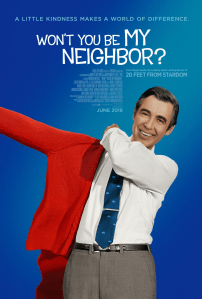
Directed by Morgan Neville who won the Academy Award for Best Documentary Feature for 2013’s 20 Feet from Stardom, Won’t You Be My Neighbor? is an excellent documentary about the remarkably kind children’s television host Fred Rogers and provides insight into what inspired him to create the iconic television program Mister Rogers’ Neighborhood. When the low-budget family-friendly show debuted on Pittsburgh public television in 1968, nobody could foresee the impact that the soft-spoken ordained minister Fred Rogers would have on children’s programming and the education of young minds through such a new medium as television. The documentary gives an insider’s look into Mister Rogers by interviewing cast and crew members as well as his children and surviving wife who describe his personal life reflective of his on-screen persona as a gentle and patient man who truly cared about children. Because of his profound influence on the millions of people who grew up with his breakthrough show that premiered its last episode in 2001, the film is at times emotional for the audience by bringing back such heartwarming and joyous memories to life. In a day in age in which several iconic personalities have let down audiences after the revelation of egregious moral failings, it is refreshing to see a movie about a honest-to-goodness wonderful human who always presented his true inner self and simply wanted to do what was best for others. As presented by the documentary, there were times when Fred Rogers struggled and felt the obligation to discuss rather depressing topics with his young audience, including the assassination of Bobby Kennedy in 1968. Overall, I found it to be a truly fascinating glimpse into the life of Fred Rogers and his passion for creating Mister Rogers’ Neighborhood, and I would highly recommend it to anybody who watched Mister Rogers or simply looking for a heartwarming story about a positive figure during such a divisive time in our country.

Hotel Artemis

Written and directed by Drew Pearce who was one of the writers for 2013’s Iron Man 3 and 2015’s Mission: Impossible – Rogue Nation, Hotel Artemis is an entertaining and stylish action thriller with the hallmarks of a midnight B movie and a surprising all-star cast. Set in dystopian Los Angeles in the near future, the story revolves around a secret hospital for criminals that becomes the refuge for outlaws from the intense violent riots enveloping the entire city. The hospital, which is located on the top floor of a vintage old world hotel, is run by a rules-bound and efficient nurse, played by Oscar winner Jodie Foster in her first role since 2013. A large muscular orderly nicknamed Everest, played by Dave Bautista, is the only other person working at the futuristic hospital, and he is sometimes enlisted as the enforcer. On a particularly busy night, the Artemis is filled with a variety of dangerous criminals who only behave because of the rules enforced while in the hospital. It begins with a pair of bank robbers, one played by Emmy Award-winning actor Sterling K. Brown, who escaped a botched robbery while being pursued by the police. The other patients include a world-class assassin, played by Sofia Boutella, and a wisecracking criminal, played by Charlie Day. Things get increasingly complicated and violent with the arrival of the so-called Wolf King, played by Jeff Goldblum, who is the criminal overlord of Los Angeles and is accompanied by his obsequious son, played by Zachary Quinto. Foster’s character is trying to keep everyone happy and allow Hotel Artemis to continue running smoothly while she also has to deal with her anxiety deriving from the traumatic memory of losing her son. Overall, I found it to be an exciting and fun action flick that is notable for its unique vision of a dystopian future in which medical technology advances, but society as a whole collapses.

First Reformed

Written and directed by Golden Globe-nominated screenwriter Paul Schrader who is best known for 1976’s Taxi Driver, 1980’s Raging Bull, and 1988’s The Last Temptation of Christ, First Reformed is a first-rate drama exploring the complexities of religion, environmental issues, and self-reflection and is truly remarkable for the Oscar-worthy performance of Ethan Hawke. The plot follows the troubled Reverend Ernst Toller, played by Oscar nominee Ethan Hawke in perhaps his best role, who leads a very small congregation at an upstate New York Dutch Reform church that is about to celebrate its 250th anniversary. Struggling with alcoholism and past trauma, he finds little solace in his pastoral work and lives a lonely existence without practically any friends or family. His somber and quiet life changes course after meeting a pregnant parishioner named Mary, played by the terrific Amanda Seyfried, and her distraught husband who is an extremist environmental activist. While trying to navigate religious issues with Mary and her husband and coming to terms with the environment, the Reverend is under the guidance of his mother megachurch Abundant Life led by the influential Pastor Jeffers, played by Cedric the Entertainer in a very dramatic role, who has financial ties to the region’s largest polluter. The beautifully dark cinematography with a smaller aspect ratio and set during the depths of winter brilliantly underscores Reverend Toller’s quiet despair grappling with his own demons and conscience about the church’s involvement with what he sees as an immoral corporation. In the gripping climax towards the end of the movie, he contemplates committing a grievous act out of desperation and as his own form of environmental activism. Overall, I can say without any doubt that it is one of the best films of the year and Ethan Hawke’s mesmerizing acting should be universally applauded; therefore, I highly recommend the movie to true lovers of cinema.

Action Point

Starring Johnny Knoxville famous for his TV series Jackass first released in 2000, Action Point is a rather stupid movie that is essentially a series of Jackass-like physical comedy stunts pretending to be a full narrative film. However, it should not be criticized too severely because it is exactly the type of movie you should expect from Johnny Knoxville and what appeared in the previews. The story follows the free-spirited owner of a cheap amusement park in the 1970s named D.C., played by Knoxville, who fights for his beloved park to remain open while trying to please his young teenage daughter nicknamed Boogie. The movie is told from the perspective of an older version of D.C. who recounts his memories about Action Point park to his young granddaughter. The amusement park is an extremely unsafe yet thrilling place for the local kids as well as the misfit employees who are often drunk or high. With the opening of a nearby corporate-owned amusement park and the arrival of a litigious real estate developer, D.C. struggles to keep up with competition and decides to up the ante by making the rides even more fun and dangerous. He also tries to connect with his daughter who lives with her mother in New York. The rather ridiculous premise is designed as justification for displaying all of the extremely dangerous stunts for comedic effect that Johnny Knoxville and his crew are known for in the TV show and subsequent movies. Overall, I found the movie largely without any redeeming qualities or even moments of laughter, and I could only recommended to those who really enjoy watching people hurt themselves or are fans of Johnny Knoxville’s work.

Adrift

Based on a remarkable true story, Adrift is a fairly typical survival movie that is enhanced by terrific acting performances and realistic and beautiful cinematography. The film follows the 23-year-old Tami Oldham, played by Golden Globe nominee Shailene Woodley, who travels the world away from her hometown of San Diego and finds herself on the island of Tahiti where she meets the handsome 34-year-old British sailor Richard Sharp, played by Sam Claflin. Through a series of flashbacks, they fall in love and enjoy sailing around the South Pacific Islands on his small sailboat that he built himself. Eventually, a couple who are friends with Richard ask Richard and Tami to take their 44-foot sailboat over 4,000 miles back to San Diego. They set out for their journey in October 1983, but tragedy strikes when their boat is heavily damaged by an unexpected Category 4 hurricane in the middle of the Pacific Ocean. Richard is severely injured so Tami must take on the duties to try and survive with the sailboat missing its sails and all navigation and radio equipment inoperable. As the days progress, Tami is in an increasingly dire situation as food begins to run low and the boat is many miles away from land. She decides that the best hope for survival is to head for Hawai’i and must navigate only using the primitive tools of the sextant and following the stars. At some point, the audience realizes the extent that her mental state and hallucinations impact her ability to think properly and ultimately survive the ordeal. Overall, I found it to be a somewhat compelling survival adventure movie that differentiates itself from the rather generic formula of the genre by having a dynamic and raw performance from the talented young actress Shailene Woodley.

Upgrade

Produced by Jason Blum who is best known for horror films and the Academy Award-nominated Whiplash released in 2014 and Get Out released in 2017, Upgrade is a surprisingly fun and exhilarating low-budget sci-fi film that has a uniquely creative script filled with tongue-in-cheek humor and gruesomely violent action sequences. Played by television actor Logan Marshall-Green, Grey Trace is living a peaceful life as a stay-at-home husband who enjoys working on classic cars and is happily married to the beautiful Asha until tragedy strikes after he and his wife are viciously attacked, which leaves him paralyzed. Depressed over his condition and the loss of his wife, Grey agrees to participate in a secret futuristic experiment offered by tech mogul Eron Keen, played by the creepy Australian actor Harrison Gilbertson, that has the ability to restore his body functions to normal. Eron has developed a technological device called STEM that when implanted gives the person super strength and increased awareness by bridging its advanced technology with the human body. Grey uses his new abilities to track down and brutally hunt those responsible for his wife’s death after the police investigation led by Detective Cortez, played by Betty Gabriel best known for her role in Get Out, appears to go nowhere. Eventually, he learns that STEM can talk to him and ultimately take complete control of his body even against his will. Reminiscent of the filmmaker’s other work, especially the Saw film series first released in 2004, the fight scenes are extremely graphic but are choreographed like some sort of robotic dance in which Grey is viciously able to dispatch his opponents. As the body count rises, he discovers that there is a dark and mysterious conspiracy that motivated the initial attack that left him paralyzed. Furthermore, the twist ending makes for even more of a thrill ride that was unexpected from the beginning. Overall, I found it to be a thoroughly entertaining action sci-fi flick that feels like a midnight B movie while also being a smart movie that explores the implications of technology and surveillance.

The Seagull

Based on the famous play of the same name written by Russian playwright Anton Chekhov in 1895, The Seagull is a suitably well-done prestige drama that attempts to retell the acclaimed theatrical production in a more cinematic fashion and is remarkable for its tour de force cast. Set in the idyllic Russian countryside in the early 20th century, the story revolves around the complicated relationships between the house guests at the vacation home of a famous aging and self-centered actress named Irina, played by Academy Award nominee Annette Bening, and her ailing brother played by Golden Globe winner Brian Dennehy. Irina’s son Konstantin, played by Billy Howle, is an aspiring writer who becomes jealous of his mother’s younger famous author boyfriend Boris, played by Corey Stoll. Over the course of the movie, things get even more complicated with the presence of several love triangles involving the characters. Konstantin is in a relationship with the beautiful neighbor Nina, played by Academy Award nominee Saoirse Ronan, who falls in love with the brilliant Boris who encourages her to pursue her dream of acting in Moscow. Unbeknownst to Konstantin, the household caretaker’s daughter Masha, played by Golden Globe winner Elisabeth Moss, is in love with Konstantin while she is loved by the local school teacher. The plot very much reminds me of a English country house party drama written by Jane Austen but with obvious Russian elements of a tragicomedy in which there is a lot of witty conversations between characters and several of the characters’ stories end in tragedy. Overall, I thought the filmmaker did a good job of transforming such an important play into an admirable work of fiction that would work on the big screen, and it is definitely helped by a stellar cast; however, the audience can come away with the feeling that many of the talented actors were simply on board because it is an Anton Chekhov adaptation.

On Chesil Beach

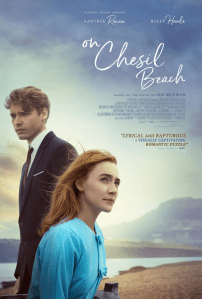
Based on the 2007 novel of the same name written by critically acclaimed British author Ian McEwan who also wrote the novel that was adapted into the Academy Award-winning 2007 film Atonement, On Chesil Beach is a beautifully shot and acted British drama that explores a young couple’s romance and sexuality shortly following their marriage. Set on their wedding night in the summer of 1962 at their honeymoon hotel and the nearby spectacular Chesil Beach located on the southern coast of Dorset, England, the movie follows the love story of Florence, played by Academy Award-nominated actress Saoirse Ronan, and Edward, played by up-and-coming actor Billy Howle. Following a rather slow pace imitating their gradual romance over the years, the story is mostly told through a series of flashbacks to the pivotal moments in their courtship through the past several years. Like Florence, Edward is shown as a young accomplished student who studies at Oxford and has great ambitions in life. Despite overcoming several challenges while dating, including Edward’s mother’s grave mental health, their inexperience with physical intimacy as virgins in their early twenties poses a crucial problem on their honeymoon as they are about to consummate their marriage. They have drawn-out arguments over the course of the night as Florence tries to grapple with her awkward fear of sex even with her true love Edward who is eager for intimacy. As the characters have deeply philosophical dialogue about love and sex, the filmmaker uses evocative cinematography with sweeping shots of the famous beach to convey a tender yet heartbreaking story. Overall, I found it to be a particularly well-made film that felt like a typically British drama complete with outstanding emotional acting performances and a somber story with great heart.

A Quiet Place

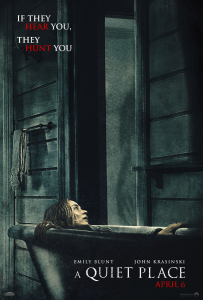
Directed by first-time filmmaker John Krasinski who is best known for acting in the widely popular TV show The Office, A Quiet Place is a terrific horror film that is notable for its creative writing and outstanding subtle acting performances. It relies on a rather simple yet extremely effective premise: a family is trying to survive post-apocalyptic creatures that attack when they hear any noise. The father and husband Lee, played by John Krasinski, along with his wife Evelyn, played by Golden Globe winner Emily Blunt who is Krasinski’s real life wife, do their best to protect their two young sons and deaf daughter Regan, played by the extraordinary young actress Millicent Simmonds who is deaf in real life, from the truly horrifying monsters lurking in the background. Lee has set up on the family farm elaborate defenses against the blind creatures with a hypersensitive ability to hear even the smallest sound. Even though it definitely has elements of a horror film with terrifying jump scares and gruesome monsters, the movie is able to appeal to those who avoid the horror genre, like myself, because of its innovative story and remarkable build-up of thrilling suspense. Transcending the typical horror flick, the film focuses on how one family copes with tragedy and perpetual fear and lays it out in a taut ninety minutes without superfluous gore. The dramatic ending, with a surprising twist involving the deaf daughter and warding off the creatures, is particularly brilliant and leads perfectly into the already planned sequel. Overall, although I was hesitant to see it at first, the movie is definitely worth seeing even if horror is not your thing, and it displays the remarkable talent of first-time director John Krasinski.

Disobedience

Directed by Chilean filmmaker Sebastián Lelio who just who won the Academy Award for Best Foreign Language Film for 2017’s A Fantastic Woman, Disobedience is an emotionally evocative drama exploring the complex intersectionality of love and religion and is anchored by terrific acting performances. The plot follows the return of an ostracized photographer living in New York named Ronit, played by the always brilliant Oscar-winning actress Rachel Weisz, to her strict Orthodox Jewish community in London after the death of her father who was the beloved rabbi and leader. Neither really wanting to be there or being welcomed back by the close-knit religiously conservative community, she must confront the very reasons she was forced to leave the group and grapple with the repercussions. She is shocked to learn that one of her former best friends Dovid, played by Alessandro Nivola in a standout performance, who is the heir apparent to her father, is married to Esti, played by Oscar-nominated actress Rachel McAdams. It is later revealed that Ronit and Esti were engaged in a sexually intimate relationship that was discovered and resulted in Ronit’s banishment. Involved in such an obviously grevious sinful act as homosexuality among the Orthodox, the now liberalized Ronit is never completely recognized by the community and is feared because of her tainted reputation. The somber and repressed Esti tries to hide her affection for Ronit, but, ultimately, she cannot deny her desires and acts out on her sexuality with Ronit despite the high costs, including affecting her husband and his status as the possible lead rabbi. The filmmaker does a remarkable job of showing what life must be like living in an insular Orthodox Jewish or any other conservative religious group and how the traditional rules and norms impact the individual. It vividly portrays the anguish and suffering of the two lead female characters who must deal with their frowned-upon love for one another. Overall, I found it to be a truly exceptional film with top-notch acting performances that brought to life the struggles of living in a extremely conservative community that has heartbreaking results for those involved in forbidden love.