Rocketman

Directed by Dexter Fletcher who was the director who finished the 2018 Freddie Mercury biopic Bohemian Rhapsody, Rocketman is a truly extraordinary cinematic experience that perfectly encapsulates the fantastical career of Elton John by presenting the movie as a musical fantasy that definitely breaks the mold of the traditional biopic. Punctuated by well-choreographed dance sequences set to Elton John’s music, the film is a series of rapid-fire flashbacks told from the personal perspective of Elton John, played by the terrific Taron Egerton best known for his role in The Kingsmen action comedy movie franchise, while he is receiving treatment at a rehab facility. The story retraces his early life living in a dysfunctional family led by his dismissive mother Sheila, played by Bryce Dallas Howard, but his musical talents are encouraged by his kind-hearted grandmother who supports his decision at such a young age to enroll in the prestigious Royal Academy of Music. Eventually, he decides to change his name to Elton John and take on a flamboyant stage persona, which coincides with his meteoric rise to global musical fame. His amazing ability to place music to lyrics is greatly enhanced when he begins a writing partnership with a songwriter named Bernie Taupin, played by Jamie Bell. As is the case with a majority of musical geniuses, he quickly spirals out of control with the heavy influence of alcohol, drugs, and sex and also under the unhealthy pressure of his music manager and one-time lover John Reid, played by Richard Madden. The filmmaker makes the brilliant decision to convey the excesses and low points of Elton John’s personal life through the use of his own music with lyrics that somehow perfectly fit within the context of each and every scene. Overall, I found it to be a fabulously entertaining cinematic journey that takes a refreshing twist on the traditional musical biopic by incorporating Elton John’s unique personality and sound; it is undoubtedly one of the most creative films of the year and runs laps around last year’s Bohemian Rhapsody.
The Last Black Man in San Francisco

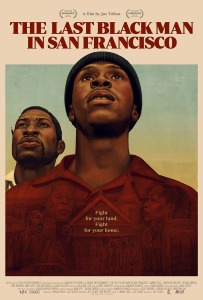
Directed by first-time feature filmmaker Joe Talbot who won the award for Best Directing at the 2019 Sundance Film Festival for this film, The Last Black Man in San Francisco is a breathtakingly beautiful cinematic elegy to a friendship and a city and is one of the best movies, if not the best movie, I have seen so far this year as a result of its magnificent cinematography and quietly rich storytelling. The film is a collaboration between the director Joe Talbot and the main actor Jimmie Fails who are long time friends from the city that inspired them, San Francisco. The rather simple story follows a young black man named Jimmie, played by Jimmie Fails as a version of himself, struggling to make a living in the increasingly expensive city of San Francisco and his obsession over his old family home located in the one-time black and Asian neighborhood of the Fillmore District. He lives with his best friend Mont, played by Jonathan Majors, at the small run-down house of Mont’s blind father, played by Danny Glover. Mont is a very quiet aspiring artist and playwright with a visibly unusual intellect trapped by his situation in life. The movie is very much a ballad and exploration of the ever-changing San Francisco with its current housing crisis and the rapid gentrification primarily affecting minority and lower-income communities. Jimmie often accompanied by Mont visits his deceased grandfather’s old Victorian house on a weekly basis to help maintain its condition despite upsetting the current residents. Eventually, the duo find the opportunity to live in the house as squatters after the previous owners suddenly vacate the house. The house is a metaphor for the old San Francisco and especially that neighborhood, which at one time was a welcoming place for African Americans several decades ago. The loss of the house by his family represents the change in the neighborhood and the city as a whole largely displacing minority populations in favor of predominantly Caucasian people who could afford the now exorbitant housing prices. What really makes the movie special is the filmmaker’s unique ability to combine mesmerizing cinematography, a moody score and soundtrack complete with a haunting rendition of the famous 1967 song San Francisco, and subtle yet memorable acting performances. With his skillful and seemingly effortless creative decisions, the novice filmmaker somehow crafts one of the most beautiful cinematic dedications to a city and the power of friendship, almost as if he is a veteran and award-winning director. Overall, I found it to be a truly magnificent masterpiece of filmmaking that is able to convey a rather basic premise and transform it into a tender and often heartbreaking story of humanity marked by such exquisite and meditative cinematography and music.

Late Night

Directed by Nisha Ganatra best known for her work on the award-winning TV show Transparent and written by Mindy Kaling best known for her hit TV show The Mindy Project, Late Night is a terrifically entertaining comedy about a fictional late night comedy show like The Tonight Show hosted by the only female in the industry and is remarkable for its first-rate acting performances, especially from the always terrific Emma Thompson. The story revolves around the late night comedian host Katherine Newbury, played by Oscar winner Emma Thompson, whose long-running show on a major television network is struggling in the ratings as it becomes increasingly irrelevant in today’s fast-paced news cycle and social media influence. In a last-ditch hope of revitalizing the show, the producers and network force Katherine to make a diversity hire by hiring its first female writer who happens to have no professional comedy experience but is very energetic. Although the male-dominated writer’s room and the very stubborn and demanding Katherine does not like the new hire and her new ideas at first, the Indian-American writer Molly Patel, played by comedian and actress Mindy Kaling, slowly becomes friends with Katherine and helps the show rebuild with her fresh views of comedy. Katherine becomes more receptive to Molly as her personal life begins to fall apart, especially with her rapidly ailing husband who is played by Oscar-nominated actor John Lithgow. Even more pressure is added when the head of the network, played by Oscar-nominated actress Amy Ryan, threatens to replace the well-respected veteran host Katherine Newbury with a younger male comedian whose comedy is edgier to appeal to larger audiences. What I particularly liked about the film is its behind-the-scenes look at what happens on a daily basis in the offices of a late night TV show and even brings in the real late night host Seth Meyers for a cameo to create a level of authenticity about the industry. Overall, I found it to be a highly entertaining film about comedy that itself is very funny and relies on a highly talented cast to effectively illustrate what happens on the set of late night television and what it must be like if there was a major female host.

The Souvenir

Written and directed by critically acclaimed British independent filmmaker Joanna Hogg known for making movies that partly reflect her own life, The Souvenir is a very artsy indie film about a budding film student who enters into a troubled relationship with a slightly older man, and it is remarkable for the terrific acting performances and the unique filmmaking techniques and writing. A slow burn of a movie, the almost philosophical movie revolves around the main character Julie, played by the talented young newcomer Honor Swinton Byrne who is the daughter of Oscar winner Tilda Swinton, who tries to distance herself from her upper middle-class family, including her mother played by Tilda Swinton, by joining a small film school and obsessing over making a movie with a very vague topic. Eventually, she begins a romantic relationship with the mysterious and quintessentially posh Anthony, played by the mesmerizing English actor Tom Burke, who is in a constantly dark place and is revealed to have some serious addiction problems. Similar to Julie, he very much goes against what is expected of him, and it is rather a surprise to learn that his family is from a working class and laid-back background. Often, the film feels like a personal project that is a very meta exploration of filmmaking, romance, class status, and toxic relationships. Yes, it can be a difficult-to-watch and confusing movie, but somehow it leaves a deep impression upon the viewer and reveals itself to be more like a piece of artwork that should be cherished for its complexity and beauty. Overall, I found it to be one of those rare films that I did not initially know whether I liked it or not; it was only after watching the movie did I realize how much it affected me. Only now do I appreciate it as one the best movies of the year as a result of how the filmmaker and actors were able to craft such a superb cinematic experience from an occasionally frustratingly opaque story.

Photograph

Written and directed by critically acclaimed Indian filmmaker Ritesh Batra best known for 2013’s The Lunchbox, Photograph is a charming and insightful romantic movie that follows the usual patterns of a Hollywood romantic comedy but goes beyond the genre by incorporating subtle messages about Indian society, particularly the color and caste systems. With predominantly Hindi dialogue, the film explores an unexpected relationship between two very different people from separate parts of society in Mumbai, an unusual bond started with a chance encounter at the tourist landmark Gateway of India. Rafi, played by Nawazuddin Siddiqui, lives in poverty and works as a street photographer taking pictures of tourists in order to repay his family debts back home in his native village. As is the case in most of Indian families, he is constantly urged to settle down and marry an Indian woman. To appease his very insistent grandmother, he eventually decides to pretend that he is in a romantic relationship with a younger shy woman that he took a picture of at the Gateway of India. Over time, he is able to convince the young woman named Miloni, played by Sanya Malhotra, to play along and meet his grandmother who has just arrived from her small village to see this supposed girlfriend of her grandson. Miloni comes from a middle-class background and is currently studying to become an accountant at the insistence of her parents who she still lives with at home. Similar to Rafi, she is a fairly quiet person who is looking for a way out of her rather mundane life. The best part of the movie is the rather funny and persistent performance given by Rafi’s strong-willed yet sweet grandmother who is played by Farrukh Jaffra. Despite the two main characters’ diverging class status and family background, they begin to become fond of one another and spent time alone together outside of trying to convince his grandmother of their potential marriage. Overall, I found it to be a bittersweet romance that, although at times can be slow, is very touching and has a lot to say about the contemporary issues facing Indian society and culture as a whole, all the while relying on beautiful cinematography to capture the essence of Mumbai.

All Is True

Directed by critically acclaimed actor and director Kenneth Branagh best known for his Shakespearean film adaptations, All Is True is a beautifully acted and filmed historical drama that provides a fictionalized account of William Shakespeare returning home to retirement after writing his last play. Set in 1613 immediately after the Globe Theatre in London burned down, the world’s most famous playwright William Shakespeare, played by Oscar-nominated British actor Kenneth Branagh, decides to return to his family in his hometown of Stratford-upon-Avon and tries to settle down in a life of retirement. He reconnects with his wife Anne Hathaway, played by Oscar-winning British actress Dame Judi Dench, and his daughters Judith and Susanna after he has been away in London writing plays for extended periods of time. Reminiscent of a staged performance, the movie is fairly slow-paced in very intimate settings with elaborate costumes and flowery monologues between the characters. The story attempts to explore Shakespeare’s mental state by showing his preoccupation with the death of his son Hamnet many years ago and his negligence of his daughters after believing that the wrong child died; he thought his son was a genius like himself and thereby still cherishes the only supposed writings of the young Hamnet. He tries to live out a peaceful existence and even decides to create a garden in his son’s memory. However, things quickly do not going according to plan as a result of a scandal involving his married daughter Susanna and the rebellious ways of his other daughter Judith still living at home without a prospect of a husband. In one of the best moments of the film, the Earl of Southampton, played by Oscar-nominated British actor Ian McKellen also known for his Shakespearean acting, pays a visit to Shakespeare at his home and privately discuss what some believe was their romantic relationship. Overall, I found it to be yet another enriching fictionalized account of the one and only William Shakespeare and his mysterious personal life, and I was particularly taken by the terrific acting performances enhanced by the sumptuous costumes and historical attention to detail.

Trial by Fire

Directed by critically acclaimed filmmaker and Oscar-winning producer Edward Zwick best known for 1989’s Glory and 1995’s Legends of the Fall, Trial by Fire is a well-crafted drama with terrific acting performances from the two main characters and a deeply compelling plot about a man on death row for a crime that he probably did not commit. Based on a true story, the film follows Cameron Todd Willingham, played by the talented British actor Jack O’Connell, as he goes through the flawed Texas justice system and eventually meets an unexpected supporter of his case for exoneration. In the beginning of the movie, we witness his trial which leads to his conviction and being sent to death row for the arson and murder of his three young daughters in Corsicana, Texas in December 1991. As a poor and uneducated individual living in rural Texas with tattoos and a love of heavy metal music, he quickly discovers that he has not received the same level of legal representation and thereby is more susceptible to a miscarriage of justice. He spends most of his twelve years on death row learning the judicial system in order for him to try and petition for a retrial or exoneration as a result of several investigative blunders and negligent lawyers. As the years pass, he develops a very close relationship with a single mother of two kids living in Houston who comes to visit him numerous times before deciding to help out on his case. Played by Golden Globe winner Laura Dern, Elizabeth Gilbert becomes a strong advocate for Willingham even as family members question her motivation for trying to free a convicted murderer. Over the course of the film, it becomes readily apparent that he is innocent or at least not deserving of the death penalty and therefore the movie becomes much more of a anti-death penalty film critical of the justice system. Overall, I found it to be a powerful movie by a filmmaker who does an excellent job of showing the emotional rollercoaster that someone like Willingham must go through as he faces certain death by the state while providing a unique perspective from the most unexpected source of Elizabeth Gilbert.

Tolkien

Directed by critically acclaimed Finnish director Dome Karukoski, Tolkien is a well-intentioned biopic, that is slightly disappointing, about one of the most important 20th century authors J. R. R. Tolkien and tries to explore what possibly inspired him to write the famous fantasy books The Hobbit and The Lord of the Rings series. Living a difficult childhood as an orphan living in impoverished Birmingham, England, Tolkien, played by Nicholas Hoult best known for 2002’s About a Boy and 2015’s Mad Max: Fury Road, is heavily influenced by a close group of friends he meets while studying at a prestigious school sponsored by the local Catholic Church. Eventually, because of his high marks, he goes on to study at Oxford University where he discovers his love for languages and continues to pursue his love interest Edith Bratt, played by Lily Collins who is the daughter of English musician Phil Collins. The movie is interspersed with flashbacks to his horrific experiences as a soldier in the trenches during World War War I in which some of his best friends are killed in action. The filmmaker makes the case that the creative and idealistic Tolkien was partly inspired by his wartime experiences to craft his later high fantasy books about the struggle between good and evil mixed in with magic and heroism. The movie sometimes goes overboard on focusing on the events and objects in his life that are visually connected to the characters and themes of his published works. Many of the references may go over most audience’s heads, but I could see how it would be a treat for fans of The Hobbit and The Lord of the Rings book series. Overall, despite the historical visual aesthetic and commendable acting performances, I found the film to be sometimes too slow and not really geared for general audiences as a result of the constant inundation of reference points in the otherwise fascinating story of Tolkien’s life.

The White Crow

Directed by British actor Ralph Fiennes in his third film as director, The White Crow is a fascinating movie about one of the most famous ballet dancers and focuses on the seminal moment of his life in which he defects from the Soviet Union. Based on his real life, the film follows Rudolf Nureyev, played by Oleg Ivenko, and three distinct phases of his life: his early life in a struggling rural Soviet family, early career at a famous St. Petersburg ballet school, and his defection occurring during his company’s visit to Paris. The stereotypical tortured genius, he often exhibits egotistical behavior in which he does not shy away from berating his instructors, but his brilliant and unique talents are always desired by the Soviet ballet elite. The middle part of his life revolves around his relationship with the famed ballet teacher Alexander Ivanovich Pushkin, played by Oscar-nominated actor Ralph Fiennes, and his increasingly personal and strange relationship with Pushkin’s wife. The more contemporary chapter in his life is a rather slow-paced depiction of his falling in love with Western culture and society when his Soviet ballet company has a weeks-long residency at the Paris Opera in 1961 at the height of the Cold War. Nureyev enjoys the nightlife of Paris with his new-found French friends, and he eventually decides that he needs to defect from the Soviet Union in order to pursue a career in the West with much more freedom as an artist and individual. The one major problem area of the film is the often convoluted setup of having the story switch back and forth between three different time periods. Overall, I found it to be a very compelling story about a true genius against the backdrop of the Cold War that, despite the movie’s few flaws, feels like a very authentic portrayal of Rudolf Nureyev as a result of the film’s use of Russian dialogue and several beautiful dance sequences.

Red Joan

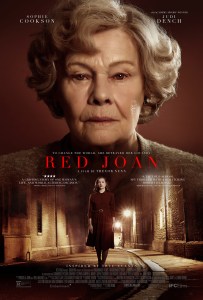
Based on the 2013 novel of the same name written by Jennie Rooney that was inspired by the real-life story of the British civil servant and Soviet spy Melita Norwood, Red Joan is a disappointing film that somehow makes the deeply fascinating material rather boring and bland, with the only bright spot being Judi Dench’s performance, albeit with very little screen time. The story starts in modern-day England when a elderly grandmother named Joan Stanley, played by Oscar winner Dame Judi Dench, is arrested on suspicion of espionage on behalf of the Soviet Union following World War II. However, most of the film takes place in flashbacks that portray the young and idealistic Cambridge physics student Joan Stanley, played by the beautiful young British actress Sophie Cookson, falling in love with a Soviet sympathizer named Leo, played by Tom Hughes best known for his work on the British TV series Victoria. After graduating, she works for a secret British nuclear weapon program run by the brilliant scientist Professor Max Davis, played by British actor Stephen Campbell Moore, and is eventually recruited by the Soviet KGB through her connections with Leo to become a spy passing highly classified information about the British nuclear program. At times, it is a fairly typical romantic drama in which Joan falls in love with the mysterious and ultimately dangerous Leo while also developing feelings for her boss Professor Davis. The rest of the film explores the intriguing case of Joan becoming a Soviet spy and her struggle between her allegiance to her native Britain and her disdain for her government’s developing nuclear weapons, particularly after learning the horrific details of the American bombing of Hiroshima and Nagasaki. To the movie’s detriment, the filmmaker relies on telling the story in a unusually slow and stale pace and does not use the talents of Judi Dench very much as a result of his emphasis on the character’s younger life. Overall, I was hoping for a prestige British historical drama that would better encapsulate one of the more interesting stories in espionage history, but, unfortunately, the execution is extremely lacking for such a terrific filmpremise.